
Ankylosis spondylitis patient anemia
Reading File
Anemia in ankylosing spondylitis (AS) is a common extra-articular manifestation, typically driven by chronic inflammation. Let me search the medical library and recent literature simultaneously.
Searching sources...
Finding Sources
Searching PubMed
ankylosing spondylitis anemia
Searching the Web
ankylosing spondylitis anemia pathophysiology management 2024
Now let me search deeper in the textbooks for the specific content on AS anemia and anemia of chronic disease:
Finding Sources
Finding Sources
Searching PubMed
"ankylosing spondylitis" AND "anemia of chronic disease"
Now let me read the most relevant textbook sections:
Reading File
Reading File
Now let me get the AS-specific rheumatology content and the hematology section in the Rheumatology textbook:
Finding Sources
Finding Sources
Reading File
Finding Sources
Now let me get the ACI section in Rheumatology and also the Washington Manual content on hepcidin/iron:
Reading File
Reading File
I now have comprehensive information from the textbooks. Let me also fetch the hepcidin diagram for visual illustration:
Loading Image
I now have all the information needed for a comprehensive answer. Here is a detailed, well-sourced response:
Anemia in Ankylosing Spondylitis (AS)
Anemia is one of the most common systemic (extra-articular) manifestations of AS, occurring in approximately 15-50% of patients with active disease. The dominant form is Anemia of Chronic Inflammation (ACI), formerly called anemia of chronic disease.
1. Types of Anemia in AS
| Type | Cause | Frequency |
|---|---|---|
| Anemia of Chronic Inflammation (ACI) | Sustained inflammation - hepcidin-mediated | Most common |
| Iron deficiency anemia | NSAID-induced GI bleeding | Common |
| Macrocytic anemia | Methotrexate therapy (folate antagonism) | With specific DMARDs |
| Aplastic anemia | Historical: radiation therapy for AS (1934-1954) | Rare/historical |
2. Pathophysiology: Anemia of Chronic Inflammation
ACI is driven by the same inflammatory milieu that causes AS itself. The mechanism is hepcidin-mediated:
Step-by-step mechanism:
- Sustained TNF-alpha, IL-1, IL-6 production in AS drives chronic systemic inflammation
- IL-6 stimulates hepatic hepcidin synthesis - hepcidin is the master regulator of iron homeostasis
- High hepcidin downregulates ferroportin (the iron export channel) on macrophages, duodenal enterocytes, and hepatocytes
- This blocks transfer of iron to erythroid precursors (iron is trapped in macrophage stores)
- Concurrent blunting of renal erythropoietin (EPO) synthesis by inflammatory cytokines reduces red cell production by the marrow
- Result: functional iron deficiency despite adequate or elevated total body iron stores
The right panel in the diagram below illustrates this perfectly - in systemic inflammation, high plasma hepcidin destroys ferroportin, trapping iron in mucosal ferritin stores and preventing delivery to erythroid marrow:
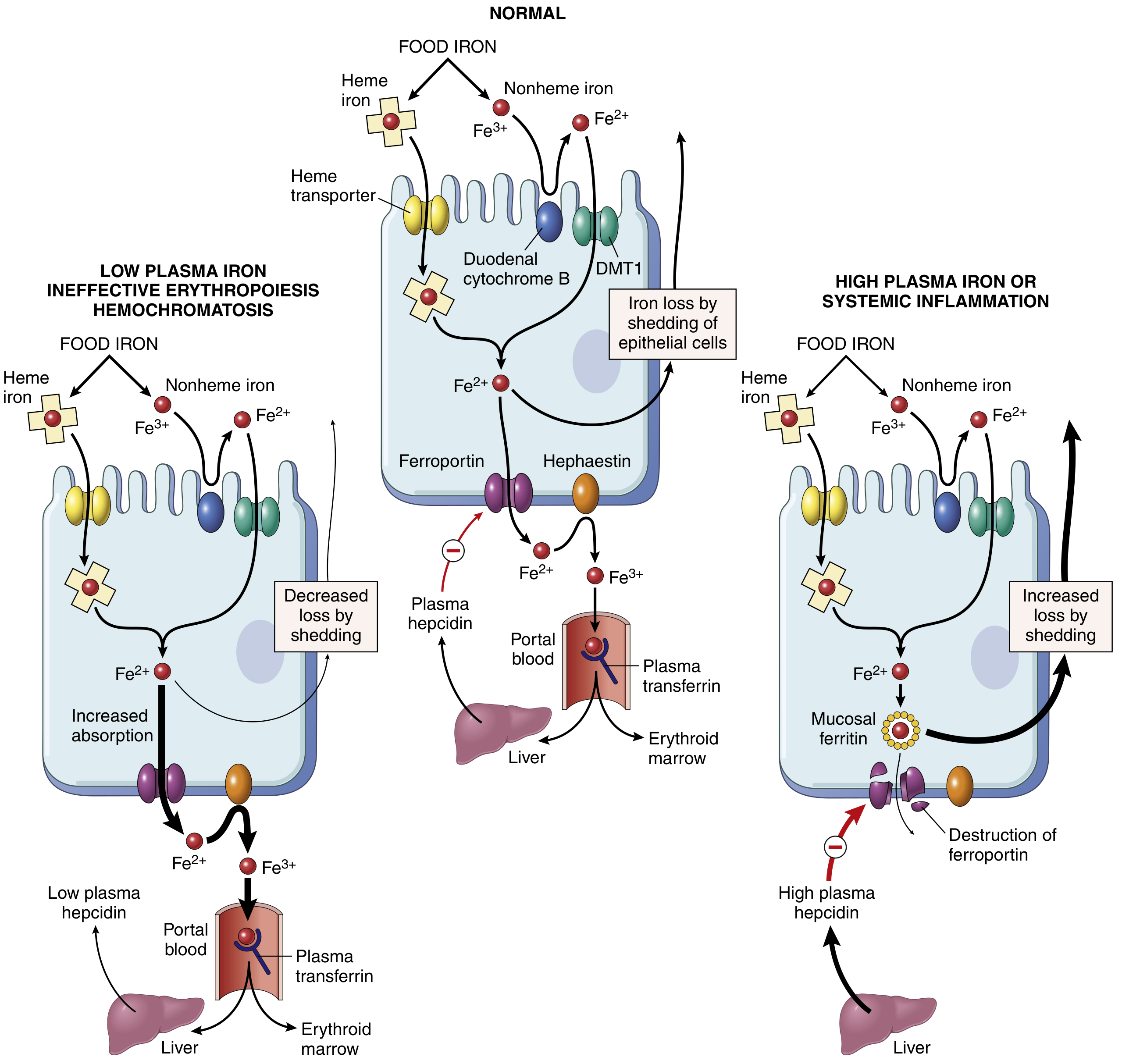
Robbins & Kumar Basic Pathology, Fig. 10.9 - Iron regulation in normal state (center), low iron/hemochromatosis (left), and high plasma iron/systemic inflammation (right)
3. Blood Picture of ACI
- Morphology: Commonly normocytic, normochromic (75% of cases); can be microcytic hypochromic in severe or prolonged disease
- Serum iron: Low
- TIBC: Low (differentiates from iron-deficiency where TIBC is elevated)
- Serum ferritin: Normal or elevated (stores are adequate - key distinguishing feature from iron deficiency)
- Bone marrow iron: Increased
- Soluble transferrin receptor (sTfR): Normal (elevated in true iron deficiency)
- Hepcidin level: Elevated
Key differentiator from iron deficiency anemia: In ACI - low serum iron + high ferritin + low TIBC. In IDA - low serum iron + low ferritin + high TIBC.
4. Additional Causes of Anemia in AS Patients
NSAID-induced GI bleeding (Iron Deficiency)
- NSAIDs are a cornerstone of AS treatment
- Chronic NSAID use causes GI mucosal injury leading to occult or overt GI blood loss
- Results in true iron deficiency anemia (low ferritin, high TIBC, microcytic)
- May coexist with ACI - called "mixed anemia"
Methotrexate-associated macrocytic anemia
- Methotrexate is used in peripheral AS/psoriatic arthritis
- Acts as a folate antagonist - inhibits dihydrofolate reductase
- Leads to macrocytic megaloblastic anemia
- Monitored with periodic CBC; managed with folic acid supplementation
5. Clinical Assessment
Lab workup in AS patient with anemia:
- CBC with differential, reticulocyte count
- Iron studies: serum iron, TIBC, ferritin
- Peripheral blood smear
- ESR, CRP (correlate anemia severity with disease activity)
- Vitamin B12, folate (if macrocytic)
- Consider fecal occult blood / endoscopy if NSAID use or GI bleeding suspected
- Soluble transferrin receptor (if ferritin indeterminate - 30-100 ng/mL range)
6. Treatment
The treatment hierarchy is:
| Approach | Indication |
|---|---|
| Treat underlying AS (anti-TNF agents, IL-17 inhibitors, NSAIDs) | Primary - reduces inflammation → normalizes hepcidin → resolves ACI |
| IV iron supplementation | If ferritin <30 ng/mL (coexisting iron deficiency); oral iron often ineffective in ACI due to reduced intestinal absorption |
| Folic acid supplementation | If on methotrexate |
| Stop/replace NSAIDs | If GI bleeding source |
| Erythropoietin (EPO) | Rarely needed; may be considered in severe symptomatic cases refractory to above |
The Washington Manual notes: "Enteral iron is typically ineffective in ACI because of reduced intestinal absorption." IV iron may benefit patients with ferritin up to 100 ng/mL. - Washington Manual of Medical Therapeutics
Effective treatment of the underlying inflammatory disease is curative for ACI. - Robbins & Kumar Basic Pathology
7. Clinical Correlation
- Anemia severity correlates with disease activity scores (ASDAS, BASDAI) and CRP/ESR
- Biologics (TNF-alpha inhibitors like adalimumab, etanercept; IL-17 inhibitors like secukinumab) significantly reduce inflammatory burden and secondarily improve anemia
- Anemia improves with effective biologic therapy as IL-6 levels fall and hepcidin normalizes
Sources:
- Rheumatology, 2-Volume Set (Elsevier, 2022) - Red Blood Cells section, p. 278
- Robbins & Kumar Basic Pathology - Anemia of Chronic Inflammation, p. 394
- Washington Manual of Medical Therapeutics - Anemia of Chronic Disease, p. 806
- Tietz Textbook of Laboratory Medicine, 7th Ed. - Hepcidin section
This is a shared conversation. Sign in to Orris to start your own chat.