
Which type of joint us knee joint
The knee joint is a synovial joint - specifically a modified hinge joint (also called a bicondylar joint).
Searching sources...
Reading File
Finding Sources
Finding Sources
Reading File
Reading File
Loading Image
The Knee Joint - Type and Classification
The knee joint is a modified hinge joint (also called a bicondylar synovial joint).
More precisely, it is classified as:
| Classification Level | Type |
|---|---|
| Structural type | Synovial joint (diarthrodial) |
| Functional/movement type | Modified hinge joint |
| Specific subtype | Bicondylar joint |
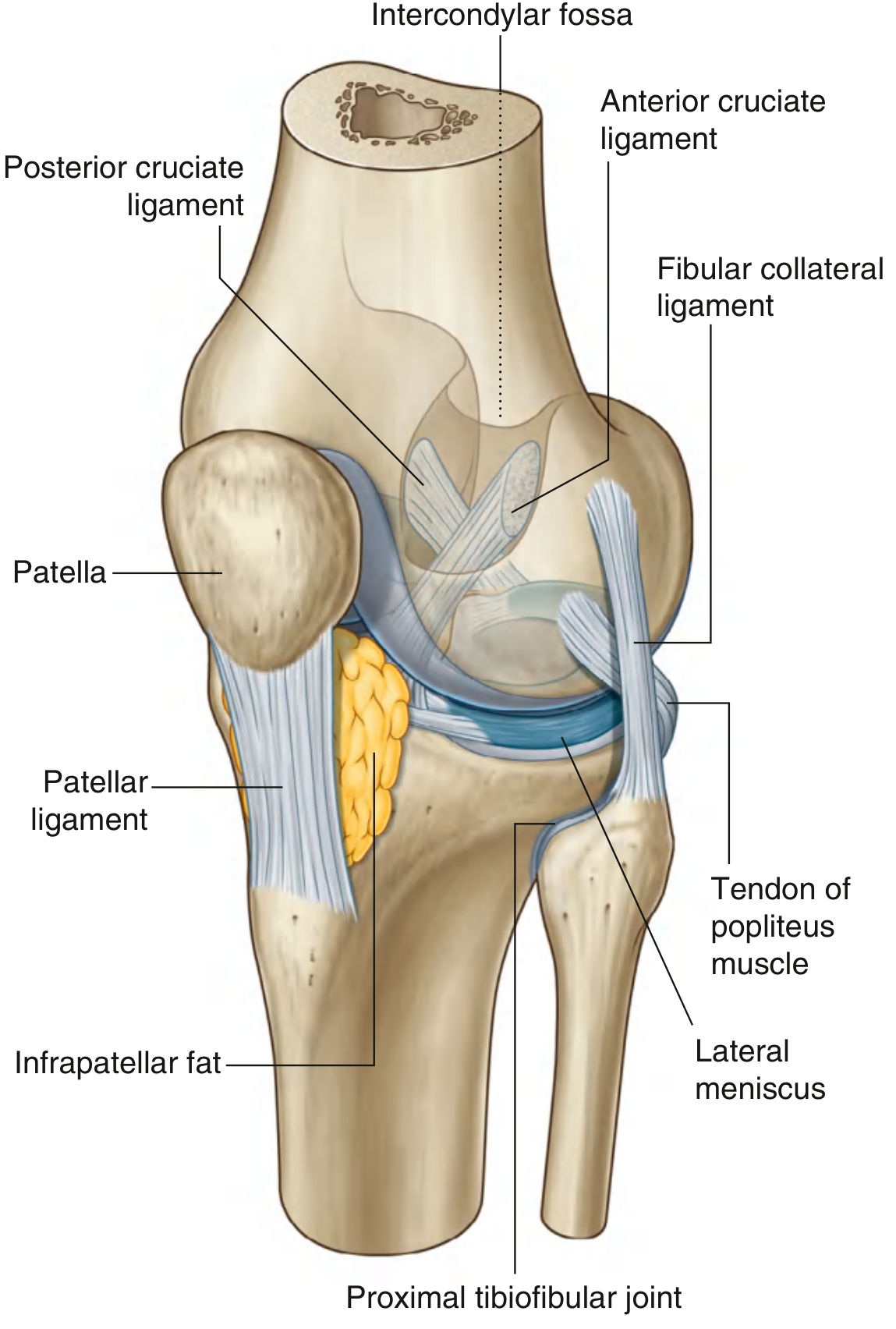
Why "Modified" Hinge?
A pure hinge joint allows movement in only one plane (like the elbow). The knee is called "modified" because it allows:
- Flexion and extension (primary movements, like a hinge)
- Limited medial and lateral rotation - especially the "screw-home mechanism" (terminal external rotation of the tibia when the knee fully extends, "locking" it)
As stated in Rosen's Emergency Medicine: "The knee is a modified hinge, diarthrodial synovial joint that consists of the tibiofemoral and patellofemoral joints."
And from Rheumatology (Elsevier, 2022): "The knee joint functions as a modified hinge joint that allows flexion and extension, together with some limited rotation."
Component Articulations
The knee joint is actually made up of three articulations within a single joint capsule:
- Medial tibiofemoral joint - between medial femoral condyle and medial tibial condyle
- Lateral tibiofemoral joint - between lateral femoral condyle and lateral tibial condyle
- Patellofemoral joint - between the patella and the femoral trochlea
Key Structural Features
-
Menisci - two C-shaped fibrocartilaginous discs (medial and lateral) that improve congruence and cushion the joint
-
Collateral ligaments (MCL and LCL) - provide medial/lateral stability
-
Cruciate ligaments (ACL and PCL) - prevent anterior/posterior displacement of the tibia on the femur
-
Synovial membrane - lines the joint cavity and produces synovial fluid for lubrication
-
Gray's Anatomy for Students, p. 709
-
Rosen's Emergency Medicine, Anatomy & Physiology section
This is a shared conversation. Sign in to Orris to start your own chat.