
Phimosis
I'll look up phimosis in the medical library for a thorough answer.
Reading File
Now let me search the medical library and PubMed simultaneously.
Finding Sources
Searching PubMed
phimosis treatment
Excellent sources found. Let me read the most comprehensive ones in parallel.
Reading File
Reading File
Reading File
Good content so far. Let me now read the Campbell Walsh Urology content (most comprehensive) and Tintinalli's block 11 for pediatric content, plus Bailey and Love for surgical perspective.
Reading File
Reading File
Reading File
Reading File
Reading File
Now let me fetch the clinical images and also grab the Robbins pathology content for the BXO/pathological aspect.
Loading Image
Loading Image
Reading File
I now have comprehensive content from multiple authoritative textbooks. Let me compile the full answer.
Phimosis
Definition
Phimosis is the inability to retract the foreskin (prepuce) proximally over the glans penis due to a narrowed or stenosed preputial opening. - Robbins Pathologic Basis of Disease
Types
1. Physiological (Primary) Phimosis
- Present at birth in virtually all uncircumcised newborns
- Due to natural adhesions between the glans and inner preputial skin and/or a tight preputial ring
- By 3 years of age, fewer than 10% of foreskins remain non-retractile
- Nearly all resolve spontaneously by late adolescence
- Not a pathological condition - does not require treatment unless causing symptoms
- Children under 2 years rarely have true phimosis
Bailey and Love's Short Practice of Surgery notes: physiological adhesions begin to disappear around age 2 and may persist until age 6, giving a false impression that the prepuce will not retract - this should not be confused with true phimosis.
2. Pathological (Secondary/Acquired) Phimosis
- Caused by scarring of the preputial ring from:
- Recurrent balanoposthitis (inflammation of glans + prepuce)
- Recurrent infections / poor hygiene
- Forcible retraction of the foreskin (causing micro-tears and scarring)
- Lichen Sclerosus (LS) / Balanitis Xerotica Obliterans (BXO) - foreskin becomes thickened, whitish, and forms a constricting band
- Diabetes mellitus (chronic balanoposthitis in older diabetic men may be the initial complaint)
- Excessive skin left after circumcision becoming stenotic
Clinical Features
- Inability to retract the foreskin
- Ballooning of the foreskin during urination (urine trapped under prepuce then dribbles after voiding)
- Edema, erythema, and tenderness of the prepuce
- Purulent discharge (in infected cases)
- Dyspareunia / painful erections (in adults)
- Rarely: acute urinary retention when the preputial orifice is nearly completely sealed - a true urologic emergency
Lichen Sclerosus (BXO) - Active Phase
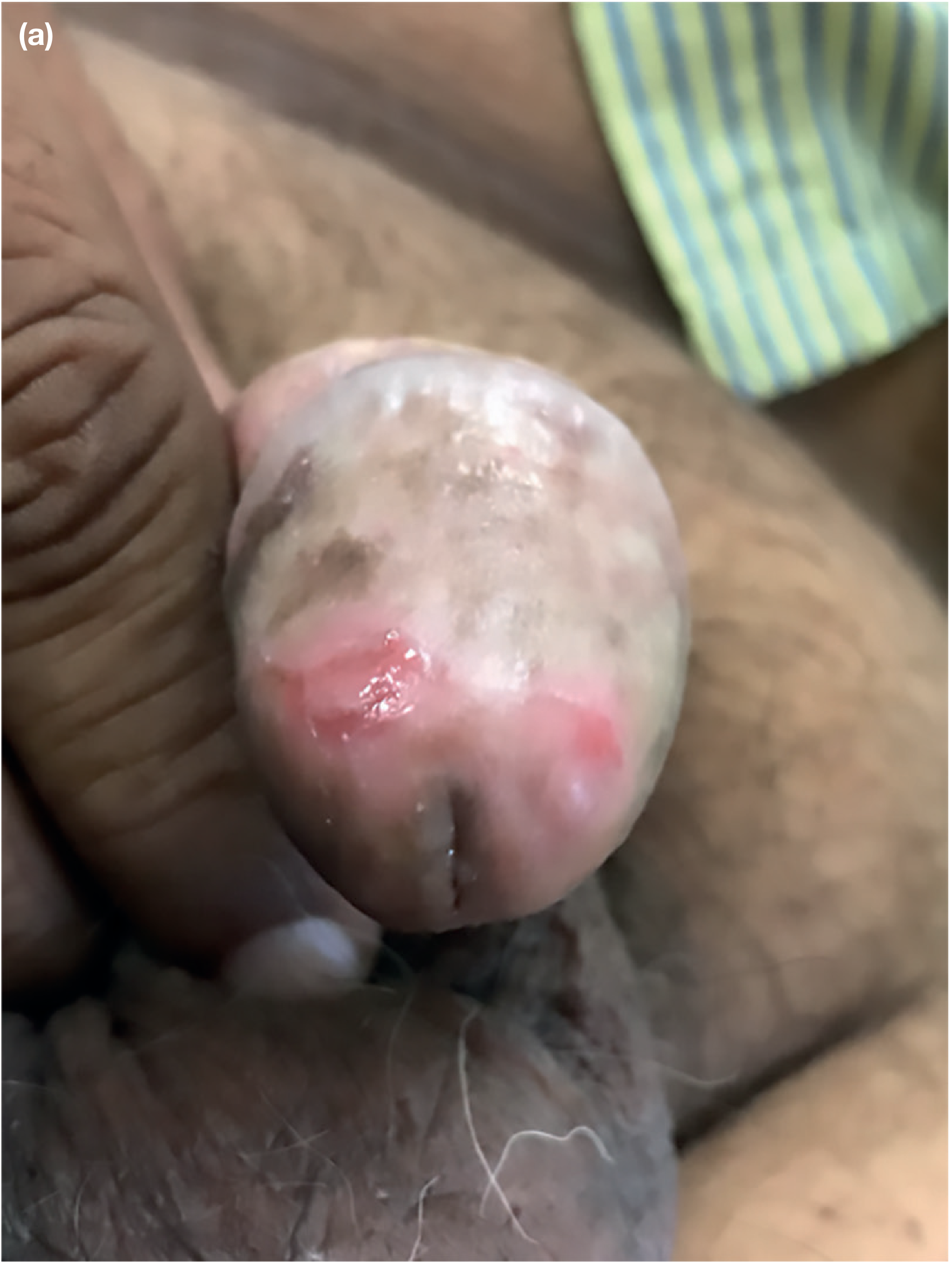
Active phase of Lichen Sclerosus (LS) - a major cause of pathological phimosis in adults - Bailey and Love's Short Practice of Surgery
Complications
| Complication | Mechanism |
|---|---|
| Recurrent balanoposthitis | Smegma accumulation under non-retractile foreskin |
| Urinary tract infections | Poor hygiene, urinary stasis |
| Urinary retention | Complete preputial occlusion |
| Paraphimosis | Tight phimotic band retracts and gets stuck proximal to glans |
| Penile carcinoma | Chronic smegma irritation, HPV infection, poor hygiene - higher incidence in uncircumcised males with phimosis |
| Calculi | Formation under foreskin |
- Robbins: "Phimosis is important because it interferes with cleanliness and permits the accumulation of secretions and detritus under the prepuce, favoring development of secondary infections and increasing the risk for penile carcinoma."
Management
Conservative (First-line for physiological and early pathological)
Topical Corticosteroids
- Betamethasone 0.05-0.10% applied twice daily to the tip of the foreskin extending to the glandis corona for 4-8 weeks, combined with daily gentle manual preputial retraction
- Success rate: ~84-87% (Palmer & Palmer 2008)
- Response may be visible within 2 weeks
- Failure (~15%) is associated with increased collagen density and decreased elastin in the prepuce histologically
- A 2024 Cochrane systematic review (PMID 38269441) confirms topical corticosteroids are safe and effective for phimosis in boys, with moderate-quality evidence
- Acquired phimosis (secondary to scarring/BXO) is often refractory to topical steroids
Emergency / Temporizing
- Hemostatic dilation of the preputial ostium - temporarily relieves acute urinary retention
- Dorsal slit under local anesthesia - when catheterization is required urgently
Surgical (Definitive)
Circumcision - the curative treatment for true, symptomatic phimosis
- Indications: persistent/symptomatic phimosis, secondary phimosis, recurrent balanoposthitis, BXO, UTIs, topical steroid failure, paraphimosis, penile carcinoma risk
- Should be deferred in children requiring general anesthesia unless there are recurrent infections
- Should be performed after any active infection is controlled (treat first with broad-spectrum antibiotics)
- AAP (2012): benefits of circumcision (reduced UTI risk, reduced HIV and STI transmission) are sufficient to warrant access and third-party payment for neonatal circumcision, though not recommended routinely for all newborns
Preputioplasty - foreskin-sparing widening procedures (alternative to full circumcision in selected patients)
Paraphimosis (Related Emergency)
Paraphimosis is the inability to reduce a retracted phimotic foreskin back over the glans - a true urologic emergency. The constricting ring causes venous/lymphatic obstruction → glans edema → arterial compromise → gangrene if not promptly treated.
Management:
- Compress the glans firmly for 5 minutes (or wrap with 2-inch elastic bandage x 5 min) to reduce edema
- EMLA cream (2.5% lidocaine + 2.5% prilocaine) for analgesia
- Manual reduction: thumbs on glans pushing proximally, fingers on foreskin pulling distally
- If unsuccessful: dorsal penile nerve block + superficial dorsal slit of the constricting band under local anesthesia (1% lidocaine without epinephrine)
- Circumcision once inflammation subsides
Key Points Summary
| Feature | Physiological | Pathological |
|---|---|---|
| Age | Birth to adolescence | Any age, more common adults |
| Cause | Normal development | Infection, BXO, trauma |
| Spontaneous resolution | Yes (most) | No |
| Treatment | Watchful waiting | Topical steroids → circumcision |
| Foreskin appearance | Normal | Scarred/thickened/white (BXO) |
Sources: Tintinalli's Emergency Medicine; Smith and Tanagho's General Urology 19th Ed.; Campbell-Walsh-Wein Urology; Bailey and Love's Short Practice of Surgery 28th Ed.; Robbins Pathologic Basis of Disease; Cochrane Review: Topical corticosteroids for phimosis in boys (2024), PMID 38269441; Phimosis treatment and UTI risk in infant males (2026), PMID 41274309
This is a shared conversation. Sign in to Orris to start your own chat.