
slow or late development of secondary sexual characteristics (e.g. breast) in female with regular menstrual cycle
Reading File
Finding Sources
Finding Sources
Finding Sources
Finding Sources
Finding Sources
Finding Sources
Reading File
Reading File
Finding Sources
Reading File
Finding Sources
Finding Sources
Reading File
Reading File
Loading Image
Loading Image
I now have a thorough evidence base. Here is the complete, structured answer.
Slow/Late Development of Secondary Sexual Characteristics (e.g. Breast) in a Female WITH a Regular Menstrual Cycle
This is a clinically distinct and important scenario. The presence of regular menses tells you the hypothalamic-pituitary-ovarian (HPO) axis is functional and producing enough estrogen to shed endometrium - yet breast (and other secondary sexual) development is lagging. This combination narrows the differential considerably.
Why Breast Development and Menstruation Can Be Dissociated
Breast development (thelarche) is the first sign of estrogen exposure in puberty (Tanner stage 2). It requires not just circulating estrogen but also:
- Intact estrogen receptors in breast tissue
- Adequate local tissue response
- The timing of thelarche relative to menarche varies normally
Regular menstruation confirms estrogen is being made and endometrium is responsive. So poor breast development despite regular cycles points to one of these mechanisms:
- Estrogen levels sufficient for endometrial cycling but below the threshold for breast growth
- Partial end-organ insensitivity to estrogen in breast tissue specifically
- Androgen excess opposing breast fat deposition
- Constitutionally delayed adrenarche/thelarche that has partially corrected (menses began, breast lagging)
- Low BMI / undernutrition - insufficient adipose substrate for breast tissue development
Differential Diagnosis
1. Constitutional / Self-Limited Delayed Puberty (Most Common)
- Accounts for ~60% of delayed puberty cases overall; represents a normal variant where 2-3% of the population falls outside the usual timing range
- The HPO axis eventually activates fully; menses may begin before breast development reaches full Tanner stage 5
- Family history of late maturation is common
- No pathology; Tanner stages simply progress slowly
- Harrison's Principles of Internal Medicine 22E
2. Androgen Excess (Hyperandrogenism)
- Elevated androgens (from polycystic ovary syndrome, congenital adrenal hyperplasia, adrenal or ovarian tumors) suppress fat deposition in breast tissue and can blunt thelarche despite normal or even slightly elevated estrogen
- PCOS classically causes irregular cycles, but milder forms may have regular menses with subtle androgen excess
- Clinical clues: hirsutism, acne, clitoromegaly
3. Low Body Weight / Eating Disorders / Excessive Exercise
- Breast tissue is largely adipose; significant underweight or low body fat delays/impairs breast development
- The HPO axis can maintain just enough estrogen for menses while breast tissue growth lags
- Functional hypogonadotropic hypogonadism accounts for ~20% of delayed puberty cases (Harrison's)
4. Partial Estrogen Receptor Insensitivity / Rare Receptor Mutations
- Very rare mutations in the estrogen receptor (ESR1) can cause selective tissue resistance - endometrium remains responsive (cycling occurs) while breast tissue growth is blunted
- Associated with tall stature, osteoporosis, elevated FSH/LH
5. Partial Gonadal Dysgenesis / Mosaicism
- Women with partial X chromosome deletions or low-level mosaicism (e.g. 45,X/46,XX) may synthesize enough estrogen for menses but insufficient for full breast development
- From Berek & Novak: "Occasionally patients with a partial deletion of the X chromosome, mosaicism, or pure gonadal dysgenesis (46,XX) may synthesize enough estrogen in..." - i.e., partial function can produce variable phenotypes
- Berek & Novak's Gynecology
6. Hyperprolactinemia (Mild/Subclinical)
- Mild prolactin elevation can impair breast development (paradoxically) and antagonize estrogen action at the breast even if cycles are maintained
- Usually causes oligomenorrhea but regular cycles are possible in mild cases
7. Hypothyroidism
- Thyroid hormone is required for normal pubertal progression and breast development
- Hypothyroidism can delay thelarche while still permitting menstruation in some cases
Tanner Staging Context
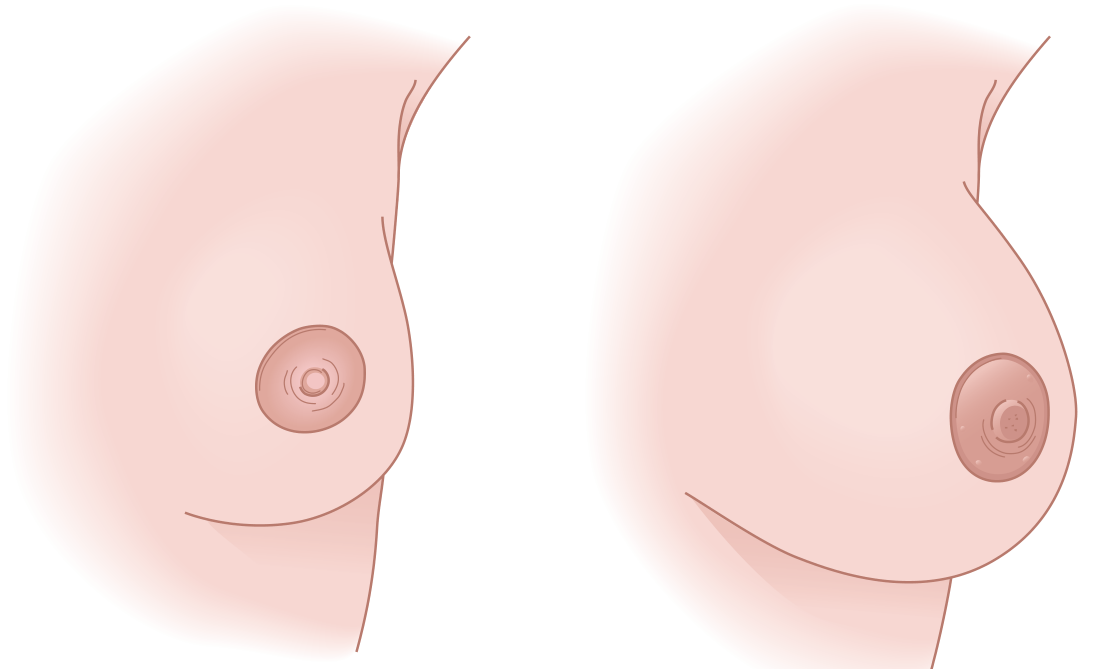
Normal female puberty follows the sequence: thelarche (breast bud, Tanner 2) → pubarche → menarche → Tanner 5 breast. Tanner breast and pubic hair stages are scored independently and need not be synchronous. A girl can be menstruating at Tanner breast stage 2-3.
- Medical Physiology (Boron & Boulpaep)
Workup Algorithm
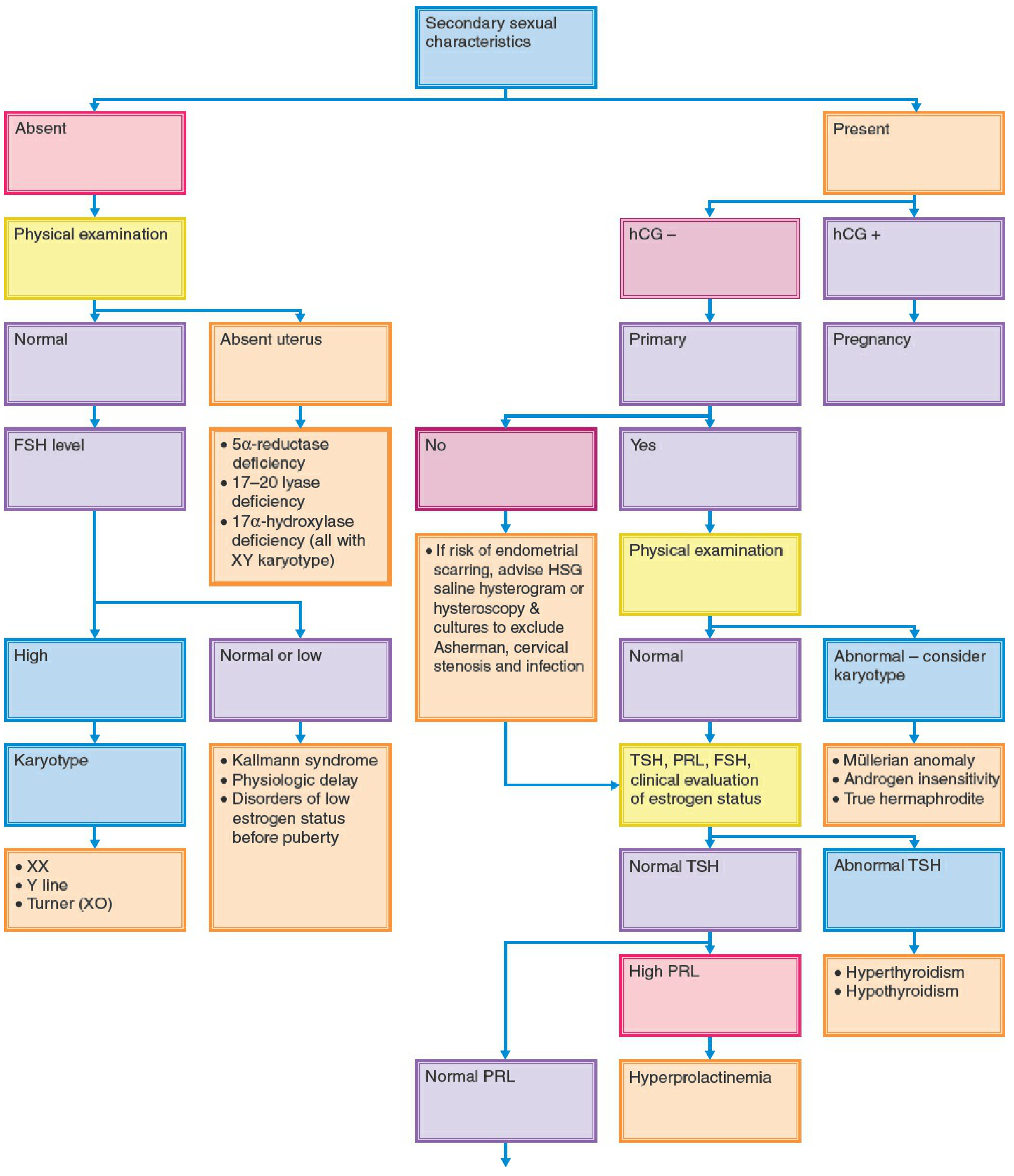
Since menses are present and regular, the workup is focused:
| Investigation | Rationale |
|---|---|
| Height, weight, BMI, growth chart | Rule out nutritional causes |
| Tanner staging (breast + pubic hair) | Quantify the lag |
| LH, FSH | Hypergonadotropic = gonadal issue; Low = central |
| Estradiol (E2) | May be low-normal despite menses |
| Total/free testosterone, DHEA-S | Rule out androgen excess |
| Prolactin | Rule out hyperprolactinemia |
| TSH, free T4 | Rule out hypothyroidism |
| Karyotype | If FSH elevated or other stigmata present |
| Bone age (X-ray wrist) | Assess skeletal maturation |
Key Clinical Points
- Breast development is the most estrogen-sensitive secondary sexual feature and the first to appear in puberty - it requires adequate E2, adequate local tissue, and sufficient body fat
- Regular menstruation does NOT guarantee that estrogen is high enough for full breast development - the endometrium is highly sensitive and cycles at low estrogen levels that may be insufficient for breast growth
- The most common explanation in an otherwise healthy girl is constitutional delay (slow maturers) or low body fat
- Androgen excess is an important treatable cause
- Rare but important: partial gonadal dysgenesis (karyotype-related) and estrogen receptor mutations
Sources: Berek & Novak's Gynecology; Harrison's Principles of Internal Medicine 22E; Medical Physiology (Boron & Boulpaep)
treatment option for a 19 year old
Finding Sources
Finding Sources
Finding Sources
Reading File
Finding Sources
Finding Sources
Finding Sources
Finding Sources
Finding Sources
Reading File
Finding Sources
I now have enough to build a complete, cause-targeted treatment guide.
Treatment Options for a 19-Year-Old Female with Poor Secondary Sexual Characteristics (Breast) but Regular Menses
At 19, the first priority is to identify the underlying cause - because treatment is etiology-driven. Below is a structured approach:
Step 1 - Confirm the Cause First
Before any treatment, the workup from the previous discussion should be completed (LH, FSH, E2, testosterone, DHEA-S, prolactin, TSH, karyotype if indicated, BMI/nutritional assessment). At 19, normal breast development should be Tanner stage 4-5 - anything below that warrants investigation.
Treatment by Cause
A. Constitutional Delay (Slow Maturation, Normal Variant)
- At 19, this diagnosis is becoming less tenable - most constitutional delayers will have reached Tanner 4-5 by this age
- If bone age is still delayed and the girl is otherwise healthy, watchful waiting with reassurance is still an option for a short period
- However, if psychological distress is present or development has truly stalled, low-dose estrogen supplementation may be initiated to accelerate the process (see below)
B. Low Estrogen / Partial Hypogonadism - Estrogen Induction
This is the most directly applicable treatment when estrogen levels are found to be low-normal or low.
The principle is to mimic the physiology of puberty with gradually increasing estrogen doses:
| Phase | Regimen | Goal |
|---|---|---|
| Initiation | Conjugated estrogens 0.3 mg/day or ethinyl estradiol 5-10 mcg/day on days 1-21/month | Start breast development, bone maturation |
| Gradual escalation over 6-12 months | Increase to 0.625 mg conjugated estrogens or 20 mcg EE | Full breast development |
| Maintenance | Adult doses of estrogen + cyclical progestogen | Maintain secondary characteristics, protect bone, prevent unopposed estrogen effect on endometrium |
| Progestin addition | Add medroxyprogesterone acetate 5-10 mg or micronized progesterone after first uterine bleeding | Prevent endometrial hyperplasia |
At 19, since menses are already present, the starting dose can often be higher than in a younger girl beginning puberty induction from scratch. The goal is breast development and bone density protection.
- Katzung's Basic and Clinical Pharmacology 16th Ed
Practical options:
- Transdermal estradiol patches (25-100 mcg) - preferred for younger women as they bypass first-pass hepatic metabolism and have lower VTE risk than oral forms
- Oral 17β-estradiol (1-2 mg/day)
- Combined oral contraceptive pill (COCP) - a reasonable all-in-one option if contraception is also desired; the estrogen component (20-30 mcg EE) will promote breast tissue growth while the progestin provides endometrial protection
C. Low Body Weight / Eating Disorder / Excessive Exercise
Treatment here is not hormonal in the first instance:
- Nutritional rehabilitation - increase caloric intake, target BMI ≥18.5; breast tissue is largely adipose and will develop naturally as body fat is restored
- Multidisciplinary approach for eating disorders: family-based therapy is first-line for adolescents/young adults; hospitalization for severe cases
- Exercise moderation - reduce training load if athlete-related
- Calcium 1,200-1,500 mg/day + Vitamin D 400-800 IU/day to protect bone density
- If hypoestrogenism persists after weight restoration, higher-dose estrogen may be needed to maintain bone density (Berek & Novak's Gynecology)
- Note: Bisphosphonates are not recommended in young women - they deposit in bone and have unknown long-term effects, especially in future pregnancy
D. Androgen Excess (e.g. Mild PCOS / CAH)
Reducing androgen excess allows estrogen to exert its normal effect on breast tissue:
- Combined oral contraceptive pill (COCP): first-line - suppresses LH-driven ovarian androgen production, contains estrogen that promotes breast growth, provides reliable contraception
- Preferred: preparations containing cyproterone acetate or drospirenone (anti-androgenic progestins)
- Spironolactone 50-100 mg/day: androgen receptor blocker; adjunct to COCP if hirsutism/acne is prominent
- For CAH: low-dose glucocorticoid (hydrocortisone) to suppress ACTH-driven adrenal androgen excess
E. Hyperprolactinemia
- Discontinue any offending drug (antipsychotics, metoclopramide, domperidone)
- Dopamine agonists as primary medical therapy:
- Cabergoline 0.25-0.5 mg twice weekly (preferred - better tolerated, more effective)
- Bromocriptine 1.25-2.5 mg/day (alternative)
- Prolactin normalization restores normal estrogen bioavailability → breast development can resume
- Pituitary macroadenoma: neurosurgical referral if dopamine agonist therapy fails
- Berek & Novak's Gynecology
F. Hypothyroidism
- Levothyroxine (thyroxine replacement) - dose titrated to normalize TSH
- As thyroid function is restored, GH-IGF-1 axis and gonadal axis normalize, allowing pubertal completion
Bone Health - A Universal Concern at 19
Regardless of cause, any young woman with delayed/incomplete puberty is at risk for reduced peak bone mass. This has lifelong implications for osteoporosis risk.
- All patients should receive: Calcium 1,000-1,500 mg/day + Vitamin D 600-800 IU/day
- Estrogen therapy (when indicated) doubles as bone protection
- DEXA scan is reasonable if estrogen deficiency has been prolonged
Psychological Support
- Body image concerns are significant at 19 with underdeveloped secondary sexual characteristics
- Refer to a psychologist or counselor as part of management, particularly if there is associated anxiety, depression, or eating disorder pathology
Summary Table
| Cause | First-Line Treatment |
|---|---|
| Constitutional delay | Low-dose estrogen (or COCP), reassurance |
| Low BMI / nutrition | Nutritional rehabilitation + Ca/Vit D |
| Eating disorder | Multidisciplinary; family-based therapy |
| Androgen excess (PCOS) | COCP (anti-androgenic progestin preferred) |
| Hyperprolactinemia | Cabergoline or bromocriptine |
| Hypothyroidism | Levothyroxine |
| Partial hypogonadism (low E2) | Transdermal/oral estradiol + cyclic progestin |
| CAH | Low-dose glucocorticoid |
Sources: Katzung's Basic and Clinical Pharmacology 16th Ed; Berek & Novak's Gynecology; Harrison's Principles of Internal Medicine 22E
This is a shared conversation. Sign in to Orris to start your own chat.