

ab150b38-6372-40d1-8c95-4dd36867218a.jpeg
I want pharmacology syllabus general pharmacology
I can see from your image that this is the Paper V - Pharmacology (BPT 2nd Year) syllabus, with General Pharmacology [5 Hours] covering: Introduction, Definitions, Classification of drugs, Sources of drugs, Routes of drug administration, Distribution of drugs, Metabolism and Excretion of drugs, Pharmacokinetics, Pharmacodynamics, Factors modifying drug response, and Adverse effects.
Let me pull detailed content on each of these topics from the medical library.
Searching sources...
Reading File
Finding Sources
Finding Sources
Reading File
Finding Sources
Finding Sources
Finding Sources
Reading File
Reading File
I now have rich content from Katzung and Lippincott. Let me fetch the key pharmacodynamics section and adverse effects content from Lippincott block 2 to complete the picture.
Finding Sources
Reading File
I have all the content I need from the medical library. Let me now compile a thorough, well-organized response covering the entire BPT II Year General Pharmacology syllabus.
General Pharmacology - BPT II Year (Paper V) - Complete Syllabus Notes
Source: Katzung's Basic and Clinical Pharmacology 16e & Lippincott Illustrated Reviews: Pharmacology
1. Introduction and Definitions
Pharmacology is the study of substances that interact with living systems through chemical processes - typically by binding to regulatory molecules and activating or inhibiting normal body processes. It includes both beneficial therapeutic effects and toxic effects.
- Medical Pharmacology - the science of substances used to prevent, diagnose, and treat disease
- Toxicology - the branch dealing with undesirable effects of chemicals on living systems
- Drug - any chemical substance that, when taken into a living organism, modifies one or more biological functions
- Pharmacokinetics - what the BODY does to the drug (absorption, distribution, metabolism, excretion - ADME)
- Pharmacodynamics - what the DRUG does to the body (mechanism of action, dose-response relationships)
2. Classification of Drugs
Drugs can be classified by several criteria:
| Basis | Examples |
|---|---|
| Pharmacological action | Analgesics, antihypertensives, antibiotics |
| Chemical structure | Opioids, benzodiazepines, beta-lactams |
| Mechanism of action | Beta-blockers, ACE inhibitors, COX inhibitors |
| Source | Plant-derived, animal-derived, synthetic |
| Therapeutic use | Cardiovascular, CNS, antimicrobial drugs |
| Legal status | Prescription (Rx), OTC, controlled substances |
3. Sources of Drugs
- Plants - morphine (opium poppy), digoxin (foxglove), atropine (deadly nightshade), quinine (cinchona bark), aspirin (willow bark)
- Animals - insulin (porcine/bovine pancreas), heparin, thyroid hormones
- Minerals/Inorganic - iron salts, lithium carbonate, magnesium sulfate, iodine
- Microorganisms - penicillin (Penicillium mold), streptomycin (Streptomyces bacteria), cyclosporine
- Synthetic/Semi-synthetic - most modern drugs; e.g., chloroquine, diazepam, omeprazole
- Recombinant DNA technology (Biotechnology) - human insulin, erythropoietin, monoclonal antibodies (e.g., adalimumab)
4. Routes of Drug Administration
The route is determined by drug properties (lipid/water solubility, ionization) and therapeutic objectives (speed of onset, duration, local vs systemic).
(Lippincott Illustrated Reviews: Pharmacology, p. 22)
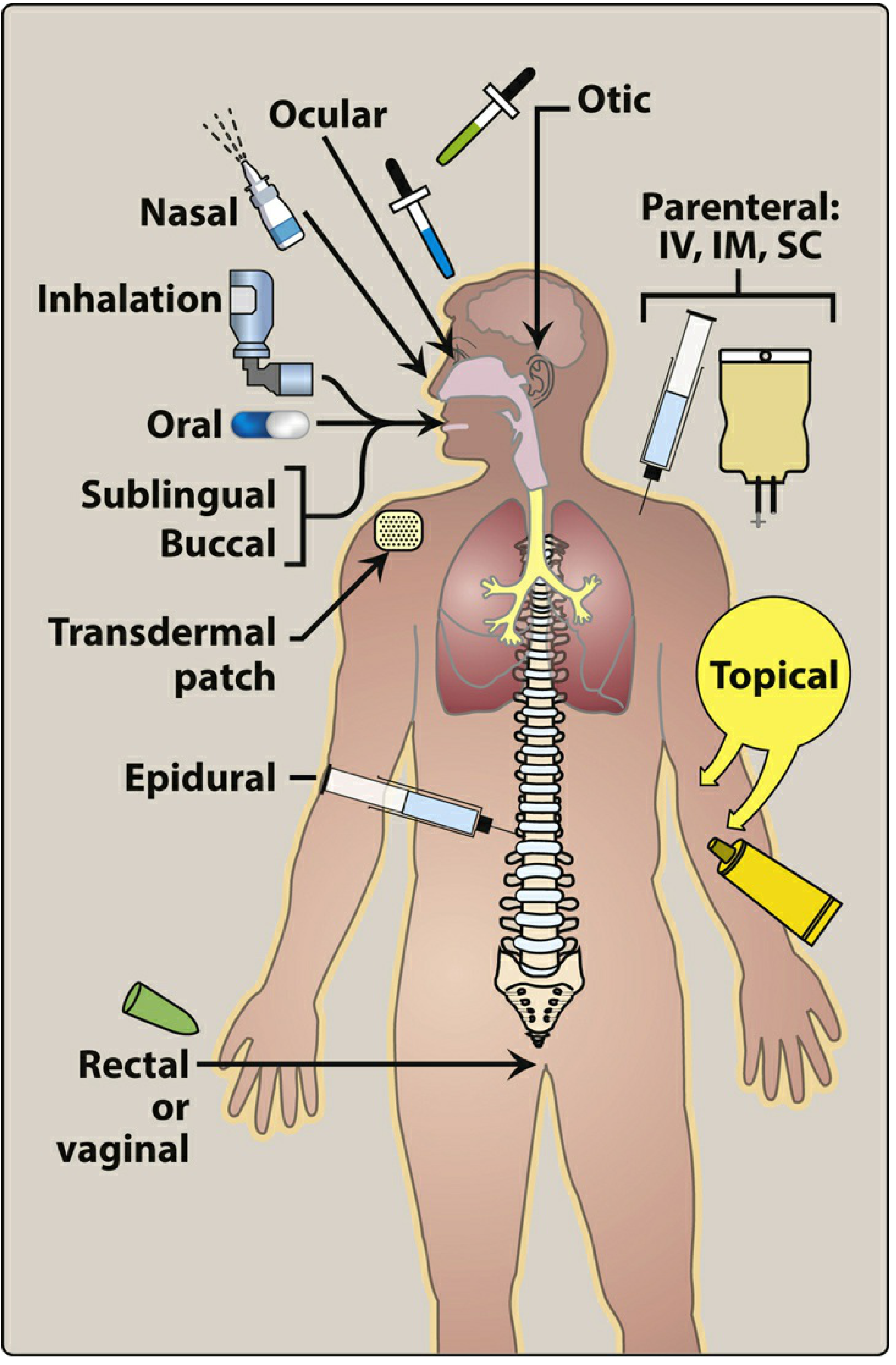
A. Enteral (via GI tract)
| Route | Features |
|---|---|
| Oral (PO) | Most common, convenient, economical; first-pass effect; not for emergencies |
| Sublingual | Under the tongue; rapid absorption, bypasses first-pass; e.g., nitroglycerin |
| Buccal | Between gum and cheek; similar to sublingual |
| Rectal (PR) | Useful when oral not possible (vomiting, unconscious); partial first-pass bypass |
B. Parenteral (bypasses GI tract)
| Route | Onset | Features |
|---|---|---|
| Intravenous (IV) | Fastest | 100% bioavailability; used in emergencies; no first-pass; precise control |
| Intramuscular (IM) | Fast | Aqueous or depot formulations; e.g., vaccines |
| Subcutaneous (SC) | Slower | Small volumes only; e.g., insulin, heparin |
| Intradermal | Slowest | Allergy testing, BCG vaccine |
| Intrathecal | Rapid CNS | Bypasses blood-brain barrier; e.g., spinal anaesthesia |
C. Topical / Inhalational
| Route | Use |
|---|---|
| Transdermal | Slow systemic absorption; patches e.g., fentanyl, nicotine |
| Inhalation | Rapid onset for respiratory drugs; e.g., salbutamol, anaesthetic gases |
| Topical (skin/eye) | Local effect; e.g., corticosteroid creams |
Key concept: IV is the route of choice in emergencies because it achieves therapeutic plasma levels fastest.
5. Distribution of Drugs
After absorption, drugs distribute from blood into tissues. Key determinants:
- Plasma protein binding - drugs bound to albumin (acidic drugs) or alpha-1-acid glycoprotein (basic drugs) are pharmacologically inactive and cannot cross membranes; only FREE drug is active
- Lipid solubility - highly lipophilic drugs penetrate cell membranes, CNS, and fat easily
- Tissue binding - some drugs accumulate in specific tissues (e.g., chloroquine in retina, tetracycline in bone)
- Blood-brain barrier (BBB) - restricts entry of hydrophilic or protein-bound drugs into CNS
- Placental barrier - many drugs cross the placenta (teratogenic risk)
Volume of Distribution (Vd)
Vd = Dose given / Plasma concentration
- Low Vd (e.g., heparin, warfarin) - drug stays in plasma (large, protein-bound)
- High Vd (e.g., chloroquine, digoxin) - drug distributes widely into tissues
6. Metabolism (Biotransformation) of Drugs
Metabolism converts drugs into more polar (water-soluble) metabolites for excretion. Primarily occurs in the liver.
(Lippincott Illustrated Reviews: Pharmacology)
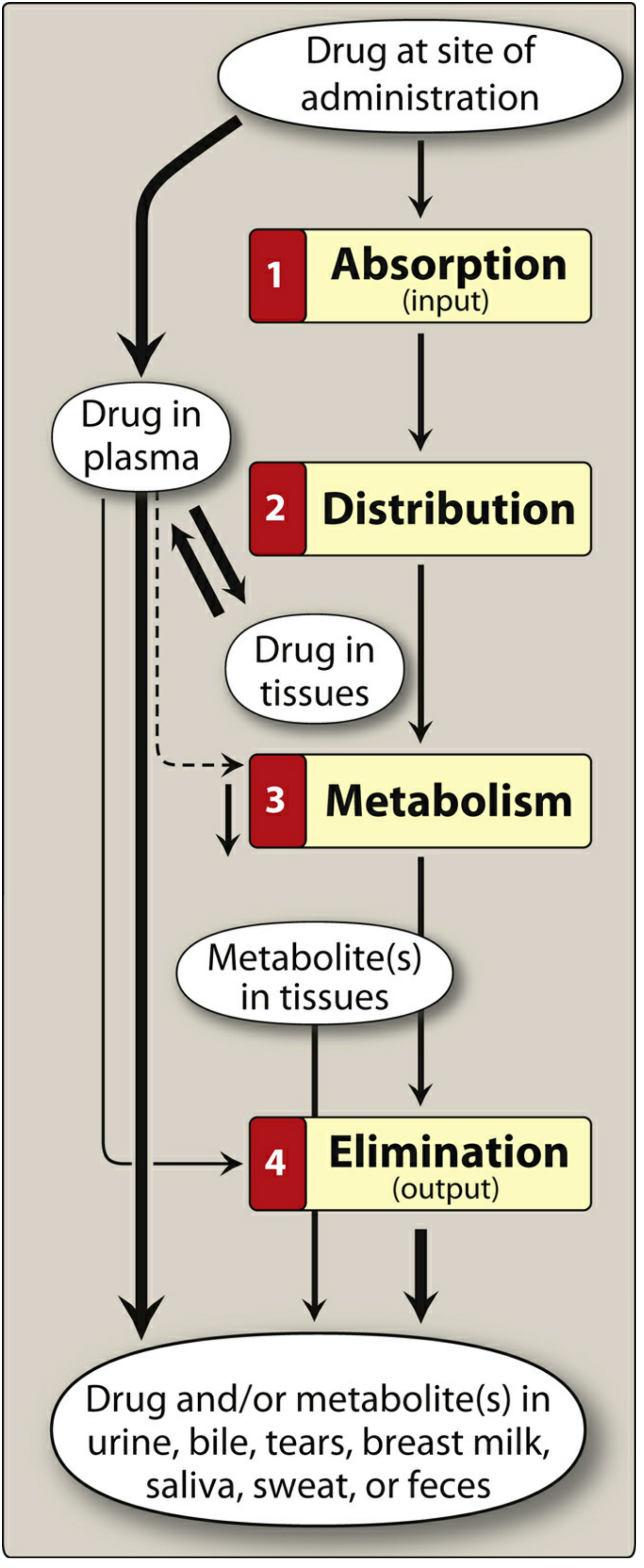
Phase I Reactions (Modification)
- Oxidation, reduction, hydrolysis
- Catalyzed by cytochrome P450 (CYP) enzymes in liver microsomes
- Products may be active, inactive, or toxic
- Example: codeine → morphine (active); paracetamol → NAPQI (toxic)
Phase II Reactions (Conjugation)
- Attach endogenous molecules to Phase I products: glucuronic acid, sulfate, acetate, glycine
- Products are almost always inactive and more water-soluble
- Excreted in urine or bile
First-Pass Effect (Pre-systemic metabolism)
- Oral drugs absorbed from gut pass through liver before reaching systemic circulation
- Drugs with high first-pass effect have low oral bioavailability (e.g., morphine, GTN, lidocaine)
Enzyme Induction & Inhibition
| Effect | Result | Examples |
|---|---|---|
| Enzyme induction | Faster metabolism, lower drug levels | Rifampicin, carbamazepine, phenytoin |
| Enzyme inhibition | Slower metabolism, higher drug levels (toxicity risk) | Ketoconazole, erythromycin, grapefruit juice |
7. Excretion of Drugs
Renal Excretion (most common)
Three processes:
- Glomerular filtration - free (unbound) drug is filtered; protein-bound drug is not
- Active tubular secretion - energy-dependent; can secrete protein-bound drugs
- Tubular reabsorption - lipophilic/un-ionized drugs are reabsorbed; ionization manipulations (urinary pH) affect this
pH trapping: Alkalinizing urine (sodium bicarbonate) enhances excretion of weak acids (e.g., aspirin, phenobarbital). Acidifying urine enhances excretion of weak bases (e.g., amphetamine).
Other Routes of Excretion
- Bile/Feces - large molecular weight drugs; some undergo enterohepatic circulation
- Lungs - volatile anaesthetics, alcohol
- Breast milk - risk of drug exposure to nursing infants
- Saliva, sweat, tears - minor routes
8. Pharmacokinetics - Key Parameters
| Parameter | Definition | Formula |
|---|---|---|
| Bioavailability (F) | Fraction of dose reaching systemic circulation | F = AUC oral / AUC IV |
| Half-life (t½) | Time for plasma concentration to fall by 50% | t½ = 0.693 × Vd / CL |
| Volume of Distribution (Vd) | Apparent volume drug distributes into | Vd = Dose / Cp |
| Clearance (CL) | Volume of plasma cleared of drug per unit time | CL = 0.693 × Vd / t½ |
| Steady state | Plasma level when rate in = rate out | Reached after ~4-5 half-lives |
| Loading dose | Initial large dose to rapidly reach therapeutic level | Ld = Vd × Target Cp |
| Maintenance dose | Dose to keep steady-state concentration | Md = CL × Target Cp |
9. Pharmacodynamics
Drug-Receptor Interaction
- Most drugs act by binding to specific receptors (proteins on cell surface or intracellularly)
- Agonist - binds receptor and activates it (produces response)
- Antagonist - binds receptor but does NOT activate it (blocks agonist)
- Competitive antagonist - reversible; can be overcome with higher agonist dose
- Non-competitive antagonist - irreversible or allosteric; cannot be overcome
- Partial agonist - binds and activates receptor but with less maximal effect than full agonist
Dose-Response Relationship
- Graded dose-response curve - increasing dose → increasing response (up to maximum)
- ED50 - dose producing 50% of maximal effect (potency measure)
- Emax - maximal effect possible (efficacy measure)
- Therapeutic index (TI) = TD50 / ED50 - higher TI = safer drug
Mechanisms of Drug Action
- Acting on receptors (GPCRs, ion channels, enzyme-linked receptors, nuclear receptors)
- Enzyme inhibition (e.g., ACE inhibitors, aspirin)
- Ion channel blockade (e.g., local anaesthetics, calcium channel blockers)
- Physical/chemical action (e.g., antacids, osmotic diuretics)
10. Factors Modifying Drug Response
The same drug at the same dose can produce different effects in different individuals due to:
Patient-Related Factors
| Factor | Effect |
|---|---|
| Age | Neonates (immature enzymes, high Vd); elderly (reduced renal/hepatic function, increased sensitivity) |
| Body weight/composition | Affects Vd; obese patients may need dose adjustments for lipophilic drugs |
| Sex | Hormonal differences affect drug metabolism |
| Genetics (pharmacogenomics) | CYP2D6 poor metabolizers (codeine toxicity); G6PD deficiency (hemolysis with primaquine) |
| Disease states | Renal failure (reduced excretion); hepatic failure (reduced metabolism); heart failure (reduced distribution) |
| Pregnancy | Altered absorption, distribution, metabolism; teratogenic risk |
Drug-Related Factors
| Factor | Definition |
|---|---|
| Tolerance | Reduced response to drug after repeated use; need higher doses for same effect |
| Tachyphylaxis | Rapid tolerance developing within a few doses |
| Drug interactions | One drug alters absorption, metabolism, or effect of another |
| Pharmacogenetics | Genetic variation in drug metabolism (fast vs slow acetylators - e.g., isoniazid) |
| Idiosyncrasy | Unusual/unexpected drug response due to genetic abnormality |
| Cumulation | Drug accumulates when excretion rate < administration rate (especially with impaired kidneys/liver) |
11. Adverse Drug Effects
An adverse drug reaction (ADR) is any unwanted, unintended effect of a drug at therapeutic doses.
Classification (Rawlins & Thompson)
| Type | Features | Examples |
|---|---|---|
| Type A (Augmented) | Dose-dependent, predictable, common, extension of pharmacological action | Morphine - respiratory depression; warfarin - bleeding |
| Type B (Bizarre) | Dose-independent, unpredictable, immunological or idiosyncratic | Penicillin anaphylaxis; halothane hepatitis |
| Type C (Chronic) | Related to long-term use | Steroid osteoporosis; NSAID nephropathy |
| Type D (Delayed) | Appear after prolonged latency | Drug-induced carcinogenesis, teratogenesis |
| Type E (End of use) | On withdrawal | Beta-blocker rebound; benzodiazepine withdrawal |
Specific Types of Adverse Effects
- Side effects - unwanted but pharmacologically predictable effects at therapeutic doses (e.g., dry mouth with atropine)
- Toxic effects - dose-dependent harmful effects (hepatotoxicity, nephrotoxicity, cardiotoxicity)
- Allergic (hypersensitivity) reactions - immune-mediated; Type I (anaphylaxis), Type II (cytotoxic), Type III (immune complex), Type IV (delayed/cell-mediated)
- Idiosyncratic reactions - genetically determined abnormal drug responses
- Teratogenicity - drug-induced fetal malformation (e.g., thalidomide, isotretinoin)
- Carcinogenicity - drug-induced cancer with long-term exposure (e.g., alkylating agents)
- Drug dependence/addiction - opioids, benzodiazepines, alcohol
- Drug interactions - pharmacokinetic (CYP-mediated) or pharmacodynamic (synergism, antagonism)
Quick Revision Summary
| Topic | Key Point |
|---|---|
| Pharmacokinetics | ADME - Absorption, Distribution, Metabolism, Excretion |
| Pharmacodynamics | Drug-receptor binding; agonist/antagonist; dose-response |
| Routes | IV fastest/most reliable; oral most convenient; sublingual bypasses first-pass |
| Distribution | Determined by protein binding, lipid solubility, Vd |
| Metabolism | Phase I (CYP450) + Phase II (conjugation); first-pass effect |
| Excretion | Primarily renal; pH affects tubular reabsorption of weak acids/bases |
| Adverse effects | Type A (predictable) vs Type B (unpredictable); allergy, tolerance, teratogenicity |
| Factors modifying | Age, genetics, disease, tolerance, drug interactions |
Sources: Katzung's Basic and Clinical Pharmacology, 16th Edition; Lippincott Illustrated Reviews: Pharmacology
This is a shared conversation. Sign in to Orris to start your own chat.