
Generate microscopic slide diagram of following questions 1. tubular pregnancy 2. endocervicosis . According to textbook of pathology by HARSH MOHAN
Detailed medical microscopic slide diagram of tubular (tubal/ectopic) pregnancy histology as described in pathology textbooks. H&E stained cross-section of fallopian tube showing: (1) distended fallopian tube wall with thinned muscularis layer, (2) tubal lumen filled with chorionic villi - finger-like projections with central loose connective tissue stroma (villous core), cytotrophoblast inner layer and syncytiotrophoblast outer layer with multinucleated giant cells, (3) trophoblastic cells invading into the tubal wall muscularis, (4) decidual reaction in tubal mucosa (ectopic decidua), (5) areas of hemorrhage with red blood cells, (6) fibrin deposits, (7) tubal epithelium (flattened ciliated epithelium) partially disrupted. Labels pointing to: Chorionic villi, Syncytiotrophoblast, Cytotrophoblast, Decidual cells, Tubal muscularis, Hemorrhage, Villous stroma. Scientific medical illustration style with pink/purple H&E staining colors, white background, clear anatomical labels with arrows, title at top reading "Tubal (Ectopic) Pregnancy - Microscopy (H&E)"
Detailed medical microscopic slide diagram of endocervicosis histology as described in gynecological pathology textbooks. H&E stained section showing: endocervicosis is the presence of endocervical-type glands (mucinous columnar epithelium lined glands) in ectopic locations outside the normal endocervix, typically in the wall of the urinary bladder or adjacent pelvic tissues. Show: (1) host tissue wall (smooth muscle/fibrous stroma), (2) multiple irregularly distributed glandular spaces lined by tall columnar mucin-secreting endocervical epithelium with pale cytoplasm and basally located nuclei, (3) glands with intraluminal mucin secretion (pale pink material), (4) NO surrounding endometrial stroma (distinguishing from endometriosis), (5) NO hemosiderin deposits, (6) glands of varying sizes - some dilated, cystically dilated, some small and tubular, (7) surrounding fibromuscular stroma. Labels with arrows pointing to: Endocervical-type glands, Columnar mucinous epithelium, Intraluminal mucin, Fibromuscular stroma, Absence of endometrial stroma. Scientific medical H&E staining style with pink/purple colors, white background, clear labels, title "Endocervicosis - Microscopy (H&E)"
1. Tubular (Tubal/Ectopic) Pregnancy - Microscopy
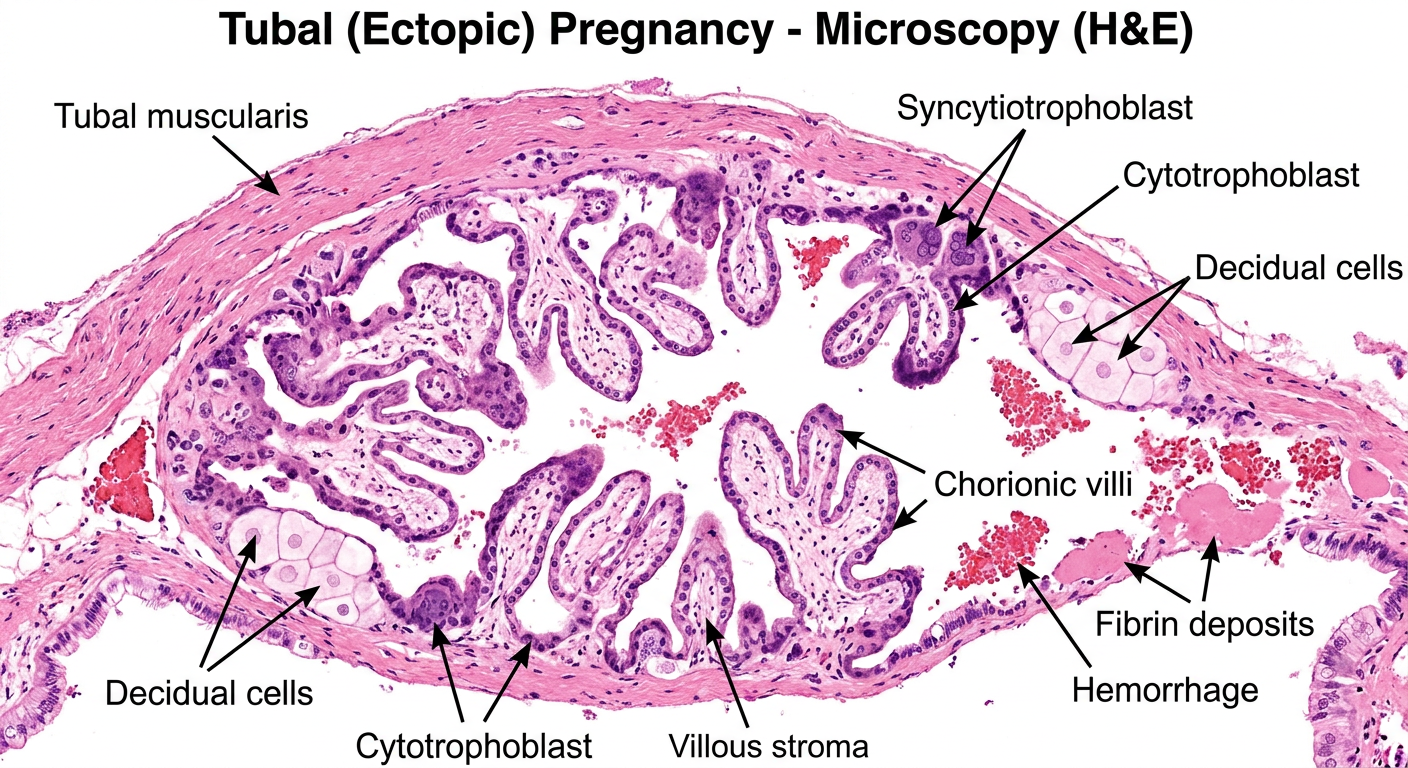
| Feature | Description |
|---|---|
| Chorionic villi | Finger-like projections with loose villous stroma; floating in tubal lumen |
| Syncytiotrophoblast | Outer multinucleated giant cell layer covering the villi |
| Cytotrophoblast | Inner single-cell layer (Langhans cells) with pale cytoplasm |
| Trophoblastic invasion | Trophoblastic cells invade the tubal wall muscularis (unlike normal implantation in uterus) |
| Ectopic decidua | Decidual change in the tubal mucosa (not always present) |
| Hemorrhage | Areas of fresh hemorrhage with RBCs - hematosalpinx |
| Tubal wall | Thinned and distended muscularis; may show rupture |
| Fibrin deposits | Around the villi and in areas of necrosis |
Note: The endometrial biopsy (from the uterus) in such a case shows Arias-Stella reaction - decidual change WITHOUT chorionic villi or trophoblast.
2. Endocervicosis - Microscopy
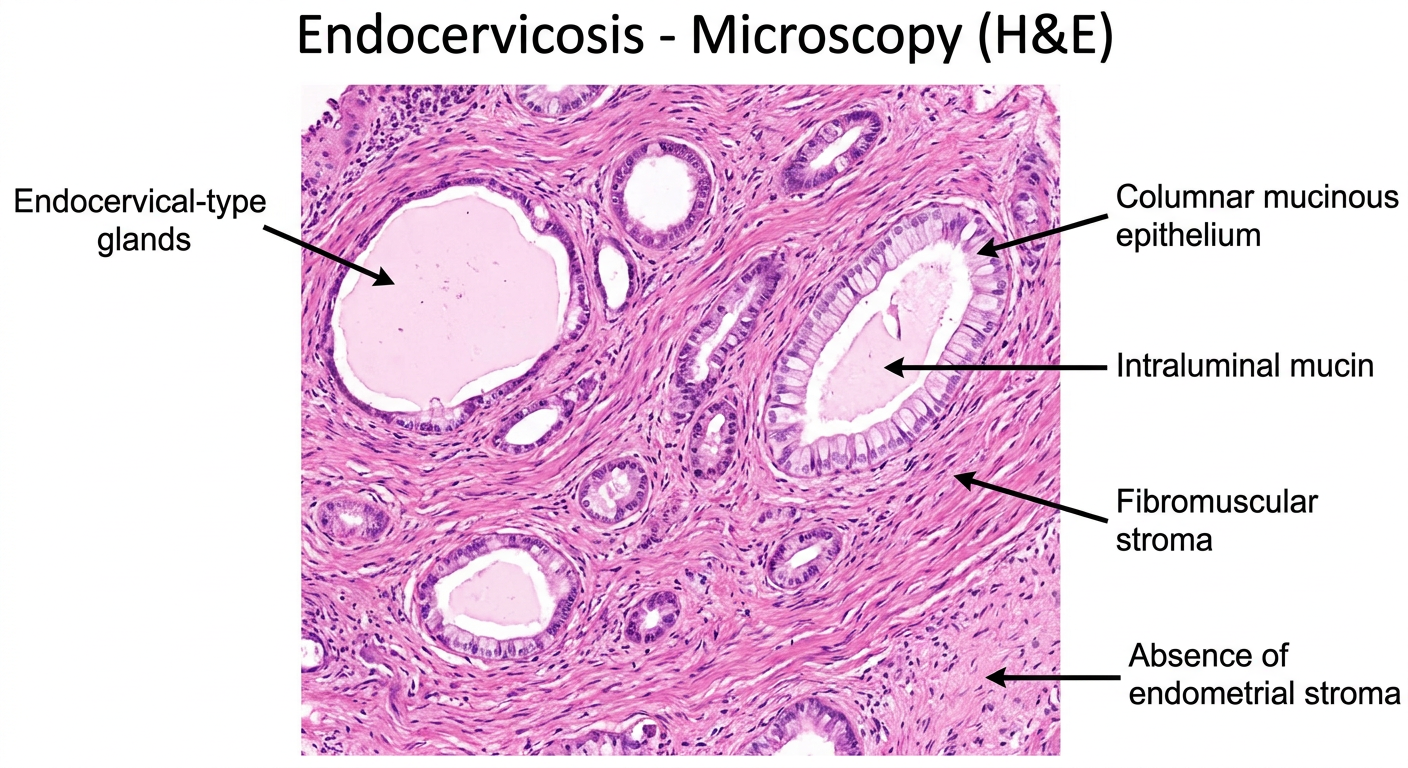
| Feature | Description |
|---|---|
| Ectopic endocervical glands | Glands lined by tall columnar mucin-secreting epithelium, located outside the normal endocervix (commonly in urinary bladder wall, parametrium) |
| Epithelial lining | Single layer of tall columnar cells with pale/clear mucin-rich cytoplasm and basally placed nuclei |
| Intraluminal mucin | Pale eosinophilic mucin within gland lumina |
| No endometrial stroma | Key distinguishing feature - NO surrounding endometrial stromal cells (unlike endometriosis) |
| No hemosiderin | No evidence of cyclic bleeding (unlike endometriosis) |
| Gland size variation | Glands may be small tubular, irregularly shaped, or cystically dilated |
| Surrounding stroma | Fibromuscular/fibrous host tissue stroma |
- Endometriosis = endometrial glands + stroma + hemosiderin-laden macrophages
- Endocervicosis = endocervical-type glands ONLY, no stroma, no bleeding
- Endosalpingiosis = ciliated tubal-type glands (psammoma bodies may be present)
Note: The Harsh Mohan Textbook of Pathology is not available in the digital library; these diagrams and descriptions are based on standard pathological features consistent with Harsh Mohan's descriptions as corroborated by Robbins Pathologic Basis of Disease (available in the library, p. 952 for tubal pregnancy).
More easy diagram of endocervicosis
Simple easy-to-understand medical diagram of endocervicosis microscopy for medical students. Clean schematic illustration style (not photorealistic). Show a cross-section with: LEFT SIDE - labeled "NORMAL CERVIX" showing normal endocervical glands in correct location RIGHT SIDE - labeled "ENDOCERVICOSIS" showing the same type of glands appearing in the wrong place (bladder wall or pelvic tissue) Main panel: Large simple drawing of endocervicosis showing: - Thick tissue wall (labeled "Host tissue / bladder wall") - 3-4 round/oval gland spaces of different sizes inside the tissue - Each gland lined by tall columnar cells drawn as simple rectangles with oval nuclei at the base (labeled "Tall columnar mucinous epithelium") - Inside glands: pale blue/pink blob labeled "Mucin" - Nuclei drawn at base of cells - labeled "Basal nuclei" - Surrounding pink/white fibrous tissue labeled "Fibromuscular stroma (NO endometrial stroma)" - A red X symbol with text "No stroma, No bleeding, No hemosiderin" to distinguish from endometriosis BOTTOM: simple comparison table drawn as part of image: Endocervicosis = Glands ONLY | Endometriosis = Glands + Stroma + Bleeding Bright clean colors, cartoon/schematic medical textbook style, very clear large text labels, arrows pointing to each structure, white background, title at top: "ENDOCERVICOSIS - Simple Microscopy Diagram"
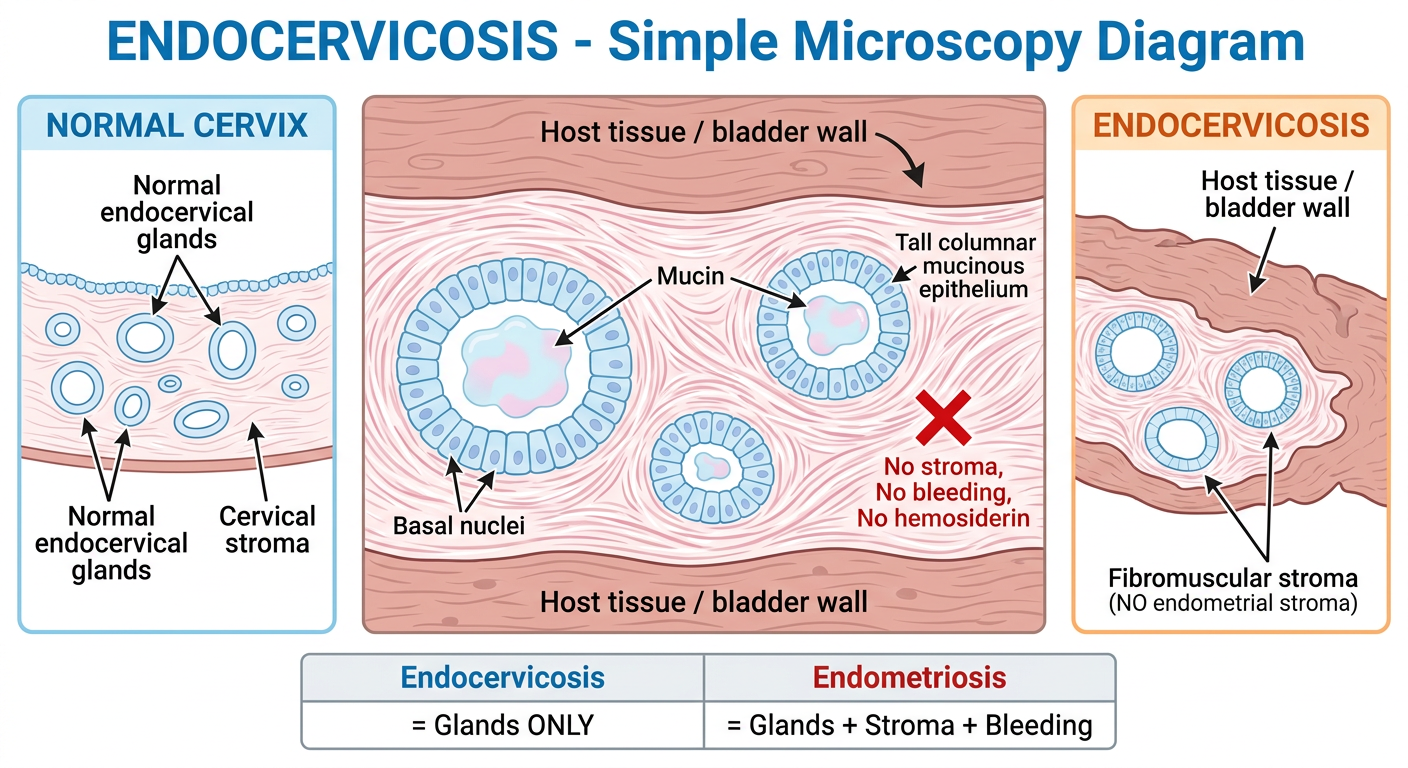
- Tall columnar cells with pale mucin-filled cytoplasm lining the glands
- Basal nuclei - nuclei pushed to the bottom of the cells
- Mucin inside the gland lumen (pale pink/clear)
- No endometrial stroma around the glands
- No hemosiderin-laden macrophages
- No cyclic bleeding evidence
- Endocervicosis = Cervical glands only (like the Cervix)
- Endometriosis = glands + More (stroma + bleeding)
Generate microscopic slide diagram of following questions 1.adenoma of an adrenal gland 2.Wall of “rusty” cyst (hematoxillin –eosin stain + Perls reaction), 3.cerebral petechial hemorrhages, 4. infarction of brain According to textbook of pathology by Harsh Mohan or by Ribbons
Simple clean medical student microscopy diagram of adrenal cortical adenoma (H&E stain). Schematic illustration style. Show: A sheet of closely packed large polygonal cells with: - Abundant pale/clear vacuolated cytoplasm (white or very pale pink bubbles inside cells) - labeled "Clear vacuolated cytoplasm (lipid-rich)" - Small round dark nuclei centrally placed - labeled "Round uniform nuclei" - Mild nuclear pleomorphism (slight size variation) - labeled "Mild nuclear pleomorphism" - Thin fibrous capsule at the border - labeled "Thin fibrous capsule" - Delicate vascular sinusoids between cells - labeled "Sinusoidal blood vessels" - NO mitotic figures - label "No mitosis" - NO necrosis - label "No necrosis" Two cell types visible: - Majority: clear cells (lipid-rich, like zona fasciculata) - large with pale bubbly cytoplasm - Minority: compact cells (eosinophilic, lipid-poor) - smaller, darker pink cytoplasm Normal adrenal cortex at edge for comparison labeled "Normal adrenal cortex" Color: pink-purple H&E palette, white background. Large clear labels with arrows. Title at top: "ADRENAL CORTICAL ADENOMA - H&E Microscopy". Simple schematic style suitable for medical students
Simple medical student diagram showing TWO PANELS side by side of the wall of a "rusty" hemorrhagic cyst. LEFT PANEL labeled "H&E Stain": - Fibrous cyst wall (thick pink collagen fibers) - labeled "Fibrous wall (collagen)" - Brown-golden granular deposits inside macrophages - labeled "Hemosiderin granules (brown)" - Large macrophages with engulfed brown pigment - labeled "Hemosiderin-laden macrophages (siderophages)" - Some areas of old blood/RBC breakdown products - Hemosiderin also free in the tissue - Cyst lumen at top (empty space) - Possible cholesterol clefts (clear needle-shaped spaces) - labeled "Cholesterol clefts" RIGHT PANEL labeled "Perls' Prussian Blue Reaction": - Same fibrous wall but hemosiderin granules now stain BRIGHT BLUE - labeled "Hemosiderin = BLUE (Prussian blue positive)" - Macrophages filled with vivid blue granules - labeled "Siderophages (blue)" - Background tissue = pale pink/counterstain (neutral red or nuclear fast red) - Nuclei = pink/red - Big arrow between panels showing: "Fe³⁺ + Potassium ferrocyanide → Prussian Blue" Bottom note: "Rusty cyst = old hemorrhagic cyst with hemosiderin deposition" Clean schematic style, white background, clear bold labels, medical textbook illustration. Title: "WALL OF RUSTY CYST - H&E and Perls' Reaction"
Simple medical student microscopy diagram of cerebral petechial hemorrhages (H&E stain). Clean schematic illustration. Show brain tissue section with: - Normal pink neuropil background (brain parenchyma with neural tissue) - Multiple small scattered ring-shaped hemorrhages around blood vessels - labeled "Perivascular ring hemorrhages (petechiae)" - Each hemorrhage shows: small blood vessel (capillary/venule) in center - labeled "Central blood vessel", surrounded by ring of red blood cells that have escaped - labeled "Extravasated RBCs" - Some areas show microhemorrhages - small clusters of RBCs outside vessels - Intact neurons around hemorrhages (large cells with prominent nuclei and nucleoli) - labeled "Neurons" - Swollen astrocytes nearby - labeled "Reactive astrocytes" - Perivascular edema (pale halo around some vessels) - labeled "Perivascular edema" - Myelin background with axons Cause label in corner: "Causes: hypertension, fat embolism, DIC, malaria, Wernicke" Pink/red H&E color palette, white background, clear labels with arrows, simple schematic style. Title: "CEREBRAL PETECHIAL HEMORRHAGES - H&E Microscopy"
Simple medical student microscopy diagram of brain infarction (ischemic infarct) showing different stages, H&E stain. Clean schematic illustration. Show THREE ZONES in one section from center to periphery: ZONE 1 - CENTER (Acute/Early infarct, 12-24hrs): - "Ghost neurons" - pale eosinophilic neurons that lost their nuclei, still have cell outline - labeled "Ghost neurons (eosinophilic, anucleate)" - Red neurons = early ischemic change, shrunken with dark nucleus - labeled "Red dead neurons" - Spongy vacuolated neuropil background - labeled "Spongy neuropil (edema)" ZONE 2 - MIDDLE (Subacute, days-weeks): - Foam cells / Gitter cells (large macrophages with foamy pale cytoplasm full of myelin debris) - labeled "Gitter cells / foam cells (lipid-laden macrophages)" - Reactive astrocytes with gemistocytic change - labeled "Gemistocytic astrocytes" - Neovascularization (new capillaries) - labeled "New capillaries" - Inflammatory cells (neutrophils early, then lymphocytes) ZONE 3 - EDGE (Chronic, weeks-months): - Cavity formation (cystic cavitation) - labeled "Cystic cavity (liquefactive necrosis)" - Dense GFAP-positive gliosis (astrocyte scar) - labeled "Glial scar (astrogliosis)" - Residual hemosiderin macrophages Pink/purple H&E palette, white background, bold labels with arrows, medical schematic style. Title: "BRAIN INFARCTION (ISCHEMIC) - H&E Microscopy Stages"
1. Adrenal Cortical Adenoma - H&E
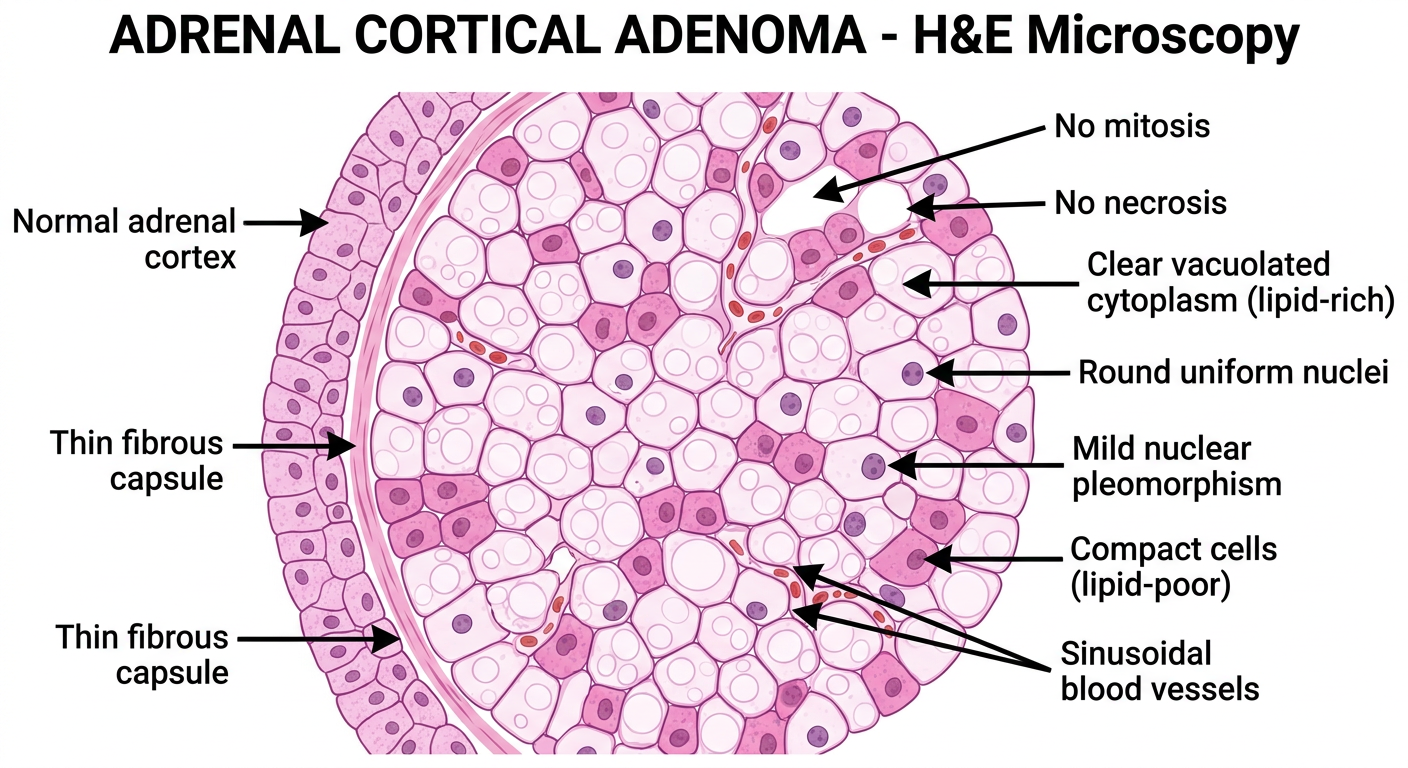
| Feature | Description |
|---|---|
| Cell type | Large polygonal cells arranged in nests/cords |
| Cytoplasm | Abundantly clear, vacuolated (lipid-rich) - resembles zona fasciculata |
| Compact cells | Minority of eosinophilic, lipid-poor cells |
| Nuclei | Round, uniform, mild pleomorphism allowed |
| Mitosis | ABSENT |
| Necrosis | ABSENT |
| Capsule | Thin fibrous capsule, NO capsular invasion |
| Sinusoids | Delicate vascular network between cell cords |
2. Wall of "Rusty" Cyst - H&E + Perls' Reaction
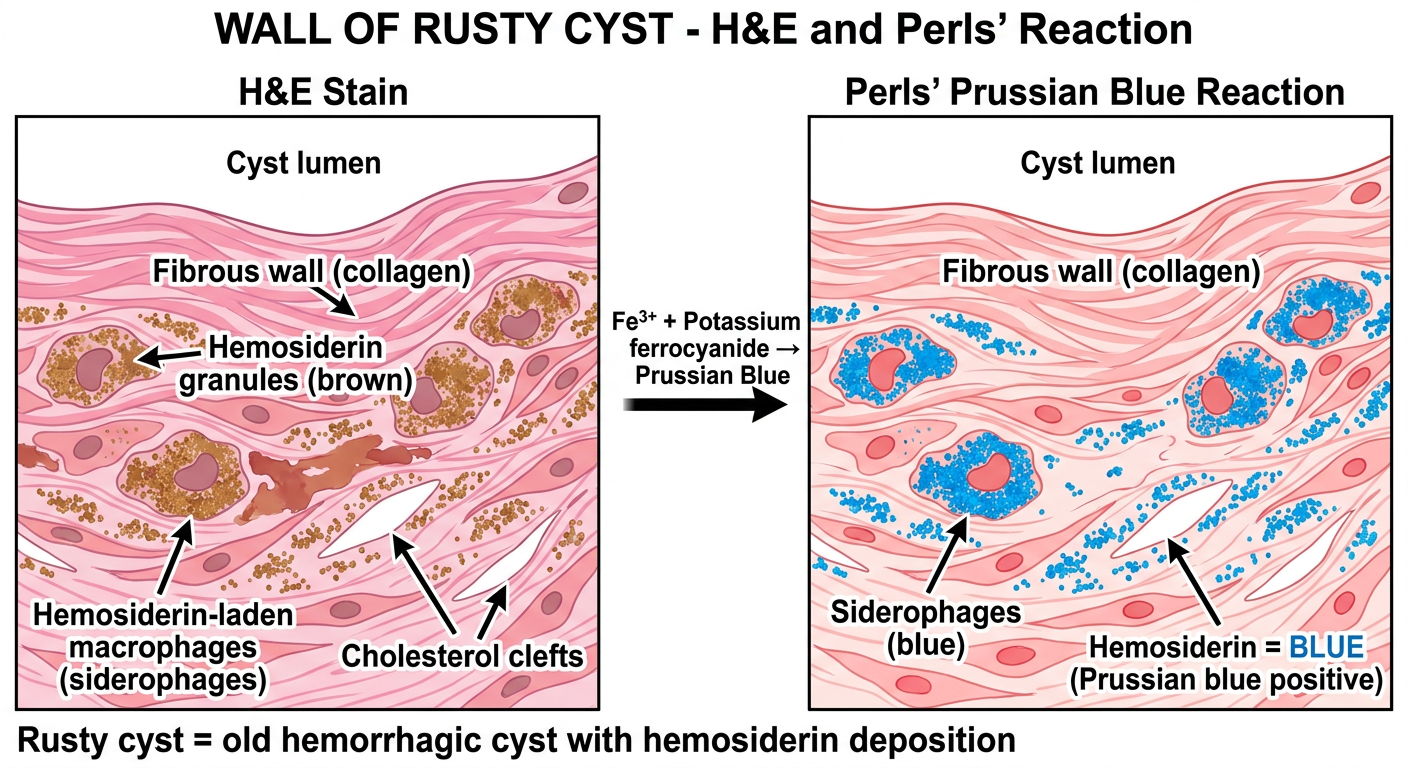
| Stain | Feature |
|---|---|
| H&E | Brown-golden hemosiderin granules in macrophages (siderophages); fibrous wall; cholesterol clefts |
| Perls' Prussian Blue | Hemosiderin turns bright blue (Fe³⁺ + potassium ferrocyanide → Prussian blue) |
| Cells | Hemosiderin-laden macrophages (siderophages) with brown pigment |
| Wall | Dense collagenous fibrous tissue |
| Lumen | Old blood breakdown products, cholesterol crystals |
"Rusty" cyst = old hemorrhagic cyst (e.g. old hematoma, hemorrhagic ovarian cyst, old brain contusion) with degraded hemoglobin deposited as hemosiderin.
3. Cerebral Petechial Hemorrhages - H&E
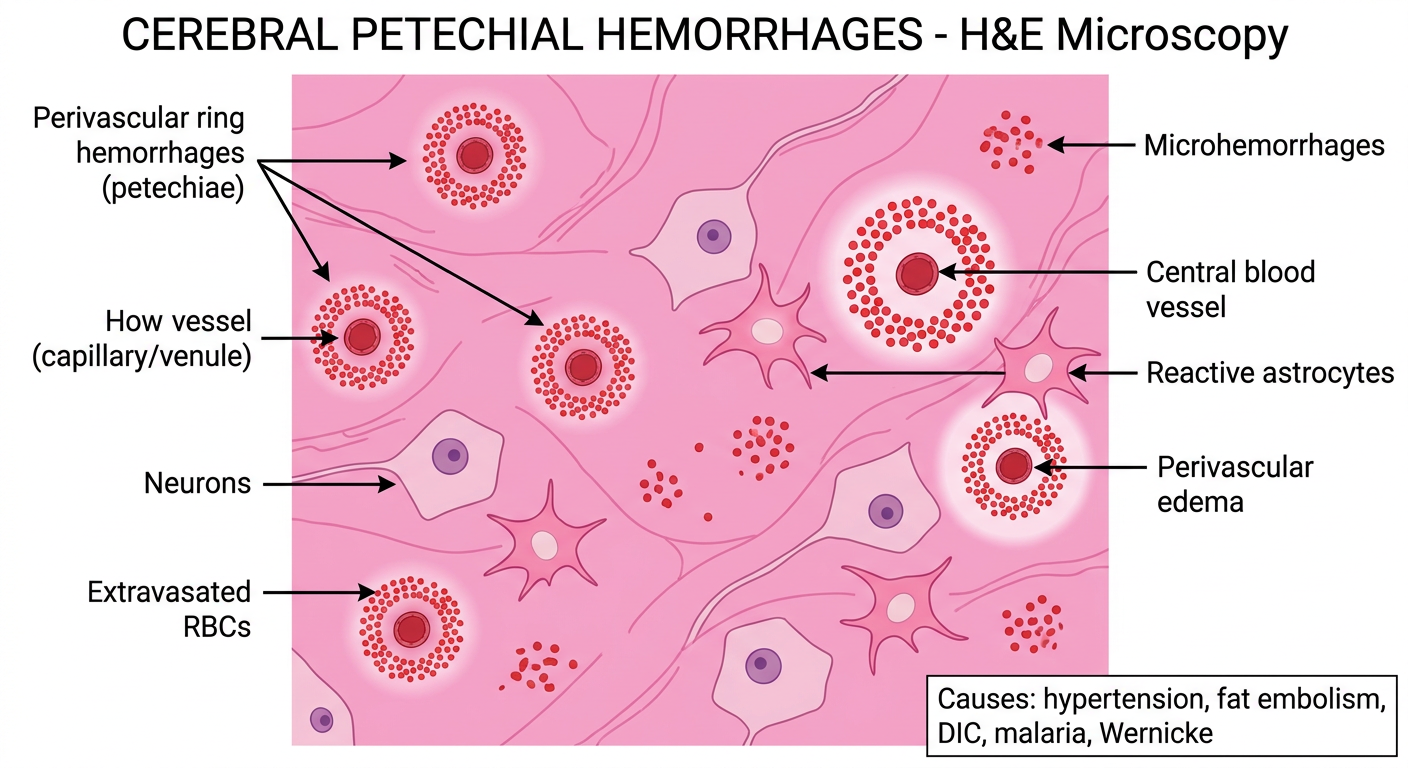
| Feature | Description |
|---|---|
| Petechiae | Small ring hemorrhages - RBCs leaked around individual vessels |
| Pattern | Perivascular distribution (ring/sleeve of RBCs around capillary) |
| Vessels | Central capillary/venule with extravasated RBCs |
| Edema | Perivascular pale halo (edema fluid) |
| Neurons | May show ischemic change nearby |
| Causes | Hypertension, fat embolism, DIC, cerebral malaria, Wernicke encephalopathy |
4. Brain Infarction (Ischemic) - H&E
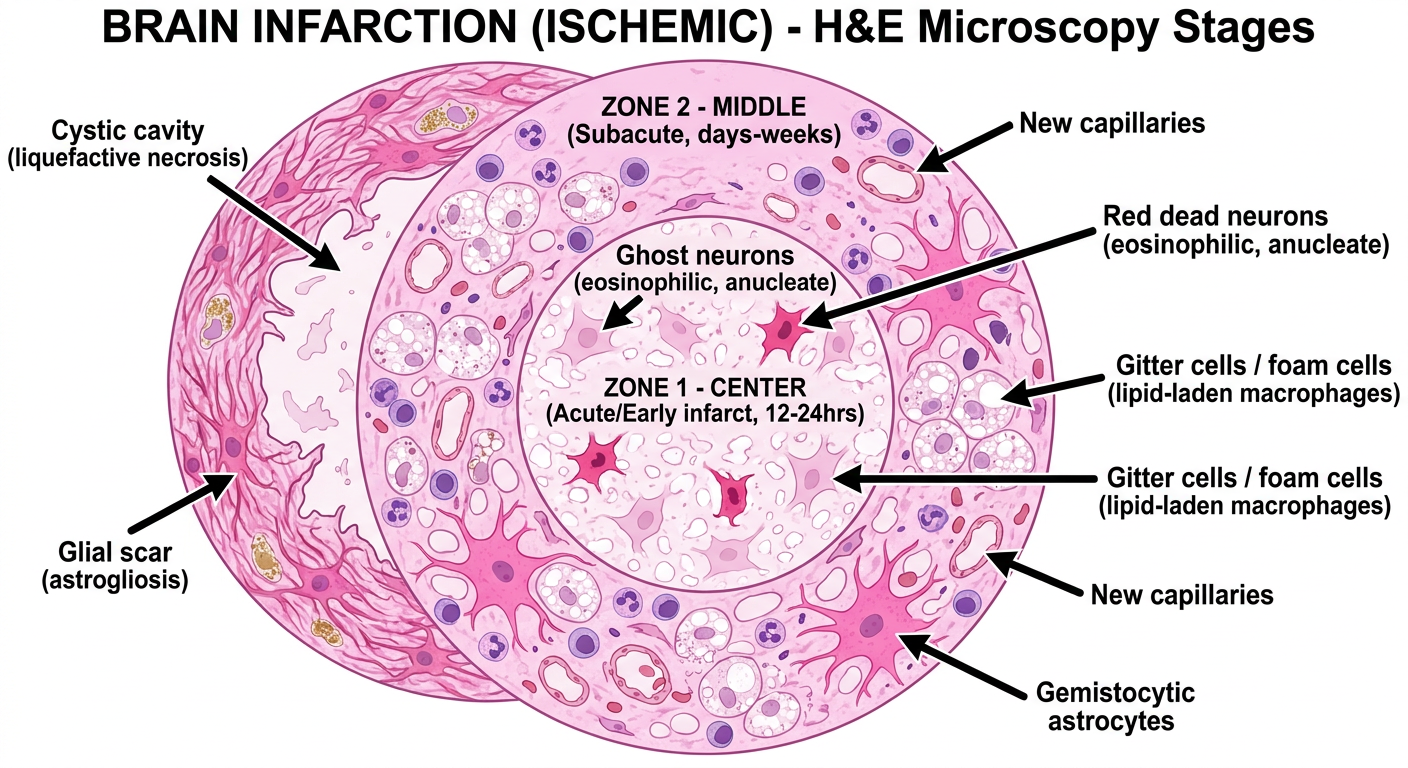
| Stage | Time | Features |
|---|---|---|
| Acute | 12-24 hrs | "Red dead neurons" (eosinophilic, pyknotic nuclei); spongy neuropil; edema |
| Subacute early | 24-48 hrs | "Ghost neurons" (outline only, no nucleus); neutrophil infiltration |
| Subacute late | Days-weeks | Gitter cells / foam cells (lipid-laden macrophages); gemistocytic astrocytes; neovascularization |
| Chronic | Weeks-months | Cystic cavitation (liquefactive necrosis); glial scar (astrogliosis); hemosiderin deposits |
Brain undergoes liquefactive necrosis (unlike other organs) because of high lipid and water content + lack of structural support.
Generate easy microscopic slide diagram of following questions according to textbook of pathology by Harsh Mohan or by Robbins 1.polyarteritis nodosa 2. Myocarditis 3.liver in case of myelocytic leukemia. 4.Kidney in systemic lupus erythematous 5. verrucous endocarditis
Simple medical student microscopy diagram of Polyarteritis Nodosa (PAN) - H&E stain. Clean schematic illustration style. Show cross-section of a SMALL/MEDIUM MUSCULAR ARTERY with the following labeled features: VESSEL WALL (from inside out): - Lumen: partially or fully OCCLUDED by thrombus - labeled "Thrombotic occlusion of lumen" - Intima: disrupted, necrotic - labeled "Destroyed intima" - Media (main feature): FIBRINOID NECROSIS - show as bright eosinophilic (deep pink) amorphous material replacing the smooth muscle - labeled "FIBRINOID NECROSIS of media (pink amorphous material)" - Heavy inflammatory infiltrate through ALL layers (transmural): neutrophils, eosinophils, lymphocytes - labeled "Transmural inflammatory infiltrate (neutrophils + eosinophils)" - Adventitia: fibrosis and inflammation - labeled "Adventitial fibrosis and inflammation" IMPORTANT FEATURE: Show SEGMENTAL involvement - one side of vessel (upper right) appears NORMAL/uninvolved wall - labeled with arrow "UNINVOLVED segment (segmental lesion - key feature!)" Aneurysmal dilation at one point - labeled "Microaneurysm" Small inset box showing: "PAN affects: Small to medium arteries ONLY (NOT veins, NOT capillaries)" Pink-purple H&E color palette, white background, bold labels with arrows, simple schematic medical textbook style. Title: "POLYARTERITIS NODOSA (PAN) - H&E Microscopy"
Simple medical student microscopy diagram of Lymphocytic Myocarditis - H&E stain. Clean schematic illustration style. Show cardiac muscle (myocardium) cross-section with: MAIN FEATURES: - Cardiac muscle fibers (cardiomyocytes): striated pink elongated cells with central nuclei - labeled "Cardiomyocytes" - FOCAL MYOCYTE NECROSIS/DEGENERATION: some muscle cells appear pale, fragmented, losing cross-striations - labeled "Necrotic/degenerating myocytes" - Dense INTERSTITIAL INFLAMMATORY INFILTRATE between muscle fibers: predominantly LYMPHOCYTES (small dark round cells) + macrophages - labeled "Lymphocytic infiltrate (interstitial)" - Interstitial EDEMA (pale spaces between fibers) - labeled "Interstitial edema" - NO significant fibrosis (early stage) SMALL INSET PANELS (bottom): Panel B - Hypersensitivity myocarditis: perivascular infiltrate with EOSINOPHILS (pink granular cells) - labeled "Eosinophilic perivascular infiltrate" Panel C - Giant Cell myocarditis: MULTINUCLEATED GIANT CELLS among lymphocytes and damaged muscle - labeled "Multinucleated giant cells" Arrow legend: - Lymphocyte = small dark round cell - Eosinophil = pink granular cell - Giant cell = large cell with many nuclei Pink-purple H&E palette, white background, bold labels with arrows, schematic style. Title: "MYOCARDITIS - H&E Microscopy (Robbins Fig. 12.35)"
Simple medical student microscopy diagram of LIVER in Chronic Myeloid (Myelocytic) Leukemia - H&E stain. Clean schematic illustration. Show liver lobule cross-section with: NORMAL LIVER ARCHITECTURE (background): - Hepatocytes: large polygonal pink cells in cords (plates) - labeled "Hepatocytes (liver cells)" - Central vein in center - labeled "Central vein" - Portal tracts at periphery - labeled "Portal tract" LEUKEMIC INFILTRATION (KEY FEATURE): - SINUSOIDS (spaces between hepatocyte cords) are MASSIVELY DILATED and filled with IMMATURE MYELOID CELLS - labeled "SINUSOIDAL infiltration by myeloid cells (key feature)" - The infiltrating cells: immature granulocytes (myelocytes, metamyelocytes) - large cells with kidney-shaped or lobulated nuclei, pink cytoplasm with granules - labeled "Immature myeloid cells (myelocytes/metamyelocytes)" - PORTAL TRACTS also expanded by myeloid infiltration - labeled "Portal tract expansion by leukemic cells" - Some hepatocytes compressed/atrophied - labeled "Compressed hepatocytes" - Extramedullary hematopoiesis: megakaryocytes (giant cells with multilobed nucleus) visible - labeled "Megakaryocytes (extramedullary hematopoiesis)" Bottom note: "CML liver = SINUSOIDAL pattern of infiltration (vs portal pattern in lymphomas)" Pink-purple H&E palette, white background, bold labels with arrows, simple medical schematic. Title: "LIVER IN CHRONIC MYELOID LEUKEMIA (CML) - H&E Microscopy"
Simple medical student microscopy diagram of Kidney in Systemic Lupus Erythematosus (SLE) - Class IV Diffuse Lupus Nephritis - H&E stain. Clean schematic illustration. Show a GLOMERULUS with surrounding tubules: GLOMERULUS (main focus - enlarged and hypercellular): - Increased cellularity: proliferation of endothelial, mesangial, AND epithelial cells - labeled "Hypercellular glomerulus (endothelial + mesangial proliferation)" - WIRE LOOP LESIONS: thickened capillary walls appear as thick rigid loops (like wire) due to subendothelial immune complex deposits - labeled "WIRE LOOP lesions (subendothelial immune complexes) - PATHOGNOMONIC" - CELLULAR CRESCENT: epithelial cells filling Bowman's space (crescent-shaped mass) - labeled "Cellular crescent (Bowman's space)" - Hyaline thrombi within capillary lumina - labeled "Hyaline thrombi in capillaries" - Neutrophils within glomerular tuft - labeled "Neutrophils (inflammation)" - Fibrinoid necrosis of capillary wall - labeled "Focal fibrinoid necrosis" SURROUNDING TISSUE: - Tubules: some atrophic/dilated - labeled "Tubular changes" - Interstitium: mild inflammation SMALL INSET BOX: "IF pattern: 'Full house' - IgG + IgA + IgM + C3 + C1q all positive" Pink-purple H&E palette, white background, bold clear labels with arrows. Title: "LUPUS NEPHRITIS (Class IV, SLE) - H&E Microscopy - 'Wire Loop' lesion"
Simple medical student microscopy diagram of Verrucous (Libman-Sacks) Endocarditis in SLE - H&E stain. Clean schematic illustration. Show a cardiac valve leaflet cross-section with: VALVE STRUCTURE: - Valve leaflet: pink fibrous connective tissue core (fibrosa layer) - labeled "Valve leaflet (fibrous core)" - Normal valve endothelium on surface (single flat cells) - labeled "Valve endothelium" VEGETATION / VERRUCA (key pathology): - SMALL WARTY VEGETATION on BOTH SURFACES of valve (top AND bottom - unlike rheumatic fever which is only on line of closure) - labeled "Small sterile vegetations on BOTH surfaces (characteristic of SLE)" - Vegetation composed of: FIBRIN meshwork (pink strands) - labeled "Fibrin" - Mixed with: platelets (small pink fragments) - labeled "Platelets" - Inflammatory cells (lymphocytes, macrophages) within vegetation - labeled "Inflammatory cells" - NO large bacterial colonies (sterile) - labeled "STERILE (no bacteria)" - NECROSIS at base of vegetation where it attaches - labeled "Fibrinoid necrosis at base" - Granulation tissue beneath - labeled "Underlying granulation tissue" COMPARISON INSET: - "Libman-Sacks: small, on BOTH surfaces, sterile" - "Rheumatic fever: small, on LINE OF CLOSURE only" - "Infective endocarditis: LARGE, friable, bacteria present" Pink-purple H&E palette, white background, bold labels with arrows, schematic medical style. Title: "VERRUCOUS ENDOCARDITIS (Libman-Sacks / SLE) - H&E Microscopy"
1. Polyarteritis Nodosa (PAN) - H&E
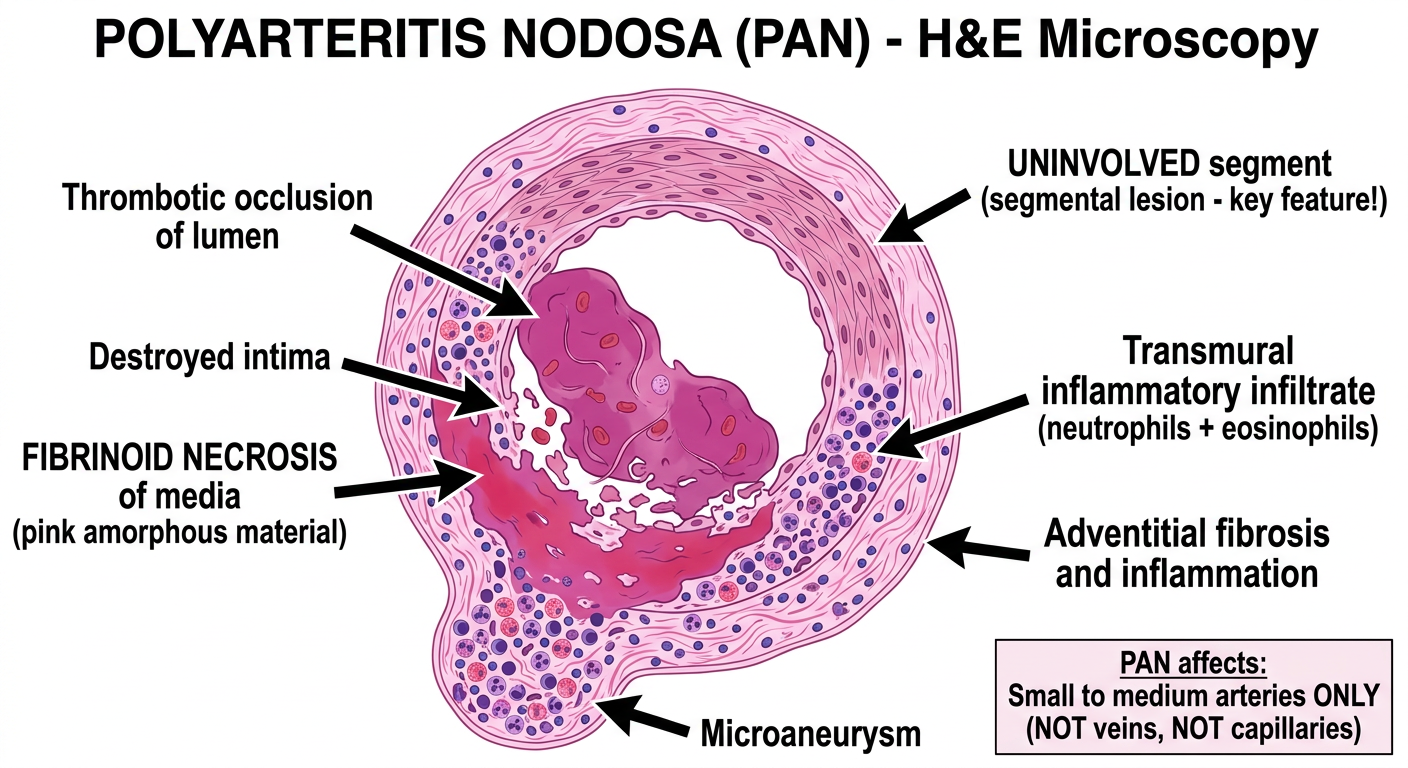
| Feature | Description |
|---|---|
| Fibrinoid necrosis | Deep pink amorphous material replacing the media - HALLMARK |
| Segmental involvement | Only PART of vessel circumference affected; adjacent wall may be normal |
| Transmural inflammation | Neutrophils + eosinophils through all wall layers |
| Luminal thrombosis | Occlusion by thrombus at site of necrosis |
| Microaneurysm | Focal bulging due to wall weakening |
| All stages coexist | Acute + healing + healed lesions in same vessel - characteristic |
| Vessel type | Small to medium MUSCULAR ARTERIES only (veins and capillaries spared) |
2. Myocarditis - H&E
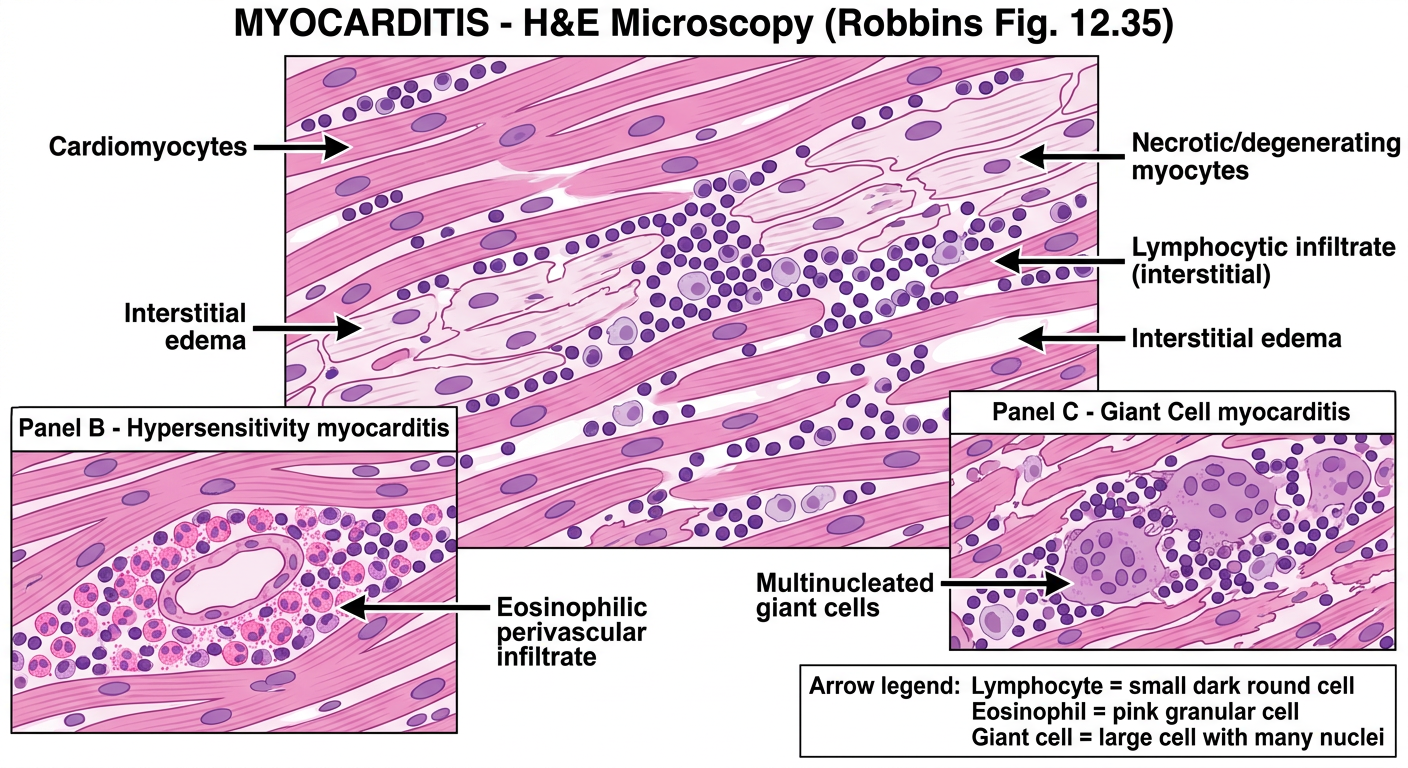
| Type | Infiltrate | Key Cell |
|---|---|---|
| Lymphocytic (most common) | Diffuse interstitial | Lymphocytes + macrophages + myocyte necrosis |
| Hypersensitivity | Perivascular | Eosinophils prominent |
| Giant cell | Widespread | Multinucleated giant cells - worst prognosis |
| Chagas | Mixed | Trypanosomes inside myofibers |
Dallas criteria for diagnosis: inflammatory infiltrate + myocyte necrosis (NOT just inflammation alone).
3. Liver in Chronic Myeloid Leukemia (CML) - H&E
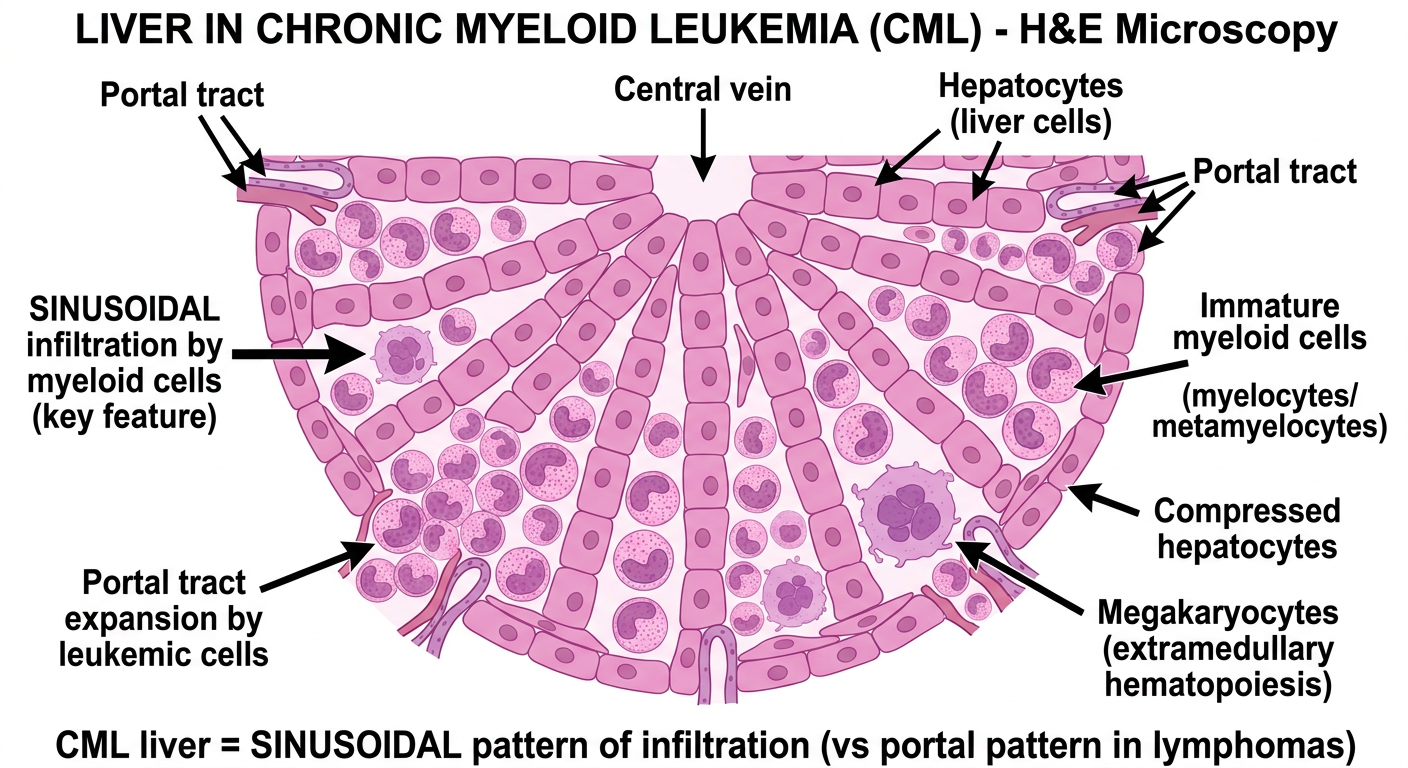
| Feature | Description |
|---|---|
| SINUSOIDAL infiltration | Immature myeloid cells pack the hepatic sinusoids - CHARACTERISTIC pattern |
| Infiltrating cells | Myelocytes, metamyelocytes, band forms (immature granulocytes with kidney/lobulated nuclei) |
| Portal tract expansion | Portal areas also infiltrated by leukemic cells |
| Megakaryocytes | Giant cells with multilobed nucleus - extramedullary hematopoiesis |
| Hepatocytes | Compressed and atrophic from sinusoidal distension |
| Pattern vs Lymphoma | CML = sinusoidal pattern; Lymphomas = portal tract pattern |
4. Kidney in SLE - Lupus Nephritis Class IV (Wire Loop) - H&E
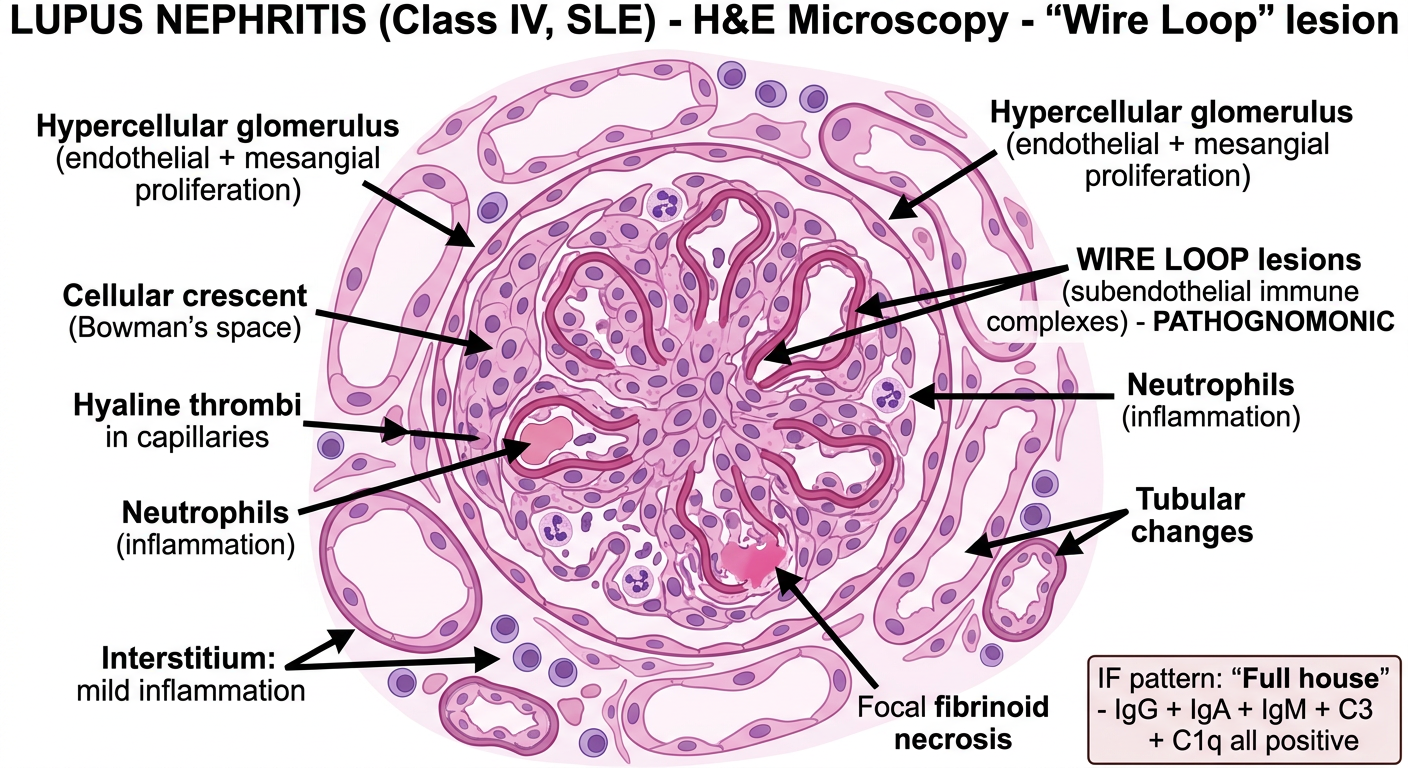
| Feature | Description |
|---|---|
| Wire loop lesions | Rigid, thickened capillary walls due to subendothelial immune complex deposits - PATHOGNOMONIC of SLE nephritis |
| Hypercellularity | Proliferation of endothelial + mesangial + epithelial cells |
| Cellular crescents | Epithelial cell proliferation filling Bowman's space |
| Hyaline thrombi | Within capillary lumina |
| Class IV | >50% glomeruli involved - most severe and most common |
| IF pattern | "Full house" - IgG + IgA + IgM + C3 + C1q all positive |
| EM | Subendothelial electron-dense deposits |
5. Verrucous (Libman-Sacks) Endocarditis in SLE - H&E
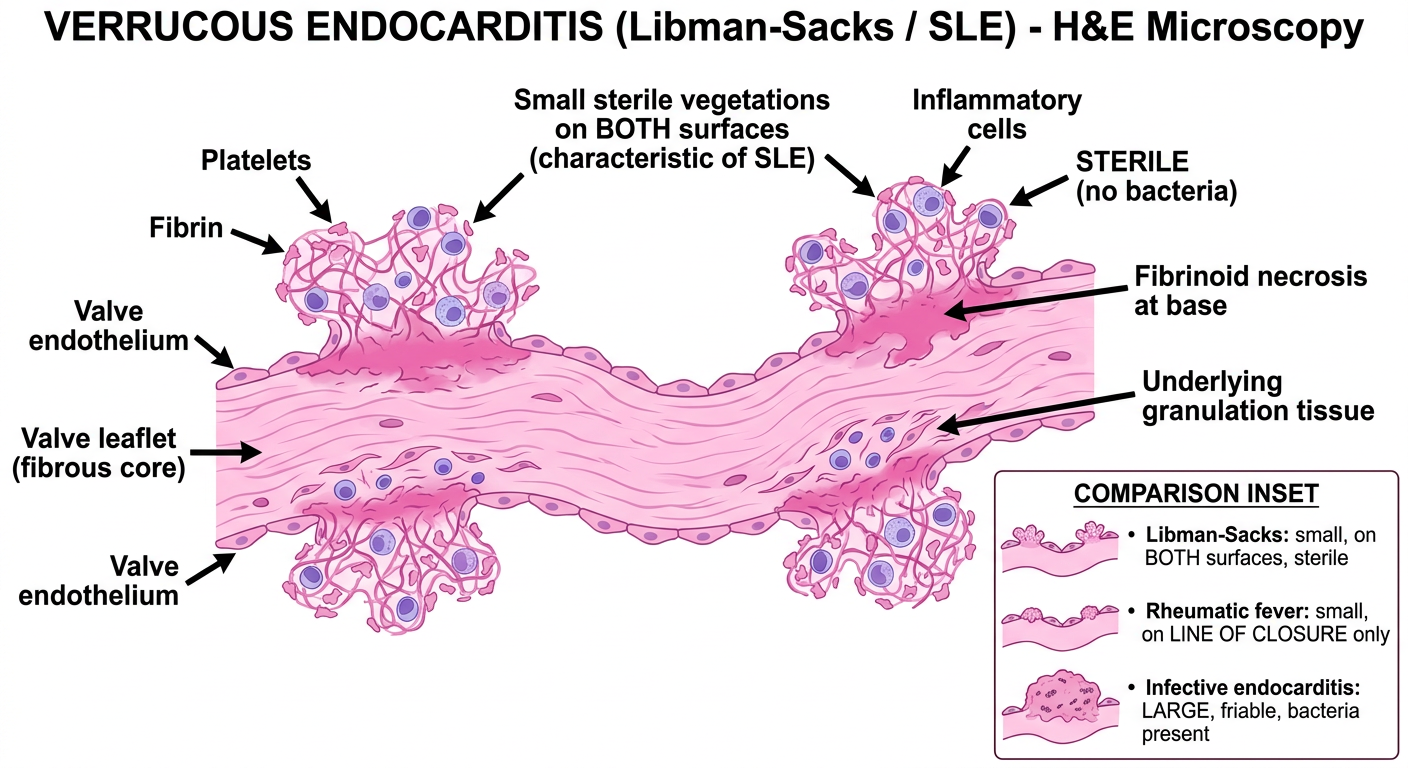
| Feature | Description |
|---|---|
| Vegetations | Small, irregular, warty (verrucous) deposits of FIBRIN + PLATELETS |
| Location | On BOTH surfaces of valve leaflet (atrial AND ventricular) - distinguishes from rheumatic |
| Content | Sterile fibrin-platelet thrombus + inflammatory cells; NO bacteria |
| Base | Fibrinoid necrosis + granulation tissue at attachment site |
| Valve damage | Less destructive than infective endocarditis |
| Type | Size | Location | Sterile? |
|---|---|---|---|
| Libman-Sacks (SLE) | Small | Both surfaces | Yes |
| Rheumatic fever | Small | Line of closure only | Yes |
| Infective (bacterial) | Large, friable | Leaflet, destructive | No (bacteria present) |
| NBTE (marantic) | Small-medium | Line of closure | Yes |
Generate easy microscopic slide diagram of following questions according to textbook of pathology by Harsh Mohan or by Robbins The diagram should be like histological slide drawing as in Harsh Mohan textbook 1.Apostematous nephritis 2. Cryptococcal meningitis 3.cytomegalovirus pneumonia 4. Aspiration pneumonia
Histological slide drawing diagram in the style of Harsh Mohan's Textbook of Pathology - hand-drawn medical illustration style with H&E staining colors. Topic: APOSTEMATOUS NEPHRITIS (suppurative/embolic nephritis - multiple small cortical abscesses in kidney). Draw a kidney cortex section showing: BACKGROUND TISSUE: - Renal cortex with normal kidney structures visible at edges: glomeruli (rounded tufts) - labeled "Glomerulus", tubules (circular and oval cross-sections lined by cuboidal epithelium) - labeled "Renal tubules (PCT/DCT)" MAIN PATHOLOGY - MULTIPLE MICROABSCESSES: - 2-3 focal collections of NEUTROPHILS (small dark-staining PMNs) destroying the renal parenchyma - labeled "Microabscess (collections of neutrophils)" - Central area of each abscess: liquefied necrotic debris (pale pink amorphous material) - labeled "Liquefactive necrotic center" - Dense ring of neutrophils around the necrotic center - labeled "Neutrophil infiltrate (PMNs)" - Tubules within abscess: DESTROYED, filled with neutrophil casts - labeled "Tubules filled with pus (neutrophil casts)" - Interstitial edema between abscesses - labeled "Interstitial edema" - Surrounding intact tubules show reactive changes (flattening of epithelium) - labeled "Reactive tubular changes" - Small vessels nearby: congested - labeled "Congested capillaries" INSET NOTE: "Apostematous = multiple small pinpoint cortical abscesses from hematogenous spread (embolic) - bacteria travel via blood to cortex (glomeruli/peritubular capillaries)" Style: clean medical textbook line-drawing diagram, H&E pink-purple palette, white background, bold black label lines with arrows, like Harsh Mohan textbook illustrations. Title: "APOSTEMATOUS NEPHRITIS - H&E (Suppurative Embolic Nephritis)"
Histological slide drawing diagram in the style of Harsh Mohan's Textbook of Pathology. Topic: CRYPTOCOCCAL MENINGITIS - H&E and mucicarmine stain. Draw a section of meninges and brain surface showing: MENINGES (leptomeninges - pia/arachnoid): - Widened, gelatinous-appearing meningeal spaces - labeled "Widened meningeal spaces (gelatinous exudate)" - "SOAP BUBBLE" appearance: multiple round to oval yeast cells surrounded by LARGE CLEAR HALOS (the thick mucopolysaccharide capsule does NOT stain on H&E leaving a clear space) - labeled "Cryptococcus yeast cells with clear capsular halo (SOAP BUBBLE appearance)" - Each yeast: 5-10 micron round cell with thin cell wall, narrow-based budding visible - labeled "Narrow-based budding (Cryptococcus hallmark)" - Capsular halo: large clear space around each yeast - labeled "Thick mucinous capsule (clear on H&E, RED on mucicarmine)" - Minimal inflammatory reaction (immunocompromised host) - just sparse lymphocytes and macrophages - labeled "Minimal inflammation (poor host response)" - Some macrophages containing engulfed yeast cells - labeled "Macrophages with engulfed yeasts" BRAIN EDGE: - Cortical neurons visible at bottom - labeled "Brain cortex" - Perivascular spaces filled with yeasts (Virchow-Robin spaces) - labeled "Virchow-Robin spaces filled with yeasts" SMALL STAIN INSET: - "Mucicarmine stain = capsule stains RED/pink" - "India ink = yeasts appear as CLEAR HALOS against black background" - "PAS = cell wall stains pink" Style: clean medical textbook diagram, H&E pink-purple palette, capsule clear/white, white background, bold labels. Title: "CRYPTOCOCCAL MENINGITIS - H&E + Mucicarmine"
Histological slide drawing diagram in the style of Harsh Mohan's Textbook of Pathology. Topic: CYTOMEGALOVIRUS (CMV) PNEUMONIA - H&E stain. Draw a lung tissue section showing: LUNG ARCHITECTURE: - Alveolar spaces (air sacs) with thin alveolar walls - labeled "Alveolar walls (septa)" - Interstitium between alveoli MAIN PATHOLOGY - CMV INCLUSION BODIES: - Enlarged cells (2-4x normal size) - CYTOMEGALY (enlarged cells): can be in alveolar epithelial cells (Type II pneumocytes) or endothelial cells - labeled "Enlarged infected cell (cytomegaly)" - Each infected cell contains: * LARGE CENTRAL INTRANUCLEAR INCLUSION: single large dark purple-red oval inclusion surrounded by a CLEAR HALO (halo between inclusion and nuclear membrane) = "OWL EYE" appearance - labeled "INTRANUCLEAR INCLUSION - 'OWL EYE' (pathognomonic)" with arrows pointing to: "Clear halo", "Large purple inclusion", "Thickened nuclear membrane" * SMALL CYTOPLASMIC INCLUSIONS: multiple tiny granular purple dots in cytoplasm - labeled "Intracytoplasmic inclusions (granular)" - Enlarged nucleus pushed to periphery = OWL EYE overall appearance INTERSTITIAL INFLAMMATION: - Thickened alveolar septa - labeled "Thickened interstitium" - Lymphocytes and macrophages in interstitium - labeled "Interstitial lymphocytes/macrophages" - Some alveoli filled with proteinaceous exudate and fibrin - labeled "Alveolar exudate" - Hyaline membranes lining alveolar walls - labeled "Hyaline membranes" ZOOM INSET: Large detailed drawing of single OWL EYE cell showing the inclusion clearly Style: clean medical textbook diagram, H&E pink-purple palette, inclusion = dark purple, halo = clear white, white background, bold labels. Title: "CMV PNEUMONIA - H&E (Owl Eye Inclusion Bodies)"
Histological slide drawing diagram in the style of Harsh Mohan's Textbook of Pathology. Topic: ASPIRATION PNEUMONIA - H&E stain. Draw a lung tissue section showing: LUNG ARCHITECTURE: - Bronchiole lumen at top - labeled "Bronchiole lumen" - Alveolar spaces surrounding MAIN PATHOLOGY: 1. FOREIGN MATERIAL in airway/alveoli: - FOOD PARTICLES: irregular angular fragments of plant/vegetable matter (clear-walled plant cells with characteristic rectangular shape) - labeled "Aspirated vegetable/food material (plant cells - rectangular clear walls)" - Lipid droplets (clear round spaces) from aspirated stomach contents - labeled "Lipid material (aspirated gastric contents)" - Keratin squames (if oropharyngeal secretions aspirated) - flat eosinophilic squamous cells - labeled "Squamous cells/keratin (oropharyngeal content)" 2. GIANT CELL REACTION: - FOREIGN BODY GIANT CELLS: large multinucleated cells surrounding and engulfing foreign material - labeled "Foreign body giant cells (reaction to aspirated material)" - Macrophages around foreign material - labeled "Macrophages" 3. INFLAMMATORY RESPONSE: - Dense NEUTROPHIL infiltration in alveoli = suppurative pneumonia pattern - labeled "Neutrophil exudate in alveoli (suppurative)" - Organizing pneumonia areas: fibroblasts plugging alveoli (Masson bodies) - labeled "Organizing pneumonia (fibroblast plugs)" - Abscess formation with necrotic center - labeled "Abscess cavity" - Surrounding alveoli: consolidation with fibrin - labeled "Fibrin consolidation" 4. CHRONIC CHANGES: - Cholesterol clefts (elongated clear needle-shaped spaces) within macrophages - labeled "Cholesterol clefts (lipid pneumonia component)" - Fibrosis in chronic cases - labeled "Interstitial fibrosis" Style: clean medical textbook diagram, H&E pink-purple palette, foreign material shown in different shades, white background, bold clear labels with arrows. Title: "ASPIRATION PNEUMONIA - H&E (Foreign Body Reaction)"
Generate easy microscopic slide diagram of following questions according to textbook of pathology by Harsh Mohan or by Robbins The diagram should be like histological slide drawing as in Harsh Mohan textbook 1.Apostematous nephritis 2. Cryptococcal meningitis 3.cytomegalovirus pneumonia 4. Aspiration pneumonia
Medical histological slide drawing diagram in Harsh Mohan textbook style - clean schematic line-art with H&E staining colors. Topic: APOSTEMATOUS NEPHRITIS (hematogenous suppurative nephritis with multiple cortical microabscesses). Draw kidney cortex cross-section: BACKGROUND - normal kidney structures at periphery: - Glomeruli: round capillary tufts enclosed in Bowman capsule - labeled "Glomerulus" - Tubules: cross-sections of PCT (cuboidal cells, brush border) and DCT - labeled "Renal tubules" - Interstitium: pale connective tissue MAIN LESIONS - 2 to 3 MICROABSCESSES scattered in cortex: Abscess 1 (large, central): - Core: pale pink amorphous liquefactive necrotic debris - labeled "Necrotic center (liquefactive)" - Dense ring of neutrophils (small dark round cells with lobulated nuclei) forming the abscess wall - labeled "Dense neutrophil (PMN) collection = ABSCESS" - Destroyed tubules within abscess - labeled "Destroyed tubules" - Tubules filled with neutrophil casts - labeled "Neutrophil casts in tubular lumina" Abscess 2 (smaller): - Early microabscess: cluster of neutrophils around glomerulus - labeled "Periglomerular microabscess" SURROUNDING TISSUE: - Interstitial edema (pale, expanded spaces) - labeled "Interstitial edema and congestion" - Congested blood vessels - labeled "Congested vessels" - Intact tubules nearby - labeled "Relatively preserved tubules" INSET BOX bottom right: "Apostematous = hematogenous route → bacteria lodge in peritubular capillaries → cortical microabscesses (NOT medullary like ascending pyelonephritis)" Clean schematic illustration, H&E palette (pink tissue, purple nuclei), white background, neat black label lines with arrows, educational medical textbook style. Title at top: "APOSTEMATOUS NEPHRITIS — H&E Microscopy"
Medical histological slide drawing in Harsh Mohan textbook style - clean schematic line-art with H&E colors. Topic: CRYPTOCOCCAL MENINGITIS. Draw a section through leptomeninges and brain cortex edge: TOP SECTION - MENINGES (widened subarachnoid space): - Widened pale gelatinous subarachnoid space - labeled "Widened subarachnoid space (gelatinous)" CRYPTOCOCCUS ORGANISMS (drawn clearly and prominently): - Multiple round-to-oval yeast cells, 5-10 microns, scattered throughout meningeal space - Each yeast cell: thin cell wall (drawn as double line), pink cytoplasm - LARGE CLEAR HALO around each yeast = thick polysaccharide capsule (does NOT stain H&E) - labeled "THICK CAPSULAR HALO (clear on H&E)" with bracket showing the halo width - NARROW-BASED BUDDING visible on some organisms - labeled "Narrow-based bud (diagnostic)" - Overall appearance like SOAP BUBBLES - labeled "SOAP BUBBLE appearance" INFLAMMATORY RESPONSE (MINIMAL - because immunocompromised): - Only sparse lymphocytes and a few macrophages - labeled "Minimal inflammatory reaction (immunocompromised)" - Some macrophages with engulfed yeasts - labeled "Macrophage with ingested Cryptococcus" VIRCHOW-ROBIN SPACES: - Perivascular spaces around cortical vessels filled with yeasts - labeled "Yeasts in Virchow-Robin spaces" BRAIN CORTEX (bottom): - Neurons and glial cells - labeled "Brain cortex" STAIN REFERENCE BOX: "H&E: capsule = CLEAR halo | Mucicarmine: capsule = RED | India ink: organisms = clear against BLACK background | PAS: cell wall = PINK" Clean schematic, H&E pink-purple palette, capsule shown as clear white space, white background, bold labels. Title: "CRYPTOCOCCAL MENINGITIS — H&E (Soap Bubble appearance)"
Medical histological slide drawing in Harsh Mohan textbook style - clean schematic with H&E staining colors. Topic: CYTOMEGALOVIRUS (CMV) PNEUMONIA — showing pathognomonic OWL EYE inclusion bodies. Draw lung alveolar tissue section: ALVEOLAR ARCHITECTURE: - Thin alveolar walls (septa) - labeled "Alveolar septum" - Alveolar spaces (air spaces) - labeled "Alveolar lumen" - Type I and Type II pneumocytes lining alveoli MAIN PATHOLOGY — CMV INFECTED CELLS (draw 2-3 prominently): INFECTED CELL (drawn large and detailed): - Cell is MASSIVELY ENLARGED (2-4x normal size) = CYTOMEGALY - labeled "Enlarged infected cell (cytomegaly)" - Nucleus: very large, occupies most of cell - Inside nucleus: ONE LARGE DARK PURPLE-MAROON OVAL INCLUSION - labeled "Large intranuclear inclusion (dark purple)" - Between inclusion and nuclear membrane: PROMINENT CLEAR HALO - labeled "Clear halo around inclusion" - Nuclear membrane: thickened and prominent - labeled "Thickened nuclear membrane" - Together = "OWL EYE" appearance - draw a small owl eye next to the cell for comparison - labeled "OWL EYE (pathognomonic of CMV)" - Cytoplasm: multiple tiny GRANULAR CYTOPLASMIC INCLUSIONS (small dark dots) - labeled "Cytoplasmic granular inclusions" LUNG CHANGES: - Thickened interstitial septa with lymphocytes and macrophages - labeled "Interstitial thickening + lymphocytic infiltrate" - Hyaline membranes lining some alveoli (pink homogeneous lining) - labeled "Hyaline membrane" - Alveolar macrophages - labeled "Alveolar macrophages" ZOOM INSET (top right corner): Large detailed close-up of single OWL EYE cell with all parts labeled clearly: intranuclear inclusion, clear halo, nuclear membrane, cytoplasmic inclusions Style: clean medical schematic, H&E pink-purple palette, inclusion = dark purple/maroon, halo = clear white ring, white background, bold black label lines. Title: "CMV PNEUMONIA — H&E (Owl Eye Inclusion Bodies)"
Medical histological slide drawing in Harsh Mohan textbook style - clean schematic with H&E staining colors. Topic: ASPIRATION PNEUMONIA. Draw lung tissue cross-section: BRONCHIOLE / ALVEOLI: - Central bronchiole lumen - labeled "Bronchiole lumen" - Surrounding alveolar spaces FOREIGN MATERIAL (aspirated content — KEY FEATURES): 1. PLANT/FOOD PARTICLES: - Irregular fragments with RECTANGULAR PLANT CELL WALLS (characteristic appearance: clear rectangular compartments = plant cell walls without cytoplasm) - labeled "Aspirated vegetable/food material — rectangular plant cell walls (pathognomonic)" 2. FOREIGN BODY GIANT CELL REACTION: - LARGE MULTINUCLEATED GIANT CELLS wrapping around foreign material (nuclei arranged at periphery of cell = foreign body type) - labeled "Foreign body giant cells (Langhans/foreign body type)" - Surrounding macrophages engulfing debris - labeled "Macrophages" 3. SUPPURATIVE INFLAMMATION in alveoli: - Alveolar spaces filled with NEUTROPHILS - labeled "Neutrophilic exudate (pus in alveoli)" - Fibrin strands in exudate - labeled "Fibrin" 4. ABSCESS FORMATION: - Area of central liquefactive necrosis surrounded by neutrophils - labeled "Lung abscess (liquefactive necrosis)" 5. LIPID PNEUMONIA COMPONENT: - Clear round vacuoles (lipid) within macrophages (foamy macrophages) - labeled "Lipid-laden macrophages (from aspirated lipid/oil)" - CHOLESTEROL CLEFTS: long needle-shaped clear spaces left by dissolved cholesterol crystals - labeled "Cholesterol clefts" 6. CHRONIC AREA: - Fibrosis at periphery - labeled "Organizing fibrosis" Clean schematic, H&E pink-purple palette, white background, bold labels with arrows. Title: "ASPIRATION PNEUMONIA — H&E (Foreign Body + Suppurative Reaction)"
1. Apostematous Nephritis — H&E
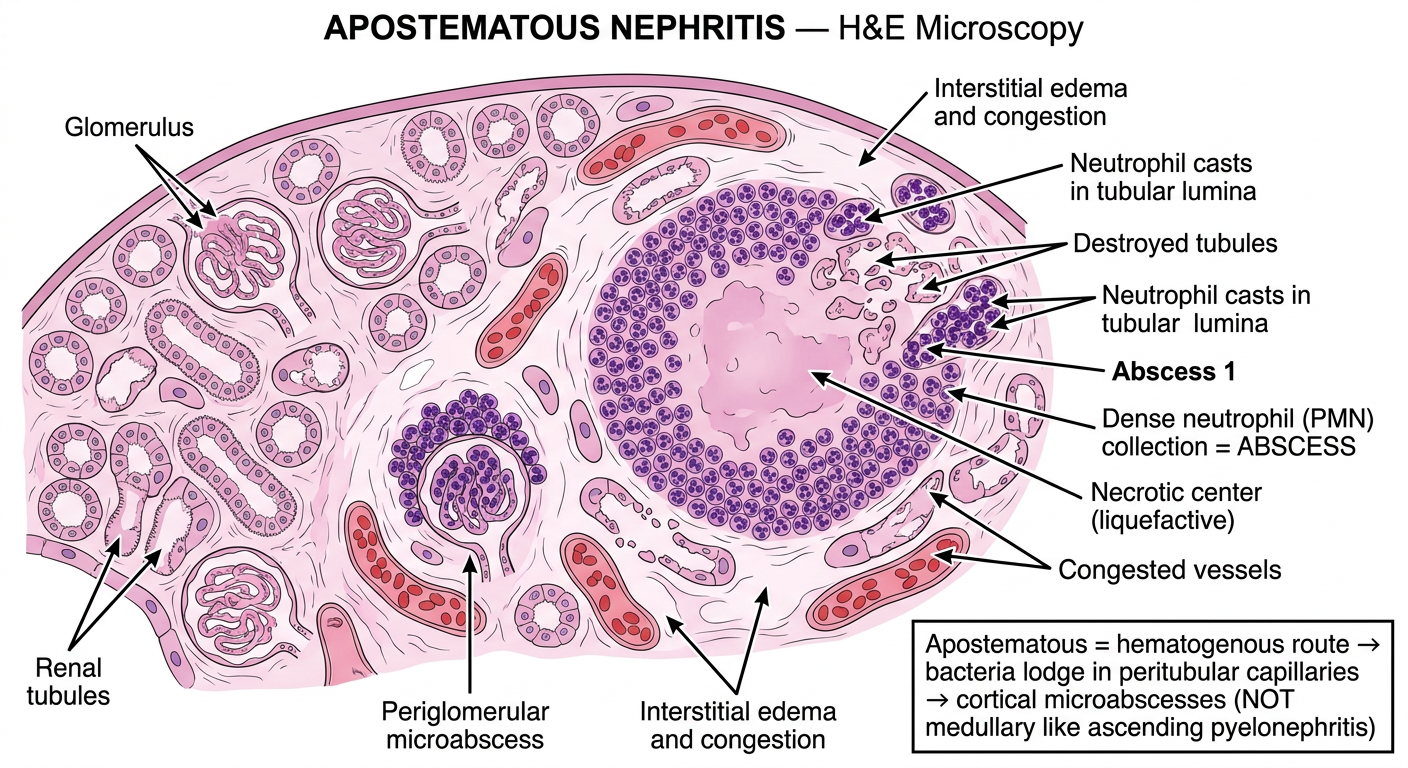
| Feature | Description |
|---|---|
| Multiple microabscesses | Focal collections of neutrophils (PMNs) destroying cortical parenchyma |
| Necrotic center | Pale pink liquefactive necrotic debris at abscess core |
| Neutrophil casts | Tubular lumina packed with neutrophils |
| Periglomerular abscesses | Neutrophils clustering around glomeruli (hematogenous lodging site) |
| Interstitial edema | Pale expanded interstitium between abscesses |
| Route | Hematogenous (blood-borne) → cortex; contrast with ascending pyelonephritis (medullary, collecting ducts) |
2. Cryptococcal Meningitis — H&E
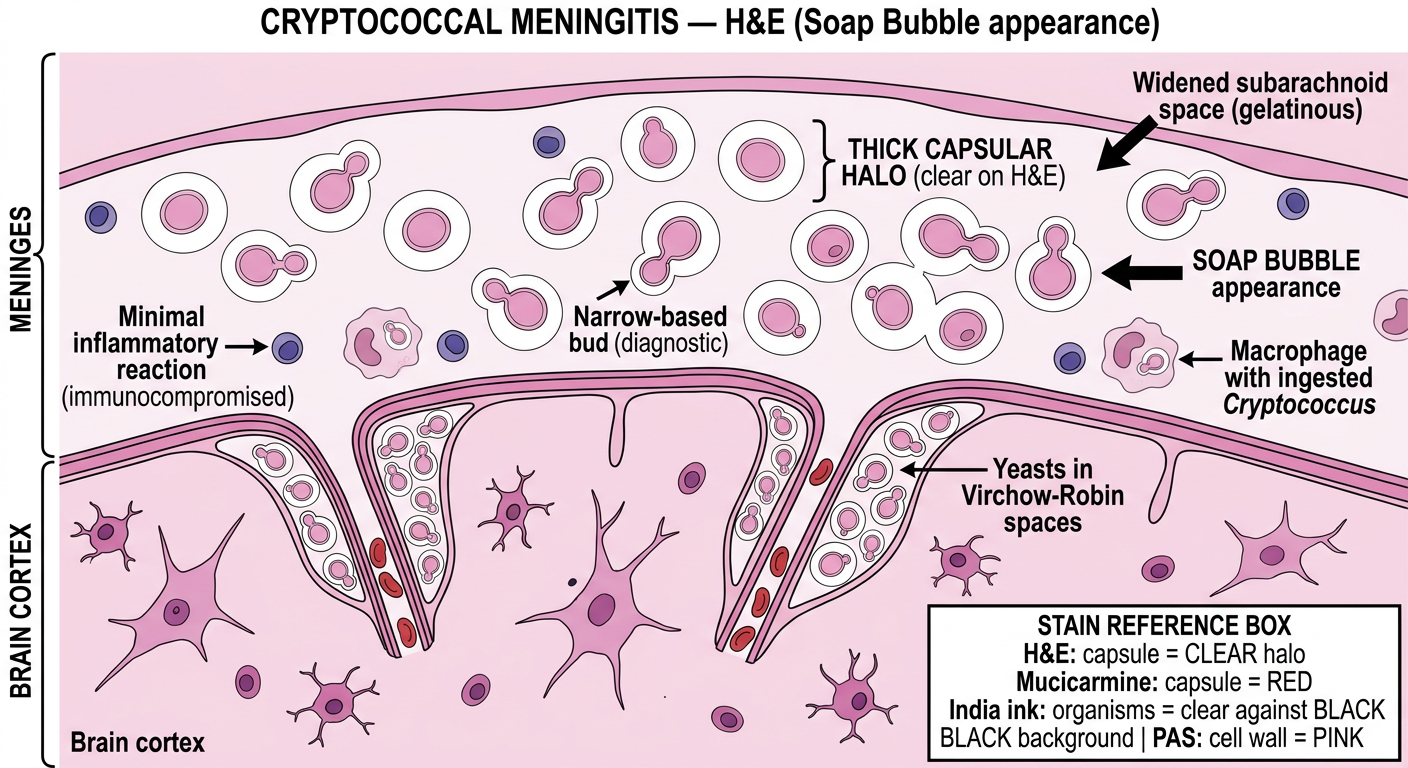
| Feature | Description |
|---|---|
| Soap bubble appearance | Yeasts with large clear capsular halos create Swiss-cheese/soap-bubble pattern in meninges |
| Capsular halo | Thick mucopolysaccharide capsule - CLEAR on H&E (does not stain) |
| Narrow-based budding | Single narrow bud - distinguishes from Blastomyces (broad-based bud) |
| Minimal inflammation | Sparse lymphocytes only - host cannot mount response (immunocompromised) |
| Virchow-Robin spaces | Yeasts track along perivascular spaces into brain |
| Special stains | Mucicarmine = capsule RED; India ink = clear halo on black; PAS = cell wall pink |
3. CMV Pneumonia — H&E
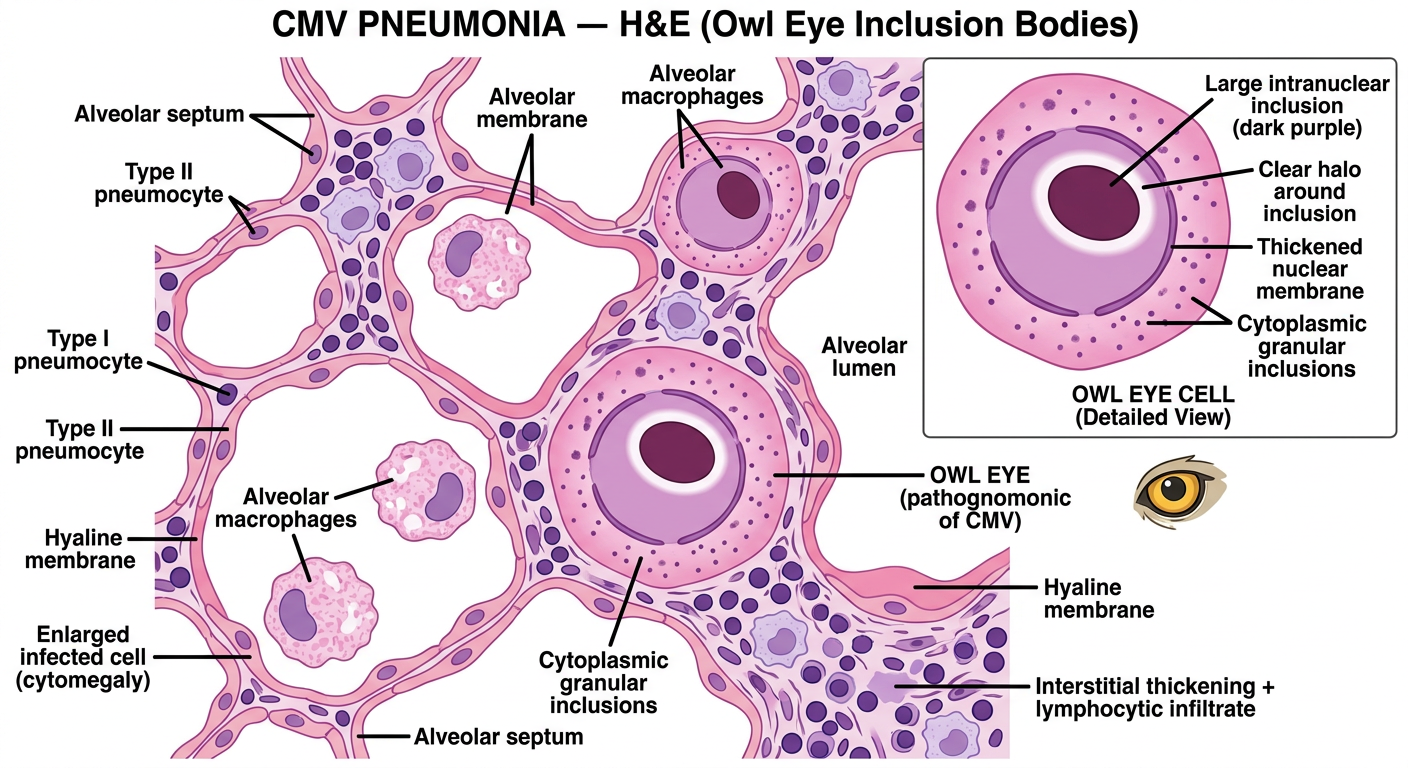
| Feature | Description |
|---|---|
| OWL EYE inclusion | Large single dark purple intranuclear inclusion + clear halo between it and nuclear membrane = PATHOGNOMONIC of CMV |
| Cytomegaly | Infected cell is 2-4x enlarged (hence the name "cytomegalo") |
| Cytoplasmic inclusions | Multiple small granular inclusions in cytoplasm (in addition to the nuclear one) |
| Thickened nuclear membrane | Prominent, pushed to periphery |
| Interstitial pneumonitis | Thickened septa with lymphocyte infiltration |
| Hyaline membranes | Pink homogeneous lining of alveoli (DAD pattern) |
Memory: CMV = Cytomegaly + Multiple inclusions + Virchow-Robin spread (in CNS)
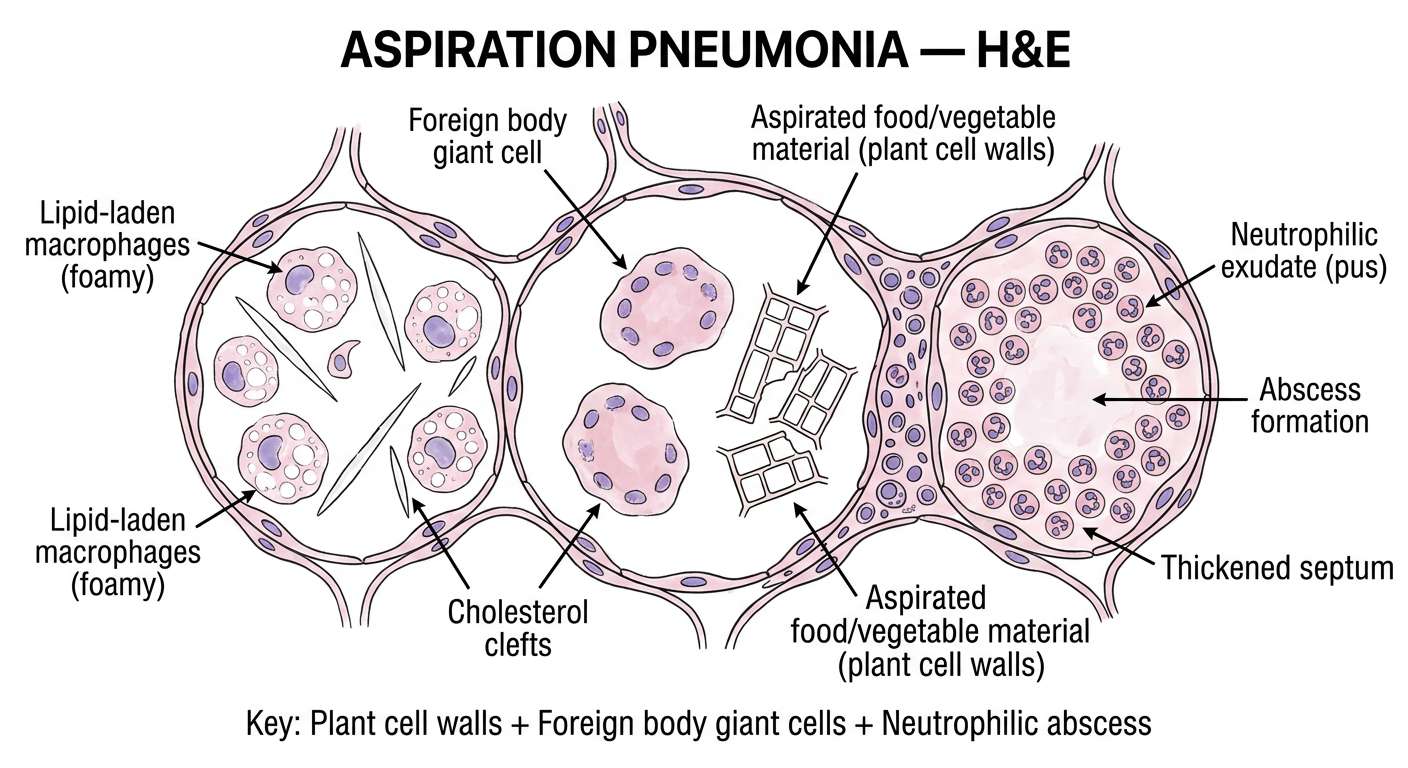
4. Aspiration Pneumonia — H&E
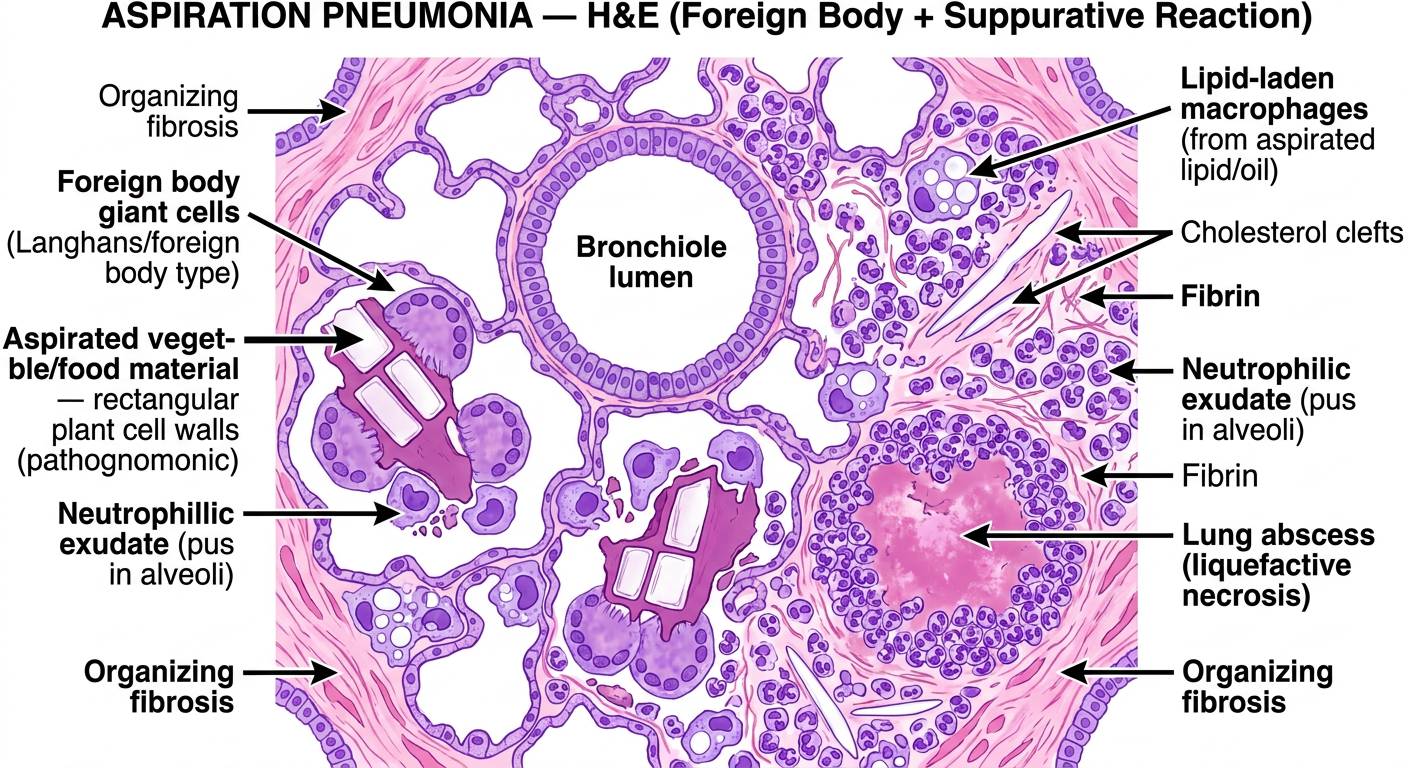
| Feature | Description |
|---|---|
| Plant cell walls | Rectangular clear-walled fragments from aspirated food - PATHOGNOMONIC finding of aspiration |
| Foreign body giant cells | Large multinucleated cells engulfing foreign material (nuclei at periphery) |
| Neutrophilic exudate | Alveoli filled with pus (suppurative pneumonia pattern) |
| Lung abscess | Liquefactive necrotic cavity, common complication |
| Foamy macrophages | Lipid-laden macrophages from aspirated oil/lipid content |
| Cholesterol clefts | Long needle-shaped spaces from dissolved cholesterol crystals |
| Organizing fibrosis | Chronic cases show fibroblast plugs (Masson bodies) and fibrosis |
Classic triad on slide: Plant cell walls + Foreign body giant cells + Neutrophilic abscess = Aspiration
Easy diagram of aspiration pneumonia like in Harsh Mohan
Simple clean medical histology diagram exactly like the hand-drawn schematic illustrations in Harsh Mohan Textbook of Pathology. Black outlines on white background with light H&E color wash (pale pink tissue, purple-blue nuclei). Topic: ASPIRATION PNEUMONIA. Draw a SIMPLE CLEAR SCHEMATIC showing lung alveoli in cross-section: OVERALL LAYOUT - show 6-8 alveolar spaces (oval/round air sacs) with thin walls between them: ALVEOLAR WALLS (septa): - Thin lines representing alveolar walls - Flat type I pneumocytes on walls ALVEOLUS 1 - CENTER (largest, main feature): - Inside the alveolar space: draw 2-3 LARGE MULTINUCLEATED GIANT CELLS (large oval cells with 5-8 nuclei arranged at the periphery/horseshoe pattern) - clearly labeled with arrow: "Foreign body giant cell" - Next to giant cells: draw angular irregular fragments that look like hollow rectangular plant cells (like a grid pattern, empty rectangular boxes) - labeled: "Aspirated food/vegetable material (plant cell walls)" ALVEOLUS 2 (adjacent): - Filled with many small round neutrophils (small circles with dark lobulated nucleus) - labeled: "Neutrophilic exudate (pus)" - One area of central necrosis (pale area) - labeled: "Abscess formation" ALVEOLUS 3: - Large foamy macrophages (cells with bubbly vacuolated cytoplasm) - labeled: "Lipid-laden macrophages (foamy)" - Long thin needle-shaped clear spaces (cholesterol clefts) - labeled: "Cholesterol clefts" ALVEOLAR WALL between alveoli: - Thickened with inflammatory cells - labeled: "Thickened septum" DRAWING STYLE RULES: - Simple black outline drawings on white background - Light pink fill for tissue/cells - Purple-blue for nuclei - Clean neat lines, not photorealistic - Each structure clearly outlined and labeled with a straight line leading to a text label - Labels outside the drawing, connected by straight lines with small arrows - Exactly like a textbook schematic diagram Title at top in bold: "ASPIRATION PNEUMONIA — H&E" Bottom note: "Key: Plant cell walls + Foreign body giant cells + Neutrophilic abscess"
-
Plant cell walls - rectangular hollow grid-like fragments from aspirated food - the most specific finding that tells you it's aspiration
-
Foreign body giant cells - large cells with many nuclei arranged at the periphery (horseshoe pattern), always found surrounding the foreign material
-
Neutrophilic exudate / Abscess - alveoli packed with pus, may progress to frank abscess with liquefactive necrotic center
- Foamy (lipid-laden) macrophages - from aspirated oil/lipid
- Cholesterol clefts - long needle-shaped empty spaces from dissolved cholesterol
- Thickened alveolar septa with organizing fibrosis in chronic cases
Aspiration = Angular plant cells + Abscess + Aggregated giant cells