
Explain the cell cell junction in detail and provide meaning if the word is complicated
Reading File
Now let me search the medical library for cell-cell junctions:
Finding Sources
Finding Sources
Searching Images
cell cell junction tight junction gap junction desmosome diagram
Now let me read the detailed content from the histology textbooks:
Reading File
Reading File
Reading File
Reading File
Reading File
Reading File
Loading Image
Reading File
Loading Image
I now have comprehensive information from the textbooks. Let me compile this into a detailed, beginner-friendly explanation.
Cell-Cell Junctions — A Detailed Guide
What Are Cell-Cell Junctions?
Cells in the body rarely work in isolation. They must stick to each other, communicate, and prevent unwanted substances from leaking between them. Cell-cell junctions are specialized protein structures on the lateral (side) surfaces of cells that serve these purposes. They are especially numerous and prominent in epithelial tissue — the tissue that lines organs, skin, and body cavities.
📖 Junqueira's Basic Histology, p. 200: "Several membrane-associated structures make up junctions providing adhesion and communication between cells. Epithelial cells adhere strongly to neighboring cells and basal laminae, particularly in epithelia subject to friction or other mechanical forces."
Overview Diagram
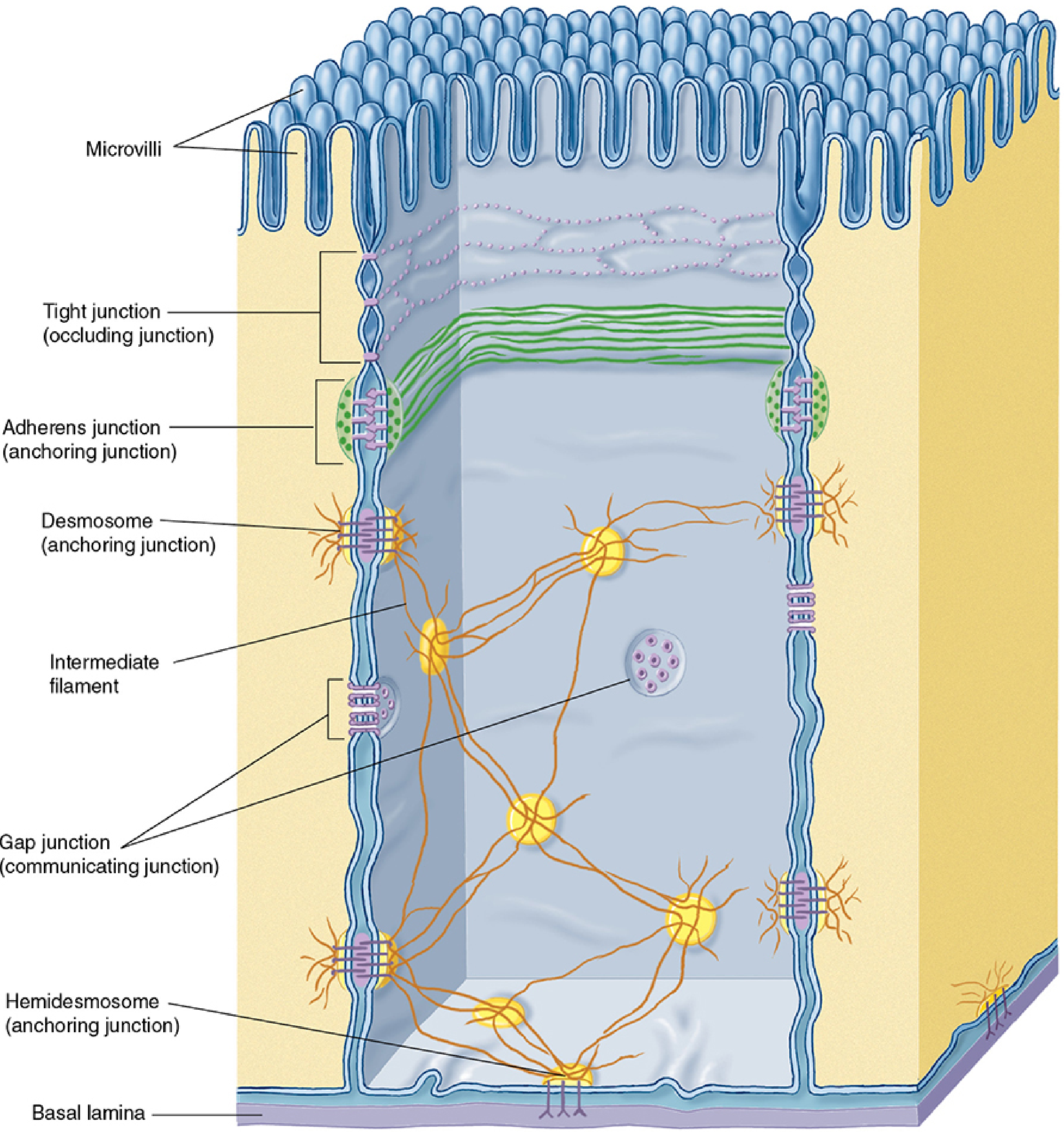
Electron Micrograph of the Junctional Complex
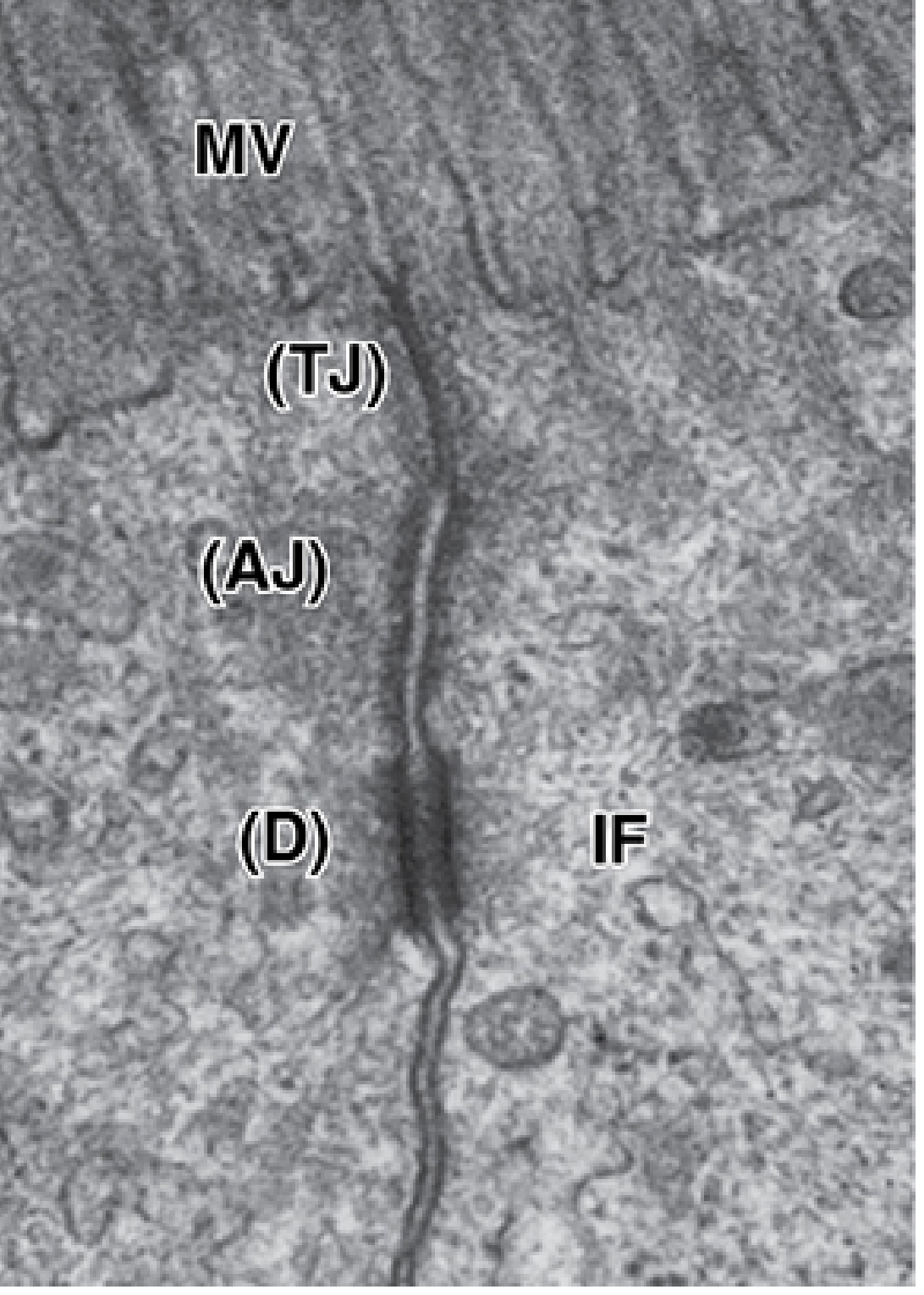
The Four Main Types of Cell-Cell Junctions
There are four main types, organized from top (apical) to bottom (basal) on the lateral surface of epithelial cells:
1. 🔒 Tight Junction (Zonula Occludens)
Word breakdown:
- Zonula (Latin) = "little belt" or "zone" — this junction forms a continuous belt completely encircling the top of the cell
- Occludens (Latin) = "closing/sealing" — it seals the space between cells
What it does
The tight junction acts like a zipper or gasket between neighboring cells. It prevents molecules and ions from slipping through the space between cells (called the paracellular pathway — para = beside, cellular = of the cell).
Structure
- Made of transmembrane proteins called occludins, claudins, and ZO proteins (Zonula Occludens proteins)
- These proteins from one cell interlock with those from the neighboring cell, forming fused sealing strands
- Inside the cell, they connect to actin filaments (thin protein rods that are part of the cell's internal skeleton)
Important roles
- Barrier function: Forces molecules to pass through cells (transcellular path) rather than between them — this allows selective control of what enters or exits a tissue
- Fence function: Prevents membrane proteins on the apical (top) surface from mixing with proteins on the basolateral (bottom/side) surface — maintaining the cell's polarity (different functions on different sides)
Clinical significance
| Condition | Mechanism |
|---|---|
| Blood-brain barrier defects | Defects in occludin proteins compromise the fetal blood-brain barrier → severe neurologic disorders |
| Food poisoning (C. perfringens) | Enterotoxin binds claudins, disrupts tight junction → fluid leaks into intestinal lumen |
| Gastric ulcers (H. pylori) | Bacteria binds tight junction proteins, inserts a protein targeting ZO-1 → disrupts the junction |
📖 Junqueira's Basic Histology, p. 202: "Epithelia with one or very few fused sealing strands (e.g., proximal renal tubule) are more permeable to water and solutes than epithelia with many fused strands (e.g., lining of the urinary bladder)."
2. 🤝 Adherens Junction (Zonula Adherens)
Word breakdown:
- Zonula = "little belt" — also encircles the entire cell like a belt
- Adherens (Latin) = "sticking/adhering" — its job is adhesion (sticking cells together)
What it does
Located just below the tight junction, this junction anchors cells firmly to their neighbors and stabilizes/strengthens the tight junction above it.
Structure
- Main proteins: E-cadherin — "E" stands for epithelial; cadherin comes from "calcium-dependent adhesion"
- E-cadherin is a transmembrane glycoprotein (glyco = sugar-coated, protein = protein molecule, transmembrane = spans across the entire cell membrane)
- The extracellular (outside) part of E-cadherin from one cell binds to E-cadherin from the neighboring cell — only in the presence of Ca²⁺ (calcium ions)
- The intracellular (inside) part binds catenins (catenin from Latin catena = chain), which link to actin filaments
Significance
- The actin filaments linked here form the terminal web — a sheet of actin across the top of the cell
- Loss of E-cadherin in cancer allows tumor cells to break away from each other → promotes invasion and malignancy (this is critical in carcinomas — cancers of epithelial origin)
3. 🔩 Desmosome (Macula Adherens)
Word breakdown:
- Desmosome: from Greek desmos = "binding/chain" + soma = "body"
- Macula (Latin) = "spot" — unlike the belt-like junctions above, this one is a single spot, like a spot-weld or a rivet
What it does
Desmosomes provide very strong, point-like attachments between cells, particularly important in tissues subject to mechanical stress (like skin, heart muscle, and the esophagus).
Structure
- Main proteins: desmogleins and desmocollins — both belong to the cadherin family (calcium-dependent)
- Their cytoplasmic (inside-cell) ends bind plakoglobins → which link to desmoplakins in a dense plaque (a thick plate of proteins anchored to the cell membrane)
- Desmoplakins connect to intermediate filaments — specifically cytokeratins (also called tonofilaments — tono from Greek = tension), which are stronger, rope-like protein cables that run across the entire cell
Why it's special
Unlike the adherens junction (which connects to thin actin filaments), the desmosome connects to intermediate filaments — making it far stronger. The intermediate filaments act like cables running from one cell to the next, distributing mechanical tension across the whole tissue.
Clinical significance
- Pemphigus vulgaris — an autoimmune disease (auto = self, immune = immune system attacking self) where antibodies attack desmoglein proteins → cells lose adhesion → fluid-filled blisters (bullae) form in the skin and oral mucosa
- Genetic mutations in desmosomal proteins also cause blistering skin disorders
4. 📡 Gap Junction (Nexus)
Word breakdown:
- Nexus (Latin) = "link/connection"
- Unlike the others, this junction is not about adhesion — it's about communication
What it does
Gap junctions act as direct channels between neighboring cells, allowing small molecules, ions, and electrical signals to pass from one cell to another without going through the extracellular space.
Structure
- Made of proteins called connexins (connexin = connecting protein)
- Six connexins arrange in a ring to form a connexon — a half-channel (like a hollow tube) that spans one cell's membrane
- Two connexons from neighboring cells align and dock together to form a complete intercellular channel — about 1.5 nm in diameter
- These channels appear in clusters/patches on the cell membrane
What passes through
- Ions (Na⁺, K⁺, Ca²⁺) — enabling electrical signal transmission
- Small metabolites (metabolite = a small molecule involved in cell chemistry)
- Regulatory molecules and second messengers
- Maximum size allowed: molecules up to ~1,000 daltons (small-to-medium sized)
Why this is important
- Heart muscle: Gap junctions at intercalated discs allow electrical impulses to spread rapidly between cardiomyocytes (cardio = heart, myo = muscle, cyte = cell) so all cells contract in synchrony
- Smooth muscle: Coordinates coordinated contractions (e.g., in gut and uterus)
- Nervous tissue: Allows electrical coupling between neurons and glial cells
Clinical significance
- Mutations in connexin 26 (Cx26) and other connexin genes are linked to certain types of hereditary deafness (connexins in the cochlea — inner ear — recycle potassium ions needed for hearing)
- Mutations in connexin 32 are linked to Charcot-Marie-Tooth disease — a peripheral neuropathy (peripheral = outer nerves, neuropathy = nerve disease)
5. 🏗️ Hemidesmosome (Bonus: Cell-Matrix Junction)
Word breakdown:
-
Hemi (Greek) = "half" — it looks like half a desmosome
-
But it anchors cells to the basement membrane (basal lamina) below, not to another cell
-
Made of integrins (integrin = integrating proteins that link the inside of the cell to the outside matrix)
-
Connects intermediate filaments inside the cell to laminin proteins in the basement membrane
-
Mutations in integrin-β4 → epidermolysis bullosa — a severe skin-blistering disease
Summary Table
| Junction | Latin/Greek Name | Shape | Key Proteins | Connects to | Main Function |
|---|---|---|---|---|---|
| Tight junction | Zonula occludens | Belt (ring) | Occludins, claudins, ZO proteins | Actin filaments | Seals paracellular space; maintains cell polarity |
| Adherens junction | Zonula adherens | Belt (ring) | E-cadherin, catenins | Actin filaments | Cell-cell adhesion; stabilizes tight junctions |
| Desmosome | Macula adherens | Spot ("rivet") | Desmogleins, desmocollins, desmoplakins | Intermediate filaments (cytokeratins) | Strong mechanical adhesion |
| Gap junction | Nexus | Patch | Connexins (→ connexons) | None (no cytoskeleton link) | Cell-cell communication (ions, small molecules) |
| Hemidesmosome | — | Spot | Integrins | Intermediate filaments → basal lamina | Cell-matrix adhesion |
How They Work Together
Think of these junctions like different types of fasteners holding two walls together:
- Tight junction = Weather seal around the edge — nothing leaks through the gap
- Adherens junction = Glue along the top edge — holds the walls tightly aligned
- Desmosome = Bolts (rivets) at multiple points — provides extreme tensile strength
- Gap junction = Electrical conduits running through both walls — they communicate with each other
📖 Histology: A Text and Atlas, p. 419: "The lateral domain is characterized by the presence of cell adhesion molecules (CAMs) that form junctional complexes (occluding, anchoring, or communicating junctions) between the apposed lateral domains of neighboring cells."
Key Vocabulary Summary
| Term | Meaning |
|---|---|
| Epithelium | Lining tissue of body surfaces and organs |
| Transmembrane | Protein that spans across the entire cell membrane |
| Paracellular | Through the space between cells |
| Transcellular | Through the inside of a cell |
| CAM | Cell Adhesion Molecule — any protein that helps cells stick together |
| Cadherin | Calcium-dependent adhesion protein |
| Actin filaments | Thin protein rods forming part of the cell's internal skeleton (cytoskeleton) |
| Intermediate filaments | Stronger, rope-like protein cables in the cytoskeleton |
| Connexon | Half-channel made of 6 connexin proteins |
| Autoimmune | Condition where the immune system attacks the body's own tissues |
| Plaque | Dense protein plate on the inside of the cell membrane at a junction |
| Polarity | Having distinct top (apical) and bottom (basolateral) surfaces with different functions |
Sources: Junqueira's Basic Histology (17e), p. 199–207; Histology: A Text and Atlas with Correlated Cell and Molecular Biology, p. 369–420
1 and 3
I want to make sure I give you exactly what you need. You mentioned "1 and 3" — could you clarify what you mean?
Asking for Preferences
What do you mean by '1 and 3'?
I'll take "1 and 3" to mean junction types 1 and 3 from the previous answer — the Tight Junction and the Desmosome — and go much deeper on both.
Finding Sources
Finding Sources
Reading File
Reading File
Reading File
Reading File
Finding Sources
Reading File
Loading Image
Loading Image
Reading File
Loading Image
I have everything needed. Here is a deep-dive on junction types 1 and 3.
1. Tight Junction (Zonula Occludens) — Deep Dive
Word Meaning
- Zonula (Latin) = "little zone/belt" — it wraps around the entire cell like a belt
- Occludens (Latin) = "closing/occluding" — it closes off the space between cells
- Paracellular = para (beside) + cellular (cell) = the space beside/between cells
- Transcellular = trans (across) + cellular = going through the cell
Where It Sits
The tight junction sits at the most apical (top) end of the lateral (side) surface of epithelial cells — right at the border between the top surface and the side surface. It is the first junction you encounter going from the apical surface downward.
Structural Components
The tight junction is made of three main groups of proteins:
1. Claudins
- The word comes from Latin claudere = "to close/shut"
- They are the backbone of the tight junction
- Each claudin has four transmembrane domains — meaning it weaves in and out of the cell membrane four times, like a snake
- The extracellular (outside-the-cell) loops of claudins from one cell reach across and interact with claudins from the neighboring cell, locking them together like a zipper
- There are at least 27 different claudin types (claudin-1, 2, 3, 4, 5, etc.), each with different permeability properties
- Claudin-2 forms water/ion channels — it makes junctions leaky (found in the proximal kidney tubule, which must reabsorb a lot of fluid)
- Claudin-5 makes the blood-brain barrier extremely tight
2. Occludin
- From Latin occludere = "to block/shut"
- Also has four transmembrane domains, like claudin
- Attaches to the ZO proteins (see below) inside the cell
- Acts as a regulator — when occludin is internalized (pulled into the cell), the junction becomes more permeable (this is how TNF-α — a protein made during inflammation — causes diarrhea by loosening gut tight junctions)
3. ZO Proteins (Zonula Occludens proteins: ZO-1, ZO-2, ZO-3)
- These are scaffolding proteins (scaffold = a support structure) — they sit on the inside of the cell membrane (not transmembrane)
- ZO-1 tethers the claudins and occludins to actin filaments inside the cell, anchoring the junction to the cytoskeleton (cyto = cell, skeleton = internal framework)
- They also act as signaling hubs — passing messages from the junction into the cell
4. Junctional Adhesion Molecules (JAMs)
- Single-pass transmembrane proteins (cross the membrane once)
- Help in the initial assembly of the tight junction and in cell migration
How It Works: Two Pathways Through the Tight Junction
The tight junction is not completely impermeable — it has two pathways for selective movement of molecules:
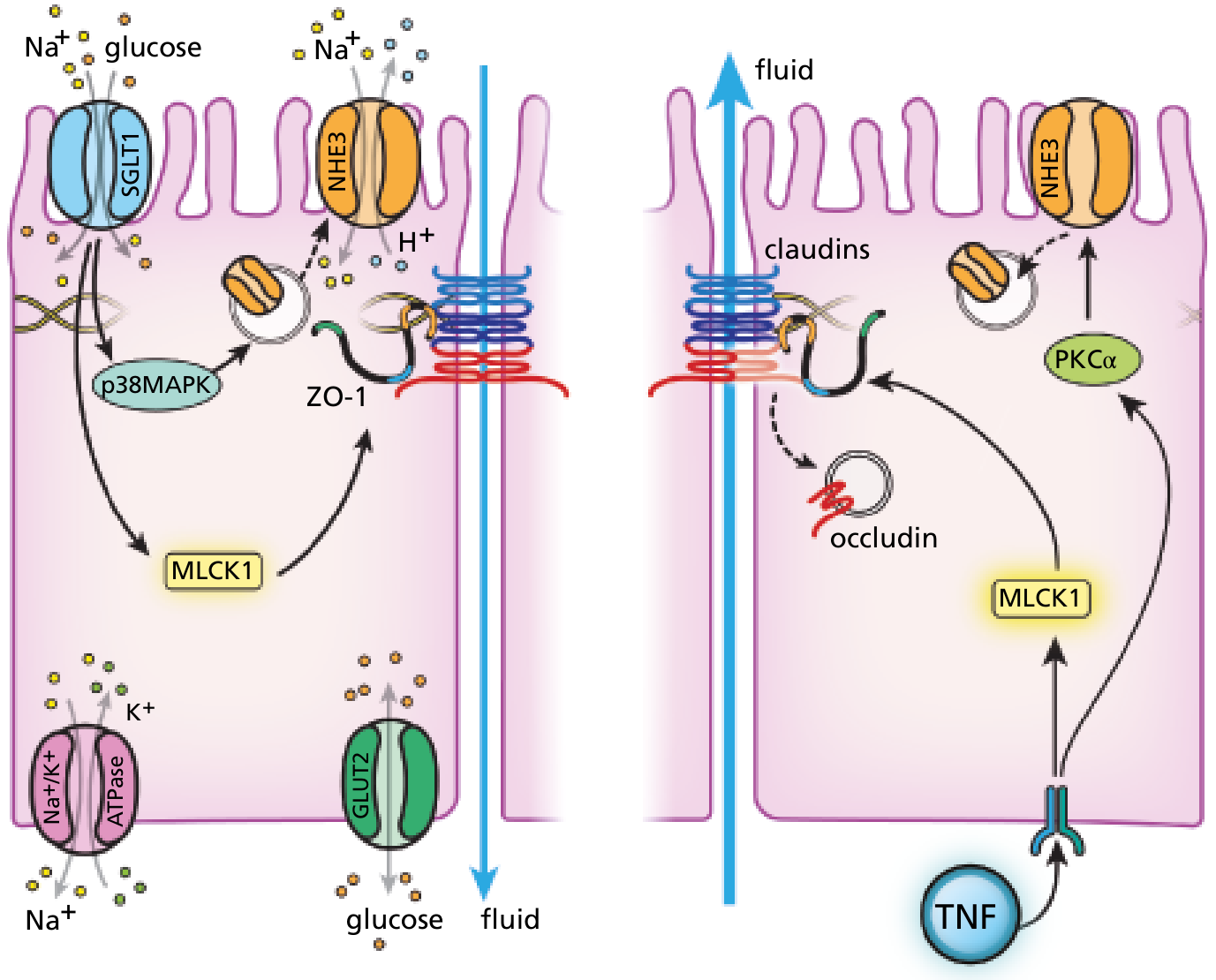
| Pathway | Size | Selectivity | Example |
|---|---|---|---|
| Pore pathway | Up to ~8 Ångströms (very small) | Size- and charge-selective | Ion transport in kidney; controlled by claudin-2 |
| Leak pathway | Up to ~125 Ångströms (larger) | Relatively non-selective | Macromolecule passage during inflammation |
Ångström (Å) = one ten-billionth of a metre — an extremely small unit used to measure atoms and molecules.
The "Fence" Function
The tight junction also acts as a fence inside the membrane itself. It stops lipids (fats) and proteins from freely diffusing between the apical (top) and basolateral (bottom + sides) membrane regions. This maintains cell polarity:
- Apical surface = faces the lumen (inside of organ) — has receptors for nutrient absorption (e.g., SGLT1 for glucose uptake)
- Basolateral surface = faces the bloodstream — has different transporters (e.g., GLUT2, Na⁺/K⁺-ATPase)
Without this fence, these proteins would freely mix and the cell would lose directional transport.
Where Tight Junctions Are Found (and How "Tight" They Are)
The tightness varies by tissue — measured by transepithelial resistance (TER):
| Tissue | Tight Junction Tightness | Reason |
|---|---|---|
| Urinary bladder | Very tight (many claudin strands) | Must hold concentrated urine without leaking |
| Blood-brain barrier | Extremely tight (claudin-5, occludin) | Protects the brain from harmful blood substances |
| Skin epidermis | Tight (claudin-1, occludin) | Prevents water loss and pathogen entry |
| Proximal kidney tubule | Leaky (claudin-2 forms channels) | Must reabsorb large amounts of water and ions |
| Intestinal epithelium | Moderate | Absorbs nutrients while preventing pathogens |
Tight Junction in the Blood-Brain Barrier (BBB)
📖 Bradley and Daroff's Neurology, p. 1843: "Zona occludins tether the tight-junction proteins to actin within the endothelial cells; occludin and claudin form the actual tight junctions within the endothelial clefts. Occludin attaches to the zona occludins, while claudins attach to occludin and protrude into the clefts between cells. The extracellular tails of claudins from adjacent cells self-assemble to form the tight junctions that are 'zip-locked' together."
- In ischemic stroke (brain tissue death from blocked blood supply), tight junction proteins are degraded → BBB breaks down → fluid and immune cells flood the brain → worsens injury
Clinical Diseases of Tight Junctions
| Disease | Protein Affected | What Happens |
|---|---|---|
| Food poisoning (Clostridium perfringens) | Claudins | Bacterial toxin binds claudins → disrupts junction → fluid leaks into gut → diarrhea |
| Gastric ulcer (H. pylori) | ZO-1 | Bacterium inserts a protein that disrupts ZO-1 signaling → junction breaks down |
| Inflammatory bowel disease (IBD) | Multiple | TNF-α triggers occludin endocytosis and MLCK1 activation → leaky gut |
| Neonatal neurologic disorders | Occludin | Defects in occludin compromise the fetal BBB |
| Celiac disease | Tight junction proteins (ZO-1, claudin-1, occludin) | mRNA levels of these proteins are reduced → increased permeability → gluten peptides enter bloodstream |
3. Desmosome (Macula Adherens) — Deep Dive
Word Meaning
- Desmosome: desmos (Greek) = "binding/chain" + soma (Greek) = "body" → "binding body"
- Macula (Latin) = "spot/stain" → it looks like a spot or rivet, not a belt
- Adherens (Latin) = "sticking" → it's an anchoring junction
What Makes It Unique
Unlike the tight junction (a belt) or adherens junction (also a belt), the desmosome is a spot-like structure — scattered like rivets across the lateral cell surface. It is the strongest anchoring junction in the body, designed to handle extreme mechanical stress.
📖 Fitzpatrick's Dermatology, p. 263: "This scaffolding is critical to stabilize epithelia in the face of shear stress or external trauma. Early morphologic studies led to the perception of the desmosome as a 'spot weld' functioning only to maintain intercellular adhesion."
Electron Micrograph + Diagram
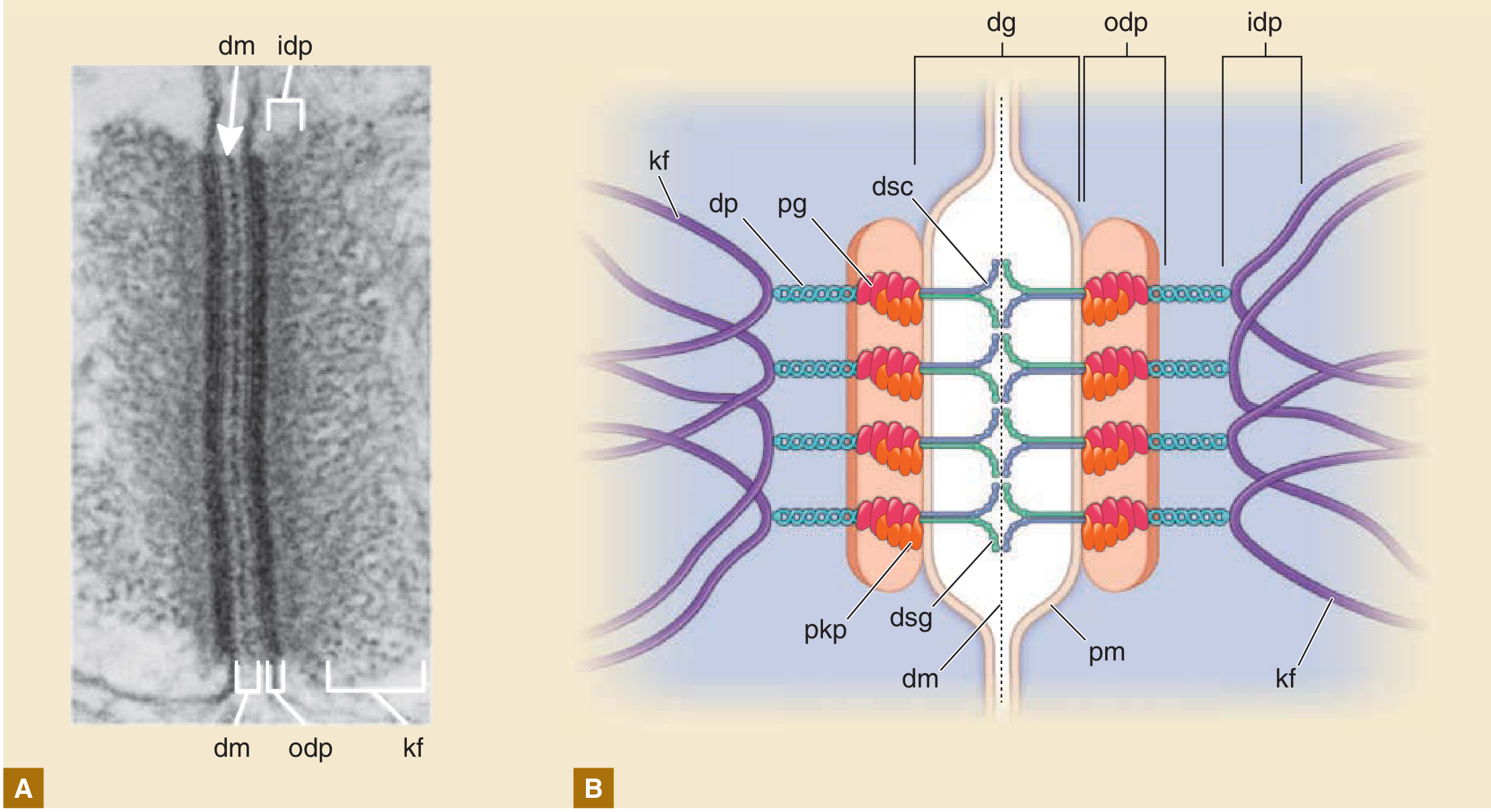
Labels explained:
| Abbreviation | Full Name | Meaning |
|---|---|---|
| dg | Desmoglea | Extracellular space between the two cells (filled with cadherin interactions) |
| dm | Dense midline | The central dark line where the cadherins from both cells meet |
| odp | Outer dense plaque | Protein plate just inside the membrane (contains plakoglobin + plakophilin) |
| idp | Inner dense plaque | Deeper protein plate (contains desmoplakin) |
| pm | Plasma membrane | The cell's outer membrane |
| dsg | Desmoglein | Cadherin-type transmembrane adhesion protein |
| dsc | Desmocollin | The other cadherin-type adhesion protein |
| pg | Plakoglobin | Adaptor/linker protein (armadillo family) |
| pkp | Plakophilin | Adaptor/linker protein (armadillo family) |
| dp | Desmoplakin | Large anchor protein that connects plaques to keratin filaments |
| kf | Keratin filaments | Intermediate filaments (the "cables") inside the cell |
Three Layers of Desmosomal Proteins
The desmosome has three major protein families:
Layer 1 — Desmosomal Cadherins (the transmembrane proteins)
These are the proteins that actually cross the cell membrane and grip onto the neighboring cell.
Desmoglein (Dsg):
- 4 types in humans: Dsg1, Dsg2, Dsg3, Dsg4
- The extracellular part has 4 cadherin repeat domains, each separated by a calcium-binding motif — calcium (Ca²⁺) is required for adhesion
- In skin: Dsg1 is at the top (superficial) layers, Dsg3 is at the bottom (basal) layers
Desmocollin (Dsc):
- 3 types: Dsc1, Dsc2, Dsc3
- Works together with desmogleins — they form both homophilic (same protein binding to same) and heterophilic (different proteins binding each other) interactions
- Homophilic = homo (same) + philic (loving)
- Heterophilic = hetero (different) + philic (loving)
- Has "a" and "b" isoforms — the "a" form can interact with intracellular adapter proteins
Layer 2 — Armadillo Family Proteins (the adaptor proteins inside the cell)
Armadillo refers to a protein domain that looks like armadillo plates — a repeated structural motif.
Plakoglobin:
- Closely related to β-catenin (the adaptor in adherens junctions)
- Sits in the outer dense plaque (~20 nm from membrane)
- Binds the cytoplasmic tails of desmoglein and desmocollin
Plakophilin (PKP):
- 3 types: PKP1, PKP2, PKP3
- Also sits in the outer dense plaque (~10 nm from membrane)
- PKP2 is the only plakophilin in heart muscle — mutations cause arrhythmogenic cardiomyopathy (arrhythmia = irregular heartbeat, cardiomyopathy = disease of heart muscle)
Layer 3 — Plakins (the linkers to intermediate filaments)
Desmoplakin:
- The largest desmosomal protein
- Its amino-terminal (head) end sits in the inner dense plaque (~40–50 nm from membrane) — connecting to plakoglobin and plakophilin
- Its carboxyl-terminal (tail) end grips the keratin intermediate filaments (also called tonofilaments — tono = tension)
- This creates a continuous mechanical highway: keratin cables → desmoplakin → plakoglobin/plakophilin → desmogleins → across desmoglea → neighboring cell's desmogleins
Expression Pattern in Skin — Why It Matters
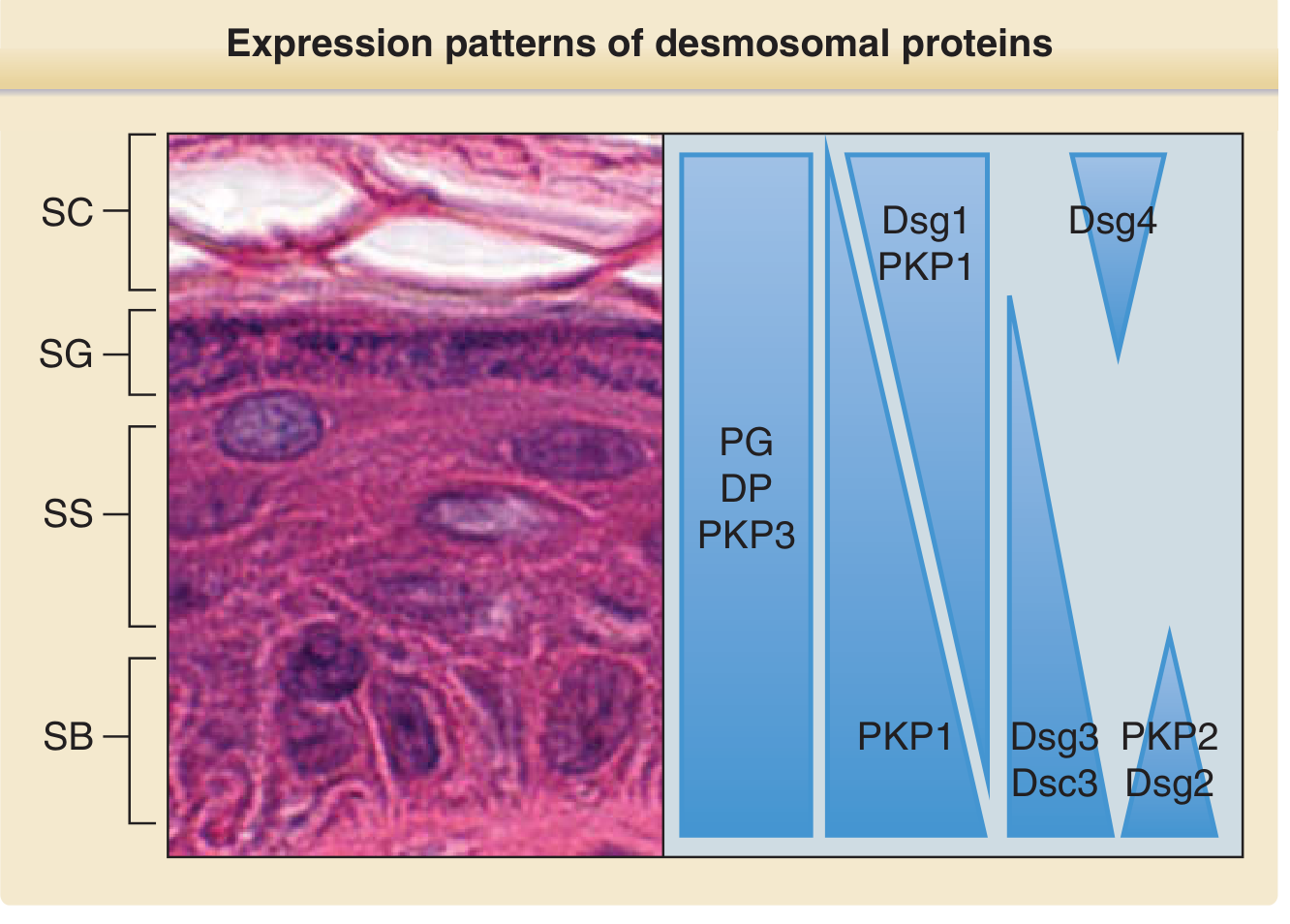
- Dsg1: Mostly in superficial layers (SG, SS)
- Dsg3: Mostly in deep layers (SB, lower SS)
- This difference in location explains exactly where blisters form in different diseases (see below)
Clinical Diseases of Desmosomes
A. Pemphigus — Autoimmune Blistering Disease
Autoimmune = auto (self) + immune (immune system) — the body attacks its own proteins.
📖 Robbins & Cotran Pathologic Basis of Disease: "All forms of pemphigus are autoimmune diseases caused by IgG autoantibodies against desmogleins that disrupt desmosome integrity and result in the formation of blisters."
IgG autoantibodies = Immunoglobulin G antibodies (the main blood-circulating antibody type) that are directed against the body's own proteins.
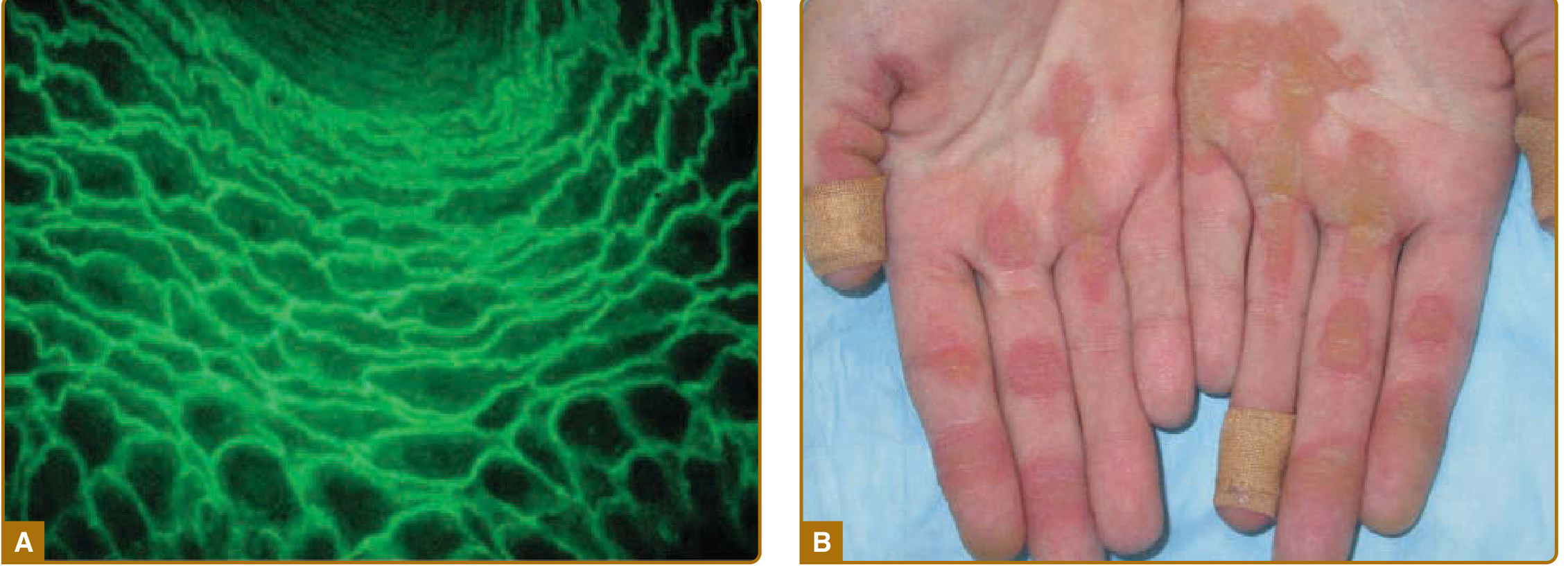
Pemphigus Vulgaris (PV)
- Target: Dsg3 (primarily) ± Dsg1
- Location of blisters: Just above the basal layer (where Dsg3 is expressed) — called suprabasal blistering
- The single intact layer of basal cells at the blister base looks like "a row of tombstones" under the microscope
- Acantholysis (acantho = thorn/spine, lysis = dissolution) = the breaking apart of cells — cells lose their polyhedral shape, round up, and float apart
- Direct immunofluorescence (immuno = immune, fluorescence = glowing under UV light): Shows characteristic net-like IgG deposits at all levels of the epidermis
Pemphigus Foliaceus (PF)
- Target: Dsg1 only
- Location: Superficial epidermis (stratum granulosum — where Dsg1 is concentrated) → very shallow blisters that break easily into crusts
- Less severe than PV because Dsg3 is intact in the deeper layers
B. Infectious Diseases Targeting Desmosomes
| Disease | Cause | Mechanism |
|---|---|---|
| Bullous impetigo | Staphylococcus aureus (bacteria) | Exfoliative toxin (exfoliatin) cleaves Dsg1 between extracellular domains 3 and 4 → blisters in superficial skin |
| Staphylococcal scalded skin syndrome | S. aureus (systemic infection) | Same toxin spreads via bloodstream → widespread Dsg1 cleavage → skin peels off in sheets |
C. Genetic (Inherited) Desmosomal Diseases
| Disease | Protein Mutated | Effect |
|---|---|---|
| Striate palmoplantar keratoderma | Dsg1 or desmoplakin | Haploinsufficiency (haplo = one copy, insufficiency = not enough) → thickened skin at palm/sole friction points |
| Arrhythmogenic right ventricular cardiomyopathy (ARVC) | Desmoplakin, plakophilin-2, Dsg2 | Desmosomes in heart fail → myocytes detach and die → replaced by fat/fibrous tissue → arrhythmias |
| Epidermolysis bullosa (some forms) | Plakophilin-1 | Skin blisters with minor trauma |
| Woolly hair + palmoplantar keratoderma | Desmoplakin | Structural heart disease + abnormal hair + thickened skin |
Comparison: Tight Junction vs. Desmosome
| Feature | Tight Junction | Desmosome |
|---|---|---|
| Shape | Continuous belt | Spot/rivet |
| Location | Most apical — top edge | Scattered along lateral surface |
| Main proteins | Claudins, occludin, ZO-1 | Desmogleins, desmocollins, desmoplakin |
| Calcium needed? | No | Yes (cadherins are Ca²⁺-dependent) |
| Cytoskeleton linked | Actin filaments (thin, dynamic) | Keratin intermediate filaments (thick, strong) |
| Primary function | Seal — blocks paracellular leakage | Rivet — mechanical strength |
| Also acts as | Fence — maintains cell polarity | Signaling hub — controls gene expression |
| Disease when broken | Leaky gut, BBB failure, food poisoning | Pemphigus, scalded skin syndrome, heart arrhythmias |
Sources: Junqueira's Basic Histology (17e); Fitzpatrick's Dermatology (Vols. 1–2); Dermatology 2-Volume Set (5e); Robbins & Cotran Pathologic Basis of Disease; Bradley and Daroff's Neurology in Clinical Practice; Yamada's Textbook of Gastroenterology (7e)
This is a shared conversation. Sign in to Orris to start your own chat.