

IMG_20260613_182941121_HDR.jpg
Diagnosis it and give mangement
Reading File
The image shows a markedly distended abdomen in a dark-skinned female patient with overlying hyperpigmented, lichenified, and scaly skin changes - suggesting longstanding ascites with chronic skin changes from stretching and possible venous congestion.
Searching sources...
Finding Sources
Finding Sources
Searching PubMed
ascites management guidelines
Finding Sources
Finding Sources
Reading File
Reading File
Now let me fetch the SAAG diagnostic algorithm image and get information on causes of ascites:
Loading Image
Finding Sources
I now have comprehensive information to provide a full clinical answer. Here is my complete response:
Clinical Diagnosis: Massive Ascites
The image shows a markedly distended, globular abdomen in a female patient with overlying skin changes including hyperpigmentation, lichenification, and fine scaling - consistent with massive ascites with chronic skin stretching. The umbilicus appears flattened/everted. These are classic features of longstanding, large-volume peritoneal fluid accumulation.
Differential Diagnosis
The three leading causes of ascites, in order of frequency, are:
| Cause | Frequency |
|---|---|
| Cirrhosis (hepatic portal hypertension) | ~85% |
| Peritoneal malignancy | ~7% |
| Cardiac failure | ~3% |
| Nephrotic syndrome, TB peritonitis, pancreatitis | Remainder |
In this patient (African female with bangles/context suggesting South Asia/sub-Saharan Africa), the most likely diagnoses are cirrhosis (alcoholic, viral hepatitis B/C, or NASH) or malignant ascites (ovarian, hepatic, or peritoneal carcinoma).
Workup - Key First Step: Diagnostic Paracentesis
Perform diagnostic paracentesis immediately and send fluid for:
- Cell count + differential (WBC >250 PMN/mm³ = spontaneous bacterial peritonitis, SBP)
- Albumin (to calculate SAAG - serum-ascites albumin gradient)
- Total protein
- Culture (blood culture bottles at bedside)
- Cytology (if malignancy suspected)
- Glucose, LDH
- ADA (adenosine deaminase) if TB suspected
SAAG Interpretation (Diagnostic Algorithm):
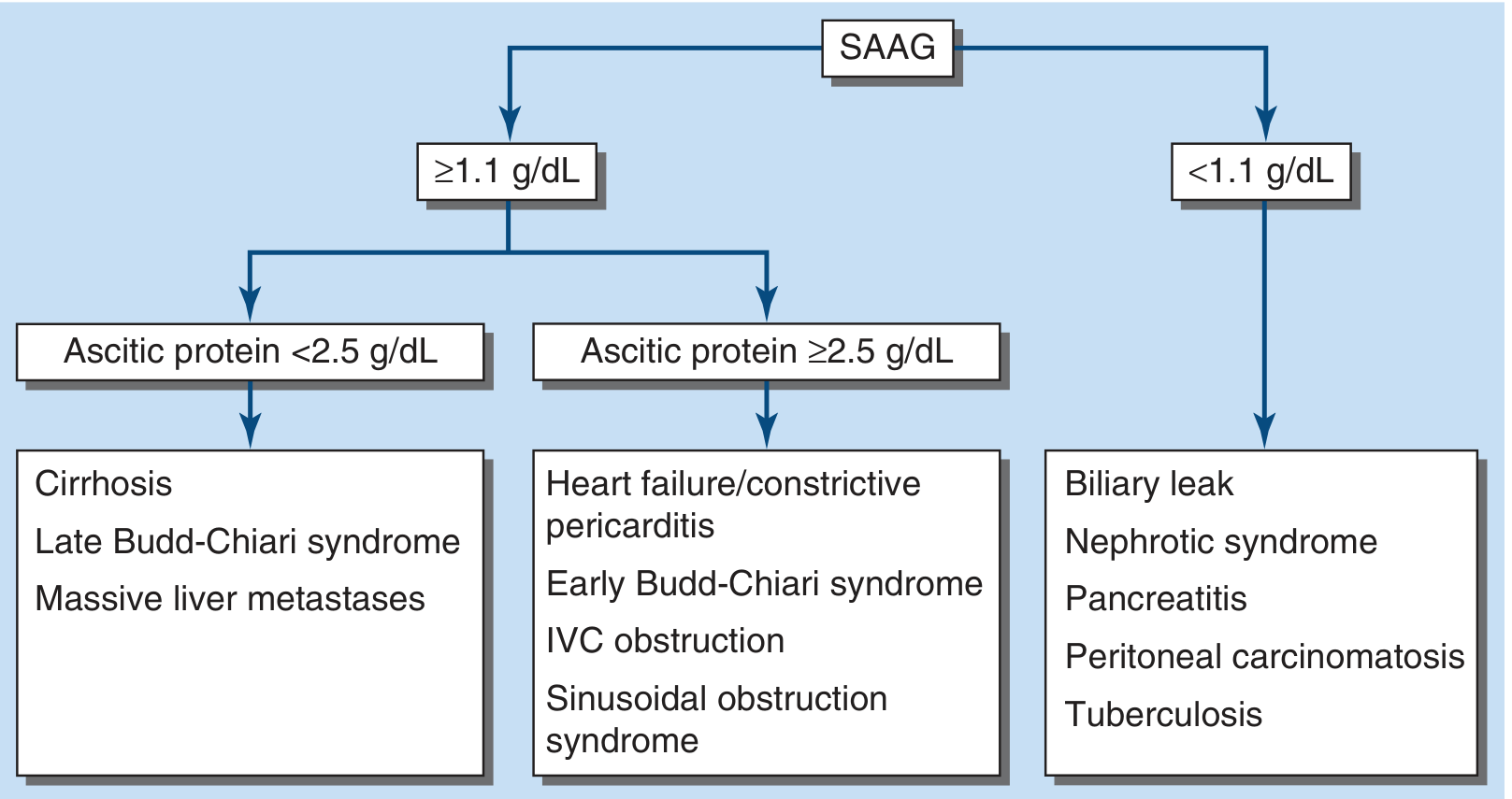
- SAAG ≥ 1.1 g/dL = portal hypertension (cirrhosis, cardiac failure, Budd-Chiari)
- SAAG < 1.1 g/dL = non-portal hypertension cause (TB, malignancy, nephrotic syndrome, pancreatitis)
(SAAG = serum albumin - ascitic fluid albumin)
Blood/Imaging Investigations
- LFTs, albumin, PT/INR, CBC (liver disease markers)
- Hepatitis B surface Ag, anti-HCV (viral hepatitis)
- Serum AFP (hepatocellular carcinoma)
- CA-125 (ovarian malignancy in women)
- Renal function panel, urine protein (nephrotic syndrome)
- Chest X-ray (pleural effusion, TB)
- Abdominal ultrasound / CT abdomen - confirm ascites, liver morphology, splenomegaly, portal vein, masses, lymphadenopathy
Management
Step 1 - Immediate (if SBP suspected or confirmed)
- IV Cefotaxime 2g q8h (or Ceftriaxone 1g daily) for 5-7 days
- IV Albumin 1.5 g/kg at diagnosis and 1 g/kg on day 3 to prevent hepatorenal syndrome
Step 2 - Medical Management of Ascites (Cirrhosis)
Sodium restriction: 2 g (88 mmol) per day - do NOT restrict more aggressively as it compromises nutrition.
Diuretics (first-line combination):
- Spironolactone 100 mg/day (aldosterone antagonist, first-line) - titrate every 3-4 days up to 400 mg/day max
- Furosemide 40 mg/day combined with spironolactone in a 40:100 ratio (furosemide:spironolactone), titrated up to 160 mg/day
- Target weight loss: 1 kg in first week, then 0.5 kg/day max (without edema) or 1 kg/day max (with peripheral edema)
Monitoring during diuretics:
- Renal function, electrolytes (watch for hyponatremia, hyperkalemia)
- If painful gynecomastia with spironolactone → switch to amiloride 5-40 mg/day
- Avoid NSAIDs, ACE inhibitors, ARBs
Long-term albumin (PILOT trial evidence):
- Adding albumin 40 g twice weekly x 2 weeks, then 40 g weekly to spironolactone + furosemide significantly reduces recurrent ascites and improves 18-month survival.
Step 3 - Refractory Ascites (10-20% of patients)
Defined as ascites not mobilized by sodium restriction + maximum diuretics, or diuretic side effects prevent max dosing.
| Option | Details |
|---|---|
| Large-Volume Paracentesis (LVP) | Remove all/most fluid; give IV albumin 6-8 g/L of fluid removed (especially >5L) to prevent post-paracentesis circulatory dysfunction |
| Midodrine (α1-agonist) | 7.5-12.5 mg TID - counters splanchnic vasodilation, improves diuretic response |
| TIPS (Transjugular Intrahepatic Portosystemic Shunt) | Superior to LVP for preventing recurrence; higher encephalopathy risk; PTFE-covered TIPS improves survival if LVP >twice/month |
| Peritoneovenous shunt | For patients not candidates for TIPS or transplant |
Note: Beta-blockers should be used cautiously - their use in refractory ascites may be associated with decreased survival.
Step 4 - Definitive Treatment
- Liver transplantation - refer early; ascites is a marker for decompensated cirrhosis (1-year survival ~50% without transplant)
- Treat underlying cause: antivirals for HBV/HCV, alcohol cessation, treat malignancy if present
Summary
| Domain | Action |
|---|---|
| Diagnosis | Diagnostic paracentesis + SAAG + cytology |
| Imaging | Abdo USS/CT |
| Labs | LFTs, viral hepatitis, AFP, CA-125, renal panel |
| Medical Rx | Sodium restriction + spironolactone + furosemide |
| Rescue | LVP + albumin if refractory |
| Escalation | TIPS or transplant referral |
Sources: Harrison's Principles of Internal Medicine 22E (2025), Goldman-Cecil Medicine; EASL Clinical Practice Guidelines on TIPS [PMID: 40180845]; AGA Practice Update on Vasoactive Drugs and Albumin in Cirrhosis [PMID: 37978969]
⚠️ Disclaimer: This is a clinical educational response. Actual patient management must be performed by a qualified physician after direct examination and investigation.
This is a shared conversation. Sign in to Orris to start your own chat.