
postgraduate internal medicine ppt for residents on seizures and epilepsy include AED drug classes, indications, escalation, doses and titration make it detailed
epilepsy AND antiseizure medication
NICE epilepsy guideline antiseizure medication monotherapy add on 2025 adults
~/
https://www.nice.org.uk/guidance/ng217/chapter/5-Treating-ep…
adult epilepsy seizure classification focal onset versus generalized onset clinical diagram
electroencephalogram focal onset seizure generalized spike wave epilepsy
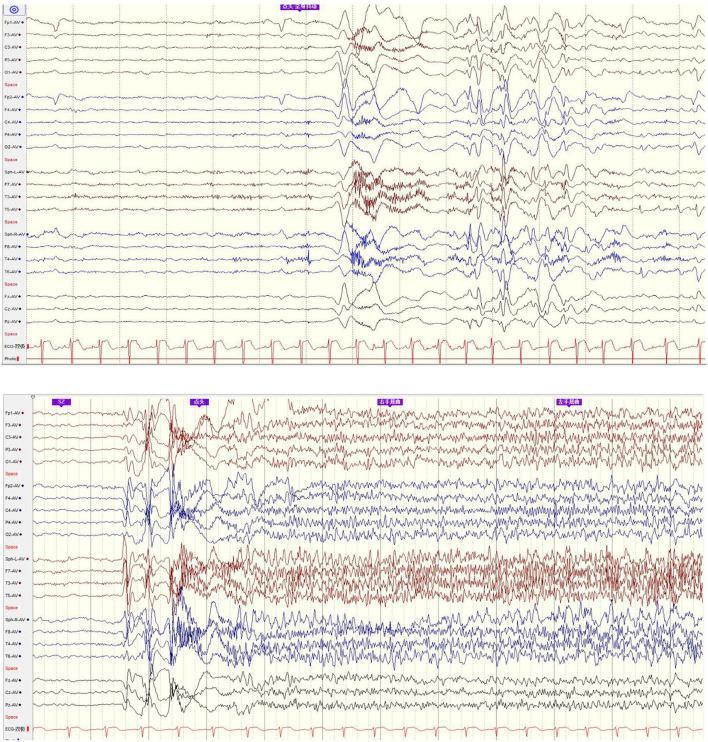
Two multi-channel electroencephalogram (EEG) tracings demonstrating the onset of different seizure types in a patient with Lennox-Gastaut syndrome (LGS). The top segment depicts an epileptic spasm, characterized by a sudden burst of high-amplitude, generalized slow waves followed by relative background suppression and lower-amplitude activity. The bottom segment shows a tonic seizure onset, featuring a transition from interictal slow spike-wave (SSW) complexes to generalized paroxysmal fast activity (GPFA). This generalized activity consists of sustained, high-frequency, rhythmic discharges appearing across all recording channels with minimal localization value. Both segments include an ECG rhythm strip at the bottom for monitoring cardiac synchrony. The images serve as diagnostic examples of the complex ictal patterns associated with refractory epilepsy and encephalopathy, highlighting the transition from intermittent focal-like events to generalized, persistent abnormal cortical discharges.
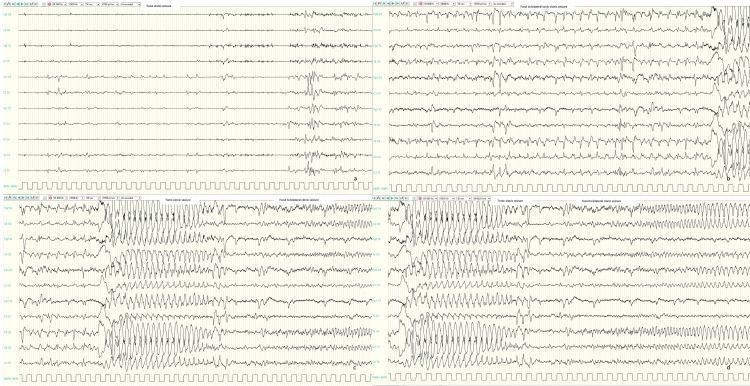
This diagnostic image displays four panels (a–d) of neonatal ictal electroencephalogram (EEG) recordings demonstrating the progression of seizure activity. Panel (a) shows the initial ictal state with focal repetitive sharp waves localized to the left central region, clinically correlating with a focal clonic seizure. Panel (b) illustrates the evolution toward focal to bilateral involvement, characterized by repetitive sharp waves emerging in the centro-temporal regions, notably on the right hemisphere. Panels (c) and (d) represent the secondary generalization of the seizure, featuring high-amplitude, rhythmic spike-and-slow-wave discharges across all channels. The waveforms exhibit a distinct temporal evolution in frequency and morphology, transitioning from discrete focal sharp waves to a continuous, generalized discharge pattern typical of a focal to bilateral tonic-clonic seizure. These EEG findings are significant in the context of intractable neonatal epilepsy and are used for localizing seizure onset and monitoring the efficacy of antiepileptic therapy.
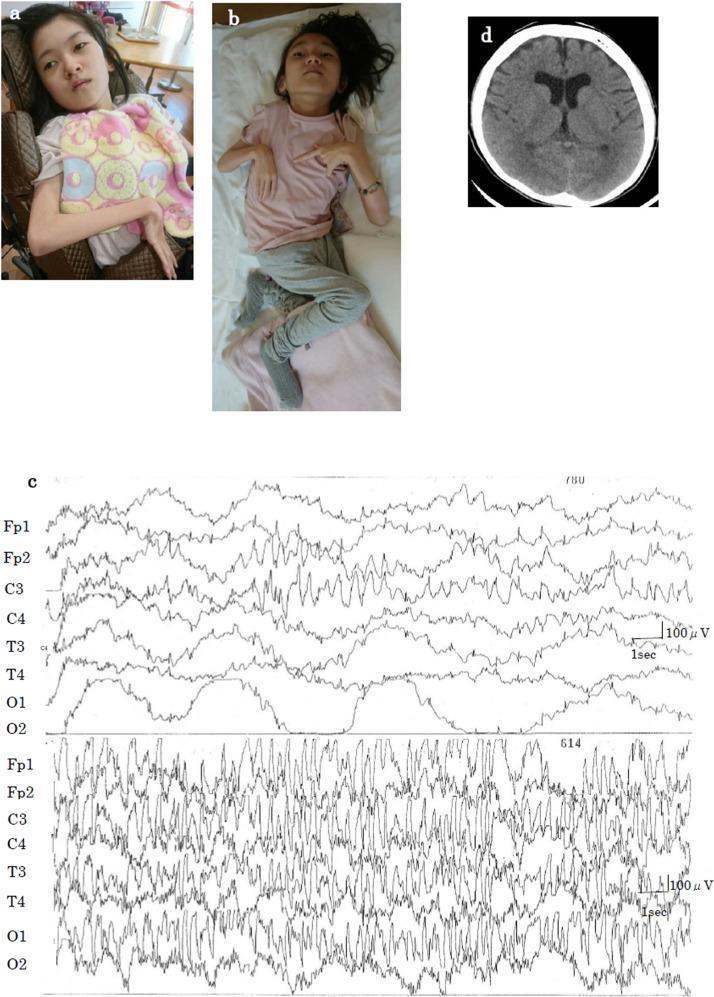
A multi-panel medical figure documenting the clinical presentation and neuroimaging of a pediatric patient with an epileptic encephalopathy. Panels (a) and (b) are clinical photographs showing a female patient with no distinct dysmorphic facial features. She exhibits physical signs of severe psychomotor delay and hypertonia, characterized by a recumbent, bedridden posture and contracted limb positioning. Panel (c) displays an electroencephalogram (EEG) tracing captured during the first seizure at 3 months of age, showing focal spikes in the central area (C3, C4) that transition into high-amplitude, generalized spike-and-wave discharges, indicating a seizure evolution. Panel (d) is an axial T2-weighted brain magnetic resonance image (MRI) taken at 13 years of age. It reveals mild bilateral frontal lobe atrophy and slight compensatory enlargement of the lateral ventricles (ventriculomegaly). This visual set serves as a clinical case study in pediatric neurology, illustrating the correlation between early-onset epilepsy, physical developmental delay, and progressive neuroanatomical changes such as cortical atrophy in neurodevelopmental disorders.
mkdir -p "/tmp/workspace/seizures-epilepsy-residents/src" "/tmp/workspace/seizures-epilepsy-residents/output" "/tmp/workspace/seizures-epilepsy-residents/assets" && python /tmp/skills/shared/scripts/fetch_images.py "https://cdn.orris.care/cdss_images/pmc_clinical_VQA_502b88f2173b4d76bfa8882170e9e7b5e29da71981eb8c505b2d8775caa76c20.jpg" > "/tmp/workspace/seizures-epilepsy-residents/assets/images.json"
~/seizures-epilepsy-residents/src/create_deck.py
from pptx import Presentation
from pptx.util import Inches, Pt
from pptx.dml.color import RGBColor
from pptx.enum.shapes import MSO_SHAPE
from pptx.enum.text import PP_ALIGN, MSO_ANCHOR
from pptx.enum.dml import MSO_THEME_COLOR
from pptx.enum.text import MSO_AUTO_SIZE
from pptx.enum.shapes import MSO_CONNECTOR
import os

OUT='/tmp/workspace/seizures-epilepsy-residents/output/Seizures_and_Epilepsy_for_Internal_Medicine_Residents.pptx'
prs=Presentation(); prs.slide_width=Inches(13.333); prs.slide_height=Inches(7.5)
blank=prs.slide_layouts[6]
# Palette
NAVY=RGBColor(10,29,51); BLUE=RGBColor(17,92,140); TEAL=RGBColor(0,143,140); SKY=RGBColor(230,244,250)
INK=RGBColor(25,38,51); MUTED=RGBColor(87,104,120); WHITE=RGBColor(255,255,255); PALE=RGBColor(246,249,252)
ORANGE=RGBColor(221,111,30); RED=RGBColor(184,48,48); GREEN=RGBColor(27,124,87); LAV=RGBColor(239,242,252)

def rect(s,x,y,w,h,fill, line=None, radius=False):
    sh=s.shapes.add_shape(MSO_SHAPE.ROUNDED_RECTANGLE if radius else MSO_SHAPE.RECTANGLE, Inches(x), Inches(y), Inches(w), Inches(h))
    sh.fill.solid(); sh.fill.fore_color.rgb=fill
    sh.line.color.rgb=line or fill
    if radius: sh.adjustments[0]=0.10
    return sh

def textbox(s,x,y,w,h,text,size=18,color=INK,bold=False,align=PP_ALIGN.LEFT, font='Aptos', valign=MSO_ANCHOR.TOP):
    sh=s.shapes.add_textbox(Inches(x), Inches(y), Inches(w), Inches(h)); tf=sh.text_frame; tf.clear(); tf.word_wrap=True
    tf.margin_left=Inches(.05);tf.margin_right=Inches(.05);tf.margin_top=Inches(.02);tf.margin_bottom=Inches(.02);tf.vertical_anchor=valign
    lines=text.split('\n')
    for i,line in enumerate(lines):
        p=tf.paragraphs[0] if i==0 else tf.add_paragraph(); p.text=line; p.alignment=align; p.space_after=Pt(3)
        for r in p.runs:
            r.font.name=font;r.font.size=Pt(size);r.font.bold=bold;r.font.color.rgb=color
    return sh

def richbox(s,x,y,w,h,items,fill=WHITE,line=RGBColor(220,228,235),radius=True):
    sh=rect(s,x,y,w,h,fill,line,radius); tf=sh.text_frame; tf.clear();tf.word_wrap=True
    tf.margin_left=Inches(.16);tf.margin_right=Inches(.14);tf.margin_top=Inches(.12);tf.margin_bottom=Inches(.08)
    for i,(txt,size,col,bold,bullet) in enumerate(items):
        p=tf.paragraphs[0] if i==0 else tf.add_paragraph();p.text=txt;p.space_after=Pt(4);p.level=0
        if bullet: p.text='• '+txt
        for r in p.runs:r.font.name='Aptos';r.font.size=Pt(size);r.font.color.rgb=col;r.font.bold=bold
    return sh

def base(title,section='',cite=''):
    s=prs.slides.add_slide(blank);rect(s,0,0,13.333,7.5,PALE)
    rect(s,0,0,13.333,.18,TEAL); textbox(s,.55,.40,11.9,.45,title,26,NAVY,True)
    if section: textbox(s,.57,.94,11.5,.25,section.upper(),8,TEAL,True)
    n=len(prs.slides); textbox(s,.55,7.14,.45,.18,str(n).zfill(2),8,MUTED,True)
    if cite:textbox(s,1.1,7.10,11.6,.22,cite,7,MUTED,False,PP_ALIGN.RIGHT)
    return s

def bullets(s, x,y,w,h, lines, size=17, fill=WHITE):
    return richbox(s,x,y,w,h,[(a,size,INK,False,True) for a in lines],fill)

def pill(s,x,y,w,text,color=TEAL):
    rect(s,x,y,w,.34,color,color,True);textbox(s,x+.06,y+.04,w-.12,.18,text,9,WHITE,True,PP_ALIGN.CENTER)

def table(s,x,y,w,h,headers,rows,widths=None,font=11):
    cols=len(headers); widths=widths or [w/cols]*cols
    yy=y; hh=.43
    for j,head in enumerate(headers):
        xx=x+sum(widths[:j]);rect(s,xx,yy,widths[j],hh,NAVY,NAVY);textbox(s,xx+.05,yy+.08,widths[j]-.1,.22,head,font,WHITE,True)
    rh=(h-hh)/len(rows)
    for i,row in enumerate(rows):
        yy=y+hh+i*rh
        for j,val in enumerate(row):
            xx=x+sum(widths[:j]);bg=WHITE if i%2==0 else SKY;rect(s,xx,yy,widths[j],rh,bg,RGBColor(210,220,228));textbox(s,xx+.06,yy+.055,widths[j]-.12,rh-.07,str(val),font,INK,False)
    return None

# 1
s=prs.slides.add_slide(blank);rect(s,0,0,13.333,7.5,NAVY);rect(s,0,0,13.333,.18,TEAL)
textbox(s,.75,1.05,11.4,.6,'SEIZURES & EPILEPSY',37,WHITE,True)
textbox(s,.78,1.75,10.9,.4,'A practical inpatient and outpatient pharmacotherapy framework',20,RGBColor(198,221,235))
rect(s,.78,2.55,2.2,.08,ORANGE);textbox(s,.78,2.84,8.7,.4,'Postgraduate Internal Medicine | Resident Teaching Deck',17,WHITE,True)
textbox(s,.78,6.45,11.5,.35,'Scope: adult acute seizure care, epilepsy classification, antiseizure medications (ASMs), dosing, titration, escalation, and safety.',13,RGBColor(198,221,235))
# 2
s=base('Learning objectives','By the end of this session', 'Sources: Harrison’s Principles of Internal Medicine, 22e (2025); NICE NG217 (updated 2025)')
for i,(head,txt,c) in enumerate([('1 | TRIAGE','Separate acute symptomatic seizure, first unprovoked seizure, and epilepsy.',TEAL),('2 | CLASSIFY','Use semiology, EEG, and imaging to assign focal vs generalized onset.',BLUE),('3 | TREAT','Choose ASMs by seizure type, patient factors, interactions, and reproductive risk.',ORANGE),('4 | ESCALATE','Manage treatment failure, status epilepticus, and drug-resistant epilepsy.',GREEN)]):
    y=1.45+i*1.22;rect(s,.7,y,11.9,.9,WHITE,RGBColor(220,228,235),True);rect(s,.7,y,.15,.9,c,c);textbox(s,1.02,y+.14,2.1,.22,head,13,c,True);textbox(s,3.3,y+.13,8.75,.42,txt,16,INK)
#3
s=base('Core definitions','Language that guides decisions','ILAE practical clinical definition of epilepsy; Harrison’s Principles of Internal Medicine, 22e (2025)')
items=[('Seizure','Transient signs/symptoms caused by abnormal excessive or synchronous neuronal activity.'),('Acute symptomatic seizure','Occurs in close temporal relation to an acute CNS/systemic insult. Treat cause; long-term ASM often unnecessary.'),('Epilepsy','≥2 unprovoked seizures >24 h apart, OR 1 unprovoked seizure with recurrence risk ≥60% over 10 years, OR diagnosis of an epilepsy syndrome.'),('Drug-resistant epilepsy (DRE)','Failure of 2 tolerated, appropriately chosen and used ASM schedules, as mono- or combination therapy, to achieve sustained seizure freedom.')]
for i,(a,b) in enumerate(items):
    y=1.35+i*1.28; pill(s,.7,y,.95,str(i+1),[TEAL,BLUE,ORANGE,RED][i]);textbox(s,1.85,y,2.55,.28,a,15,NAVY,True);textbox(s,4.25,y,8.25,.6,b,14,INK)
#4
s=base('First event: not every seizure is epilepsy','Immediate clinical frame','Harrison’s Principles of Internal Medicine, 22e (2025); NICE NG217')
richbox(s,.65,1.35,3.9,4.9,[('1. Stabilize and document',18,NAVY,True,False),('ABC, glucose, temperature, vitals; witness semiology; medication/substance history.',14,INK,False,True),('2. Look for provoking factors',18,NAVY,True,False),('Metabolic, toxicologic, alcohol withdrawal, infection, stroke, trauma, medication withdrawal.',14,INK,False,True),('3. Risk-stratify recurrence',18,NAVY,True,False),('Prior brain insult, epileptiform EEG, significant imaging lesion, nocturnal seizure.',14,INK,False,True)],WHITE)
richbox(s,4.75,1.35,3.9,4.9,[('Investigations',18,BLUE,True,False),('• Fingerstick glucose, electrolytes incl. Ca/Mg, CBC, renal/hepatic profile as indicated',14,INK,False,False),('• Pregnancy test where relevant; toxicology selectively',14,INK,False,False),('• EEG: ideally early; do not use a normal EEG to exclude epilepsy',14,INK,False,False),('• MRI epilepsy protocol when focal onset, unexplained adult-onset epilepsy, or structural cause suspected',14,INK,False,False)],WHITE)
richbox(s,8.85,1.35,3.8,4.9,[('Disposition',18,ORANGE,True,False),('Admit/urgent consult',15,RED,True,False),('Persistent altered state, recurrent seizures, focal deficit, pregnancy, fever/immunocompromise, head trauma, unreliable follow-up.',13,INK,False,True),('Outpatient pathway',15,GREEN,True,False),('Returned to baseline, reversible cause addressed, no red flags, expedited EEG/MRI and neurology follow-up.',13,INK,False,True)],WHITE)
#5
s=base('Classify before prescribing','Seizure type determines the drug list','Lippincott Illustrated Reviews: Pharmacology, Ch 19, pp. 634-36')
for x,head,color,body in [(0.75,'FOCAL ONSET',TEAL,['Aware or impaired awareness','Motor or non-motor','May evolve to bilateral tonic-clonic','Often structural, but not always']),(4.72,'GENERALIZED ONSET',BLUE,['Bilateral network onset','Tonic-clonic, absence, myoclonic, atonic, tonic','Immediate impaired awareness typical','Think genetic generalized epilepsy']),(8.69,'UNKNOWN ONSET',ORANGE,['Insufficient early information','Revisit with video, EEG, imaging','Choose broad-spectrum ASM while clarifying','Avoid narrow-spectrum error in suspected generalized epilepsy'])]:
    rect(s,x,1.55,3.62,4.3,WHITE,RGBColor(220,228,235),True);rect(s,x,1.55,3.62,.58,color,color,True);textbox(s,x+.17,1.71,3.27,.24,head,15,WHITE,True,PP_ALIGN.CENTER);bullets(s,x+.2,2.35,3.2,2.95,body,15,WHITE)
textbox(s,.9,6.25,11.5,.38,'Clinical pearl: carbamazepine, oxcarbazepine, phenytoin, gabapentin, pregabalin, tiagabine and vigabatrin can worsen absence seizures; sodium-channel agents may worsen some myoclonic epilepsies.',13,RED,True)
#6
s=base('Acute convulsive seizure and status epilepticus','Time is brain - treat at 5 minutes','NICE NG217, section 7 (updated 2025); AES status epilepticus guideline (2016)')
steps=[('0-5 min','Resuscitate','ABC, lateral position, O2 if hypoxemic, monitor, IV access, glucose, labs; treat hypoglycemia/thiamine where indicated.',TEAL),('5-20 min','Benzodiazepine','Lorazepam 0.1 mg/kg IV (max 4 mg), repeat once after 5-10 min. Alternatives: midazolam 10 mg IM (or 0.2 mg/kg IN/buccal) or diazepam 0.15-0.2 mg/kg IV.',ORANGE),('20-40 min','Second-line load','Levetiracetam 60 mg/kg IV (max 4.5 g) OR fosphenytoin 20 mg PE/kg IV (max 1.5 g PE) OR valproate 40 mg/kg IV (max 3 g). Choose by comorbidity.',BLUE),('>40 min','Refractory SE','ICU, intubation as needed, continuous EEG. Anesthetic infusion: propofol or midazolam; consider ketamine. Search/treat etiology.',RED)]
for i,(t,h,b,c) in enumerate(steps):
 y=1.3+i*1.32;rect(s,.75,y,11.85,1.05,WHITE,RGBColor(220,228,235),True);rect(s,.75,y,1.35,1.05,c,c,True);textbox(s,.85,y+.25,1.15,.22,t,14,WHITE,True,PP_ALIGN.CENTER);textbox(s,2.3,y+.16,2.15,.22,h,16,NAVY,True);textbox(s,4.55,y+.14,7.65,.58,b,13,INK)
#7
s=base('Medication mechanism map','Use mechanism to anticipate spectrum, interactions, and toxicity','Lippincott Illustrated Reviews: Pharmacology, Ch 19, pp. 636-43')
boxes=[('Na+ channel modulation','Carbamazepine, oxcarbazepine, phenytoin, lacosamide, lamotrigine, topiramate, zonisamide','Strong focal seizure utility; several can aggravate absence/myoclonus.',TEAL),('SV2A ligands','Levetiracetam, brivaracetam','Broad spectrum; low interaction burden; watch behavioral adverse effects.',BLUE),('GABA enhancement','Benzodiazepines, phenobarbital, valproate, tiagabine, vigabatrin, gabapentin/pregabalin (indirect)','Sedation, dependence/withdrawal with some; syndrome-specific limitations.',ORANGE),('Ca2+ / glutamate targets','Ethosuximide (T-type), perampanel (AMPA), cannabidiol (multitarget)','Match to absence or selected refractory syndromes.',GREEN)]
for i,(a,b,c,d) in enumerate(boxes):
 x=.72+(i%2)*6.15;y=1.4+(i//2)*2.35;rect(s,x,y,5.75,1.85,WHITE,RGBColor(220,228,235),True);textbox(s,x+.2,y+.18,5.25,.27,a,17,d,True);textbox(s,x+.2,y+.62,5.25,.38,b,13,NAVY,True);textbox(s,x+.2,y+1.15,5.25,.38,c,12,INK)
#8
s=base('ASM selection: patient factors outrank habit','Match the drug to the person','NICE NG217 (2025); Lippincott Illustrated Reviews: Pharmacology, Ch 19')
table(s,.65,1.38,12.05,4.92,['Clinical factor','Prefer / consider','Avoid / use caution','Practical point'],[
['Potential pregnancy','Lamotrigine, levetiracetam','Valproate; topiramate restrictions','Preconception counseling and effective contraception; folate; involve neurology/OB.'],
['Depression/irritability','Lamotrigine','Levetiracetam, perampanel if behavioral symptoms','Screen and ask family about mood change.'],
['Obesity/migraine','Topiramate, zonisamide','Valproate, pregabalin, gabapentin','Cognitive adverse effects limit topiramate.'],
['Hyponatremia risk','Levetiracetam, lamotrigine','Carbamazepine, oxcarbazepine, eslicarbazepine','Check sodium at baseline and after titration.'],
['Liver disease','Levetiracetam, gabapentin/pregabalin*','Valproate, carbamazepine, phenytoin','*Renal dosing required.'],
['Cardiac conduction disease','Levetiracetam, lamotrigine with judgment','Lacosamide, carbamazepine, phenytoin','Review ECG/PR interval and interacting drugs.'],
['Polypharmacy','Levetiracetam, lacosamide','Enzyme inducers: CBZ, PHT, PB','Inducers affect anticoagulants, contraception, antivirals, immunosuppressants.']
],[2.05,2.55,3.0,4.45],10)
textbox(s,.75,6.52,11.9,.3,'Do not use valproate in people who could become pregnant unless no suitable alternative and applicable regulatory safeguards are met. Local rules vary: check institutional policy.',12,RED,True)
#9
s=base('First-line therapy by seizure type','Start low, titrate to efficacy/tolerability, then reassess diagnosis','NICE NG217, section 5 (updated 2025)')
table(s,.65,1.35,12.05,4.95,['Syndrome / seizure type','Preferred initial monotherapy','Alternatives / notes','Avoid or caution'],[
['Focal onset ± bilateral tonic-clonic','Lamotrigine or levetiracetam','Carbamazepine, oxcarbazepine, lacosamide; choose per patient factors','Narrow-spectrum agents are suitable only after correct classification.'],
['Generalized tonic-clonic','Lamotrigine, levetiracetam, valproate*','Topiramate when appropriate; confirm generalized epilepsy','Carbamazepine/oxcarbazepine may worsen myoclonus/absence.'],
['Absence','Ethosuximide (pure absence); valproate* if other generalized seizures','Lamotrigine; levetiracetam may be considered in some pathways','CBZ, OXC, PHT, gabapentin, pregabalin, tiagabine, vigabatrin.'],
['Myoclonic / JME','Valproate*; levetiracetam; lamotrigine individualized','Topiramate; clonazepam as adjunct in selected cases','CBZ, OXC, PHT can exacerbate myoclonic seizures.'],
['Tonic / atonic / LGS','Specialist syndrome pathway','Valproate*, lamotrigine, clobazam, rufinamide, cannabidiol etc.','Refer early.']
],[2.35,3.0,3.6,3.1],10)
textbox(s,.75,6.5,12,.28,'*Valproate: major teratogenic and neurodevelopmental risk. Follow current regulatory safeguards and specialist guidance.',12,RED,True)
#10
s=base('Oral ASM doses: broad-spectrum workhorses','Typical adult dosing - individualize for age, renal/hepatic function, formulation, and interactions','Product labeling / local formulary; NICE NG217 (2025)')
table(s,.55,1.28,12.25,5.48,['Drug','Usual start','Titration','Typical maintenance','High-yield adverse effects / monitoring'],[
['Levetiracetam','500 mg BID','Increase by 500 mg BID q2 weeks (may faster inpatient)','1,000-1,500 mg BID; max 3,000 mg/day','Irritability, depression, psychosis; renal dose adjustment; minimal interactions.'],
['Lamotrigine (no VPA/inducer)','25 mg daily x2 wk, then 50 mg daily x2 wk','Increase by 50 mg/day q1-2 wk','100-200 mg BID (often 200-400 mg/day)','Rash/SJS-TEN, dizziness. Slow titration. With VPA: lower/slower; with inducers: higher doses.'],
['Valproate / divalproex','250-500 mg BID (or 10-15 mg/kg/day)','Increase 5-10 mg/kg/day weekly','750-2,000 mg/day; usual max 60 mg/kg/day','Weight gain, tremor, thrombocytopenia, hepatotoxicity, hyperammonemia, teratogenicity. CBC/LFT; levels selectively.'],
['Topiramate','25-50 mg nightly','Increase 25-50 mg/week','100-200 mg BID (common 200-400 mg/day)','Cognitive slowing, weight loss, stones, metabolic acidosis, glaucoma; renal adjustment.'],
['Zonisamide','100 mg nightly','Increase by 100 mg q2 weeks','200-400 mg/day','Weight loss, stones, acidosis, oligohidrosis; sulfonamide caution.']
],[1.75,2.15,2.35,2.25,3.75],10)
#11
s=base('Oral ASM doses: focal-seizure agents','Typical adult dosing - use local formulary and product-specific instructions','Product labeling / local formulary; Lippincott Illustrated Reviews: Pharmacology, Ch 19')
table(s,.55,1.28,12.25,5.48,['Drug','Usual start','Titration','Typical maintenance','High-yield adverse effects / monitoring'],[
['Carbamazepine','100-200 mg BID','Increase 200 mg/day weekly','800-1,200 mg/day divided; max often 1,600 mg/day','Diplopia, ataxia, hyponatremia, leukopenia, rash; CYP inducer; HLA-B*1502 in at-risk ancestry.'],
['Oxcarbazepine','300 mg BID','Increase 300 mg/day q3 days to weekly','600-1,200 mg BID; max 2,400 mg/day','Hyponatremia, dizziness, rash; fewer interactions than CBZ.'],
['Lacosamide','50 mg BID','Increase 100 mg/day weekly','100-200 mg BID; max 400 mg/day','Dizziness, diplopia, PR prolongation/AV block; ECG if risk.'],
['Phenytoin','100 mg TID or 300 mg nightly','Small increments only after levels/steady state','300-400 mg/day individualized','Nonlinear kinetics, gingival hyperplasia, neuropathy, rash, bone disease, interactions; interpret free level in hypoalbuminemia.'],
['Brivaracetam','25-50 mg BID','May start therapeutic dose; adjust clinically','50-100 mg BID; max 200 mg/day','Somnolence, dizziness, behavioral effects; few interactions.']
],[1.75,2.15,2.35,2.25,3.75],10)
#12
s=base('Special indication and rescue agents','Know what not to use chronically without a purpose','Product labeling / local formulary; NICE NG217')
table(s,.65,1.4,12.05,4.9,['Drug','Key indication','Typical adult approach','Important caution'],[
['Ethosuximide','Absence only','250 mg BID; increase by 250 mg q4-7 d; usual 500 mg BID (max 1.5 g/day)','No protection from tonic-clonic seizures; GI symptoms, fatigue, rash, cytopenias.'],
['Clobazam','Adjunct, selected generalized/syndromic epilepsies','5-10 mg nightly or BID; titrate to 20-40 mg/day','Sedation, tolerance, dependence, withdrawal, CYP2C19 interaction.'],
['Gabapentin / pregabalin','Adjunct focal seizures; pain comorbidity','Gabapentin 300 mg nightly → 300 mg TID; pregabalin 75 mg BID → 150 mg BID','Weight gain, edema, misuse potential; renal adjustment; not for absence.'],
['Perampanel','Adjunct focal or generalized tonic-clonic','2 mg nightly; increase 2 mg weekly; 4-8 mg/day common','Aggression/hostility, dizziness, falls; long half-life.'],
['Midazolam / diazepam','Rescue for cluster/prolonged seizures','Patient-specific seizure action plan; community route varies','Avoid delayed escalation; counsel caregivers on respiratory risk and EMS criteria.']
],[1.75,2.2,3.8,4.3],10)
#13
s=base('Titration principles: a safe repeatable method','The prescription is only the beginning','Lippincott Illustrated Reviews: Pharmacology, Ch 19; NICE NG217')
for i,(head,txt,c) in enumerate([('1. Confirm target','Seizure type, desired endpoint, baseline frequency, rescue plan, and what “failure” means.',TEAL),('2. One major change','Prefer monotherapy. Titrate one ASM to a meaningful tolerated dose before declaring failure, unless toxicity.',BLUE),('3. Cross-taper','If ineffective, introduce the replacement to effective dose before reducing the first drug, unless urgent adverse effect.',ORANGE),('4. Measure response','Seizure diary, adverse effects, adherence, interactions, renal/hepatic status, sodium/CBC/LFT where applicable.',GREEN),('5. Titrate slowly when needed','Lamotrigine: rash risk. Elderly/frail: slower. Renal impairment: lower exposure-adjusted dose for renally cleared drugs.',RED)]):
 y=1.32+i*1.03;rect(s,.75,y,11.8,.78,WHITE,RGBColor(220,228,235),True);rect(s,.75,y,.16,.78,c,c);textbox(s,1.12,y+.13,2.7,.25,head,14,c,True);textbox(s,3.75,y+.12,8.25,.38,txt,13,INK)
#14
s=base('Escalation after a breakthrough seizure','Do not reflexively add a second drug','NICE NG217 (2025); ILAE definition of drug-resistant epilepsy')
flow=[('Breakthrough seizure','Was it epileptic?\nWas it provoked?',TEAL),('Check correctable causes','Adherence, sleep, alcohol/substances, illness, metabolic issue, interacting medication, missed doses.',BLUE),('Reconfirm classification','Semiology/video, EEG, MRI, syndrome. Consider PNES/syncope/mimics.',ORANGE),('Optimize first ASM','Adequate dose? tolerated? appropriate seizure spectrum? levels only when helpful.',GREEN),('Switch or add','Second monotherapy trial if first fails. Rational polytherapy after 2nd failure, avoiding duplicate toxicity.',RED),('Refer for DRE','Failure of 2 appropriate schedules: epilepsy center for surgery/device/diet evaluation.',NAVY)]
for i,(a,b,c) in enumerate(flow):
 x=.52+(i%3)*4.22;y=1.35+(i//3)*2.55;rect(s,x,y,3.78,1.8,WHITE,RGBColor(220,228,235),True);rect(s,x,y,3.78,.42,c,c,True);textbox(s,x+.12,y+.11,3.52,.2,a,13,WHITE,True,PP_ALIGN.CENTER);textbox(s,x+.18,y+.68,3.4,.75,b,12,INK,False,PP_ALIGN.CENTER)
#15
s=base('When two ASMs fail: act on drug resistance','The third drug alone rarely solves a surgically remediable epilepsy','ILAE consensus definition of drug-resistant epilepsy; Harrison’s Principles of Internal Medicine, 22e (2025)')
richbox(s,.7,1.35,3.7,4.9,[('Definition',18,RED,True,False),('Failure of 2 tolerated and appropriately selected ASM schedules, whether as monotherapy or combination, to achieve sustained seizure freedom.',16,INK,False,False),('Do not wait',18,RED,True,False),('Refer promptly after the second adequate failure, especially focal epilepsy with lesion or disabling seizures.',15,INK,False,False)],WHITE)
richbox(s,4.78,1.35,3.7,4.9,[('Comprehensive epilepsy-center work-up',18,BLUE,True,False),('• Video-EEG capture',15,INK,False,False),('• Epilepsy-protocol MRI',15,INK,False,False),('• Neuropsychology / psychiatric review',15,INK,False,False),('• PET/SPECT/MEG/invasive EEG when indicated',15,INK,False,False)],WHITE)
richbox(s,8.86,1.35,3.7,4.9,[('Options beyond ASM',18,GREEN,True,False),('Resective/ablative surgery, laser interstitial thermal therapy, vagus nerve stimulation, responsive neurostimulation, deep brain stimulation, dietary therapy, targeted syndrome therapies.',15,INK,False,False),('Safety',18,GREEN,True,False),('Address SUDEP, driving, bathing/swimming, employment, mental health, contraception and pregnancy planning.',15,INK,False,False)],WHITE)
#16
s=base('Drug interactions and therapeutic drug monitoring','The level is a tool, not a substitute for clinical assessment','Lippincott Illustrated Reviews: Pharmacology, Ch 19; Goodman & Gilman’s Pharmacological Basis of Therapeutics')
table(s,.65,1.38,12.05,4.8,['Issue','Examples','Action'],[
['Enzyme induction','Carbamazepine, phenytoin, phenobarbital, primidone; topiramate at higher doses','Review contraception, DOAC/warfarin, antiretrovirals, transplant and oncology agents.'],
['Enzyme inhibition','Valproate inhibits lamotrigine metabolism','Use low/slow lamotrigine titration; monitor for toxicity.'],
['Protein binding','Phenytoin, valproate','In hypoalbuminemia, renal failure, pregnancy, critical illness: consider free phenytoin/valproate rather than total level.'],
['When levels help','Phenytoin; suspected nonadherence/toxicity; pregnancy; altered PK; persistent seizures','Draw a trough where possible, interpret alongside timing, formulation, albumin, seizure control, and toxicity.'],
['When routine levels help less','Levetiracetam, lamotrigine, lacosamide','Dose to clinical response; use levels selectively for adherence, pregnancy, interactions, or unusual toxicity.']
],[2.25,4.2,5.6],11)
textbox(s,.75,6.4,11.8,.32,'Avoid abrupt ASM discontinuation unless a life-threatening reaction mandates it. Withdrawal can precipitate seizures and status epilepticus.',13,RED,True)
#17
s=base('Adverse effect surveillance','Build monitoring into every follow-up','Product labeling / local formulary')
table(s,.7,1.35,11.9,5.0,['Signal','Likely ASM(s)','Response'],[
['New rash, fever, mucosal lesions','Lamotrigine, carbamazepine, phenytoin, oxcarbazepine','Urgent evaluation; stop suspected agent if serious reaction/SJS-TEN suspected.'],
['Hyponatremia','Oxcarbazepine > carbamazepine, eslicarbazepine','Check sodium, assess symptoms and volume status; reduce/switch if clinically significant.'],
['Mood or behavioral change','Levetiracetam, perampanel, topiramate','Screen suicidality and family-observed change; consider B6 only selectively, dose change or switch.'],
['Weight/metabolic change','Valproate, pregabalin, gabapentin; topiramate/zonisamide (loss)','Track weight; choose drug that aligns with comorbidity where possible.'],
['Bone health','Enzyme-inducing ASMs, valproate','Assess vitamin D/calcium risk, falls, DEXA based on global risk; lifestyle and supplementation as appropriate.'],
['Cognition / gait / falls','Topiramate, benzodiazepines, phenobarbital, phenytoin','Lower dose, reduce polytherapy, consider alternate ASM; assess frailty.']
],[2.5,3.65,5.75],11)
#18
s=base('Special population: pregnancy potential','Plan before conception, not after a positive test','NICE NG217 (2025); MHRA safety advice summarized by NICE')
richbox(s,.7,1.3,3.7,5.1,[('Before prescribing',18,NAVY,True,False),('Document pregnancy potential and plans. Discuss teratogenicity, neurodevelopmental risk, contraception, interactions and folate. Share decision-making and document it.',15,INK,False,False),('Preferred practical choices',18,TEAL,True,False),('Lamotrigine or levetiracetam often favored when appropriate for syndrome; adjust treatment only with specialist input.',15,INK,False,False)],WHITE)
richbox(s,4.82,1.3,3.7,5.1,[('Valproate',18,RED,True,False),('Avoid in people who could become pregnant unless no suitable alternative and all applicable regulatory safeguards are met. Risk is dose-related but no dose is proven safe.',15,INK,False,False),('Topiramate',18,ORANGE,True,False),('Follow current pregnancy-prevention requirements and local restrictions.',15,INK,False,False)],WHITE)
richbox(s,8.94,1.3,3.7,5.1,[('During pregnancy',18,BLUE,True,False),('Do not stop ASM abruptly. Seizures also harm parent and fetus. Monitor clinically; lamotrigine and levetiracetam concentrations may fall. Coordinate neurology and obstetrics.',15,INK,False,False),('Postpartum',18,BLUE,True,False),('Anticipate reversal of pharmacokinetic changes, sleep deprivation, and rescue plan needs.',15,INK,False,False)],WHITE)
#19
s=base('Practical inpatient consultation: common scenarios','Apply the framework','Harrison’s Principles of Internal Medicine, 22e (2025); NICE NG217')
sc=[('Case 1 | First focal to bilateral tonic-clonic seizure','MRI shows a remote cortical infarct. EEG has right temporal spikes.','High recurrence risk. Start focal-appropriate monotherapy such as levetiracetam or lamotrigine after counseling; pursue vascular/structural evaluation and driving advice.',TEAL),('Case 2 | “Refractory” seizures on 3 drugs','Events continue, EEGs normal, semiology variable, injuries absent.','Do not stack ASMs without diagnosis review. Obtain video-EEG; consider functional seizures, syncope, sleep disorders, and adherence.',ORANGE),('Case 3 | Convulsive SE and CKD','Still convulsing after benzodiazepine. eGFR 20 mL/min.','Give guideline-based second-line load promptly. Levetiracetam loading is reasonable, then renal-adjust maintenance. Do not underdose emergency loading solely for CKD.',RED),('Case 4 | Young patient with myoclonus','Morning jerks and generalized polyspike-wave.','Avoid carbamazepine/oxcarbazepine/phenytoin. Use generalized-epilepsy pathway and reproductive-risk counseling.',BLUE)]
for i,(a,b,c,d) in enumerate(sc):
 x=.7+(i%2)*6.15;y=1.3+(i//2)*2.65;rect(s,x,y,5.75,2.15,WHITE,RGBColor(220,228,235),True);textbox(s,x+.2,y+.18,5.25,.28,a,15,d,True);textbox(s,x+.2,y+.65,5.25,.42,b,13,NAVY,True);textbox(s,x+.2,y+1.18,5.25,.65,c,12,INK)
#20
s=base('Discharge checklist after a seizure admission','The final medication list is not enough','NICE NG217; local regulations and institutional protocols apply')
checks=['Diagnosis stated with uncertainty acknowledged: acute symptomatic vs unprovoked vs epilepsy; seizure type/syndrome','Medication reconciliation: exact formulation, titration schedule, last dose, rescue medication and cross-taper plan','Safety counseling: driving restrictions per jurisdiction, heights/machinery, water/bathing, sleep, alcohol/recreational drugs','Referral and tests: neurology/epilepsy clinic, EEG, MRI epilepsy protocol where indicated, follow-up timeframe','Education: seizure first aid and rescue-plan education for patient/family; written plan','Risk: SUDEP discussion individualized for ongoing tonic-clonic seizures; mental health and adherence barriers addressed']
for i,t in enumerate(checks):
 y=1.25+i*.82;rect(s,.78,y,.45,.45,TEAL,TEAL,True);textbox(s,.88,y+.09,.23,.18,'✓',14,WHITE,True,PP_ALIGN.CENTER);textbox(s,1.42,y+.02,11.0,.38,t,15,INK)
#21
s=base('Key take-home messages','Clinical summary','NICE NG217 (2025); Harrison’s Principles of Internal Medicine, 22e (2025)')
msgs=[('Classify first','Focal and generalized epilepsies have different drug pitfalls.'),('Treat status at 5 minutes','Benzodiazepine first, then promptly load levetiracetam, fosphenytoin, or valproate as appropriate.'),('Use a deliberate titration plan','Dose, titration, interactions, monitoring, and cross-taper must be written explicitly.'),('Failure needs investigation','Check adherence, diagnosis, triggers, interaction, and correct syndrome before adding medications.'),('Two adequate failures = epilepsy-center referral','Think surgery and devices early, not as a last resort.'),('Reproductive safety is a core prescribing task','Valproate and topiramate have major restrictions in people who could become pregnant.')]
for i,(a,b) in enumerate(msgs):
 x=.72+(i%2)*6.15;y=1.35+(i//2)*1.7;rect(s,x,y,5.75,1.25,WHITE,RGBColor(220,228,235),True);pill(s,x+.18,y+.18,.5,str(i+1),[TEAL,ORANGE,BLUE,GREEN,RED,NAVY][i]);textbox(s,x+.85,y+.16,4.65,.25,a,15,NAVY,True);textbox(s,x+.22,y+.65,5.15,.35,b,12,INK)
#22 references
s=base('References and prescribing caveats','Use current local protocols and product information for bedside orders','')
refs=['Harrison’s Principles of Internal Medicine. 22nd ed. McGraw Hill; 2025. Chapter: Seizures and Epilepsy.','NICE. Epilepsies in children, young people and adults. NG217. Updated January 2025. Sections 5 and 7.','Glauser T, et al. Evidence-based guideline: Treatment of convulsive status epilepticus in children and adults. Epilepsy Curr. 2016;16:48-61.','Katzung BG. Basic and Clinical Pharmacology. 16th ed. Antiseizure drugs chapter.','Lippincott Illustrated Reviews: Pharmacology. 8th ed. Chapter 19: Drugs used to treat epilepsy.','Kwan P, et al. Definition of drug resistant epilepsy: ILAE consensus proposal. Epilepsia. 2010;51:1069-1077.','Turan GB, Demir M. Factors associated with antiseizure medication adherence in patients with epilepsy: a systematic review. Brain Behav. 2026. PMID: 42289964.','Tong J, et al. Efficacy and safety of six new ASMs for adjunctive treatment: systematic review and network meta-analysis. Epilepsy Behav. 2024. PMID: 38277848.']
richbox(s,.75,1.28,11.8,4.85,[(r,13,INK,False,True) for r in refs],WHITE)
textbox(s,.78,6.38,11.7,.48,'Educational deck only. Doses are usual adult starting/maintenance ranges, not individualized orders. Confirm formulation, renal/hepatic adjustment, cardiac risk, reproductive regulations, and local emergency pathways before prescribing.',12,RED,True)

# meta
prs.core_properties.title='Seizures and Epilepsy for Internal Medicine Residents'
prs.core_properties.subject='Postgraduate Internal Medicine Resident Education'
prs.core_properties.author='Orris'
prs.save(OUT)
print(OUT)