
Balanitis
Reading File
Now I'll search the medical library and PubMed in parallel for balanitis.
Finding Sources
Searching PubMed
balanitis diagnosis treatment
Good results. Now let me read the key sections in parallel - Andrews' Diseases of the Skin (most comprehensive dermatology source) and Campbell Walsh Urology for clinical detail.
Reading File
Reading File
Finding Sources
Let me now read the Rosen's Emergency Medicine section, Fitzpatrick's section, the Urology section on BXO/pediatric, and the Family Medicine section in parallel.
Reading File
Reading File
Reading File
Reading File
I now have rich, comprehensive content. Let me also fetch the Zoon balanitis image and check the Dermatology 5e section and pseudoepitheliomatous section.
Loading Image
Reading File
Reading File
I now have comprehensive information from multiple authoritative textbooks. Let me compile a thorough answer.
Balanitis
Balanitis is inflammation of the glans penis. When the prepuce (foreskin) is also involved in uncircumcised men, it is called balanoposthitis. It is most common in young uncircumcised males.
Etiology / Classification
Balanitis has multiple causes, broadly categorized as:
1. Infectious
| Organism | Notes |
|---|---|
| Candida albicans (most common) | Especially in uncircumcised men, diabetics, or after antibiotics |
| Bacterial (mixed flora) | S. aureus, Streptococcus, anaerobes - from poor hygiene, phimosis |
| STIs | N. gonorrhoeae, Chlamydia - suspect if discharge or urethritis present |
| HPV | Condylomata, consider in recurrent cases |
| Herpes simplex virus | Ulcerative lesions |
2. Non-Infectious / Inflammatory
| Type | Notes |
|---|---|
| Irritant/contact dermatitis | Soaps, detergents, spermicides, latex |
| Psoriasis | Often without typical scaling given the moist environment |
| Lichen sclerosus (BXO) | Chronic, scarring; see below |
| Lichen planus | Wickham striae may be visible |
| Reiter syndrome / reactive arthritis | "Circinate balanitis" - shallow painless ulcers |
| Zoon balanitis | See below |
3. Premalignant / Rare
- Erythroplasia of Queyrat (SCC in situ)
- Pseudoepitheliomatous, keratotic, and micaceous balanitis (PEKMB)
Risk Factors
- Intact foreskin (uncircumcised) - most significant risk factor
- Diabetes mellitus - recurrent candidal balanitis may be the presenting sign of diabetes; always check glucose in recurrent cases
- Poor hygiene
- Phimosis (tight foreskin trapping moisture and secretions)
- Obesity, immunosuppression
- Recent antibiotics (promoting candidal overgrowth)
Clinical Features
Patients present with:
- Localized erythema, swelling, and tenderness of the glans
- Pain, pruritus, or burning
- Dysuria (due to local irritation)
- Discharge (white or purulent depending on etiology)
- Penile discharge, rash, or lymphadenopathy raises suspicion for STI
- Oral ulcerations or arthralgias point to a rheumatologic etiology (psoriasis, reactive arthritis)
- The foreskin should be assessed for concomitant phimosis or paraphimosis
Rosen's Emergency Medicine, p. 3269
Key Subtypes in Detail
Candidal Balanoposthitis
The most common form. Presents with erythema, white curd-like discharge, satellite lesions, and pruritus. Associated with diabetes - always check blood glucose in recurrent cases.
Circinate Balanitis (Reactive Arthritis / Reiter Syndrome)
Shallow, painless, map-like erosions on the glans. Part of the triad: urethritis, conjunctivitis, and arthritis. Keratoderma blennorrhagicum is the associated skin finding.
Firestein & Kelley's Textbook of Rheumatology
Zoon Balanitis (Balanitis Plasmacellularis)
Accounts for ~7% of persistent genital lesions biopsied for diagnosis. A benign, chronic inflammatory condition.
Clinical features:
- Sharply demarcated, erythematous, moist, shiny red patch on the glans or inner prepuce
- Characteristic "cayenne pepper" speckled appearance
- "Kissing" lesions on adjacent touching surfaces (glans and prepuce)
- Usually asymptomatic; may cause pruritus or dysuria
- Affects uncircumcised men, ages 24-85
- Shallow erosions may heal with a rusty pigmentation
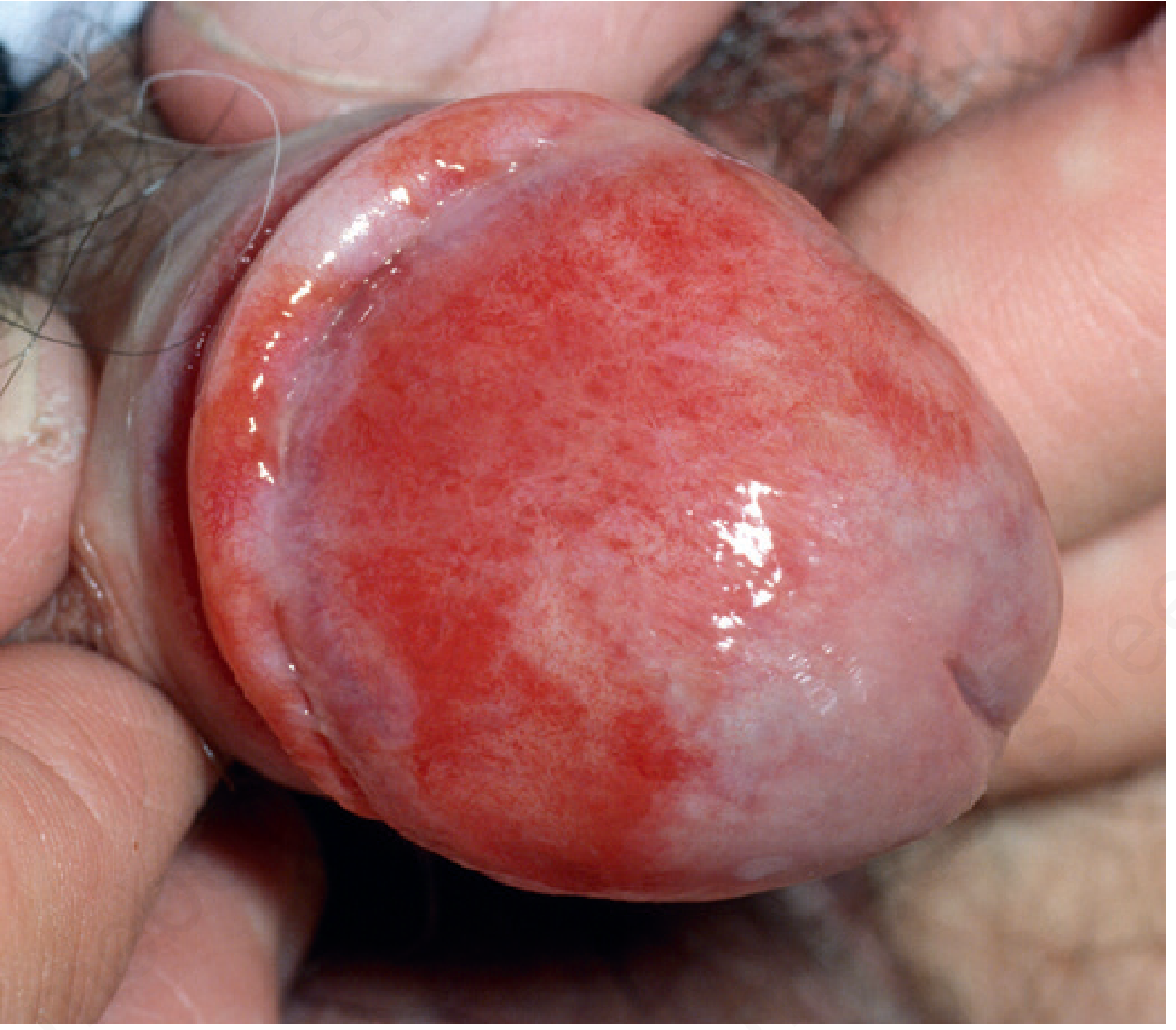
Histology: Atrophic epidermis with flattened, diamond-shaped keratinocytes; dense band of plasma cells in the papillary dermis; dilated vessels. HPV has NOT been detected.
Differential diagnosis: Penile psoriasis, lichen planus, lichen sclerosus, SCC in situ (erythroplasia of Queyrat) - the latter is distinguished by epidermal keratinocyte atypia on biopsy.
Treatment:
- Potent topical corticosteroids (first-line)
- Topical calcineurin inhibitors: pimecrolimus 1% cream, tacrolimus 0.1% ointment
- Mupirocin ointment, imiquimod 5% cream
- Circumcision is often curative
- Laser ablation and photodynamic therapy (PDT) also effective
Andrews' Diseases of the Skin, p. 3076-3089; Dermatology 5e
Balanitis Xerotica Obliterans (BXO) / Lichen Sclerosus
A chronic, progressive inflammatory dermatosis causing white, atrophic plaques on the glans and prepuce. Can cause:
- Phimosis (inability to retract foreskin)
- Meatal stenosis
- Urethral stricture
Management:
- Initial: topical steroids (betamethasone, clobetasol) or systemic tacrolimus
- Most cases require surgical resection of involved tissue and reconstruction with inner prepuce or buccal mucosa
- Recurrence rates up to 40% at median 26-month follow-up
- Biopsy always required to confirm diagnosis and exclude SCC
- Monitor closely - BXO can invade buccal mucosa grafts
Campbell Walsh Wein Urology, p. 1202
Pseudoepitheliomatous, Keratotic, and Micaceous Balanitis (PEKMB)
A rare condition in older men - thick, hyperkeratotic "mica-like" (asbestos-like) white scaly plaques on the glans. Originally thought benign, but concurrent verrucous carcinoma has been documented. Biopsy is essential to exclude SCC.
Treatment: Surgical excision or ablative techniques; topical 5-fluorouracil cream (anecdotal); close follow-up mandatory.
Campbell Walsh Wein Urology, p. 1699
Diagnosis
The diagnosis is primarily clinical, based on history and physical examination.
Additional workup in selected cases:
- Urinalysis (dysuria, recurrent episodes)
- STI testing (discharge, urethritis symptoms, extragenital findings)
- Fasting glucose or HbA1c - for recurrent candidal balanitis (to exclude diabetes)
- KOH preparation - for Candida
- Swab for bacterial culture - for bacterial balanitis
- Biopsy - for persistent, recurrent, or treatment-resistant lesions (to exclude premalignancy or malignancy)
Rosen's Emergency Medicine; Textbook of Family Medicine 9e, p. 1198
Management
General / Supportive
- Improved hygiene - gentle cleansing of the glans and inner prepuce
- Removal of irritating agents (soaps, products)
- Saline soaks
Specific Treatment
| Etiology | Treatment |
|---|---|
| Candidal | Topical clotrimazole or miconazole cream; oral fluconazole 150 mg single dose for severe/recurrent cases |
| Bacterial | Topical bacitracin or fusidic acid; oral cephalexin 25-50 mg/kg/day if cellulitis present |
| Mixed (empirical in children) | Topical bacitracin + nystatin/clotrimazole; hydrocortisone 0.5% for inflammation |
| Contact/irritant dermatitis | Avoid offending agent; low-to-mid potency topical corticosteroid |
| Zoon balanitis | Potent topical steroid ± antifungal; calcineurin inhibitors; circumcision |
| BXO / Lichen sclerosus | Clobetasol; surgical reconstruction in most |
| STI-associated | Treat underlying STI (ceftriaxone + doxycycline for gonorrhea/chlamydia) |
Fitzpatrick's Dermatology; Rosen's Emergency Medicine; Campbell Walsh Wein Urology
Circumcision
Indicated in:
- Recurrent balanoposthitis with phimosis
- Treatment-resistant Zoon balanitis (often curative)
- Severe or recurrent BXO
When to Admit (Pediatric)
- Inability to urinate
- Signs of systemic illness (fever)
- More than mild cellulitis - requires IV antibiotics + urology consultation
Complications
- Phimosis (from repeated episodes of balanitis causing scarring)
- Paraphimosis (trapped retracted foreskin - urological emergency)
- Urethral stricture (from BXO)
- Risk of penile carcinoma if premalignant conditions left untreated
- Recurrent UTIs
Key Clinical Pearls
- Recurrent candidal balanitis in a circumcised man - always investigate for diabetes
- Persistent balanitis not responding to treatment - biopsy to exclude premalignancy (erythroplasia of Queyrat, SCC, PEKMB)
- Zoon balanitis - the key differential for erythroplasia; biopsy distinguishes them (plasma cells vs. keratinocyte atypia)
- Circinate balanitis - think reactive arthritis if associated with joint pain and urethritis
- BXO/Lichen sclerosus - white atrophic plaques, risk of stricture, high recurrence after surgery
Sources: Andrews' Diseases of the Skin (Clinical Dermatology) | Campbell Walsh Wein Urology (3-Vol. Set) | Rosen's Emergency Medicine | Fitzpatrick's Dermatology | Dermatology 5e (Bolognin) | Textbook of Family Medicine 9e | Firestein & Kelley's Textbook of Rheumatology
This is a shared conversation. Sign in to Orris to start your own chat.