
Inntate immunity
Reading File
Now let me search the library for innate immunity content.
Finding Sources
Finding Sources
Excellent sources found. Let me read the most comprehensive sections - from Cellular and Molecular Immunology (dedicated Chapter 4) and Robbins & Janeway's:
Reading File
Reading File
Reading File
Let me now read more detailed content about the components, TLRs, complement, and inflammatory response:
Reading File
Reading File
Let me read more of the detailed Chapter 4 content on cellular components, TLRs, NK cells, complement, and inflammation:
Reading File
I now have extensive content from the textbooks. Let me also fetch the key diagram image and compile the full response:
Loading Image
Loading Image
I now have enough comprehensive content to write a thorough answer. Let me also fetch one more key image showing the innate immunity cellular components:
Loading Image
Now I have all the material needed for a comprehensive, well-illustrated response.
Innate Immunity
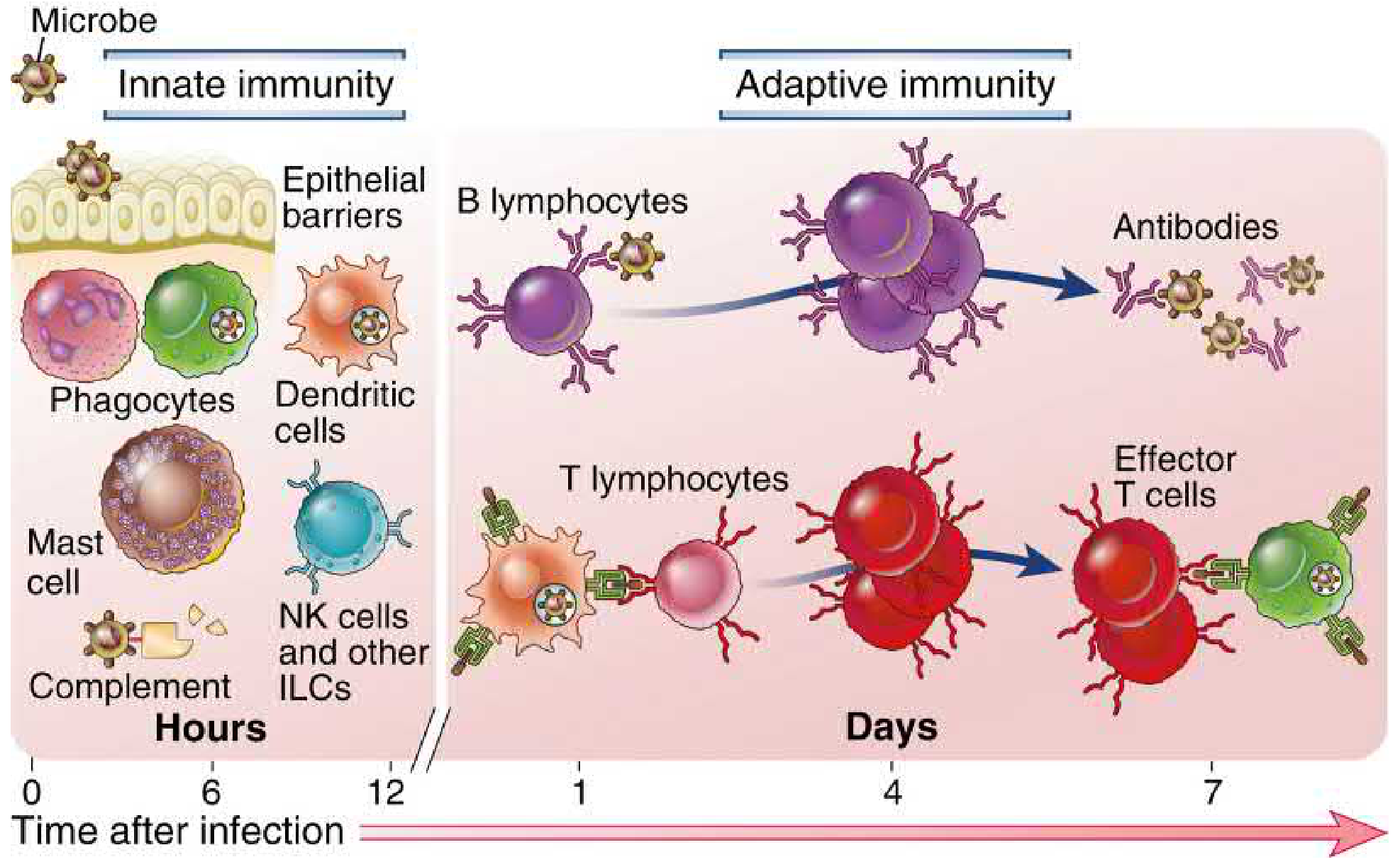
Definition and Overview
Innate immunity (also called natural or native immunity) refers to defense mechanisms that are always present and immediately available to combat microbes and other offending agents - they do not require prior exposure. It forms the first line of defense, acting within hours of infection, long before adaptive immunity (days to weeks) can be mounted.
The human genome contains approximately 850 genes directly related to innate immune responses, compared to ~575 for adaptive immunity - reflecting its biological importance.
- Cellular and Molecular Immunology, Ch. 4
- Robbins & Kumar Basic Pathology, Ch. 5
Innate vs. Adaptive Immunity - Key Differences
| Feature | Innate | Adaptive |
|---|---|---|
| Specificity | Shared molecular patterns (PAMPs, DAMPs) | Individual microbial/nonmicrobial antigens |
| Diversity | Low; germline-encoded receptors | Very high; somatic recombination of receptor genes |
| Memory | Limited | Yes (immunologic memory) |
| Timing | Immediate (0-12 hours) | Days to weeks |
| Cells | Phagocytes, DCs, NK cells, mast cells, ILCs | T and B lymphocytes |
| Secreted proteins | Complement, collectins, pentraxins | Antibodies |
| Self-tolerance | Yes | Yes |
- Cellular and Molecular Immunology, Table 1.2
Principles of Recognition: PAMPs and DAMPs
The innate immune system recognizes a limited but conserved set of molecular structures (~1,000 products), unlike the millions recognized by adaptive immunity. These fall into two categories:
1. PAMPs (Pathogen-Associated Molecular Patterns)
Molecular structures shared among classes of microbes that are essential for microbial survival (and thus cannot be easily mutated away):
- Gram-negative bacteria: Lipopolysaccharide (LPS)
- Gram-positive bacteria: Peptidoglycan, lipoteichoic acid
- Bacteria (general): Flagellin, N-formylmethionine (bacterial protein initiation signal), unmethylated CpG DNA
- Viruses: Double-stranded RNA (dsRNA), single-stranded RNA (ssRNA)
- Fungi: Beta-glucans, mannans
2. DAMPs (Damage-Associated Molecular Patterns)
Substances released from injured or necrotic host cells that signal tissue damage:
- Heat shock proteins (HSPs)
- High-mobility group box 1 (HMGB1) - normally intracellular DNA-binding proteins
- Uric acid crystals (from cell death)
- ATP released extracellularly
- Robbins & Kumar Basic Pathology, p. 156; Cellular and Molecular Immunology, Ch. 4
Pattern Recognition Receptors (PRRs)
PRRs are expressed by innate immune cells and are located in all compartments where pathogens may be present:
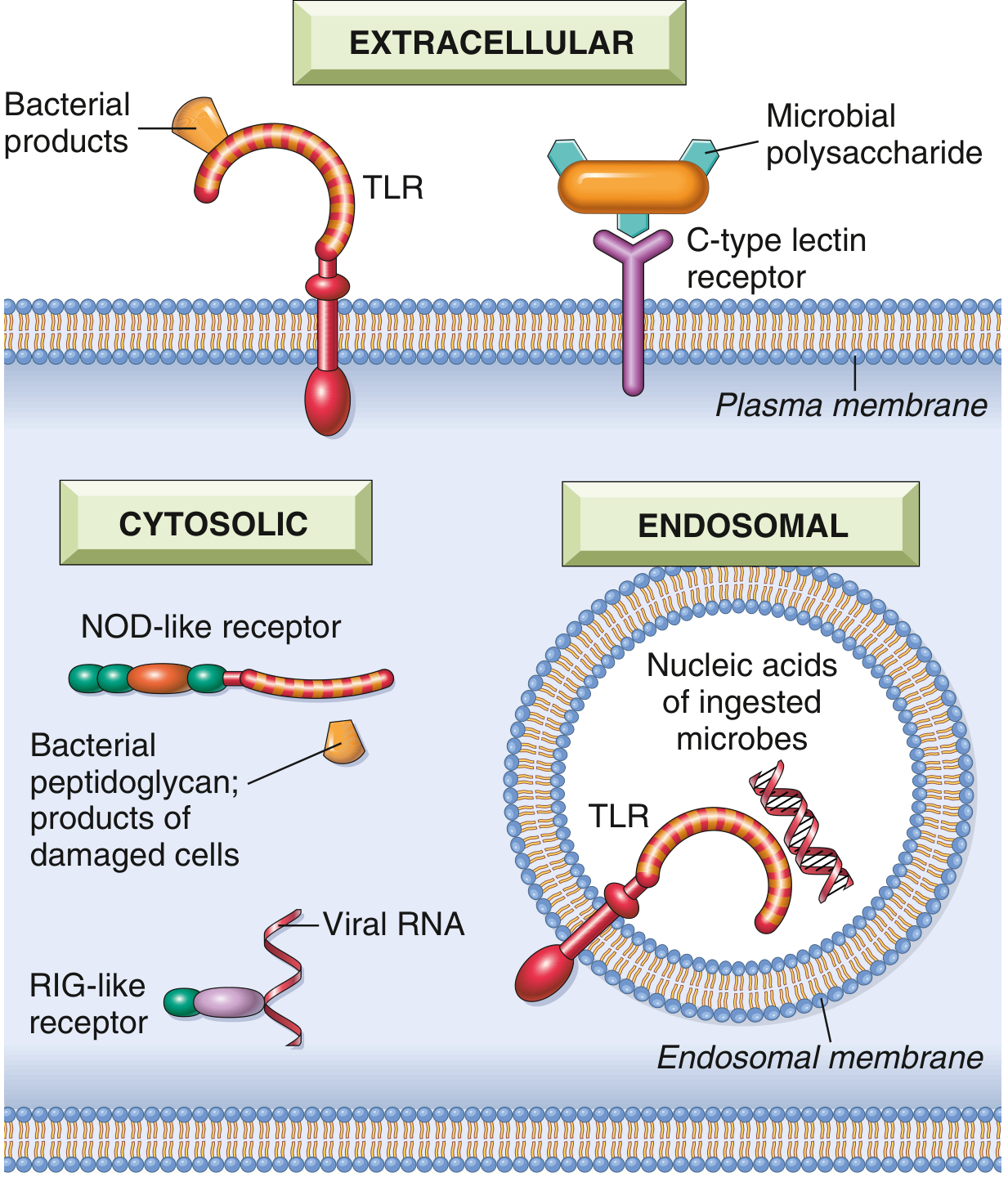
1. Toll-Like Receptors (TLRs)
The best-known and most studied PRRs. They contain extracellular/endosomal leucine-rich repeat (LRR) modules for PAMP binding and a cytoplasmic Toll/IL-1 receptor (TIR) domain for signaling.
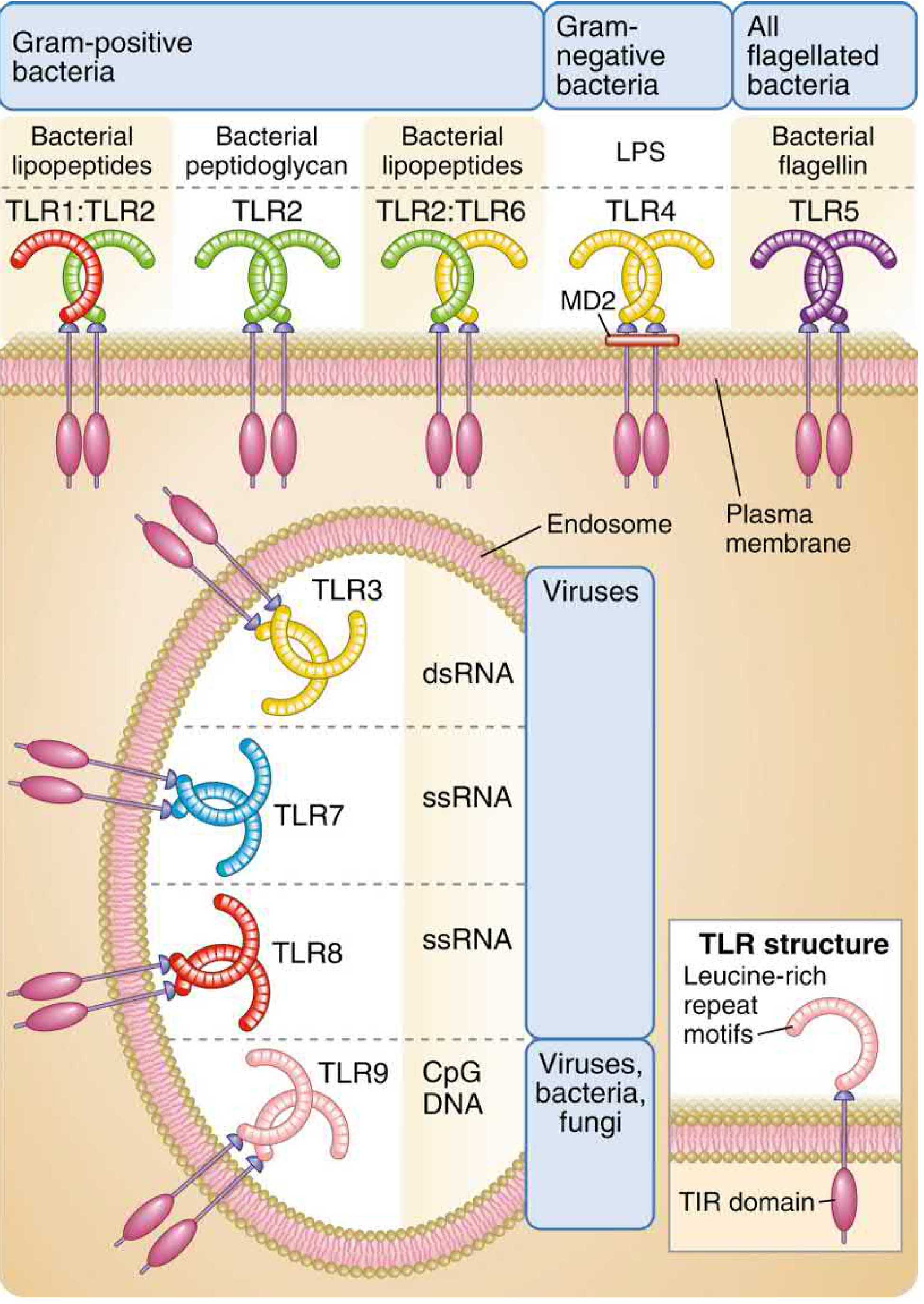
| TLR | Location | Ligand | Source |
|---|---|---|---|
| TLR1:TLR2 | Plasma membrane | Bacterial lipopeptides | Gram-positive bacteria |
| TLR2 | Plasma membrane | Peptidoglycan | Gram-positive bacteria |
| TLR2:TLR6 | Plasma membrane | Bacterial lipopeptides | Gram-positive bacteria |
| TLR4 | Plasma membrane | LPS (with MD2 co-receptor) | Gram-negative bacteria |
| TLR5 | Plasma membrane | Flagellin | All flagellated bacteria |
| TLR3 | Endosome | dsRNA | Viruses |
| TLR7 | Endosome | ssRNA | Viruses |
| TLR8 | Endosome | ssRNA | Viruses |
| TLR9 | Endosome | CpG DNA | Viruses, bacteria, fungi |
TLR signaling activates NF-κB, inducing production of:
- Pro-inflammatory cytokines (TNF, IL-1, IL-6, IL-12)
- Type I interferons (IFN-α, IFN-β) - especially from endosomal TLRs
- Costimulatory molecules on APCs (priming adaptive immunity)
2. NOD-Like Receptors (NLRs) - Cytosolic
Detect bacterial peptidoglycan fragments and DAMPs in the cytoplasm:
- NOD1 and NOD2: Detect bacterial cell wall products
- Many NLRs form the inflammasome - a multiprotein complex that activates caspase-1, which cleaves pro-IL-1β and pro-IL-18 into their active secreted forms
3. RIG-Like Receptors (RLRs) - Cytosolic
- RIG-I and MDA5 detect viral dsRNA in the cytoplasm and trigger type I interferon production
4. C-Type Lectin Receptors (CLRs) - Plasma Membrane
- Expressed on macrophages and DCs
- Detect fungal and bacterial polysaccharides (e.g., mannose, beta-glucan)
- Stimulate phagocytosis and inflammatory reactions
5. Cytosolic DNA Sensors
- Detect viral or bacterial DNA in the cytoplasm
- Activation leads to type I IFN production via the STING (Stimulator of IFN Genes) pathway
- Dysregulation causes interferonopathies
- Cellular and Molecular Immunology, Ch. 4; Robbins & Kumar Basic Pathology, p. 155-156
Cellular Components of Innate Immunity
1. Epithelial Barriers
The first physical line of defense:
- Skin: Multilayered keratinized epithelium is impenetrable to most microbes; sweat and sebaceous secretions lower pH
- Respiratory mucosa: Mucociliary escalator traps and expels microbes
- GI mucosa: Acid, enzymes, and secretory IgA
- Epithelial antimicrobial peptides: Defensins - small cationic peptides that disrupt microbial membranes (found in all organisms from plants to mammals; evolutionarily ancient)
2. Phagocytes
Neutrophils
- First cells recruited to sites of infection
- Short-lived, rapidly mobilized from bone marrow
- Kill microbes by: (a) reactive oxygen species (ROS) - respiratory burst via NADPH oxidase; (b) lysosomal enzymes (elastase, myeloperoxidase); (c) antimicrobial peptides; (d) NETs (Neutrophil Extracellular Traps) - chromatin and granule proteins extruded to trap and kill extracellular bacteria
Macrophages
- Tissue-resident (Kupffer cells in liver, microglia in CNS, alveolar macrophages, etc.) or recruited monocyte-derived
- Functions:
- Phagocytosis and killing of microbes
- Production of pro-inflammatory cytokines (TNF, IL-1, IL-6, IL-12, IL-23)
- Activation of adaptive immunity by presenting antigen and producing co-stimulatory signals
- Tissue repair (M2 phenotype)
3. Dendritic Cells (DCs)
- Sentinel cells residing in tissues (especially skin - Langerhans cells; and mucosae)
- Capture antigens and migrate to draining lymph nodes
- Key bridge between innate and adaptive immunity: Express costimulatory molecules (CD80, CD86) upon innate activation and present antigens to naive T cells
- Plasmacytoid DCs (pDCs) are the major producers of type I interferons
4. Natural Killer (NK) Cells
- Large granular lymphocytes - part of innate immunity despite lymphoid origin
- Kill cells that have lost MHC class I expression (typical of virus-infected or tumor cells)
- Recognize targets via balance of activating and inhibitory receptors:
- Inhibitory receptors (KIRs) bind MHC class I ("self") - if present, killing is suppressed
- If MHC I is absent or reduced ("missing self"), inhibition is lost and NK cell kills
- Also kill via ADCC (antibody-dependent cellular cytotoxicity) via CD16 (FcγRIII)
- Produce IFN-γ, which activates macrophages
5. Innate Lymphoid Cells (ILCs)
Non-T, non-B lymphocytes lacking antigen receptors; classified as:
- ILC1: Produce IFN-γ; defend against intracellular pathogens
- ILC2: Produce IL-4, IL-5, IL-13; important in type 2 responses (helminths, allergy)
- ILC3: Produce IL-17, IL-22; defend against extracellular bacteria and fungi at mucosal surfaces
- NK cells are technically group 1 ILCs
6. Mast Cells
- Tissue-resident, granule-rich cells
- Triggered by PAMPs (via TLRs) and complement fragments (C3a, C5a)
- Release histamine (vasodilation, increased permeability), prostaglandins, and cytokines - initiating the early vascular response of inflammation
- Critical in parasitic defense and allergic reactions
7. γδ T cells and NKT cells
- T cells with limited, semi-invariant receptor diversity
- Recognize lipid antigens and nonpeptide microbial structures without MHC restriction
- Act early like innate cells
Soluble Effector Molecules
The Complement System
Three activation pathways all converge on C3 cleavage:
| Pathway | Activated by | Key Initiators |
|---|---|---|
| Classical | Antigen-antibody complexes (IgG, IgM) | C1q, C1r, C1s |
| Lectin | Mannose-binding lectin (MBL) or ficolins binding microbial carbohydrates | MASP-1, MASP-2 |
| Alternative | Spontaneous C3 hydrolysis on microbial surfaces | Factor B, Factor D, Properdin |
Effector functions of complement:
- Opsonization: C3b coats microbes, promoting phagocytosis (phagocytes express CR1 for C3b)
- Chemotaxis: C5a recruits neutrophils and monocytes
- Inflammation: C3a and C5a (anaphylatoxins) activate mast cells and increase vascular permeability
- Lysis: Membrane attack complex (MAC = C5b-9) directly lyses gram-negative bacteria and cells
Pentraxins
- CRP (C-reactive protein) and SAP (serum amyloid P)
- Acute-phase proteins produced by the liver in response to IL-6
- Bind phosphocholine on microbial surfaces → opsonization and complement activation
- CRP is a clinical marker of inflammation
Collectins and Ficolins
- Mannan-binding lectin (MBL) and surfactant proteins SP-A, SP-D
- Recognize carbohydrate patterns on microbes → lectin complement pathway
Antimicrobial Peptides (Defensins)
- Alpha-defensins (neutrophil granules, intestinal Paneth cells), beta-defensins (epithelium)
- Disrupt microbial membranes
The Inflammatory Response
The hallmark effector response of innate immunity. Major proinflammatory cytokines:
| Cytokine | Source | Key Effects |
|---|---|---|
| TNF | Macrophages, DCs | Fever, endothelial activation, acute-phase response, systemic shock at high levels |
| IL-1β | Macrophages, DCs (via inflammasome) | Fever, endothelial activation, acute-phase response |
| IL-6 | Macrophages, DCs, endothelium | Acute-phase protein synthesis (CRP, fibrinogen), T cell differentiation |
| IL-12 | Macrophages, DCs | NK cell and T cell IFN-γ production; drives Th1 differentiation |
| CXCL8 (IL-8) | Macrophages, endothelium | Neutrophil chemotaxis and activation |
| Type I IFNs (IFN-α/β) | pDCs, virus-infected cells | Antiviral state in neighboring cells; NK cell activation |
Sequence of Vascular Events in Inflammation
- Transient vasoconstriction
- Vasodilation (histamine, prostaglandins, NO) → increased blood flow
- Increased vascular permeability (histamine, C3a, C5a, bradykinin, leukotrienes) → edema
- Leukocyte recruitment: margination → rolling (selectins) → adhesion (integrins/ICAM-1) → transmigration → chemotaxis to site
Microbial Killing by Phagocytes
Once microbes are ingested into phagosomes:
- Reactive oxygen species (ROS): NADPH oxidase generates superoxide → H₂O₂ → hypochlorous acid (via myeloperoxidase)
- Reactive nitrogen species: iNOS generates NO (especially in macrophages)
- Lysosomal enzymes: proteases, lysozyme
- Defensins within granules
- Phagosome-lysosome fusion delivers all these killing mechanisms
Antiviral Response
Type I interferons (IFN-α and IFN-β) are produced when:
- Endosomal TLRs (TLR3, 7, 8, 9) detect viral nucleic acids
- Cytosolic RIG-I/MDA5 detect dsRNA
- cGAS detects cytoplasmic dsDNA (via STING)
IFN-α/β act on infected and neighboring cells to:
- Induce antiviral enzymes (PKR, OAS/RNase L) that degrade viral RNA and block translation
- Upregulate MHC class I → better recognition by CD8+ cytotoxic T cells
- Activate NK cells
Stimulation of Adaptive Immunity
Innate immunity does not just fight infection alone - it provides the necessary signals for adaptive immune activation:
- Antigen presentation: DCs capture antigens and present them on MHC molecules
- Costimulatory signals: TLR activation upregulates B7 molecules (CD80/CD86) on DCs - essential "second signal" for T cell activation
- Polarizing cytokines: IL-12 → Th1; IL-4 → Th2; IL-6 + TGF-β → Th17; TGF-β alone → Tregs
- Complement: C3d acts as adjuvant, enhancing B cell activation
Conversely, adaptive immunity enhances innate responses: IgG opsonizes bacteria for macrophage phagocytosis; IFN-γ from Th1 cells maximally activates macrophage killing.
Regulation of Innate Immune Responses
Unchecked innate immunity is dangerous (sepsis, cytokine storm, autoimmunity). Key regulatory mechanisms:
- Short half-lives of cytokines and inflammatory mediators
- Anti-inflammatory cytokines: IL-10 (from macrophages, Tregs) and TGF-β suppress inflammation
- Regulatory T cells (Tregs) limit innate-adaptive crosstalk
- Negative regulators of TLR signaling (IRAK-M, SOCS proteins, SHIP)
- Inflammasome regulation: Efferocytosis (clearance of apoptotic cells) is anti-inflammatory
Evolution of Innate Immunity
- Innate immunity appeared ~750 million years ago with the first multicellular organisms
- Adaptive immunity is only ~350-500 million years old (vertebrates)
- TLRs and the NF-κB signaling pathway are conserved from insects to mammals
- Defensins have virtually identical tertiary structure in plants and mammals
- The genome dedicates ~850 innate immunity genes vs. ~575 for adaptive immunity
Clinical Relevance
| Clinical Scenario | Innate Immunity Relevance |
|---|---|
| Sepsis | Excessive TNF/IL-1 from macrophages in response to LPS via TLR4 |
| Chronic granulomatous disease | NADPH oxidase deficiency → failure of ROS killing → recurrent catalase-positive infections |
| Hereditary periodic fever syndromes | Gain-of-function mutations in NLRPs (inflammasome) → excess IL-1β |
| Interferonopathies | Unregulated type I IFN production (e.g., Aicardi-Goutières syndrome) |
| NK cell deficiency | Susceptibility to herpesviruses and certain tumors |
| Complement deficiencies | C3 deficiency → severe bacterial infections; C5-C9 deficiency → Neisseria bacteremia |
Sources:
- Cellular and Molecular Immunology (Abbas, Lichtman & Pillai), Chapter 1 & 4
- Robbins & Kumar Basic Pathology, Chapter 5
This is a shared conversation. Sign in to Orris to start your own chat.