

1779000577830241160912238258359.jpg
Suddenly this marks has happen in the bodyys
Reading File
Looking at the image, I can see a reddish, linear/cross-shaped skin lesion with some vesicles (small fluid-filled bumps) on the trunk. Let me search the medical library and look for similar images.
Finding Sources
Searching Images
herpes zoster shingles vesicular rash trunk linear dermatome
Searching the Web
linear vesicular rash trunk sudden onset herpes zoster early stage
Reading File
Loading Image
Loading Image
Based on the image you shared and the clinical evidence, this rash is highly consistent with Herpes Zoster (Shingles) — an early/mild presentation.
What You're Likely Seeing: Herpes Zoster (Shingles)
Here is a textbook image of herpes zoster for comparison:
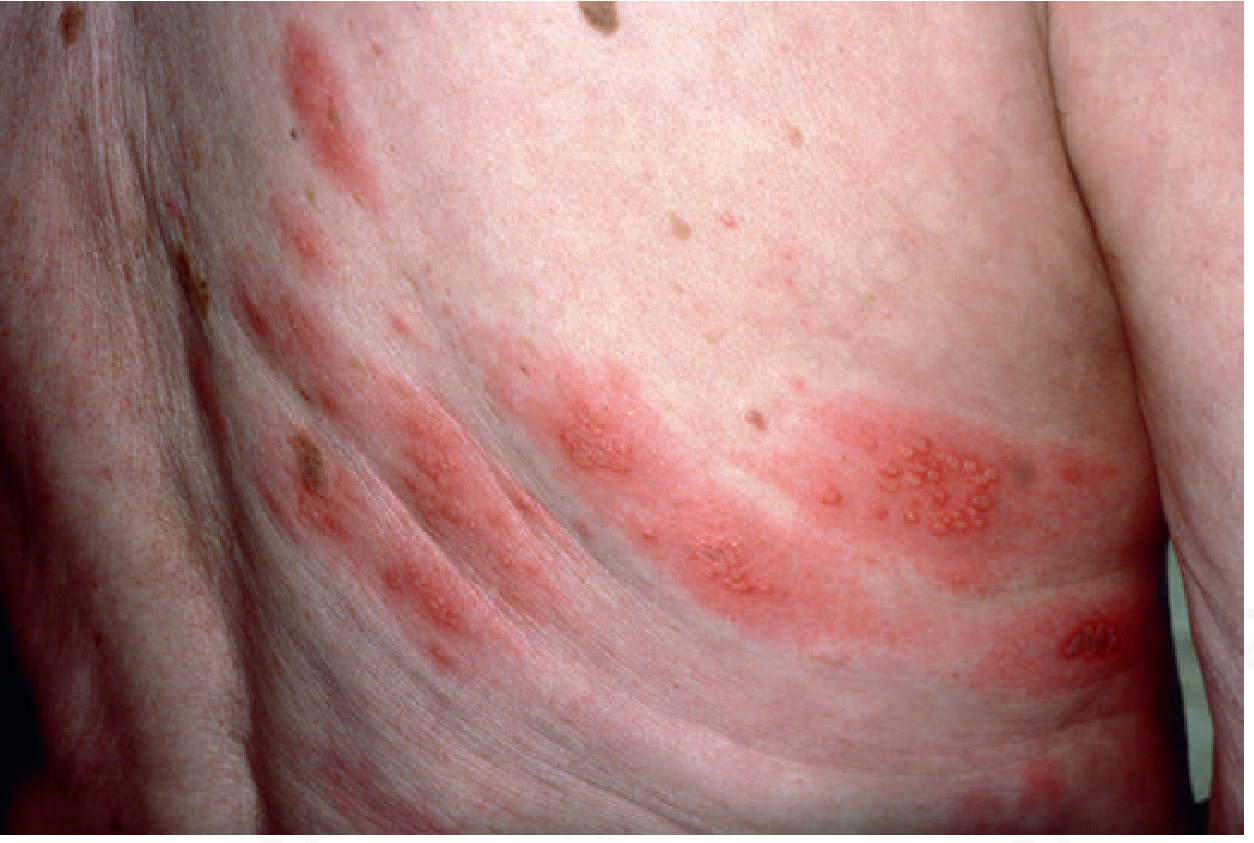
Why This Matches
Your photo shows:
- A red, linear/cross-shaped patch on the trunk
- Small vesicles (fluid-filled bumps) clustered in the center
- Sudden onset on one side of the body
- Limited to a narrow band/strip of skin
This matches the classic description from Andrews' Diseases of the Skin:
"The eruption initially presents as papules and plaques of erythema in the dermatome. Within hours the plaques develop blisters. Lesions continue to appear for several days."
The lesion appears to be following a thoracic dermatome (nerve distribution along the chest/trunk), which is the most commonly affected area (55% of all zoster cases).
What Causes It
Herpes zoster is caused by reactivation of the Varicella-Zoster Virus (VZV) — the same virus that causes chickenpox. After chickenpox, the virus lies dormant in spinal nerve cells for years and can reactivate when immunity drops (due to stress, illness, age, or medications).
Key Symptoms to Watch For
| Symptom | Details |
|---|---|
| Pain/burning/tingling | Often precedes the rash by 1–3 days |
| Itching | Common in the affected area |
| Sensitivity to touch | The skin may feel very tender |
| Blisters spreading | New vesicles may appear for 3–5 more days |
⚠️ What You Should Do — Act Quickly
See a doctor as soon as possible, ideally within 72 hours of the rash appearing. This is critical because:
- Antiviral medications (acyclovir, valacyclovir, famciclovir) are most effective when started within 72 hours
- They shorten the duration, reduce pain severity, and lower the risk of postherpetic neuralgia (chronic nerve pain that can persist for months after the rash heals)
Do not:
- Scratch or burst the blisters (risk of bacterial infection and scarring)
- Touch your face/eyes after touching the rash (risk of ocular zoster)
- Be around pregnant women, newborns, or immunocompromised people until lesions crust over (you can spread chickenpox to those who've never had it)
⚠️ Disclaimer: This is for educational purposes only and does not replace a medical diagnosis. Please consult a doctor in person — they can confirm the diagnosis and prescribe antivirals promptly.
If possible it is due to summer and sweat
Finding Sources
Searching Images
miliaria rubra heat rash sweat prickly heat vesicles trunk
That's understandable thinking, but looking carefully at the image, a heat/sweat rash (miliaria) is unlikely to be the cause here. Here's a clear comparison:
Why This Is Probably NOT a Heat/Sweat Rash
| Feature | Miliaria (Heat Rash) | Your Rash |
|---|---|---|
| Pattern | Scattered, widespread tiny bumps across sweaty areas | Localized, linear/cross-shaped — one specific spot |
| Location | Where clothes rub or sweat accumulates broadly | A single narrow patch |
| Appearance | Dozens to hundreds of tiny uniform pinpoint dots | Clustered vesicles with surrounding redness |
| Symmetry | Both sides of body, diffuse | One-sided only |
Miliaria (heat rash) looks like this — scattered uniformly across a broad area:
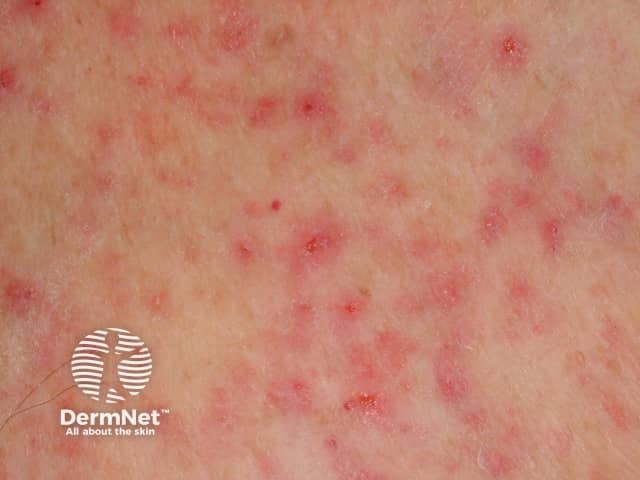
Your rash is focused in one specific strip/patch on one side of the body, with clustered fluid-filled vesicles — that pattern is characteristic of a nerve distribution (dermatome), which points back to Herpes Zoster.
The Key Distinction
Heat rash is caused by blocked sweat ducts — it spreads over large areas where you sweat (chest, back, neck, under arms). It doesn't follow a specific line or cluster in one small spot.
Herpes Zoster is caused by a virus reactivating along a nerve — it appears in a specific, localized band or patch on one side, exactly like what's visible in your photo.
Please do not delay seeing a doctor. If this is indeed shingles, antivirals work best in the first 72 hours. Even if it turns out to be something else, a doctor can confirm it quickly with a physical exam.
This is a shared conversation. Sign in to Orris to start your own chat.