
Dissociated vertical deviation
Reading File
Now let me search the medical library for dissociated vertical deviation (DVD) in parallel with a PubMed search.
Finding Sources
Searching PubMed
dissociated vertical deviation
Finding Sources
Finding Sources
Good. I have key file paths. Let me now read the most relevant sections from Kanski's (the main ophthalmology reference) and Bradley & Daroff's (neurology reference).
Reading File
Reading File
Now let me search specifically for the DVD section in Kanski's - it likely has a dedicated section on DVD management:
Finding Sources
The Kanski section on "Subsequent treatment" at line 2593 looks key. Let me read it in full, and also the Wills Eye section on infantile esotropia/DVD:
Reading File
Reading File
I have the key DVD description from Kanski starting at line 2594. Let me read the rest of it:
Reading File
I now have excellent material. Let me fetch the key DVD clinical photo to include in my answer:
Loading Image
Loading Image
I now have all the material needed. Let me compile the comprehensive answer.
Dissociated Vertical Deviation (DVD)
Definition
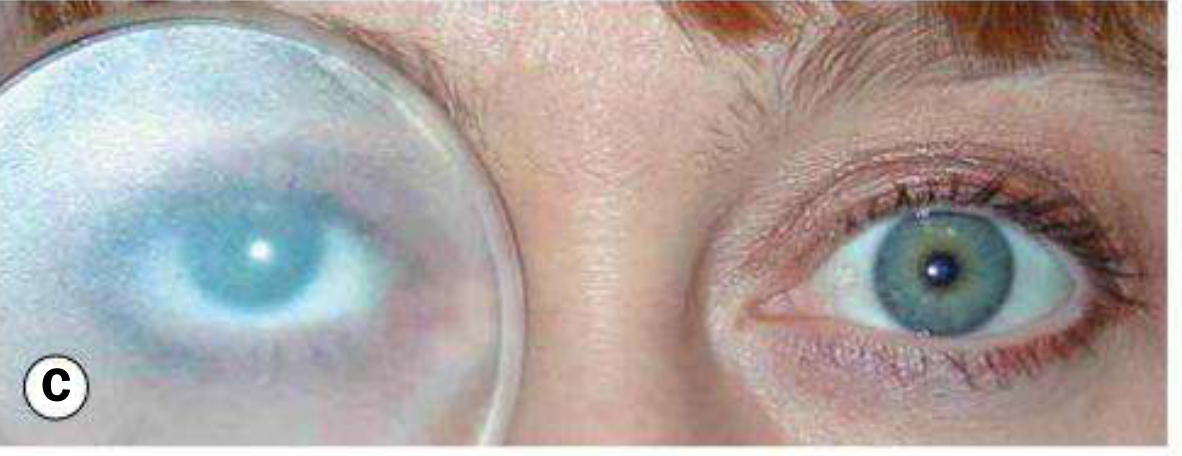
DVD is a congenital ocular motility phenomenon in which the affected eye spontaneously drifts upward with excyclorotation (extorsion) when it is covered, deprived of fixation, or during periods of visual inattention. When the cover is removed, the eye drifts back down - crucially, without a corresponding downward movement of the fellow eye. This non-adherence to Hering's law (that both eyes receive equal innervation simultaneously) is the defining feature that sets DVD apart from all other vertical strabismus.
Key Clinical Features
| Feature | Detail |
|---|---|
| Eye movement | Upward drift + extorsion under cover; returns to alignment on uncovering |
| Laterality | Almost always bilateral, but frequently asymmetric |
| Prevalence in infantile esotropia | Develops in ~80% of cases by age 3 years |
| Symptoms | Usually asymptomatic - no diplopia, discovered incidentally |
| Detection | Cover test or pupil light reflex testing |
Fig. 18.54 (A) from Kanski: Eyes straight in the primary position - no overt deviation is visible at rest.
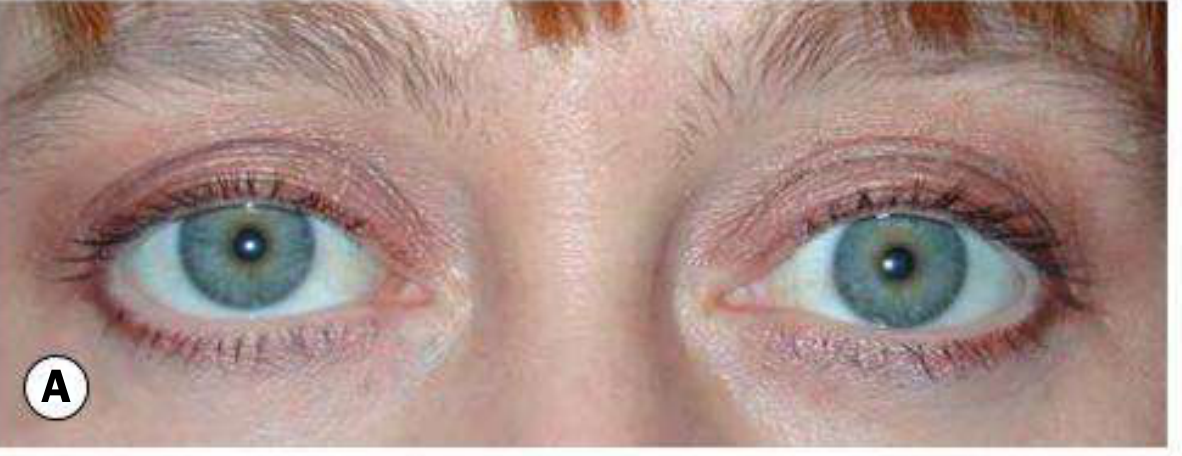
Fig. 18.54 (C): Up-drift of the right eye when it is covered.
Associations
DVD is almost never an isolated finding. It is strongly linked to:
- Infantile (congenital) esotropia - the most common association
- Inferior oblique overaction (IOOA) - must be carefully distinguished from DVD (see below)
- Latent nystagmus - fast phase toward the fixating eye when one eye is covered
- Amblyopia - develops in ~50% of cases, as a unilateral fixation preference commonly emerges postoperatively
- "A" and "V" pattern deviations
Pathophysiology
The exact mechanism remains incompletely understood. DVD violates Hering's law of equal innervation - when the covered eye rises, the fellow eye does not fall. Evoked potential studies have suggested a possible role for excessive crossing of axons at the optic chiasm, but this remains controversial. It is considered a congenital anomaly with no other clinical neurological significance.
Distinguishing DVD from Inferior Oblique Overaction
This is a clinically important distinction:
| Feature | DVD | Inferior Oblique Overaction |
|---|---|---|
| Elevation | On cover (when deprived of fixation) | In adduction (fellow eye moves into adduction gaze position) |
| Hering's law | Violated - no corresponding depression of fellow eye | Obeyed |
| Bilaterality | Usually bilateral | Usually bilateral, but symmetrical |
| Torsion | Extorsion of the deviating eye | Extorsion present |
| Timing | Develops later (~age 3) | May be present initially or develop at ~age 2 |
Clinical Tip (Kanski): "Inferior oblique overaction needs to be distinguished from dissociated vertical deviation." Both can coexist in the same patient.
Management
Treatment is indicated for psychosocial/cosmetic reasons (the deviation itself is asymptomatic). Surgical options include:
- Superior rectus recession - with or without posterior fixation (Faden) sutures
- Inferior rectus resection or tuck
- Inferior oblique anterior transposition (IOAT) - particularly useful when DVD coexists with inferior oblique overaction; the anteriorly transposed IO acts as a depressor
No single procedure is universally superior; choice depends on whether IOOA coexists and the severity of the deviation.
Summary of Congenital Esotropia Sequence
DVD is part of the "infantile esotropia complex":
- Esotropia present by 6 months (large angle, >40 prism diopters)
- Inferior oblique overaction emerges ~age 2
- DVD develops in 80% by age 3
- Latent nystagmus present
- Amblyopia in ~50% postoperatively
Sources: Kanski's Clinical Ophthalmology: A Systematic Approach, 10th ed., pp. 753-754 | Bradley and Daroff's Neurology in Clinical Practice, p. 299 | The Wills Eye Manual, 8th ed., pp. 498-499
This is a shared conversation. Sign in to Orris to start your own chat.