
teach me quinolones pharmacology
Reading File
Reading File
Finding Sources
Finding Sources
Searching PubMed
fluoroquinolones AND safety
Searching the Web
FDA fluoroquinolone drug safety communication disabling side effects aortic aneurysm hypoglycemia official
Reading File
Finding Sources
Finding Sources
Reading File
Finding Sources
Finding Sources
Reading File
Finding Sources
Finding Sources
Reading File
Quinolones and fluoroquinolones: pharmacology
Quinolones are synthetic, bactericidal antibiotics. The clinically important modern agents are mostly fluoroquinolones, which have broader activity and better pharmacokinetics than the original quinolone, nalidixic acid.
Key drugs
| Group / useful label | Drugs | Main point |
|---|---|---|
| Older urinary quinolone | Nalidixic acid | Mainly historical, narrow Gram-negative urinary activity |
| Strong Gram-negative / antipseudomonal | Ciprofloxacin, ofloxacin | Ciprofloxacin is a classic antipseudomonal quinolone |
| Respiratory fluoroquinolones | Levofloxacin, moxifloxacin, gemifloxacin | Better activity against Streptococcus pneumoniae and atypicals |
| Newer broad agent | Delafloxacin | Has MRSA activity and retains antipseudomonal activity |
| Topical agents | Moxifloxacin, ofloxacin, ciprofloxacin, ozenoxacin | Eye, ear, skin uses depending on formulation |
1. Mechanism of action
Fluoroquinolones inhibit bacterial type II topoisomerases:
- DNA gyrase (topoisomerase II): particularly important target in Gram-negative bacteria.
- Topoisomerase IV: particularly important target in Gram-positive bacteria.
Normally, these enzymes cut and then re-ligate DNA during replication. Fluoroquinolones stabilize the enzyme-DNA complex after DNA cleavage, preventing re-ligation. This produces irreversible double-strand DNA breaks and bacterial death.
Result: bactericidal inhibition of DNA replication.
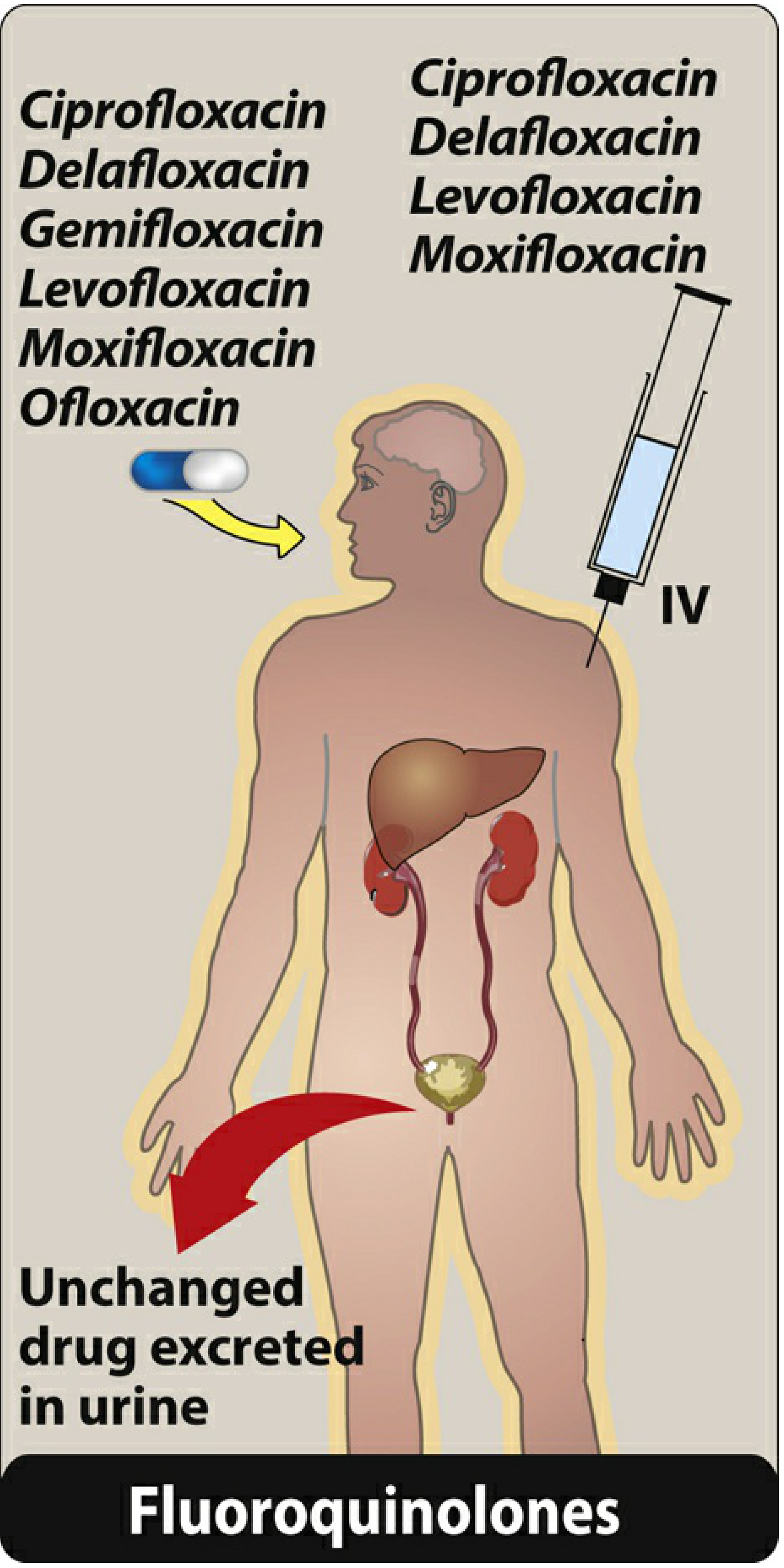
They have concentration-dependent exposure, best summarized pharmacodynamically by the AUC/MIC ratio. Source: Lippincott Illustrated Reviews: Pharmacology, p. 1020.
Exam memory aid:
“Quinolones quiet the gyrase.”
“Quinolones quiet the gyrase.”
2. Antibacterial spectrum
They cover many:
- Aerobic Gram-negative bacilli
- Atypicals: Legionella, Chlamydia, Mycoplasma
- Variable Gram-positive organisms
- Some agents cover anaerobes
Important differences
| Drug | High-yield spectrum |
|---|---|
| Ciprofloxacin | Strong Gram-negative activity, including Pseudomonas; relatively weaker pneumococcal coverage |
| Levofloxacin | “Respiratory” coverage: S. pneumoniae, atypicals, and some Pseudomonas activity |
| Moxifloxacin | Respiratory pathogens, atypicals, and anaerobes; not reliable for Pseudomonas and poor choice for UTI because urinary concentration is low |
| Delafloxacin | Gram-positive activity including MRSA, plus Gram-negative activity including Pseudomonas |
The spectrum progression is broadly: nalidixic acid for enteric Gram-negative bacilli, ciprofloxacin for stronger Gram-negative and Pseudomonas coverage, then levofloxacin/moxifloxacin for improved pneumococcal and respiratory coverage. Lippincott Illustrated Reviews: Pharmacology, pp. 1020-1021.
3. Clinical uses
Use depends on local susceptibility patterns and culture results. Major settings include:
- Complicated UTI and pyelonephritis: ciprofloxacin or levofloxacin may be options when susceptibility supports use.
- Bacterial prostatitis: good prostatic tissue penetration.
- Pseudomonal infections: ciprofloxacin, levofloxacin, or delafloxacin depending on susceptibility and site.
- Community-acquired pneumonia: levofloxacin or moxifloxacin are respiratory fluoroquinolones.
- Atypical respiratory infection: good activity against Legionella, Mycoplasma, and Chlamydia.
- Bacterial gastroenteritis / traveler’s diarrhea: use is increasingly restricted by resistance.
- Anthrax: ciprofloxacin is a well-known option for treatment or post-exposure prophylaxis.
- Second-line tuberculosis regimens: levofloxacin or moxifloxacin may be used in specific resistant-TB protocols.
- Topical eye and ear infections: ophthalmic or otic fluoroquinolone preparations.
They should generally not be routine first-line treatment for uncomplicated cystitis, acute bacterial sinusitis, or uncomplicated bronchitis when safer effective alternatives exist.
4. Pharmacokinetics
- Excellent oral absorption. Levofloxacin and moxifloxacin have >90% oral bioavailability, so oral therapy can often substitute for IV therapy when the patient can absorb oral drugs.
- Widely distributed into tissues: lung, kidney, bone, prostate, macrophages, and leukocytes.
- Most are cleared mainly by the kidney, so renal dose adjustment is often needed.
- Moxifloxacin differs: it has lower urinary concentrations and is not preferred for UTI.
- Most have a relatively long half-life, allowing once-daily dosing.
Chelation interaction: a favorite exam point
Oral absorption falls when fluoroquinolones bind polyvalent cations in the gut:
- Aluminum or magnesium antacids
- Iron
- Zinc
- Calcium supplements
- Sucralfate
- Some dairy products
Give the fluoroquinolone 2 hours before or 4 hours after such products. Katzung’s Basic and Clinical Pharmacology, p. 2921; Lippincott Illustrated Reviews: Pharmacology, p. 1022.
5. Resistance mechanisms
Resistance develops readily, especially with unnecessary or repeated exposure.
-
Target-site mutation
- Mutations in gyrA/gyrB for DNA gyrase
- Mutations in parC/parE for topoisomerase IV
These reduce drug binding.
-
Reduced intracellular drug concentration
- Reduced porin entry
- Increased efflux pumps
-
Drug modification
- Plasmid-associated enzymes such as an acetyltransferase variant can inactivate some fluoroquinolones.
Source: Lippincott Illustrated Reviews: Pharmacology, pp. 1022-1023.
Clinical implication: do not assume class activity merely because an organism is “Gram-negative.” Use culture and susceptibility data whenever possible.
6. Adverse effects: the high-yield safety section
Common
- Nausea, diarrhea, abdominal discomfort
- Headache, dizziness
- Rash or photosensitivity
- Risk of Clostridioides difficile infection
Serious and exam-relevant
| Adverse effect | Key details |
|---|---|
| Tendinitis and tendon rupture | Classically Achilles tendon. Risk rises in age >60 years, concomitant corticosteroids, renal dysfunction, and solid-organ transplant recipients. Stop the drug if tendon pain/swelling occurs. |
| Peripheral neuropathy | May begin quickly and can persist. Symptoms: pain, burning, tingling, numbness, weakness. |
| CNS effects | Insomnia, agitation, confusion, hallucinations, seizures. Higher concern in older adults and people with seizure disorders. |
| QT prolongation | Especially important with moxifloxacin. Avoid or use caution with baseline prolonged QT, hypokalemia/hypomagnesemia, or other QT-prolonging drugs. |
| Dysglycemia | Both hypo- and hyperglycemia, especially in diabetes or with glucose-lowering therapy. |
| Aortic aneurysm/dissection risk | Avoid when reasonable alternatives exist in patients with known aneurysm or high risk. |
| Cartilage/tendon toxicity | Avoid routine systemic use in pregnancy and children, except when benefits outweigh risks, such as certain serious infections. |
| Myasthenia gravis worsening | Can worsen neuromuscular weakness. Avoid in known myasthenia gravis where possible. |
The current FDA ciprofloxacin label warns about disabling, potentially irreversible effects involving tendons, peripheral nerves, and the CNS, as well as aortic risk, glucose disturbances, and QT-related precautions in relevant patients. See the FDA ciprofloxacin prescribing information.
7. Drug interactions
-
Cations and antacids
Iron, zinc, calcium, magnesium, aluminum, sucralfate reduce absorption by chelation. -
Warfarin
May increase anticoagulant effect. Monitor INR. -
Theophylline
Ciprofloxacin inhibits CYP1A2, which can raise theophylline concentration and toxicity risk. -
Caffeine
Ciprofloxacin can reduce caffeine metabolism, causing tremor, insomnia, palpitations. -
NSAIDs
May increase CNS stimulation and seizure risk in susceptible people. -
QT-prolonging drugs
Added risk with agents such as amiodarone, sotalol, macrolides, and antipsychotics.
8. Contraindications / avoid when possible
- Previous serious fluoroquinolone reaction
- Previous fluoroquinolone-related tendon rupture
- Myasthenia gravis
- High risk of QT prolongation, particularly with moxifloxacin
- Known aortic aneurysm or strong predisposition, unless no suitable alternative
- Pregnancy and routine pediatric infections, unless a serious indication outweighs risk
- Uncomplicated infections for which safer narrow-spectrum alternatives are effective
9. Rapid comparison for exams
| Feature | Ciprofloxacin | Levofloxacin | Moxifloxacin |
|---|---|---|---|
| Best remembered for | Pseudomonas | Respiratory + urinary | Respiratory + anaerobes |
| Pneumococcal activity | Lower | Good | Good |
| Pseudomonas activity | Strong | Some activity | Poor / not reliable |
| Anaerobic activity | Weak | Limited | Better |
| Suitable for UTI | Yes | Yes | No, avoid |
| QT prolongation | Some risk | Some risk | Higher concern |
One-line takeaway
Ciprofloxacin = Pseudomonas; levofloxacin = lung plus urine; moxifloxacin = lung plus anaerobes, but not urine.
Use fluoroquinolones selectively: their convenient oral bioavailability and broad tissue penetration are useful, but resistance and potentially severe class toxicities mean they are often reserved for situations where safer alternatives are unsuitable.
This is a shared conversation. Sign in to Orris to start your own chat.