
Prompt- Create a super aesthetic, handwritten-style revision note page for the topic: • Make it look like neat exam notes written on a page (top view, clean layout, colorful headings, underlines, boxes). • Keep it crisp, high-yield, and exam-oriented. • Use clear headings and organize content like this (modify if needed for topic): ○ Definition ○ Etiology ○ Pathogenesis (flow/arrow style) ○ Clinical features ○ Radiographic features (if applicable) ○ Histopathology (if applicable) ○ Key features ○ Differential diagnosis ○ Management ○ Complications ○ Key points / last-minute revision box • Add simple diagrams or labeled sketches wherever helpful. • Highlight important keywords. • Include one memory trick / one-line summary •
What topic would you like the revision notes on?
acute pancreatitis etiology pathogenesis clinical features management high yield exam notes
A super aesthetic handwritten-style medical revision note page for "ACUTE PANCREATITIS" — top-down view of a white lined notebook page. The page looks like neat, colorful, exam-oriented handwritten notes by a medical student. Layout: TOP HEADER: Big colorful bubble title "ACUTE PANCREATITIS" in bold teal/green marker with a yellow highlight strip underneath. Small subtitle "Gastroenterology | High-Yield" in small pink cursive. SECTION 1 - DEFINITION (coral/orange heading with underline): Handwritten: "Acute inflammatory condition of the pancreas due to enzymatic autodigestion. Ranges from mild self-limiting → life-threatening multiorgan failure." SECTION 2 - ETIOLOGY (purple heading, underline): Two-column mini layout: LEFT "COMMON:" with small gallstone icon: • Gallstones (40-70%) ← #1 cause • Alcohol (25-35%) ← #2 RIGHT "REMEMBER — 'GET SMASHED' mnemonic:" in small neat writing: G-Gallstones, E-Ethanol, T-Trauma, S-Steroids, M-Mumps/Metabolic, A-Autoimmune, S-Scorpion sting, H-Hyperlipidemia/Hypercalcemia, E-ERCP, D-Drugs SECTION 3 - PATHOGENESIS (teal heading with arrows): Flow diagram in boxes connected by arrows: [Trigger (gallstone/alcohol)] → [Blocked pancreatic duct] → [Premature trypsinogen activation inside acinar cells] → [Autodigestion of pancreatic tissue] → [Local inflammation + systemic SIRS] → [Mild OR → Necrotizing pancreatitis] SECTION 4 - CLINICAL FEATURES (blue heading): Two columns — SYMPTOMS and SIGNS Symptoms: • Epigastric pain radiating to back (95%) • Nausea/Vomiting • Worse on eating Signs: • Tachycardia, fever • Grey Turner sign (flank bruising) • Cullen sign (periumbilical bruising) • Epigastric tenderness/guarding Small labeled sketch of abdomen showing Grey Turner (flanks) and Cullen (umbilical) signs with colored arrows SECTION 5 - INVESTIGATIONS (green heading): Labs box (pink border): Lipase >3x ULN (more specific) | Amylase >3x ULN | ↑WBC, ↑CRP | ↑LFTs (gallstone AP) | ↑Glucose, ↓Calcium Imaging box (blue border): USS (1st line — gallstones) | CECT abdomen (gold standard, best at 72h) — shows pancreatic enlargement, fat stranding, necrosis SECTION 6 - SEVERITY SCORING (yellow/orange heading): Small neat table: "REVISED ATLANTA CLASSIFICATION" Mild | Moderate-Severe | Severe No organ failure | Transient OF <48h | Persistent OF >48h Resolves in 1 week | Local/systemic complications | High mortality "RANSON'S CRITERIA" small note: ≥3 → severe. Key: Age>55, WBC>16k, Glucose>200, LDH>350, AST>250 (on admission) SECTION 7 - MANAGEMENT (red heading): Numbered steps in neat handwriting: 1. Aggressive IV fluids (Lactated Ringer's preferred) 2. Pain control (IV opioids) 3. NPO initially → Early enteral nutrition (NG/NJ) preferred 4. No prophylactic antibiotics (unless infected necrosis) 5. ERCP within 24h if cholangitis/biliary obstruction 6. Cholecystectomy before discharge (gallstone AP) SECTION 8 - COMPLICATIONS (pink heading): LOCAL: Pseudocyst | Pancreatic abscess | Necrosis (sterile/infected) | Fistula SYSTEMIC: ARDS | AKI | DIC | Hypocalcemia | Hyperglycemia | Shock SECTION 9 - KEY POINTS / LAST-MINUTE BOX (bright yellow sticky-note box, bottom right): "⭐ LAST MINUTE NOTES" • Lipase > Amylase (more specific for pancreatitis) • Grey Turner + Cullen = severe hemorrhagic pancreatitis • CT best after 72h (necrosis not visible early) • Early enteral > parenteral nutrition • Infected necrosis = antibiotics + drainage • Mortality in severe AP = up to 30% MEMORY TRICK (small pink speech bubble bottom left): "GET SMASHED = causes of AP 🥂🥃" One-line summary: "Premature enzyme activation → autodigestion → inflammation → SIRS" Overall style: pastel background (very light cream), colorful headings in different marker colors, neat cursive/print mix handwriting, boxes drawn with colored pens, small icons (gallstone, pancreas sketch), arrow diagrams, underlines, stars for important points. Looks like a top student's neat exam cheat sheet. Clean, organized, two-column layout where appropriate. Professional but handmade aesthetic.
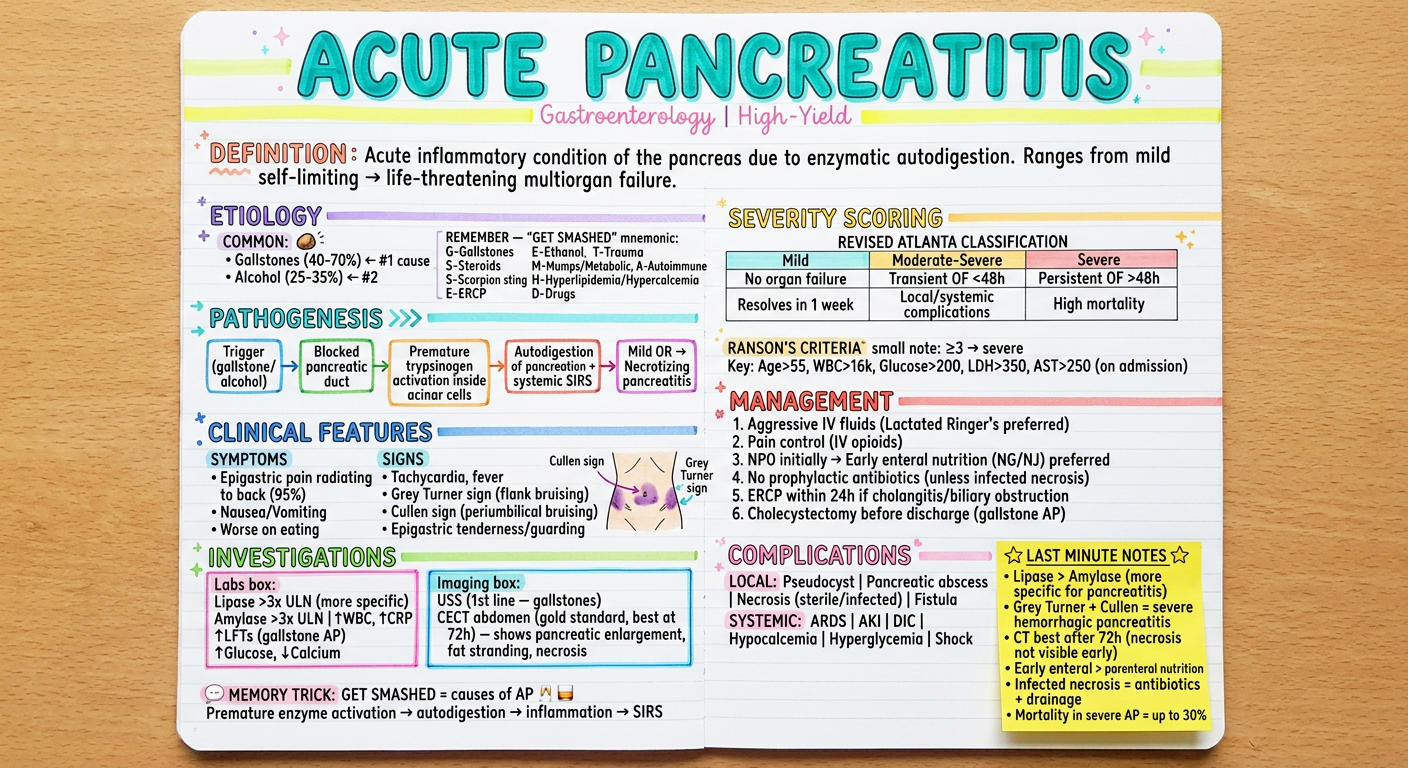
- Gallstones (#1, 40-70%) | Ethanol (#2, 25-35%) | Trauma | Steroids | Mumps/Metabolic | Autoimmune | Scorpion sting | Hypertriglyceridemia/Hypercalcemia | ERCP | Drugs
Pph management,treatment details,dosage,contraindication
postpartum hemorrhage PPH management drugs dosage oxytocin misoprostol tranexamic acid carboprost 2024 guidelines
https://www.safercare.vic.gov.au/best-practice-improvement/c…
A super aesthetic handwritten-style medical revision note page for "POST-PARTUM HAEMORRHAGE (PPH) - MANAGEMENT" — top-down view of a clean white lined notebook page. Neat, colorful, exam-oriented handwritten notes by a medical student. TOP HEADER: Large colorful bubble title "POST-PARTUM HAEMORRHAGE (PPH)" in bold red/coral marker with yellow highlight strip. Subtitle "Obstetrics | Management, Drugs & Dosage" in small purple cursive. Small uterus icon sketch beside title. SECTION 1 - DEFINITION + CLASSIFICATION (coral/orange underlined heading): Neat handwriting: "PRIMARY PPH: Blood loss ≥500 mL (vaginal) or ≥1000 mL (C-section) within 24 hrs of delivery" "SECONDARY PPH: Abnormal bleeding between 24 hrs – 12 weeks postpartum" Small box: "4 T's of Causes:" with colored arrows: TONE (70%) → TRAUMA (19%) → TISSUE (10%) → THROMBIN (1%) SECTION 2 - STEP-BY-STEP MANAGEMENT (teal underlined heading): Numbered steps in neat handwriting with small arrows: STEP 1: "CALL FOR HELP immediately — activate PPH protocol" STEP 2: "2 large-bore IV access + blood samples (FBC, crossmatch, coagulation, fibrinogen)" STEP 3: "IV fluid resuscitation — Crystalloid (NaCl 0.9% or LR) 3:1 ratio" STEP 4: "Uterine massage + bimanual compression" STEP 5: "UTEROTONICS (see drug table)" STEP 6: "Treat underlying cause (4 T's)" STEP 7: "If uncontrolled → surgical / interventional options" SECTION 3 - DRUG TABLE (blue/purple heading "UTEROTONIC DRUGS"): Neat hand-drawn table with colored column headers: Drug | Dose & Route | Mechanism | Key Contraindications Row 1 (green highlight): OXYTOCIN (1st line) | 10 IU IM or slow IV bolus; then 40 IU in 500ml infusion over 4h | Stimulates uterine contraction | Caution: rapid IV bolus → hypotension Row 2 (yellow highlight): ERGOMETRINE | 500 mcg IM or 250 mcg IV slowly | Sustained uterine contraction | ❌ Hypertension, pre-eclampsia, eclampsia, cardiovascular disease, hepatic/renal disease Row 3 (orange highlight): SYNTOMETRINE | 1 mL IM (oxytocin 5IU + ergometrine 0.5mg) | Combined action | ❌ Hypertension, cardiac disease Row 4 (pink highlight): CARBOPROST (Hemabate) PGF2α | 250 mcg IM every 15 min, max 8 doses (2mg total) | Prostaglandin — uterine tone | ❌ ASTHMA (absolute), relative: cardiac/hepatic/renal disease Row 5 (lavender highlight): MISOPROSTOL (PGE1) | 800-1000 mcg PR or 600-800 mcg SL | Prostaglandin — uterine tone | Caution: cardiovascular disease; not 1st line Row 6 (coral highlight): TRANEXAMIC ACID | 1g IV over 10 min; repeat after 30 min if needed (within 3 hrs) | Antifibrinolytic — inhibits plasmin | Caution: thromboembolism risk; NOT a uterotonic SECTION 4 - SURGICAL / INTERVENTIONAL OPTIONS (red heading, small box): Neat numbered list in two columns: Conservative surgical: Definitive: 1. Uterine packing/balloon 1. Uterine artery ligation 2. B-Lynch compression suture 2. Internal iliac artery ligation 3. Uterine artery embolisation 3. HYSTERECTOMY (last resort) Small B-Lynch suture sketch (simple diagram of uterus with suture shown) SECTION 5 - BLOOD PRODUCTS (orange heading): Small neat box: "MASSIVE TRANSFUSION PROTOCOL: pRBC : FFP : Platelets = 1:1:1" • pRBC — restore O2 carrying capacity • FFP — coagulation factors (if fibrinogen <2g/L) • Cryoprecipitate — fibrinogen replacement • Platelets — if count <50 × 10⁹/L SECTION 6 - CONTRAINDICATIONS QUICK SUMMARY (bright pink box): "❌ CONTRAINDICATIONS AT A GLANCE" • Ergometrine / Syntometrine → BP ≥140/90, pre-eclampsia, cardiac disease • Carboprost → ASTHMA (absolute CI), caution in hepatic/renal • Misoprostol → cardiovascular disease (caution) • Tranexamic acid → history of thromboembolism (caution) SECTION 7 - KEY POINTS / LAST-MINUTE BOX (yellow sticky note style, bottom right): "⭐ EXAM PEARLS" • Oxytocin = ALWAYS 1st line uterotonic • Ergometrine CI = Hypertension (classic MCQ!) • Carboprost CI = ASTHMA (classic MCQ!) • Tranexamic acid must be given within 3 hours • Misoprostol used when IV access unavailable • B-Lynch suture = uterine compression suture • Uterine atony = #1 cause of PPH (70%) • WOMAN trial → TXA reduces PPH mortality MEMORY TRICK (pink speech bubble, bottom left): "4 T's: Tone Trauma Tissue Thrombin" "Drug ladder: Oxytocin → Ergometrine → Carboprost → Misoprostol → Surgery" One-line summary: "PPH = obstetric emergency; 1st line = oxytocin + uterine massage + IV fluids" Overall style: cream/white lined notebook background, bright colorful marker headings (red, teal, purple, orange, blue), neat student handwriting mix (print + cursive), colored boxes and borders, small anatomical uterus sketch, underlines with wavy or double lines, stars for key points, colored table with pastel row highlights. Clean, organized 2-column layout. Professional neat exam cheat-sheet aesthetic. High-yield, crisp, beautiful.
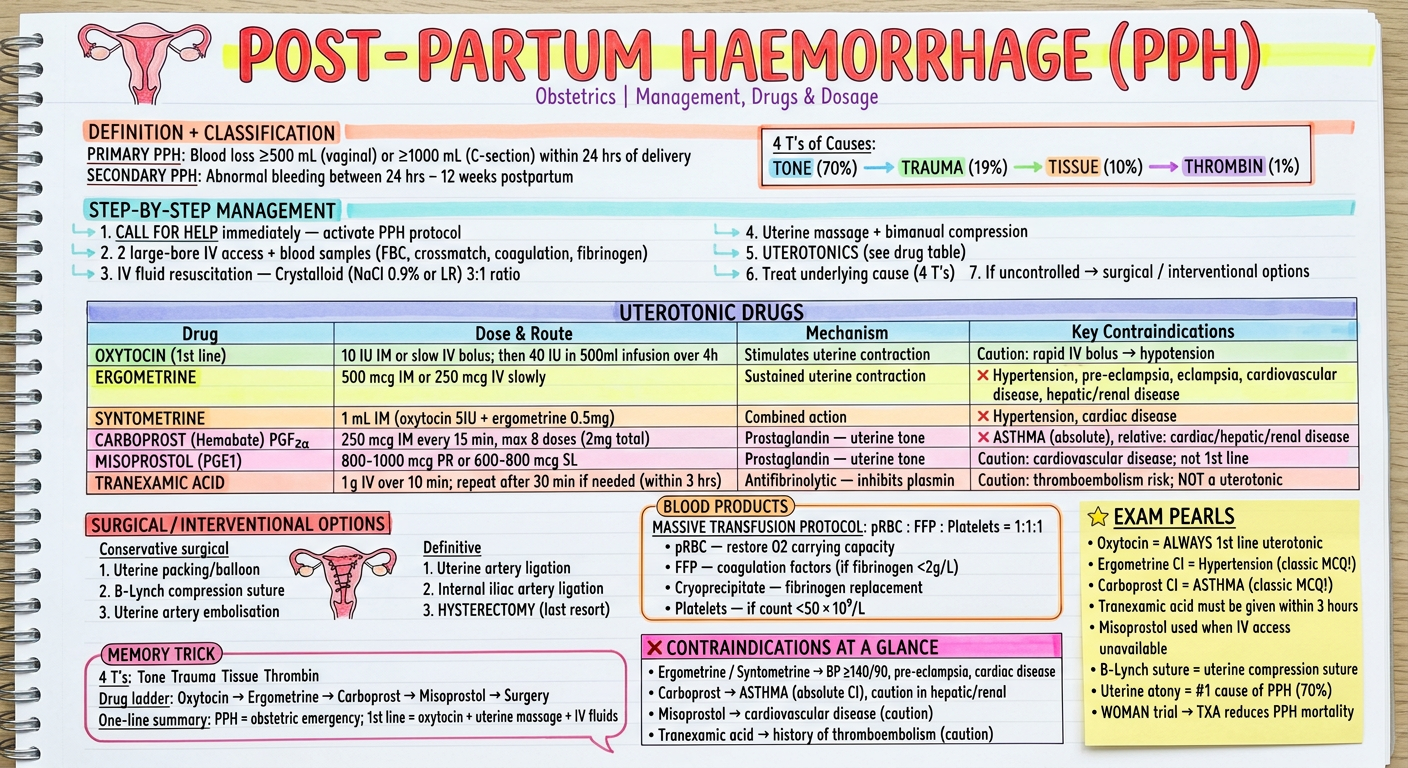
PPH - Key High-Yield Points
- Primary PPH: ≥500 mL blood loss (vaginal) / ≥1000 mL (C-section) within 24 hours
- Secondary PPH: Abnormal bleeding 24 hrs - 12 weeks postpartum
| Cause | % |
|---|---|
| Tone (uterine atony) | 70% |
| Trauma (lacerations) | 19% |
| Tissue (retained placenta) | 10% |
| Thrombin (coagulopathy) | 1% |
| Drug | Dose | Contraindications |
|---|---|---|
| Oxytocin (1st line) | 10 IU IM/slow IV; 40 IU in 500 mL infusion | Rapid IV → hypotension |
| Ergometrine | 500 mcg IM or 250 mcg IV slowly | Hypertension, pre-eclampsia, cardiac disease |
| Syntometrine | 1 mL IM | Hypertension, cardiac disease |
| Carboprost (PGF2α) | 250 mcg IM q15 min, max 8 doses (2 mg) | ASTHMA (absolute CI), hepatic/renal disease |
| Misoprostol (PGE1) | 800-1000 mcg PR or 600-800 mcg SL | Cardiovascular disease (caution) |
| Tranexamic Acid | 1g IV over 10 min; repeat after 30 min if needed (within 3 hrs) | Thromboembolism risk (caution) |
- Ergometrine ❌ = Hypertension / Pre-eclampsia
- Carboprost ❌ = Asthma (absolute contraindication)
- Tranexamic acid - give within 3 hours (WOMAN trial evidence)
Eclampsia management
eclampsia management magnesium sulfate antihypertensives dosage protocol 2024 guidelines
https://medicalguidelines.msf.org/en/viewport/EssDr/english/…
Super aesthetic handwritten-style medical revision note page for "ECLAMPSIA - MANAGEMENT" — top-down view of a clean white lined notebook page. Neat, colorful, exam-oriented student handwriting with multiple ink colors. TOP HEADER: Large bold bubble title "ECLAMPSIA — MANAGEMENT" in deep purple/violet marker with pink highlight strip underneath. Small subtitle "Obstetrics | High-Yield Exam Notes" in coral cursive. Tiny brain+lightning bolt sketch beside title. SECTION 1 — DEFINITION (coral/orange underlined heading): "Eclampsia = New-onset grand mal seizures in a woman with pre-eclampsia (no other cause)" Small neat comparison box: Pre-eclampsia: HTN (≥140/90) + proteinuria after 20 wks Severe features: BP ≥160/110 OR HELLP OR end-organ damage Eclampsia: Pre-eclampsia + SEIZURES ← EMERGENCY! "Can occur antepartum (38%), intrapartum (18%), or postpartum (44%)" SECTION 2 — IMMEDIATE ABC MANAGEMENT (red/coral heading with numbered steps): Neat numbered steps with arrows: 1. POSITION — Left lateral decubitus (prevent aortocaval compression) 2. AIRWAY — O2 via face mask, suction, protect airway 3. IV ACCESS × 2 large-bore + call for HELP 4. BLOODS — FBC, U&E, LFTs, coagulation, uric acid, crossmatch 5. FOLEY catheter — strict hourly urine output monitoring (>25-30 mL/hr) 6. Continuous fetal monitoring (CTG) 7. TREAT SEIZURE → MgSO4 (see box) 8. CONTROL BP → antihypertensives (see table) 9. DELIVER after stabilization — definitive treatment SECTION 3 — MAGNESIUM SULFATE (teal blue heading with star, double underline): Big highlighted treatment box with teal border: "MgSO4 = DRUG OF CHOICE for seizure control & prophylaxis" Mechanism: NMDA antagonist + Ca²⁺ antagonist + cerebral vasodilator + blood-brain barrier protection LOADING DOSE (bold): IV Protocol: 4–6 g in 100 mL NS over 15–20 min IV IM Protocol: 10 g IM (5 g each buttock) if no IV access MAINTENANCE DOSE: IV: 1–2 g/hour continuous infusion for 24 hours after last seizure or 24 hrs postpartum (whichever is later) IM: 5 g IM every 4 hours (alternate buttocks) RECURRENT SEIZURE: Additional bolus: 2 g IV over 5 min + increase infusion rate If seizures persist: Lorazepam 4 mg IV OR diazepam 10 mg IV Therapeutic serum level: 4–8 mEq/L (2–3.5 mmol/L) — small neat level note SECTION 4 — MgSO4 TOXICITY (bright pink/red warning box): "⚠️ MAGNESIUM TOXICITY — MONITOR FOR:" Neat table with two columns: Mg Level | Effect 4-8 mEq/L | Therapeutic (seizure prophylaxis) 5-10 mEq/L | Loss of patellar reflexes (FIRST SIGN!) 10-13 mEq/L | Respiratory depression >15 mEq/L | Cardiac arrest "BEFORE each dose check TRIAD:" ✓ Patellar reflexes PRESENT ✓ Respiratory rate >12/min ✓ Urine output >25 mL/hr (Mg excreted by kidneys!) ANTIDOTE box (bright yellow): "CALCIUM GLUCONATE 1 g IV over 10 min = antidote for MgSO4 toxicity — keep at bedside!" Contraindications to MgSO4: Myasthenia gravis | Severe renal failure | Heart block SECTION 5 — ANTIHYPERTENSIVE DRUGS TABLE (blue heading): "Control BP if ≥160/110 mmHg (persistent ≥15 min)" Neat hand-drawn table with pastel row highlights: Drug | Dose | Notes LABETALOL (1st line) | 20 mg IV bolus; repeat 40–80 mg q10 min, max 300 mg | Also oral: 200 mg | CI: Asthma, heart block, bradycardia HYDRALAZINE | 5–10 mg IV q20 min; max 30 mg | May cause reflex tachycardia | CI: Lupus, aortic dissection NIFEDIPINE (oral) | 10–20 mg oral; repeat in 30 min | Do NOT use sublingual | Do NOT combine with MgSO4 (synergistic hypotension — caution!) NICARDIPINE (IV) | 5–15 mg/hour infusion | Good alternative if IV needed Note: ACE inhibitors, ARBs, direct renin inhibitors ALL contraindicated in pregnancy! SECTION 6 — DELIVERY (green heading): "Delivery = ONLY DEFINITIVE TREATMENT" • Stabilize first (30-60 min): control seizures + BP • Mode: Vaginal preferred if feasible; C-section if obstetric indication • Timing: ≥37 wks → deliver immediately | <34 wks → corticosteroids + stabilize then deliver | <24 wks → deliver • Continue MgSO4 for 24 hours AFTER delivery SECTION 7 — HELLP SYNDROME CORNER (orange mini-box): "HELLP = Hemolysis + Elevated Liver enzymes + Low Platelets" • Complicates 10-20% of severe pre-eclampsia • Labs: ↑LDH, ↑AST/ALT, ↓platelets (<100×10⁹/L), schistocytes on smear • Management: Same as eclampsia + transfuse if platelets <50 SECTION 8 — LAST MINUTE EXAM BOX (yellow sticky note, bottom right): "⭐ EXAM PEARLS" • MgSO4 = 1st line for seizures (NOT phenytoin/diazepam as 1st choice) • Patellar reflexes lost FIRST sign of toxicity • ANTIDOTE = Calcium Gluconate • Labetalol CI = ASTHMA (remember with carboprost too!) • ACE inhibitors/ARBs = absolute CI in pregnancy • Do NOT give MgSO4 if no urine output (renal excretion) • Postpartum eclampsia most common (44%) • BP target: <160/110 in pregnancy MEMORY TRICK (pink speech bubble, bottom left): "MgSO4 toxicity: Reflexes → Respiration → Cardiac (R-R-C)" "ANTIDOTE: Ca Gluconate — always at bedside!" One-line summary: "Eclampsia = seizure + pre-eclampsia → Left lateral, O2, MgSO4, control BP, then DELIVER" Overall style: Cream white lined notebook, colorful marker headings (purple, teal, coral, red, green, blue), neat student handwriting (print + cursive mix), warning boxes with zigzag borders, highlighted key words in yellow, colored table rows (pastel), small sketch of brain with lightning bolt for seizure, double underlines for key points, stars for exam pearls, clean professional yet handmade look. Two-column layout where space allows. High-yield crisp aesthetic cheat-sheet.
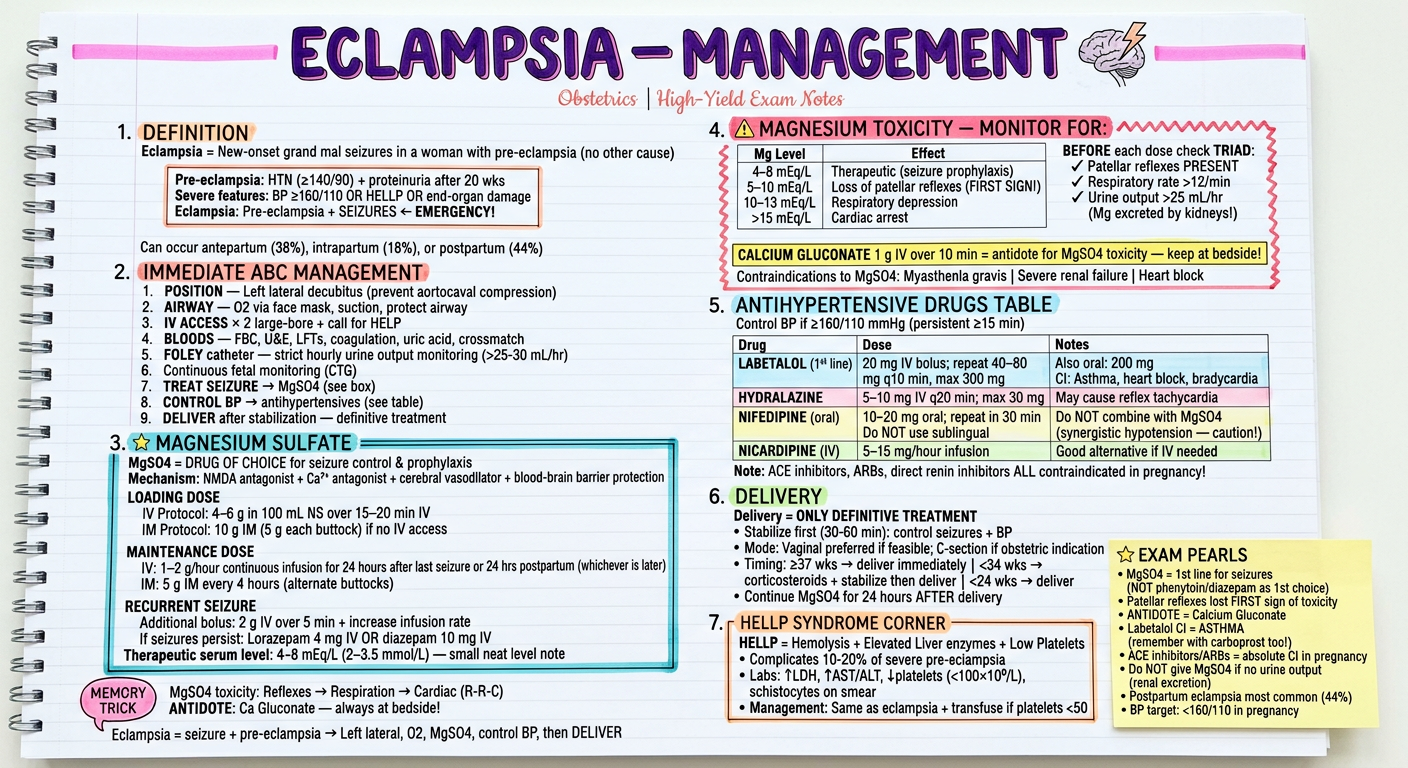
Eclampsia - Complete Management Summary
Immediate Steps (ABC + obstetric)
- Left lateral position (aortocaval decompression)
- O2 via face mask + protect airway
- 2× large-bore IV + bloods (FBC, U&E, LFTs, coag, crossmatch)
- Foley catheter - strict hourly urine output (target >25-30 mL/hr)
- Continuous CTG monitoring
- MgSO4 → seizure control
- Antihypertensives → if BP ≥160/110
- Deliver after stabilization
MgSO4 - Drug of Choice
| Protocol | Loading Dose | Maintenance |
|---|---|---|
| IV | 4–6 g in 100 mL NS over 15–20 min | 1–2 g/hr for 24 hrs after last seizure/delivery |
| IM (no IV access) | 10 g IM (5 g each buttock) | 5 g IM every 4 hrs |
| Recurrent seizure | Extra 2 g IV bolus | Increase infusion rate |
MgSO4 Toxicity - "R-R-C" Mnemonic
| Mg Level | Effect |
|---|---|
| 5–10 mEq/L | Loss of patellar reflexes (FIRST sign!) |
| 10–13 mEq/L | Respiratory depression |
| >15 mEq/L | Cardiac arrest |
- ✅ Patellar reflex present
- ✅ RR >12/min
- ✅ Urine output >25 mL/hr
Antihypertensives (target BP <160/110)
| Drug | Dose | Contraindication |
|---|---|---|
| Labetalol (1st line) | 20 mg IV → repeat 40–80 mg q10 min; max 300 mg | Asthma, heart block, bradycardia |
| Hydralazine | 5–10 mg IV q20 min; max 30 mg | Lupus, aortic dissection |
| Nifedipine (oral) | 10–20 mg oral; repeat in 30 min | Caution with MgSO4 (additive hypotension) |
| Nicardipine | 5–15 mg/hr IV infusion | - |
Key Exam MCQs
- MgSO4 = 1st line (NOT phenytoin, NOT diazepam as primary)
- Patellar reflex = first thing to disappear in toxicity
- Calcium gluconate = antidote
- Labetalol CI = Asthma
- Delivery = only definitive treatment; continue MgSO4 for 24 hrs postpartum
1p0ml NS or 13 ml NS for 4g Mgso4
4 g ÷ 0.5 g/mL = 8 mL of 50% MgSO4
How much diluent (NS)?
- 100 mL NS is correct for IV administration
- Neither "10 mL NS" nor "13 mL NS" is a standard dilution for the loading dose
Where does the confusion come from?
| Preparation | MgSO4 vol | Diluent | Total vol | Infuse over |
|---|---|---|---|---|
| Standard (WHO/RCOG) | 8 mL (50%) | 92 mL NS → total 100 mL | 100 mL | 15–20 min |
| Concentrated (some protocols) | 8 mL (50%) | 12 mL NS → total 20 mL | 20 mL | 10–15 min slow push |
| Pritchard IM protocol | 10 g IM (5 g each buttock) | No diluent | — | — |
Bottom line
| Question | Answer |
|---|---|
| Volume of 50% MgSO4 for 4 g | 8 mL |
| Standard diluent | 92 mL NS (total 100 mL) |
| "10 mL NS" correct? | ❌ No standard protocol |
| "13 mL NS" correct? | ❌ No standard protocol |
| Correct standard dilution | 8 mL MgSO4 + 92 mL NS = 100 mL total |