
Approch to glp1 analogue management in obesity
Reading File
GLP-1 receptor agonists (e.g., semaglutide, liraglutide, tirzepatide) work by mimicking incretin hormones to suppress appetite, slow gastric emptying, and promote satiety, leading to significant weight loss (10-22% body weight depending on agent). They are now a cornerstone of obesity pharmacotherapy.
Searching sources...
Finding Sources
Finding Sources
Searching PubMed
"GLP-1 receptor agonist" AND obesity AND management
Good - I have key source locations. Let me now read the Harrison's pharmacotherapy section and the Yamada's liraglutide section in parallel, plus search for more specific content.
Reading File
Finding Sources
Finding Sources
Excellent content. Let me now read the full Harrison's pharmacotherapy section on GLP-1/tirzepatide and the Sabiston surgical chapter on GLP-1 agonists.
Reading File
Reading File
Now let me read the tirzepatide/semaglutide section from Harrison's and look for the indications, contraindications, and monitoring approach.
Reading File
Finding Sources
Finding Sources
Let me fetch the weight loss comparison figure and read more of the tirzepatide section.
Loading Image
Reading File
I now have rich, comprehensive data from Harrison's (2025), Sabiston, and the comparative trial data. Let me compile the full, structured answer.
Approach to GLP-1 Analogue Management in Obesity
1. Background and Mechanism
GLP-1 receptor agonists (GLP-1 RAs) are incretin-mimetic agents that have become central to obesity pharmacotherapy. Their mechanism is multifactorial:
- Pancreatic effects: Stimulate glucose-dependent insulin secretion; inhibit glucagon secretion
- Gastrointestinal: Slow gastric emptying, prolonging satiety
- Central (hypothalamic): Activate GLP-1 receptors in the arcuate nucleus and nucleus tractus solitarius, suppressing appetite and reducing food intake
- Combined GIP/GLP-1 (tirzepatide): GIP receptor agonism in the brain acts synergistically with GLP-1 receptor activation to enhance weight loss
- Harrison's Principles of Internal Medicine 22E, p. 3236
2. Approved Agents for Obesity (Indications)
| Drug | Dose/Route | Approval for Obesity | Key Trial |
|---|---|---|---|
| Liraglutide (Saxenda) | 3.0 mg SC once daily | Adults (2014); Adolescents ≥12 yrs (2020) | SCALE program |
| Semaglutide (Wegovy) | 2.4 mg SC once weekly | Adults (2021); Adolescents (2022) | STEP program |
| Tirzepatide (Zepbound) | 5/10/15 mg SC once weekly | Adults (2023) | SURMOUNT program |
As of May 2024, 13 GLP-1 RAs are FDA approved; only liraglutide, semaglutide, and tirzepatide are specifically approved for obesity.
- Sabiston Textbook of Surgery, p. 3543; Harrison's, p. 3236-3237
3. Patient Selection - Who to Start
Standard indications (pharmacotherapy for obesity):
- BMI ≥ 30 kg/m² (obesity), OR
- BMI ≥ 27 kg/m² with at least one weight-related comorbidity (T2DM, hypertension, dyslipidemia, OSA, CVD)
- Failed lifestyle intervention (diet + exercise counseling)
Preferred when comorbidities present:
- T2DM - any GLP-1 RA (dual benefit)
- Established CVD - semaglutide 2.4 mg preferred (SELECT trial: 20% reduction in MACE)
- Heart failure with preserved EF - semaglutide (STEP-HFpEF trial benefit)
- Pre-bariatric surgery bridging - use to reduce operative risk in very high BMI
- Post-bariatric weight regain - semaglutide especially effective (~10% additional loss)
- Harrison's, p. 3236-3237; Sabiston, p. 3547
4. Dose Titration Protocol
Slow dose escalation is essential to minimize GI side effects:
Liraglutide
- Start: 0.6 mg SC once daily x 1 week
- Increase by 0.6 mg weekly
- Target: 3.0 mg SC daily
- Titration period: ~5 weeks
Semaglutide (Wegovy)
- Start: 0.25 mg SC once weekly x 4 weeks
- Escalate in 4-week increments: 0.5 mg → 1.0 mg → 1.7 mg → 2.4 mg
- Target: 2.4 mg SC weekly
- Full titration: ~17 weeks
Tirzepatide
- Start: 2.5 mg SC once weekly x 4 weeks
- Increase by 2.5 mg every 4 weeks
- Target: 5 mg, 10 mg, or 15 mg SC weekly (max 15 mg)
- Adjust upward based on tolerability
- Yamada's Textbook of Gastroenterology, p. 2149; Harrison's, p. 3237
5. Efficacy - Trial Data
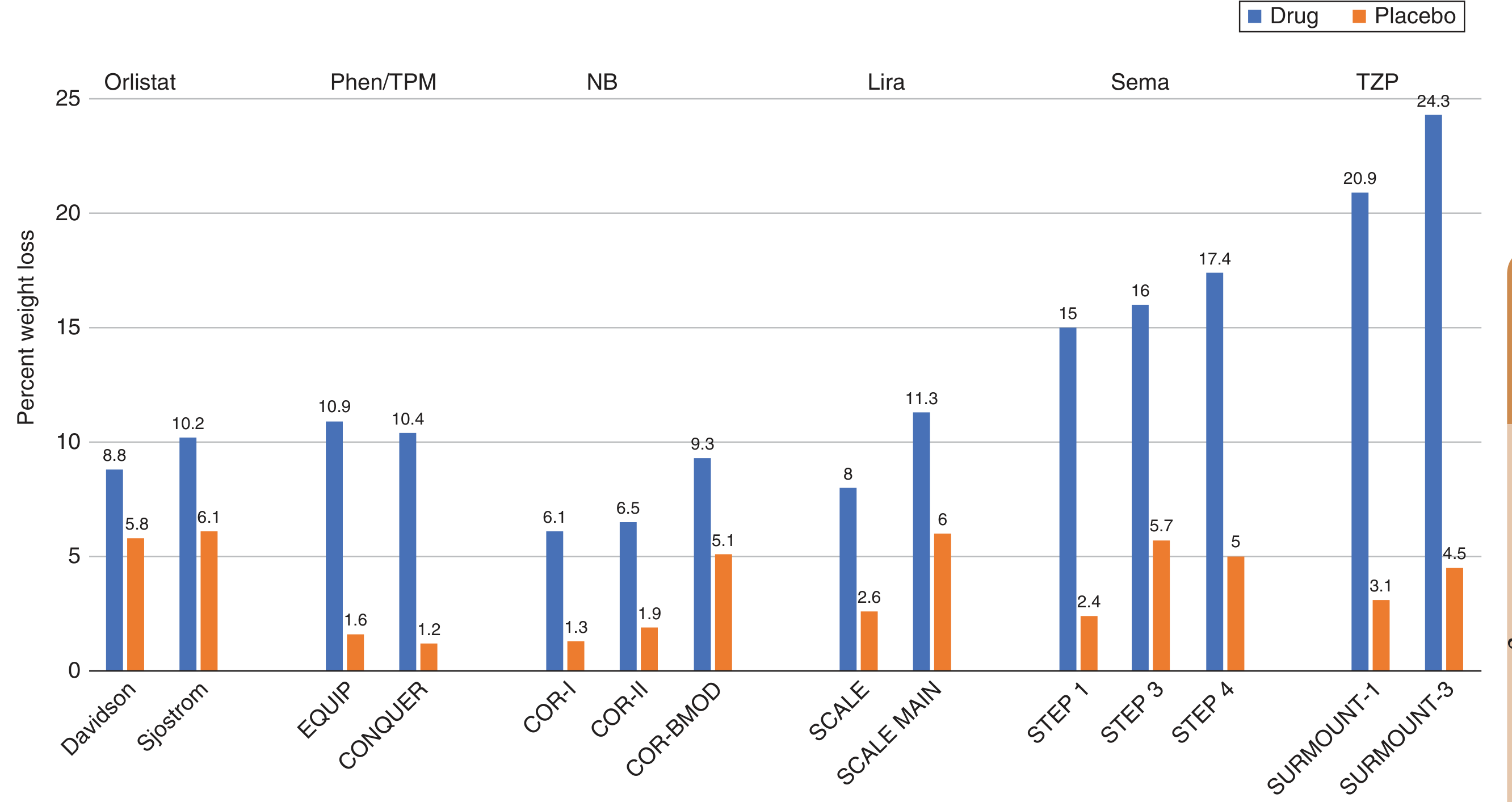
| Drug | Placebo-subtracted weight loss |
|---|---|
| Liraglutide | 3.4-6.1% (SCALE trials, 1 year) |
| Semaglutide | 6.2-14.8% (STEP 1-4, 68 wks); 12.6% at 104 wks (STEP 5) |
| Tirzepatide | 11.6-21.4% (SURMOUNT, 15 mg dose) |
Key meta-analysis (Sabiston): Pooled STEP + SURMOUNT data: placebo-subtracted body weight reduction of -12.9% with semaglutide, -19.2% with tirzepatide.
Important caveat: After stopping medication, approximately two-thirds of prior weight loss is regained within 1 year - these are likely chronic, long-term therapies.
- Harrison's, p. 3236-3237; Sabiston, p. 3545
6. Contraindications
Absolute:
- Personal or family history of medullary thyroid carcinoma (MTC)
- Multiple Endocrine Neoplasia type 2 (MEN2)
- Pregnancy (teratogenic risk; discontinue before conception attempt)
- Known hypersensitivity to the agent
Relative/precautions:
- History of pancreatitis (use with caution)
- Severe gastroparesis (GI slowing may worsen)
- Renal impairment (monitor for dehydration from GI side effects)
- Pre-operative context: increased aspiration risk - typically held for 1 week (liraglutide daily) or 2-4 weeks (semaglutide/tirzepatide weekly) before elective surgery per perioperative guidelines
- Harrison's, p. 3236-3237; Miller's Anesthesia, p. 1179-1184
7. Adverse Effects and Monitoring
Most common (class effect):
- Nausea, vomiting, diarrhea, constipation (generally mild and transient; peak during dose escalation)
- Injection site reactions
Serious but rare:
- Acute pancreatitis (monitor for abdominal pain; discontinue if suspected)
- Gallbladder disease / cholelithiasis (rapid weight loss increases risk)
- Tachycardia (mild, usually transient)
- Eustachian tube dysfunction (emerging adverse event signal from recent systematic review, PMID 39666743)
Monitoring parameters:
- Weight / BMI at each visit
- Blood glucose (hypoglycemia risk when combined with insulin/sulfonylurea)
- HbA1c if diabetic
- Renal function if GI side effects significant (dehydration)
- Thyroid (clinical vigilance; routine calcitonin not universally recommended)
8. Assessing Response and Adjusting Therapy
A standard benchmark:
- If < 5% weight loss after 12-16 weeks at the target dose → consider switching agent or augmenting with lifestyle/behavioural therapy
- If ≥ 5% weight loss → continue; reassess comorbidity improvement
- Reassess at 16 weeks; if inadequate response, consider:
- Escalating to higher dose tier (e.g., tirzepatide 10 → 15 mg)
- Adding complementary medication (e.g., phentermine/topiramate or naltrexone/bupropion if not already on)
- Referral for bariatric surgery evaluation (if BMI criteria met)
9. Special Populations
| Population | Consideration |
|---|---|
| Adolescents (≥12 yrs) | Liraglutide and semaglutide approved; tirzepatide not yet |
| T2DM | All three agents confer dual metabolic benefit |
| Established CVD | Semaglutide preferred (SELECT trial: 20% MACE reduction) |
| HFpEF | Semaglutide (STEP-HFpEF trial) |
| Post-bariatric surgery | GLP-1 RAs useful for inadequate loss/regain; semaglutide superior to liraglutide |
| Pre-surgical (bariatric) | Use as bridge to lower BMI and reduce operative risk |
| Pre-general surgery | Hold 1-2 weeks (daily agents) or 2-4 weeks (weekly agents) before procedure |
10. Treatment Algorithm Summary
Obesity (BMI ≥30 or ≥27 + comorbidity)
         ↓
Lifestyle intervention (diet + exercise + behavioural therapy)
         ↓ Insufficient response
Pharmacotherapy: GLP-1 RA (first choice in most patients)
         ↓
Choose agent based on comorbidities:
  - CVD/HFpEF → Semaglutide 2.4 mg weekly
  - T2DM → Any GLP-1 RA; tirzepatide dual benefit
  - General obesity → Tirzepatide (greatest efficacy) or semaglutide
         ↓
Titrate slowly to target dose (4-17 weeks per agent)
         ↓
Assess response at 12-16 weeks at target dose
  ≥5% loss → Continue, monitor
  <5% loss → Reassess adherence, switch/add agent, or refer for bariatric surgery
         ↓
Long-term continuation (weight regains if stopped)
Recent Evidence Update
A 2025 Cochrane meta-analysis on tirzepatide for obesity (PMID: 41161687) and a 2024 systematic review/meta-analysis on tirzepatide efficacy including SURMOUNT-2 (PMID: 38850440) confirm its superiority in body weight reduction versus placebo, with the largest effects seen at the 15 mg dose. GLP-1 RAs as adjunct to bariatric surgery also show promise (PMID: 41071360 - Langenbecks Arch Surg, 2025).
Sources: Harrison's Principles of Internal Medicine 22E (2025), pp. 3236-3238 | Sabiston Textbook of Surgery, pp. 3541-3549 | Yamada's Textbook of Gastroenterology 7e | Miller's Anesthesia 10e | PubMed: PMID 38850440, 41161687, 41071360
This is a shared conversation. Sign in to Orris to start your own chat.