
Why vit d3 is given in hypoparathyroidism
Reading File
Finding Sources
Finding Sources
Reading File
Reading File
Finding Sources
Loading Image
Finding Sources
I now have comprehensive information to give a thorough, well-sourced answer.
Why Vitamin D3 is Given in Hypoparathyroidism
The short answer: PTH is the key activator of vitamin D in the kidney. Without PTH, vitamin D cannot be converted to its active form, so you must bypass this step by giving an active (or activatable) form of vitamin D to correct hypocalcemia.
Here is the full explanation:
Normal Calcium Homeostasis - the Role of PTH and Vitamin D
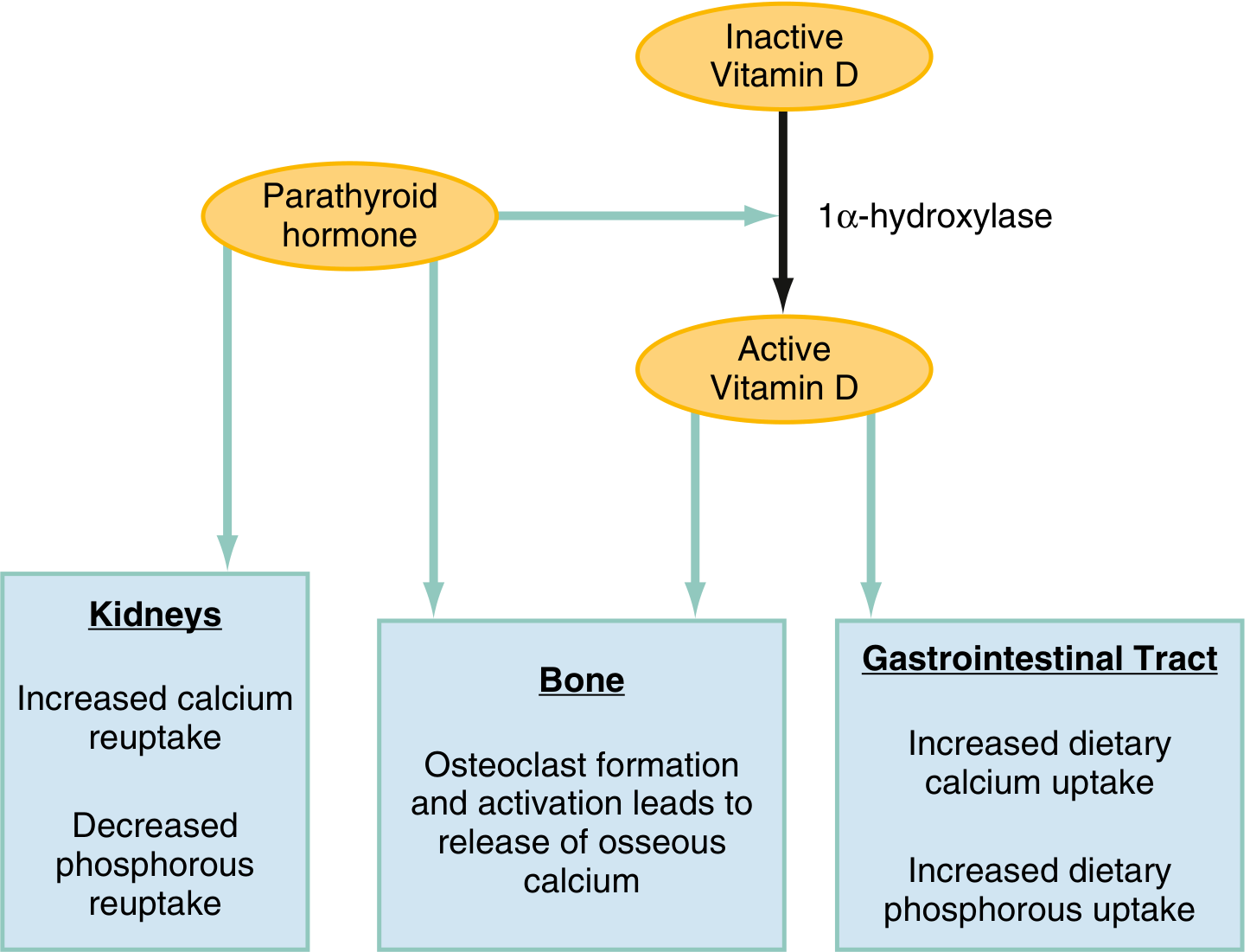
PTH and active vitamin D (calcitriol) work together to raise serum calcium via three organs:
| Target | PTH effect | Active Vit D effect |
|---|---|---|
| Kidney | Increases Ca2+ reabsorption, phosphate excretion, stimulates 1α-hydroxylase | Increases Ca2+ and phosphate reabsorption |
| Bone | Activates osteoclasts via RANKL → releases osseous Ca2+ | Promotes osteoclast formation |
| GI Tract | Indirect (via Vit D activation) | Directly increases dietary Ca2+ and phosphate absorption |
- Rosen's Emergency Medicine, p. 2486
- Basic Medical Biochemistry - A Clinical Approach, 6e
The Key Problem in Hypoparathyroidism
In hypoparathyroidism, PTH is absent or deficient. This causes:
- Hypocalcemia - bone resorption falls, renal Ca2+ reabsorption falls, GI absorption falls
- Hyperphosphatemia - kidneys cannot excrete phosphate without PTH
- Failure to activate vitamin D - because PTH is the primary stimulus for renal 1α-hydroxylase (CYP27B1), the enzyme that converts 25-hydroxyvitamin D (inactive) into 1,25-dihydroxyvitamin D (calcitriol, active form)
So even if dietary vitamin D intake is normal, it remains stuck in its inactive 25-OH form and cannot raise calcium.
- Comprehensive Clinical Nephrology, 7th Edition: "PTH promotes the synthesis of calcitriol by stimulating 1-alpha hydroxylase, which converts substrate 25-hydroxyvitamin D into its active form."
Why Give Vitamin D3 (or Active Analogues)?
Vitamin D and its analogues are the mainstay of therapy for hypoparathyroidism because they bypass the need for PTH-driven activation:
- Calcitriol (1,25-dihydroxyvitamin D3) is the active form and does NOT require PTH or kidney activation - it acts directly on the gut, kidney, and bone. It is preferred for rapid correction or temporary treatment.
- Vitamin D3 (cholecalciferol) requires only hepatic 25-hydroxylation - it bypasses the missing renal activation step and can raise calcium, though high doses may be needed since 1α-hydroxylase activity is low.
- Alfacalcidol (1α-hydroxyvitamin D3) needs only hepatic conversion to calcitriol, so it also bypasses the renal step.
By providing active or semi-active vitamin D, you restore the intestinal absorption of calcium and bone turnover that PTH can no longer drive.
- Goodman & Gilman's Pharmacological Basis of Therapeutics: "Vitamin D and its analogues are the mainstay of the therapy of hypoparathyroidism... calcitriol may be preferred for temporary treatment of hypocalcemia while awaiting effects of a slower-acting form of vitamin D."
- Katzung's Basic and Clinical Pharmacology, 16th Edition: "Standard therapy involves the use of calcitriol and dietary calcium supplements."
- Goldman-Cecil Medicine: "The main treatments for the hypocalcemia due to hypoparathyroidism are vitamin D preparations and supplemental calcium."
Standard Treatment Regimen
| Situation | Treatment |
|---|---|
| Acute/severe hypocalcemia | IV calcium gluconate + oral calcitriol |
| Chronic hypoparathyroidism | Calcitriol (0.25-1.0 µg/day) + oral calcium supplements |
| Refractory cases | Recombinant PTH (rhPTH 1-84 / Natpara) to reduce Vit D and calcium doses |
- Harrison's Principles of Internal Medicine 22E (2025): "Conventional treatment has involved increasing serum calcium by administration of active vitamin D (calcitriol) combined with oral calcium supplementation."
Summary
| Step | Normal | Hypoparathyroidism |
|---|---|---|
| PTH secretion | Present | Absent/low |
| Renal 1α-hydroxylase activation | PTH drives it | Not stimulated |
| 25-OH Vit D → Calcitriol | Occurs normally | Blocked |
| Serum calcium | Normal | Low |
| Fix | - | Give calcitriol/Vit D3 to bypass PTH-dependent activation |
This is why calcitriol (active Vit D) or high-dose cholecalciferol (Vit D3) is used - not because vitamin D itself is deficient, but because the PTH-dependent activation step is missing, and supplementation bypasses this enzymatic block.
This is a shared conversation. Sign in to Orris to start your own chat.