
30 year old male patient Pain in right lilac region and right loin and also pain in left iliac region since 1 day
Reading File
Now let me search the medical library for relevant content on this clinical presentation.
Finding Sources
Finding Sources
Reading File
Reading File
Finding Sources
Finding Sources
Finding Sources
Reading File
Finding Sources
Finding Sources
Finding Sources
Now I have sufficient information to give a comprehensive answer. Let me also fetch the pain diagram image for visual context.
Loading Image
Here is a structured clinical analysis for this presentation:
Clinical Analysis: 30-Year-Old Male
Presenting complaint: Right iliac fossa (RIF) + right loin pain + left iliac fossa (LIF) pain - 1 day duration
Most Likely Diagnosis: Bilateral Ureteric Calculi (Top Priority)
The combination of right loin + right iliac fossa pain is the classical distribution of ureteric colic. The involvement of the left iliac fossa simultaneously strongly points to bilateral ureteric stones, which is a urological emergency.
From S Das - A Manual on Clinical Surgery:
"When the stone is in the upper 1/3rd of the ureter, pain starts in the loin or near the renal angle and gradually radiates to the groin... At a lower level, pain commences rather anteriorly just above the iliac crest and is referred along the branches of the genitofemoral nerve to the testis in the male." - S Das, Manual on Clinical Surgery
The right loin-to-RIF radiation = right ureteric stone. The left iliac fossa pain = left ureteric stone (lower third, no loin component yet, or loin pain was not volunteered).
Key features to ask about:
- Colicky, episodic, severe griping pain (comes and goes suddenly)
- Radiation to the right testis or inner thigh
- Haematuria (frank or microscopic)
- Nausea/vomiting
- Dysuria or strangury (if stone near vesicoureteric junction)
- Previous stone history
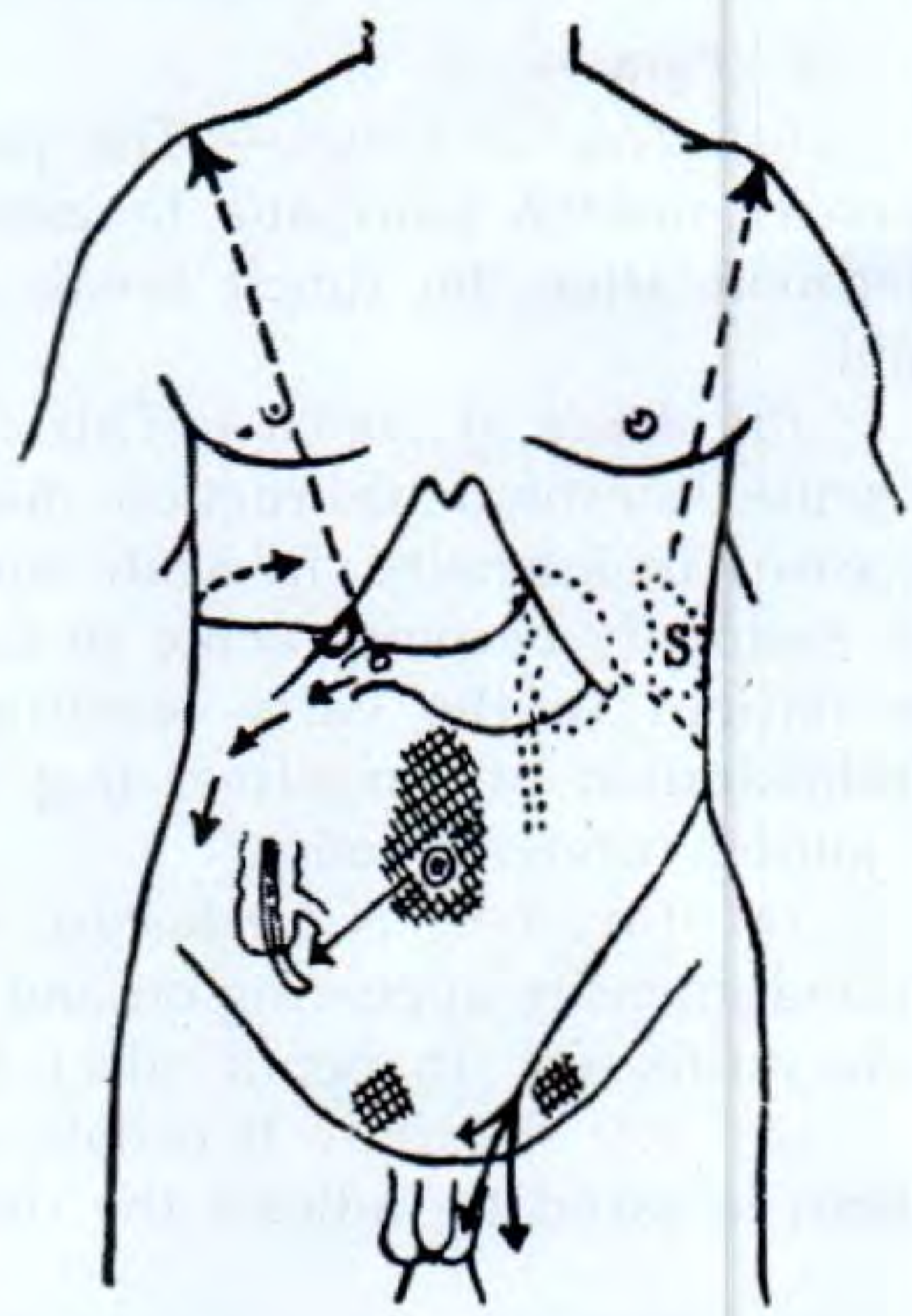
Differential Diagnoses
Right-Sided (RIF + Loin)
| Diagnosis | Supporting Features | Against |
|---|---|---|
| Ureteric colic (right) | Colicky loin-to-groin pain, haematuria, young male | - |
| Acute appendicitis | RIF pain, male age group, fever, anorexia, nausea | No classical periumbilical-to-RIF migration described; bilateral involvement unusual |
| Testicular torsion | RIF pain can be referred from torsion in young males - "easily missed" (Bailey & Love) | Check the scrotum in every case |
| Renal pathology | Hydronephrosis, PUJ obstruction - constant gnawing loin pain | Usually unilateral |
| Rectus sheath haematoma | RIF pain after strenuous exercise, no GI upset | Rare |
| Psoas abscess / IlIocaecal TB | RIF mass, vague ill health, weight loss | Duration only 1 day |
| Crohn's disease (terminal ileitis) | RIF pain, chronic, diarrhoea | Acute onset 1 day |
| Perforated duodenal ulcer | Rigidity, pain migrating to RIF via right paracolic gutter | Would be peritonitic and unwell |
Left-Sided (LIF)
| Diagnosis | Supporting Features |
|---|---|
| Ureteric colic (left) | Part of bilateral stone disease |
| Sigmoid diverticulitis | LIF pain, but unusual at age 30 |
| Constipation / sigmoid distension | Common, may co-exist |
Immediate Workup
Bedside
- Urine dipstick - haematuria strongly supports ureteric colic
- Urine microscopy and culture (rule out infection/pyonephrosis)
- Temperature, pulse, BP - fever + loin pain = infected obstructed kidney (emergency)
- Examine the scrotum (rule out torsion)
Bloods
- FBC (leucocytosis suggests inflammation/infection)
- Serum creatinine and electrolytes (renal function - bilateral obstruction risk)
- Serum amylase/lipase (exclude acute pancreatitis in RIF/loin pain differential)
- Serum uric acid, calcium (stone workup)
Imaging
- CT KUB (non-contrast CT abdomen/pelvis) - gold standard for urolithiasis, shows stones, hydronephrosis, and excludes other pathology
- Ultrasound abdomen - quick, no radiation, detects hydronephrosis, appendix if visualised, can assess for appendicitis
- X-ray KUB - only shows radio-opaque stones (calcium oxalate/phosphate); misses uric acid stones
Red Flags Requiring Urgent Action
If this patient has bilateral ureteric obstruction + fever or rising creatinine, this is a urological emergency requiring same-day urology review and possible nephrostomy or JJ stenting.
- Fever + rigidity = infected obstructed kidney -> sepsis risk
- Bilateral obstruction = acute obstructive uropathy -> renal failure
- Inability to pass urine = complete bilateral obstruction
Initial Management (While Awaiting Workup)
- Analgesia: NSAIDs (diclofenac 75 mg IM or rectal) are first-line for ureteric colic - superior to opioids for ureteric smooth muscle; ketorolac IV is an alternative
- IV fluids if vomiting
- Alpha-blocker (tamsulosin 0.4 mg OD) - facilitates stone passage (medical expulsive therapy) for stones <10 mm
- NPO if surgical intervention looks likely
- Urgent urology referral given bilateral involvement
Bottom line: This 30-year-old male almost certainly has bilateral ureteric calculi until proven otherwise. The combination of right loin + right and left iliac fossa pain is the anatomical hallmark. Bilateral obstruction needs urgent imaging and urology input today. - Bailey and Love's Short Practice of Surgery 28th Ed; S Das Manual on Clinical Surgery 13th Ed
This is a shared conversation. Sign in to Orris to start your own chat.