
Dendue management in 11 year boy
Reading File
Now let me search the medical library for dengue management in children.
Finding Sources
Finding Sources
Searching PubMed
"dengue fever"[MeSH Terms] AND "child"[MeSH Terms] AND management
Reading File
Finding Sources
Reading File
Reading File
Reading File
Finding Sources
Loading Image
Loading Image
Searching the Web
WHO dengue management guidelines 2024 children pediatric
Now I have comprehensive information. Let me compile a thorough answer.
Dengue Management in an 11-Year-Old Boy
An 11-year-old falls squarely in the school-age/pediatric category for dengue. The key principle is risk stratification using the WHO classification, then applying the correct treatment arm. Severe dengue (formerly DHF) is more likely in children with a second infection.
Step 1 - Classify the Child (WHO 2009/2015 Framework)
| Group | Features | Action |
|---|---|---|
| Group A (Dengue, no warning signs) | Fever, rash, myalgia, headache; tolerates oral fluids; urine output adequate | Outpatient management |
| Group B (Warning signs present) | Abdominal pain, persistent vomiting (≥3 episodes/hr), mucosal bleeding, lethargy, liver enlargement ≥2 cm, rising haematocrit | Hospital admission, IV access |
| Group C (Severe dengue) | Shock, respiratory distress from plasma leakage, severe bleeding, severe organ impairment (myocarditis, encephalitis, hepatitis with ALT/AST >1000) | ICU-level care |
Warning signs in a child signal imminent plasma leakage - the critical period is typically day 3-6 as fever defervesces.
Step 2 - Baseline Investigations
- Full blood count (FBC): Do at first visit to establish baseline haematocrit and platelet count
- Serial haematocrit from day 3 onwards - a rise ≥20% from baseline signals plasma leakage
- Rising haematocrit + falling platelet count = progress toward DHF
- Dengue serology/NS1 antigen: NS1 is positive early (days 1-5); IgM/IgG from day 4-5
Group A Management (Outpatient)
For a child who is alert, drinking well, and urinating at least every 6 hours:
- Oral fluids: Oral rehydration solution (ORS), coconut water, fruit juices - adequate intake can prevent hospitalization. Plain water alone is insufficient (needs electrolytes).
- Antipyretic: Paracetamol only - 10-15 mg/kg/dose, no more than every 6 hours. Do NOT give aspirin (risk of Reye's syndrome in children), ibuprofen, or other NSAIDs (worsen bleeding and gastritis).
- Tepid sponging for high fever.
- Return immediately if any of these develop:
- Severe abdominal pain
- Persistent vomiting
- Cold, clammy extremities
- Bleeding (black tarry stools, coffee-ground vomit, gum/nasal bleeding)
- Restlessness, irritability, or excessive drowsiness
- No urine for 4-6 hours
- Daily monitoring by healthcare provider: temperature, fluid intake/output, urine frequency, haematocrit, platelet count.
Group B Management (DHF Grade I & II - Hospital)
DHF Grade I: Fever + thrombocytopenia + haemoconcentration + positive tourniquet test
DHF Grade II: Above + spontaneous bleeding (petechiae, gum bleeds, epistaxis, black stools)
DHF Grade II: Above + spontaneous bleeding (petechiae, gum bleeds, epistaxis, black stools)
- Hospitalise immediately
- IV access and monitoring
- Keep temperature below 39°C with paracetamol
- IV fluid if child cannot tolerate oral intake
IV Fluid Algorithm (DHF Grades I & II):
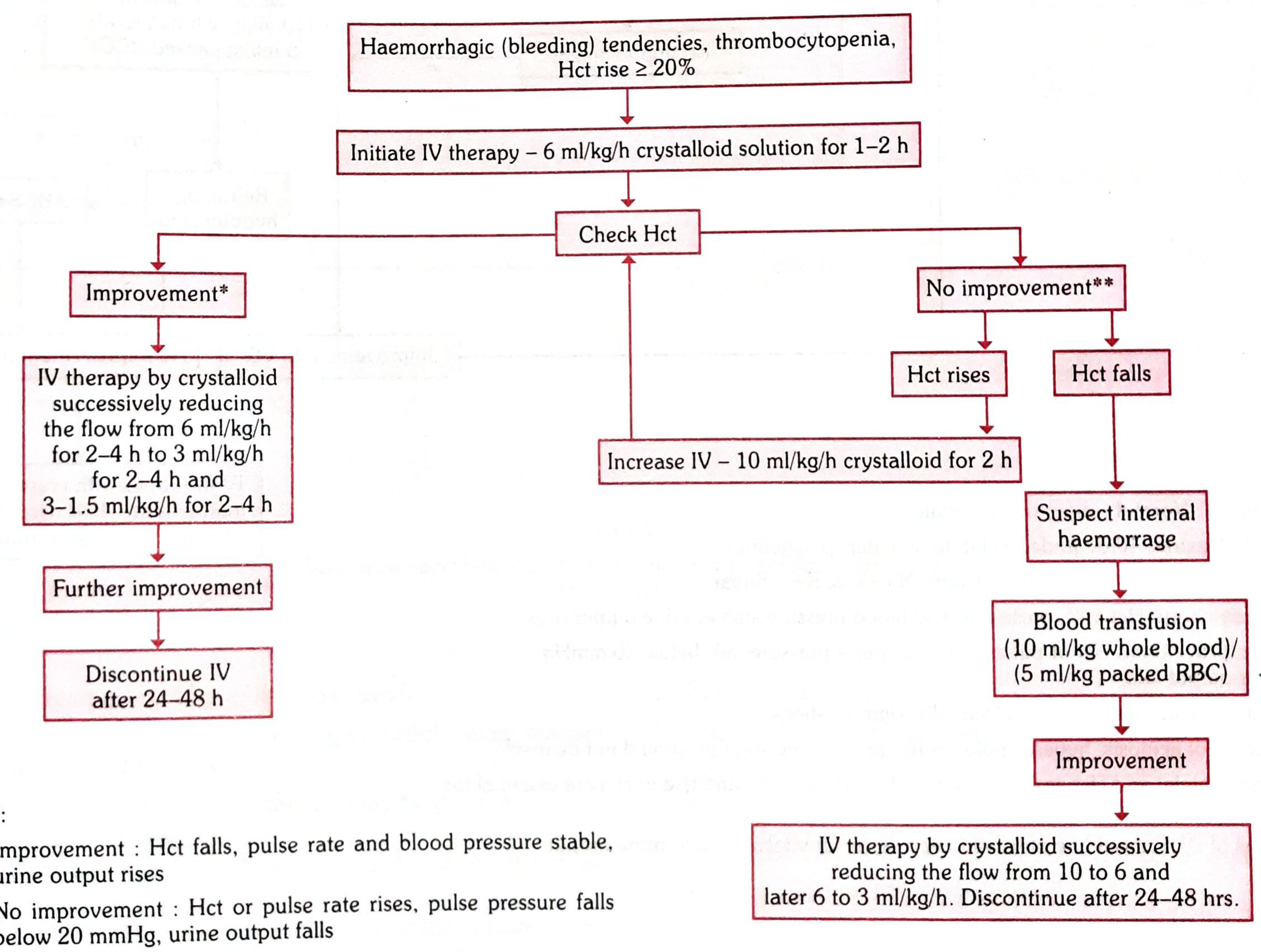
- Start IV crystalloid (normal saline or Ringer's lactate) at 6 ml/kg/hour for 1-2 hours
- Check haematocrit after:
- Improvement (Hct falls, stable vitals, urine output rises): reduce IV stepwise to 3 ml/kg/h then 1.5 ml/kg/h; discontinue after 24-48 hours
- No improvement, Hct rises: increase to 10 ml/kg/h crystalloid for 2 hours
- No improvement, Hct falls: suspect internal haemorrhage; give blood transfusion (10 ml/kg whole blood or 5 ml/kg packed RBCs)
Group C Management (DHF Grade III & IV / Dengue Shock Syndrome)
DHF Grade III: Features of Grade I/II + circulatory failure (weak rapid pulse, pulse pressure ≤20 mmHg, hypotension, cold clammy skin, restlessness)
DHF Grade IV: Profound shock - undetectable BP and pulse
DHF Grade IV: Profound shock - undetectable BP and pulse
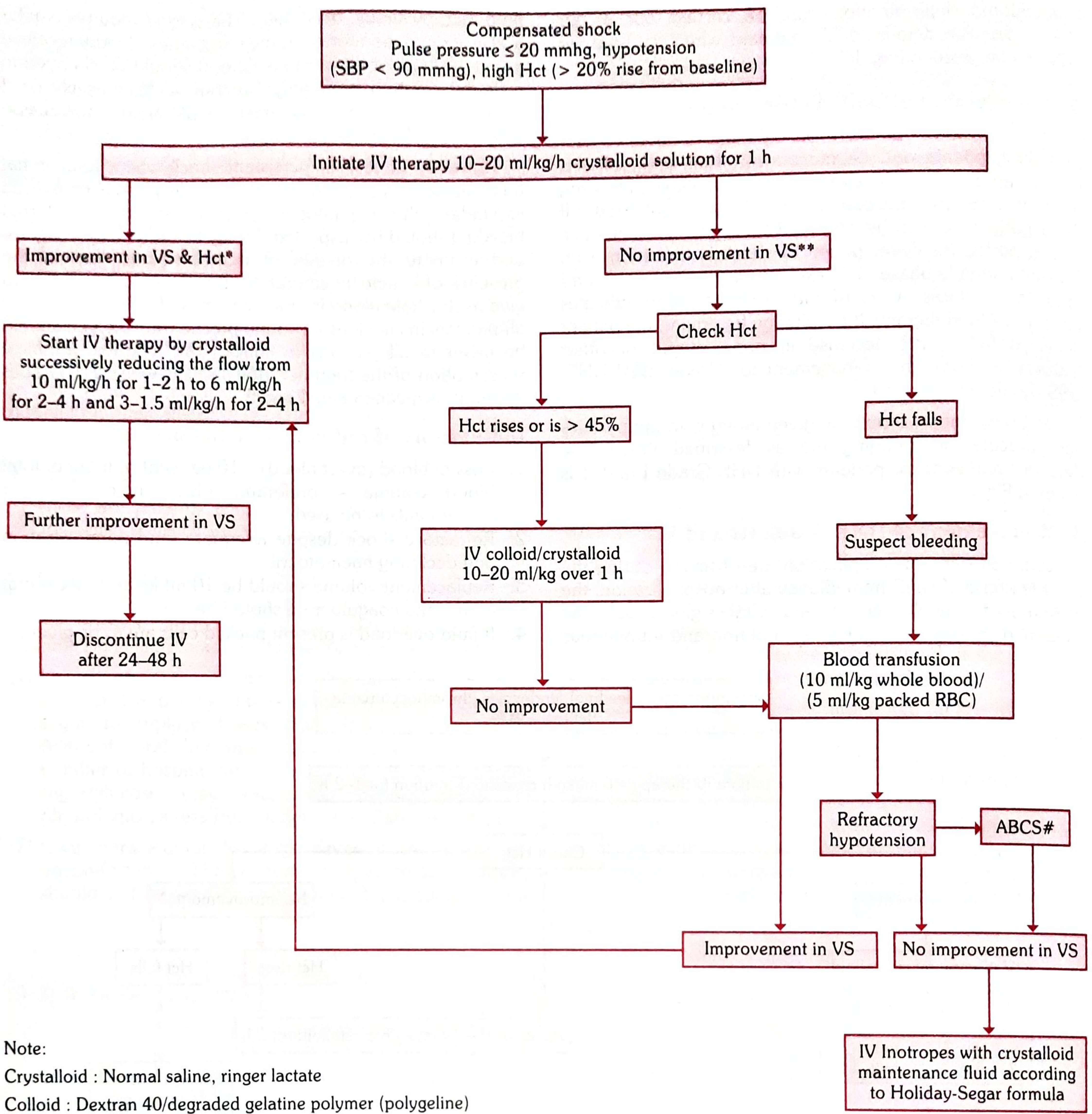
- IV crystalloid bolus: 10-20 ml/kg/h for 1 hour (aggressive resuscitation)
- Oxygen to all patients in shock
- Reassess vitals and haematocrit:
- Improved: Reduce fluids stepwise from 10 → 6 → 3 → 1.5 ml/kg/h; stop IV after 24-48 h
- No improvement, Hct rises or >45%: Switch to IV colloid/crystalloid 10-20 ml/kg over 1 hour
- No improvement, Hct falls: Suspect bleeding - transfuse (10 ml/kg whole blood / 5 ml/kg packed RBC)
- Refractory hypotension: Address ABCS - Acidosis, Bleeding, Calcium/electrolytes, Sugar; start IV inotropes + maintenance crystalloid using Holliday-Segar formula
Blood / Platelet Transfusion Indications
| Indication | Action |
|---|---|
| Overt blood loss ≥10% total blood volume | Whole blood or packed cells (10 ml/kg) |
| Refractory shock + declining haematocrit | Packed RBC (5 ml/kg) |
| Fluid overload present | Packed cells only (not whole blood) |
| Platelet transfusion | NOT routinely indicated; only for severe spontaneous bleeding with very low counts. Do not transfuse prophylactically. |
Drugs - Key Do's and Don'ts for Children
| Allowed | Avoid |
|---|---|
| Paracetamol (10-15 mg/kg, q6h max) | Aspirin (Reye's syndrome) |
| Oral/IV crystalloids | Ibuprofen/NSAIDs (worsen bleeding, gastritis) |
| Oxygen in shock | Antibiotics (no bacterial cause) |
| Inotropes in refractory shock | Steroids (no proven benefit, may worsen) |
Monitoring Targets
- Haematocrit every 4-6 hours in admitted children
- Urine output: aim for ≥0.5-1 ml/kg/hour
- Vital signs: pulse, BP, capillary refill
- Blood glucose (hypoglycaemia is a complication)
- Electrolytes (watch for hyponatraemia)
- Platelet count at least once daily
When to Discharge
The child can be discharged when:
- Afebrile for 48 hours without antipyretics
- Clinically improved, good appetite
- Adequate urine output
- No respiratory distress
- Haematocrit stable, platelet count rising (usually >50,000)
- No IV fluids for at least 24 hours
Sources:
Patient complaint of only fever and pain around eye
Fever + retro-orbital (peri-orbital) pain is a classic dengue presentation - this is the "breakbone fever" pattern. The child likely falls into Group A (dengue without warning signs) based on these two symptoms alone.
Searching sources...
Finding Sources
Finding Sources
Reading File
Reading File
This confirms the diagnosis and management. Here is the focused answer for this specific presentation:
Dengue - Fever + Retro-orbital Pain Only (11-Year-Old Boy)
This is Classic Dengue Fever, Group A
Fever with retro-orbital pain (pain behind/around the eyes) is one of the hallmark features of dengue. The WHO probable diagnosis criteria require fever + at least 2 of the following - and retro-orbital pain is explicitly listed:
- Headache
- Retro-orbital pain ✓ (present here)
- Myalgia / arthralgia / bone pain
- Rash
- Haemorrhagic manifestations
- Leucopenia / thrombocytopenia
Since there are no warning signs, this child is Group A - dengue without warning signs. He can be managed as an outpatient.
Why the Eye Pain Happens
Dengue virus causes inflammation of the periorbital and retrobulbar tissues. The pain is typically described as a deep, aching pain felt behind the eyes, often worsened by eye movement. It is caused by direct viral effect and local inflammatory cytokine release - not by any eye structure being infected. It resolves as the fever subsides.
Management Plan (Group A - Outpatient)
1. Medications
| Drug | Dose | Notes |
|---|---|---|
| Paracetamol | 10-15 mg/kg/dose every 6 hours (max 4 doses/day) | Only antipyretic allowed |
| Tepid sponging | As needed for high fever | Adjunct to paracetamol |
| No aspirin | Contraindicated | Risk of Reye's syndrome in children |
| No ibuprofen/NSAIDs | Contraindicated | Worsen bleeding risk and gastritis |
2. Fluids - Oral Hydration is the Priority
- Give ORS, coconut water, fruit juices - fluids with electrolytes and sugar, not plain water alone
- Adequate oral intake reduces risk of needing hospitalisation
- Target: urine output at least every 6 hours
3. Rest
- Bed rest at home; avoid strenuous activity
Investigations to Order Today
| Test | Purpose |
|---|---|
| Full blood count (FBC) | Establish baseline haematocrit + platelet count |
| NS1 antigen (if within day 1-5) | Early rapid diagnosis |
| Dengue IgM/IgG serology (from day 4-5 onwards) | Confirmatory |
| Repeat FBC daily from day 3 | Track rising Hct + falling platelets |
Red Flag Warning Signs - Bring Back to Hospital Immediately If:
The parents must be counselled to return without delay if any of the following develop:
- Severe or worsening abdominal pain
- Persistent vomiting (cannot keep fluids down)
- Bleeding - black tarry stools, vomiting blood, gum/nose bleed
- Cold, clammy hands or feet
- Lethargy, irritability, or confusion
- No urine for more than 4-6 hours
- Condition worsens as fever is coming down (day 3-6 is the critical window)
The most dangerous period is around defervescence (when fever drops) - this is when plasma leakage and shock can develop. The family must not assume the child is getting better just because the fever breaks.
Follow-up
- Daily review by a healthcare provider while febrile
- Monitor temperature, fluid intake/output, warning signs, haematocrit, and platelet count
- Expect illness to last 5-7 days total; retro-orbital pain usually resolves within 2-3 days as fever subsides
Sources: Park's Textbook of Preventive and Social Medicine, p. 293-294 | Harriet Lane Handbook, 23rd Ed., p. 606 | Tintinalli's Emergency Medicine, p. 1123
I gave him PCM 500 Bd and injection pcm I'm but no improvement
This is an important clinical escalation point. A few quick clarifying questions before advising further:
Asking for Preferences
Which day of illness is the child on now? · Do you have any blood reports (CBC/haematocrit/platelets)? · Any of these present now?
Day 3-4 is the single most dangerous window in dengue. This is exactly when the febrile phase transitions to the critical phase and plasma leakage begins - even if the child looks "okay" right now with no warning signs.
Reasoning...
Finding Sources
Finding Sources
Reading File
Action Required - Day 3-4 Dengue: No Labs Yet
The Problem with "No Improvement" on PCM
PCM (paracetamol) does not shorten dengue illness - it only manages fever symptomatically. In dengue, the fever persists for 5-7 days regardless of treatment. "No improvement" on PCM is therefore expected - the virus must run its course.
However, Day 3-4 is not the time to continue outpatient monitoring without blood tests. This is the pivot point.
⚠️ IMMEDIATE ACTION - Do These Now
1. Get Blood Tests TODAY - Cannot Wait
"Haematocrit should be determined daily from the third day until the temperature has remained normal for one or two days. Serial haematocrit determinations are the essential guide to treatment." - Park's Textbook of Preventive and Social Medicine
| Test | Why Urgent |
|---|---|
| Full Blood Count (FBC/CBC) | Check haematocrit (Hct) rise ≥20% = plasma leakage starting |
| Platelet count | Rapid fall + rising Hct = critical phase |
| NS1 antigen (if not done) | Confirm dengue |
| Liver function tests | ALT/AST - if >1000 IU = severe dengue |
Without these numbers, you are flying blind at the most dangerous point in dengue.
2. Escalate PCM Dose Correctly
PCM 500 mg twice daily (BD) is underdosing for an 11-year-old.
| Parameter | Current | Correct |
|---|---|---|
| Dose | 500 mg BD | 10-15 mg/kg per dose |
| Frequency | BD (2x/day) | Every 6 hours (QID/4 times/day) |
| Max doses | 2/day | 4 doses/day (no dose less than 6 hours apart) |
For an average 11-year-old (~30-35 kg): correct dose is 325-500 mg every 6 hours - so BD is correct in terms of dose size but the frequency is insufficient. Should be TDS or QID (every 6-8 hours), not BD.
3. Fluid Hydration - Push Oral Fluids Aggressively
If the child is tolerating oral fluids:
- ORS, coconut water, fruit juices, soups - copious amounts
- Aim for urine output at least every 6 hours
- Plain water alone is inadequate
If he is vomiting or refusing fluids - he needs IV fluids and admission regardless of other signs.
Decision Point Based on Blood Results
| Blood Result | Action |
|---|---|
| Hct normal, platelets >100,000 | Continue outpatient, daily CBC, push oral fluids |
| Hct rising ≥20% OR platelets <100,000 | Admit for IV fluid monitoring (DHF Grade I/II) |
| Hct rising + platelets <100,000 + any warning sign | Admit immediately, IV crystalloid 6 ml/kg/h |
| Platelets <20,000 OR active bleeding | Emergency admission |
Watch Closely Over Next 24-48 Hours
The fever may drop around day 4-5 - this is not reassurance. Defervescence is when plasma leakage peaks. A child who looks better because fever broke can deteriorate rapidly into shock within hours.
Return immediately if:
- Fever suddenly drops AND child becomes lethargic/restless
- Abdominal pain appears
- Hands/feet become cold or mottled
- Bleeding from any site
- No urine for >4-6 hours
- Vomiting persists
Bottom line: Get a CBC with haematocrit and platelet count right now. The management decision for the next 24 hours depends entirely on those numbers.
Source: Park's Textbook of Preventive and Social Medicine, p. 294-295
Refresh response
Here is the refreshed summary of the clinical situation:
Dengue - Day 3-4, 11-Year-Old Boy
Fever + Retro-orbital Pain | PCM Given | No Labs Yet
What "No Improvement" Actually Means
Paracetamol does not cure dengue - it only reduces fever temporarily. The virus runs for 5-7 days total. Persistent fever despite PCM is expected and normal in dengue. The real concern at Day 3-4 is not the fever itself - it is what is happening underneath (plasma leakage, falling platelets).
PCM Dosing Issue
| Given | Correct | |
|---|---|---|
| Dose | 500 mg | 10-15 mg/kg per dose (~350-500 mg for 30-35 kg child - acceptable) |
| Frequency | BD (twice daily) | Every 6 hours (QID) - BD is underdosing |
| Interval rule | - | Never less than 6 hours between doses |
Fix: Change to paracetamol 500 mg every 6-8 hours (not BD). IV paracetamol is appropriate if he is vomiting or refusing oral medication.
⚠️ Day 3-4 is the Critical Transition Window
"The critical period is during the transition from the febrile to the afebrile stage and usually occurs after the third day of illness."
- Park's Textbook of Preventive and Social Medicine
This is when plasma leakage begins. A child with no warning signs right now can deteriorate into shock within hours if haematocrit is silently rising.
IMMEDIATE Priority: Blood Tests - Cannot Be Delayed
No labs at Day 3-4 = flying blind at the most dangerous point.
| Test | What to Look For |
|---|---|
| Full Blood Count (CBC) | Haematocrit rise ≥20% from baseline = plasma leakage |
| Platelet count | Falling platelets + rising Hct = critical phase entered |
| NS1 antigen | Confirm dengue (still positive at day 3-4) |
| LFT (ALT/AST) | If >1000 IU = severe dengue, needs ICU |
Act on the Results
| CBC Result | Decision |
|---|---|
| Hct normal, platelets >100,000, no symptoms | Continue outpatient - push oral fluids, repeat CBC tomorrow |
| Hct rising OR platelets 100,000 or below | Admit - IV crystalloid 6 ml/kg/h |
| Any warning sign + abnormal CBC | Admit immediately |
| Platelets <20,000 or active bleeding | Emergency admission |
Oral Fluids - Push Aggressively
- ORS, coconut water, fruit juice, soup - NOT plain water alone
- Goal: urine every 6 hours minimum
- If vomiting or refusing fluids - admit for IV fluids regardless of CBC
Warning Signs - Admit Without Delay if Any Appear
| Sign | Significance |
|---|---|
| Severe abdominal pain | Plasma leakage / ascites |
| Persistent vomiting | Cannot maintain hydration |
| Cold / clammy extremities | Early shock |
| Lethargy or irritability | Reduced brain perfusion |
| Any bleeding (gums, black stool, skin petechiae) | DHF Grade II+ |
| No urine >4-6 hours | Renal hypoperfusion |
| Fever drops suddenly + child looks unwell | Most dangerous sign - this is when shock strikes |
What to Do Right Now - In Order
- Send CBC + platelet count immediately
- Correct PCM frequency to every 6-8 hours (not BD)
- Push oral fluids hard
- Reassess fully when results return
- If vomiting - admit and start IV fluids now, do not wait for labs
Source: Park's Textbook of Preventive and Social Medicine, p. 294-295 | Harriet Lane Handbook, 23rd Ed.
I gave him Nemusulide 100mg +PCM 325mg TDS
⚠️ STOP Nimesulide Immediately
This is a serious medication error that needs to be corrected right now.
Why Nimesulide is Contraindicated in Dengue
Nimesulide is an NSAID (Non-Steroidal Anti-Inflammatory Drug). In dengue, all NSAIDs are explicitly contraindicated because:
| Risk | Mechanism |
|---|---|
| Worsens bleeding | NSAIDs inhibit platelet aggregation - in a child already at risk of thrombocytopenia, this can trigger or worsen haemorrhage |
| Gastric bleeding | NSAIDs cause gastric mucosal damage - bleeding from gut is a recognised dengue complication and NSAIDs amplify this |
| Masks deterioration | Anti-inflammatory effect may suppress warning signs, delaying recognition of plasma leakage |
| Hepatotoxicity | Nimesulide is specifically known for liver toxicity - dengue already stresses the liver (raised ALT/AST); combination can cause acute liver failure |
"Do not give acetylsalicylic acid (aspirin), ibuprofen or other non-steroidal anti-inflammatory agents (NSAIDs) as these drugs may aggravate gastritis or bleeding."
- Park's Textbook of Preventive and Social Medicine
Nimesulide falls squarely in this category.
Additional Concern - Nimesulide in Children
Nimesulide is banned/restricted for use in children under 12 years in many countries (including India's regulatory warnings) due to:
- Risk of Reye's syndrome-like hepatotoxicity
- Acute liver failure reported in paediatric cases
- The child is 11 years old - this is a high-risk age group
What to Do Right Now
1. Stop Nimesulide immediately
Do not give the next dose.
2. Continue Paracetamol only
- PCM 325 mg alone is underdosed for an 11-year-old (~30-35 kg)
- Correct dose: 500 mg every 6-8 hours (10-15 mg/kg per dose)
- This is the only safe antipyretic in dengue
3. Check Liver Function NOW
Because nimesulide has already been given (multiple doses at TDS), check:
- ALT and AST - baseline liver status
- Full Blood Count - haematocrit + platelets (still urgently needed, Day 3-4)
- PT/INR if any bleeding signs present
4. Watch for Nimesulide-Related Harm
| Sign | Concern |
|---|---|
| Jaundice, yellow eyes | Hepatotoxicity |
| Dark urine | Hepatotoxicity |
| Unusual bleeding from any site | NSAID-induced platelet dysfunction |
| Vomiting blood or black stools | Gastric bleeding |
Corrected Drug Plan
| Drug | Dose | Frequency | Route |
|---|---|---|---|
| ✅ Paracetamol | 500 mg | Every 6-8 hours | Oral or IV |
| ❌ | STOP | - | - |
| ❌ | Avoid | - | - |
| ❌ | Avoid | - | - |
Bottom line: Nimesulide must be stopped now, liver function tests added to today's blood work, and paracetamol alone continued at correct dose and frequency.
This is a shared conversation. Sign in to Orris to start your own chat.