
Hyperprolactinemia
I'll start with a quick overview, then pull from the medical library for a thorough answer.
Hyperprolactinemia is elevation of serum prolactin above normal (typically >20 ng/mL in women, >15 ng/mL in men). The most common causes are prolactinomas, dopamine-antagonist drugs, hypothyroidism, and physiologic states (pregnancy, breastfeeding). It causes galactorrhea, hypogonadism, and infertility via suppression of GnRH pulsatility.
Searching sources...
Reading File
Now I'll search the library and PubMed in parallel.
Finding Sources
Searching PubMed
"hyperprolactinemia"[MeSH Terms] AND ("diagnosis" OR "treatment")
Good results. Now I'll read the key sections in parallel - Harrison's (most comprehensive), Goldman-Cecil, and Tietz for lab values.
Reading File
Reading File
Reading File
Excellent content. Let me now read the Harrison's treatment section and Goldman-Cecil continuation for management details.
Reading File
Reading File
I have comprehensive content. Let me now fetch the MRI images and read a bit more on prolactinoma treatment from Harrison's.
Loading Image
Loading Image
Reading File
I have a very thorough dataset now. Let me fetch the treatment flowchart image as well.
Loading Image
I now have everything needed for a thorough, well-structured answer. Here it is:
Hyperprolactinemia
Definition and Normal Values
Hyperprolactinemia is defined as a serum prolactin (PRL) level above the upper limit of normal. Normal PRL is generally <20 ng/mL in women and <15 ng/mL in men (though reference ranges vary slightly by assay). It is the most common hypothalamic-pituitary disorder encountered in clinical endocrinology and can affect fertility, gonadal function, and bone health.
- Prevalence: <1% of the general population, but up to 14% of women with abnormal menses
- PRL >200 ng/mL strongly suggests a prolactinoma (macroadenoma)
Physiology of Prolactin
- Secreted by lactotropes of the anterior pituitary
- Primarily under tonic inhibitory control by hypothalamic dopamine (DA) - dopamine keeps PRL suppressed under normal conditions
- Stimulatory factors: TRH, VIP, estrogen, serotonin, opioids
- Main physiologic roles: mammary gland development and lactation; suppresses GnRH pulsatility
Any process that reduces dopamine delivery to lactotropes (hypothalamic or stalk lesions, DA-blocking drugs) OR any autonomous PRL-secreting tumor leads to hyperprolactinemia.
Etiology / Causes
I. Physiologic
| Cause | Mechanism |
|---|---|
| Pregnancy | Estrogen stimulates lactotrope hyperplasia |
| Lactation / nipple stimulation | Suckling reflex arc |
| Sleep | Nocturnal PRL surge (reverts within 1h of waking) |
| Stress, exercise | Transient |
| Sexual orgasm | Transient |
II. Pharmacologic (Drug-Induced) - Very Common
Dopamine antagonists or agents disrupting dopaminergic tone:
- Antipsychotics (risperidone, haloperidol, phenothiazines) - risperidone can push PRL >200 ng/mL
- Antidepressants (TCAs, SSRIs less so)
- Antiemetics (metoclopramide, domperidone, prochlorperazine)
- Antihypertensives - methyldopa (inhibits DA synthesis), verapamil (blocks DA release)
- Opioids / H2 blockers (cimetidine)
- Estrogens (directly stimulate lactotropes)
- Drug-induced PRL is typically <100 ng/mL
III. Pathological - Pituitary / Hypothalamic
| Cause | PRL Level | Notes |
|---|---|---|
| Microprolactinoma (<1 cm) | Variable, often 100-250 ng/mL | Most common pituitary tumor in women |
| Macroprolactinoma (≥1 cm) | Often >250, can be in thousands | More common in men; mass effects |
| Stalk compression (any non-lactotrope mass) | Typically 30-100 ng/mL | Blocks dopamine delivery |
| Hypothalamic tumors/cysts | 30-100 ng/mL | Craniopharyngioma, germinoma |
| Infiltrative disease | 30-100 ng/mL | Sarcoidosis, histiocytosis X, TB |
| Radiation-induced damage | Varies | Loss of dopaminergic neurons |
| GH- or ACTH-secreting adenomas | Varies | Plurihormonal co-secretion |
IV. Systemic Disease
- Primary hypothyroidism - elevated TRH compensatorily stimulates both TSH and PRL (always check TSH)
- Chronic renal failure - reduced peripheral PRL clearance
- Cirrhosis - impaired PRL metabolism
- Polycystic ovarian syndrome (PCOS) - up to 30% have mildly elevated PRL
V. Macroprolactinemia (Artifact)
PRL can dimerize ("big prolactin") or complex with IgG ("big-big prolactin / macroprolactin") - these complexes are biologically inactive but measured as elevated by some immunoassays. This is a benign condition. Polyethylene glycol (PEG) precipitation differentiates macroprolactin from true monomeric PRL.
Pathophysiology of Symptoms
Elevated PRL suppresses hypothalamic GnRH pulsatility → decreased LH and FSH → hypogonadotropic hypogonadism.
- Women: low estrogen → menstrual irregularity → oligomenorrhea → amenorrhea; infertility; osteopenia (direct PRL effect + indirect estrogen deficiency)
- Men: low testosterone → decreased libido, impotence, oligospermia, reduced muscle mass, osteopenia; late presentation since male hypogonadism symptoms are subtle
- Both sexes: galactorrhea (PRL drives milk production when breast tissue is primed by estrogen)
Clinical Features
Women (Premenopausal)
- Amenorrhea or oligomenorrhea (most common presenting symptom)
- Galactorrhea - present in up to 80%; may be bilateral/spontaneous or unilateral/manual
- Infertility (anovulation)
- Decreased libido, vaginal dryness
- Mild hirsutism and weight gain
- Osteopenia/osteoporosis (with sustained hypoestrogenemia)
- Primary amenorrhea if onset before menarche
Note: Postmenopausal women do not develop galactorrhea despite elevated PRL because estrogen priming is absent.
Men
- Decreased libido, impotence (usually the presenting complaint)
- Oligospermia, infertility
- Osteopenia, reduced muscle mass, decreased beard growth
- Galactorrhea - rare (requires elevated estrogen, e.g., in cirrhosis)
- Visual field defects (bitemporal hemianopsia from optic chiasm compression by large tumor) - men often present late with macroadenomas
- Headaches
Diagnosis
Step 1: Serum PRL
- Measure under resting conditions (minimal stress, no breast stimulation, morning sample)
- Borderline elevation: repeat on at least 2 separate occasions
- PRL >200 ng/mL: very likely prolactinoma (macroadenoma)
- PRL 100-200 ng/mL: adenoma possible; MRI mandatory
- PRL <100 ng/mL: microadenoma, drug-induced, stalk effect, or systemic cause
Hook Effect (Prozone Effect): Very high PRL levels (macroprolactinoma with PRL >1000 ng/mL) can saturate the immunoassay antibodies and give a falsely low reading. Suspect this when a large pituitary mass has a "low" PRL - request serial dilutions.
Step 2: Exclude Secondary Causes
- TSH - rule out hypothyroidism
- Serum creatinine/BUN - rule out renal failure
- Pregnancy test (urine/serum hCG) in all women of reproductive age
- Drug history (careful medication review)
- Consider macroprolactin if PRL is mildly elevated with no symptoms (PEG precipitation assay)
Step 3: MRI of the Pituitary
- Indicated in all patients with:
- PRL >100 ng/mL
- Symptomatic hyperprolactinemia (galactorrhea, amenorrhea, visual symptoms)
- No obvious drug/systemic cause
- Classifies tumor as microadenoma (<1 cm) or macroadenoma (≥1 cm)
- For macroadenomas: also perform formal visual field testing (Goldman or Humphrey perimetry)
Treatment
Treatment goal: normalize PRL, alleviate hypogonadism, stop galactorrhea, preserve/restore bone density, and - for prolactinomas - reduce tumor size.
Treat the Underlying Cause First
- Drug-induced: withdraw offending drug if possible; for psychiatric patients, supervised dose reduction, drug switch (e.g., quetiapine has lower PRL-elevating potential), or cautious DA agonist co-administration (note: DA agonists may worsen psychosis)
- Hypothyroidism: thyroid hormone replacement normalizes PRL
- Renal failure: PRL often normalizes after successful renal transplantation
- Stalk compression by non-functioning tumor: surgical resection can reverse hyperprolactinemia
- Idiopathic hyperprolactinemia: spontaneous resolution occurs in up to 30% of cases; only treat if symptomatic
Dopamine Agonists - First-Line for Prolactinomas
Both are ergoline derivatives acting on D2 receptors on lactotropes to suppress PRL synthesis and secretion, and to shrink tumor mass.
Cabergoline (preferred)
- Dose: 0.5-1.0 mg orally twice weekly, titrated to lowest effective dose
- Achieves normoprolactinemia in ~80% of microadenomas and ~70% of macroadenomas
- Reduces tumor size in 80-90% of macroprolactinomas
- Long half-life (>14 days after single dose); better tolerability than bromocriptine
- Galactorrhea resolves in 90% of patients
- Visual field defects can begin improving within days
- Caution: doses >2 mg/week long-term - concern for cardiac valve fibrosis (particularly tricuspid); echocardiogram recommended yearly for patients on >5 mg/week or with known valvular disease
Bromocriptine
- Dose: start 0.625-1.25 mg at bedtime with a snack, gradually increased to 2.5-15 mg/day
- Preferred when pregnancy is desired (more safety data in pregnancy; short-acting so can be stopped quickly once pregnant)
- More GI side effects (nausea, vomiting, dizziness) than cabergoline
- Can be administered vaginally in women to improve tolerability
Monitoring Response
- PRL measured at regular intervals after dose adjustments
- For macroadenomas: repeat MRI within 16 weeks of starting therapy; then annually
- Target PRL: <10 ng/mL (Goldman-Cecil recommendation)
- ~20% of patients (especially males) are resistant to dopaminergic treatment due to decreased D2 receptor numbers
Stopping Therapy
- Microadenomas: after 2+ years of normoprolactinemia and significant tumor shrinkage, may cautiously withdraw DA agonist with close monitoring; ~5% achieve permanent remission
- PRL and MRI repeated at 3 months, 6 months, then annually after stopping
- Macroadenomas: higher recurrence risk; generally require longer treatment
Surgery (Transsphenoidal Adenomectomy)
- Indicated when:
- DA agonist intolerance or resistance
- Tumor growth despite medical therapy
- Apoplexy with acute visual loss
- Patient preference (desire for drug-free state)
- Cure rates: ~70-80% for microadenomas, ~30% for macroadenomas
- Risk of CSF leak, hypopituitarism, diabetes insipidus
Radiotherapy
- Reserved for aggressive or malignant prolactinomas unresponsive to drugs and surgery
- Stereotactic radiosurgery (Gamma Knife) for well-defined residual tumors
- Risk of delayed hypopituitarism
Prolactinoma in Pregnancy
- Women with microprolactinomas: very low risk of clinically significant tumor growth during pregnancy (~2-5%); bromocriptine/cabergoline can be stopped once pregnancy is confirmed
- Macroadenomas: ~25% grow significantly during pregnancy; continue dopamine agonist or consider surgery if vision threatened; monitor visual fields each trimester
- Prolactin levels rise physiologically during pregnancy, so PRL measurements are not useful for monitoring tumor growth - rely on symptoms and visual fields
Treatment Algorithm
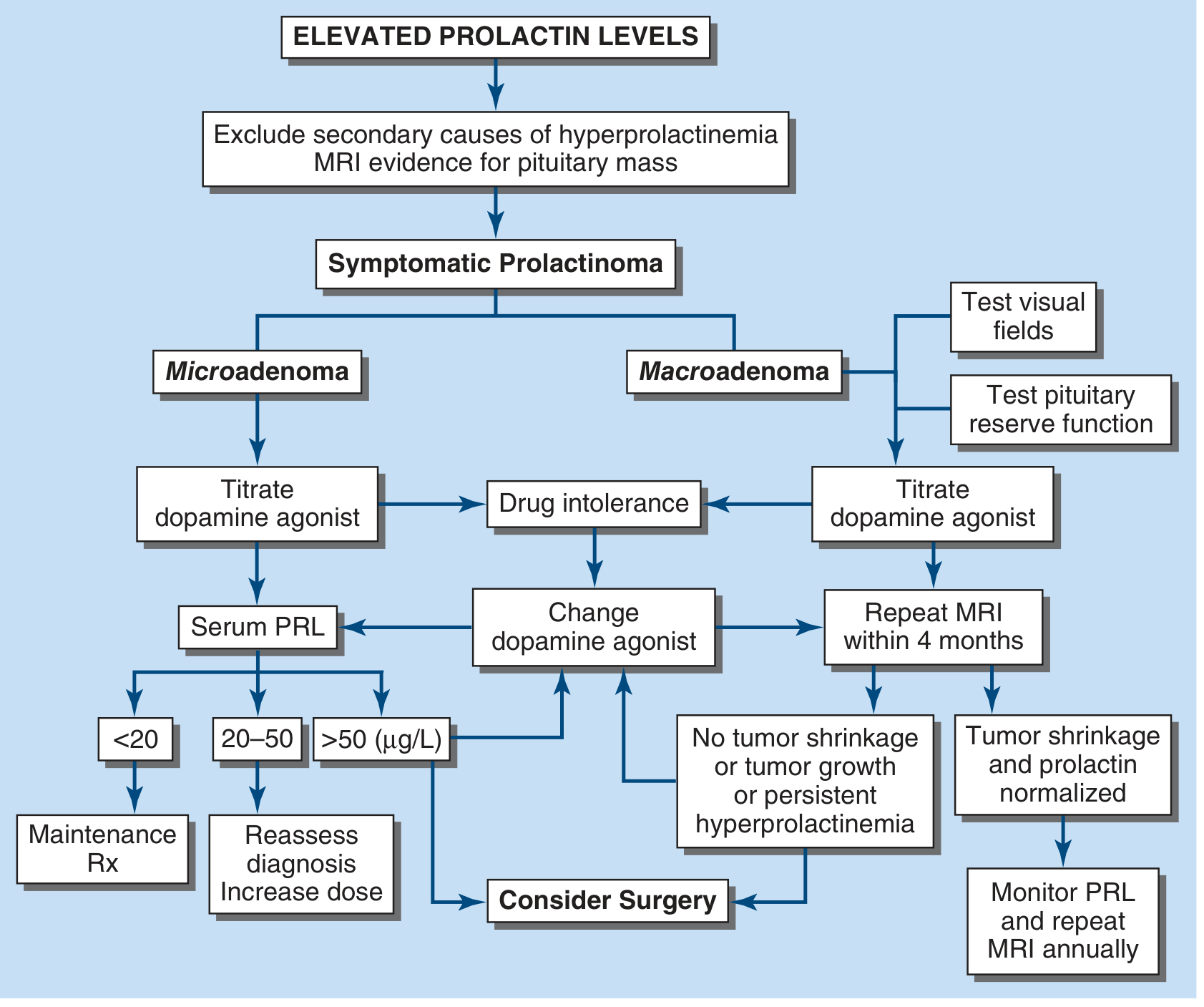
Treatment algorithm for elevated prolactin levels / prolactinoma - Harrison's Principles of Internal Medicine 22e
MRI Response to Cabergoline
Before treatment (A) and after 6 months of cabergoline (B) in a macroprolactinoma:
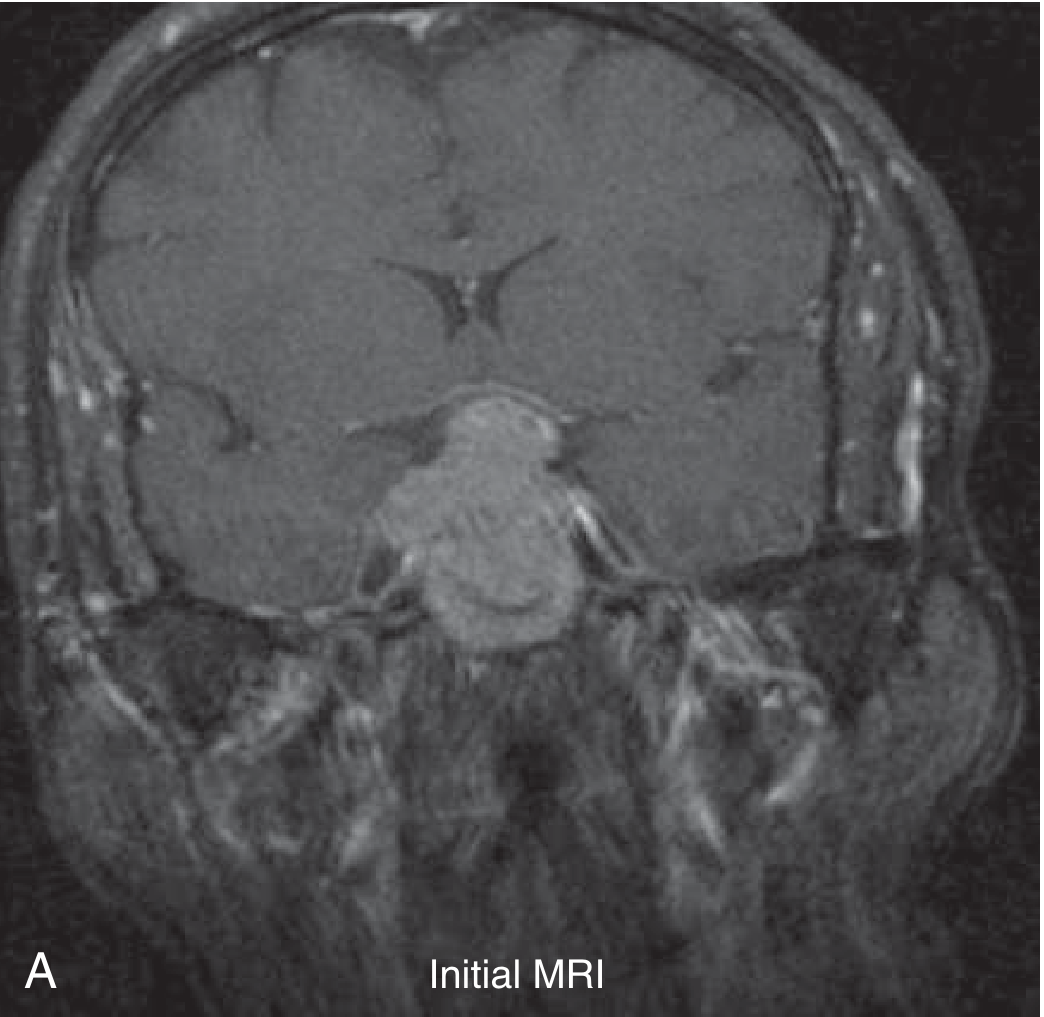
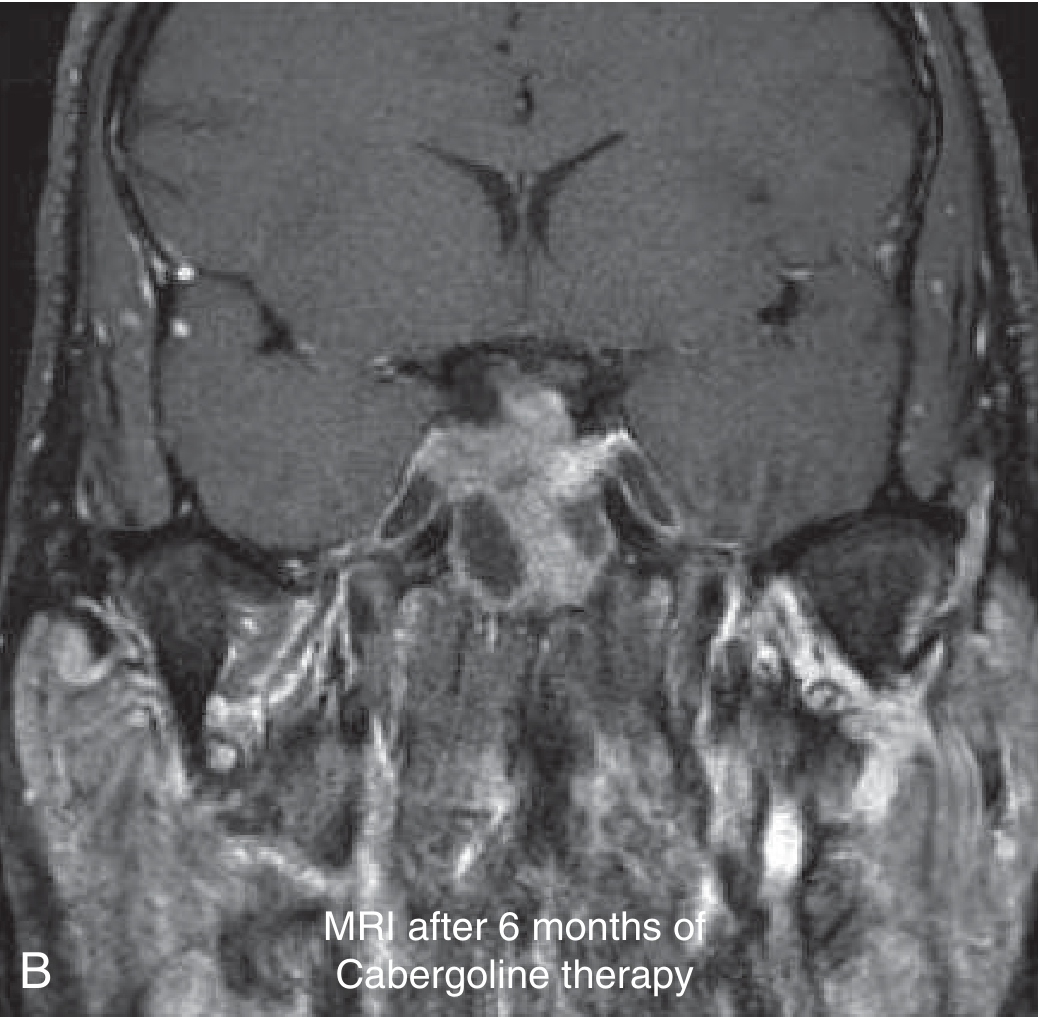
A 43-year-old man with prolactin 8,000 ng/dL and a large sellar mass. After 2 doses of cabergoline, PRL fell to 2,086; after 6 months, PRL was 15 ng/dL with dramatic tumor shrinkage on MRI. - Goldman-Cecil Medicine
Key Differentiating Points
| Feature | Microprolactinoma | Macroprolactinoma | Drug/Stalk Effect |
|---|---|---|---|
| PRL level | Variable, can be any | Usually >250 | Usually <100 |
| MRI | <1 cm lesion | ≥1 cm lesion | Normal or stalk compression |
| Visual fields | Normal | May be impaired | Normal (unless mass) |
| Female:Male ratio | 20:1 | ~1:1 | N/A |
| Risk of progression | ~5% progress to macro | Invasive potential | Resolves with drug change |
| Treatment | DA agonist ± watch | DA agonist first-line | Withdraw drug |
Recent Evidence (PubMed 2024-2026)
- A network meta-analysis (2025) [PMID: 39411853] comparing aripiprazole, bromocriptine, and cabergoline found cabergoline had superior efficacy and favorable safety for hyperprolactinemia treatment.
- A meta-analysis (2024) [PMID: 38945085] in women with PCOS and hyperprolactinemia showed metformin + cabergoline was more effective than metformin alone for reducing prolactin and improving ovulation.
- A systematic review (2024) [PMID: 39627209] in systemic lupus erythematosus found elevated prolactin correlates with disease activity and dopaminergic agonists modestly reduce both prolactin and disease activity.
Sources: Harrison's Principles of Internal Medicine 22e (2025), Goldman-Cecil Medicine (International Ed.), Tietz Textbook of Laboratory Medicine 7e
This is a shared conversation. Sign in to Orris to start your own chat.