
Lateral wall of nose 5 marks
Reading File
Finding Sources
Searching Images
lateral wall of nose anatomy
Finding Sources
Finding Sources
Reading File
Finding Sources
Gray's Anatomy for Students has a dedicated "Lateral wall" section. Let me read it fully.
Reading File
Reading File
Reading File
Reading File
Reading File
Loading Image
I now have comprehensive information from Gray's Anatomy for Students and Color Atlas of Human Anatomy. Let me also fetch the covered-with-mucosa diagram showing the meatuses.
Loading Image
I now have everything needed for a comprehensive 5-mark answer. Here is the structured response:
Lateral Wall of the Nose
1. Bony Framework
The bony lateral wall is formed by contributions from multiple bones (from anterior to posterior):
| Bone | Contribution |
|---|---|
| Nasal bone | Anterosuperior part |
| Frontal process of maxilla | Anterolateral wall |
| Lacrimal bone | Between frontal process of maxilla and ethmoid |
| Ethmoid (ethmoidal labyrinth) | Superiorly — bears superior and middle conchae + uncinate process |
| Inferior nasal concha | A separate independent bone; forms the inferior concha |
| Perpendicular plate of palatine bone | Posteroinferior part |
| Medial pterygoid plate of sphenoid | Most posterior part |
In the external nose (anterior to the piriform aperture), the lateral wall is supported by cartilage — the lateral process of the septal cartilage and the major and minor alar cartilages.
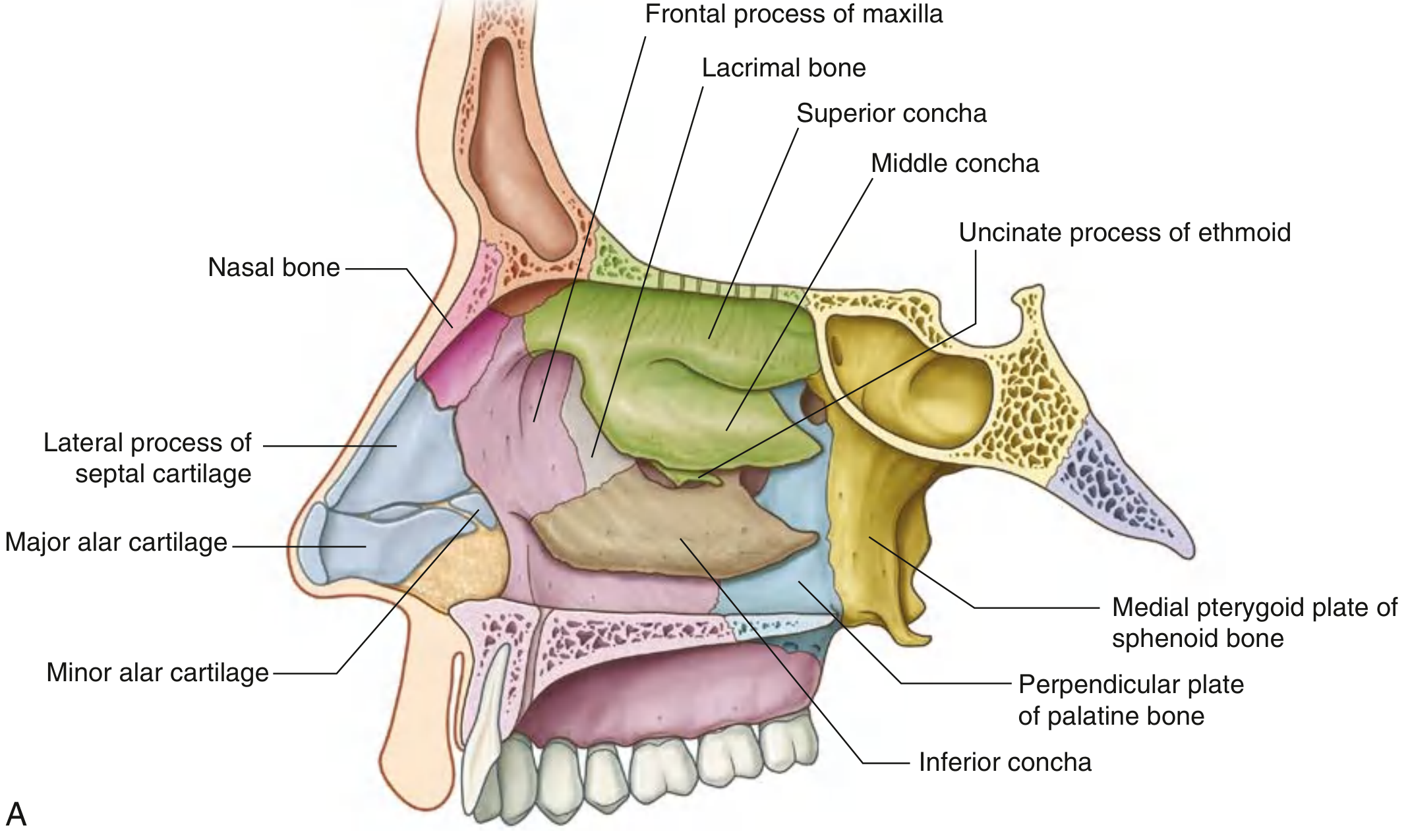
2. Conchae (Turbinates) and Meatuses
The hallmark of the lateral wall is three curved bony shelves (conchae/turbinates) projecting medially and inferiorly, dividing the nasal cavity into four air channels:
| Air Channel | Location |
|---|---|
| Inferior meatus | Between inferior concha and nasal floor |
| Middle meatus | Between inferior and middle conchae |
| Superior meatus | Between middle and superior conchae |
| Spheno-ethmoidal recess | Between superior concha and nasal roof |
The conchae enormously increase the mucosal surface area for humidification, warming, and filtering of inspired air.
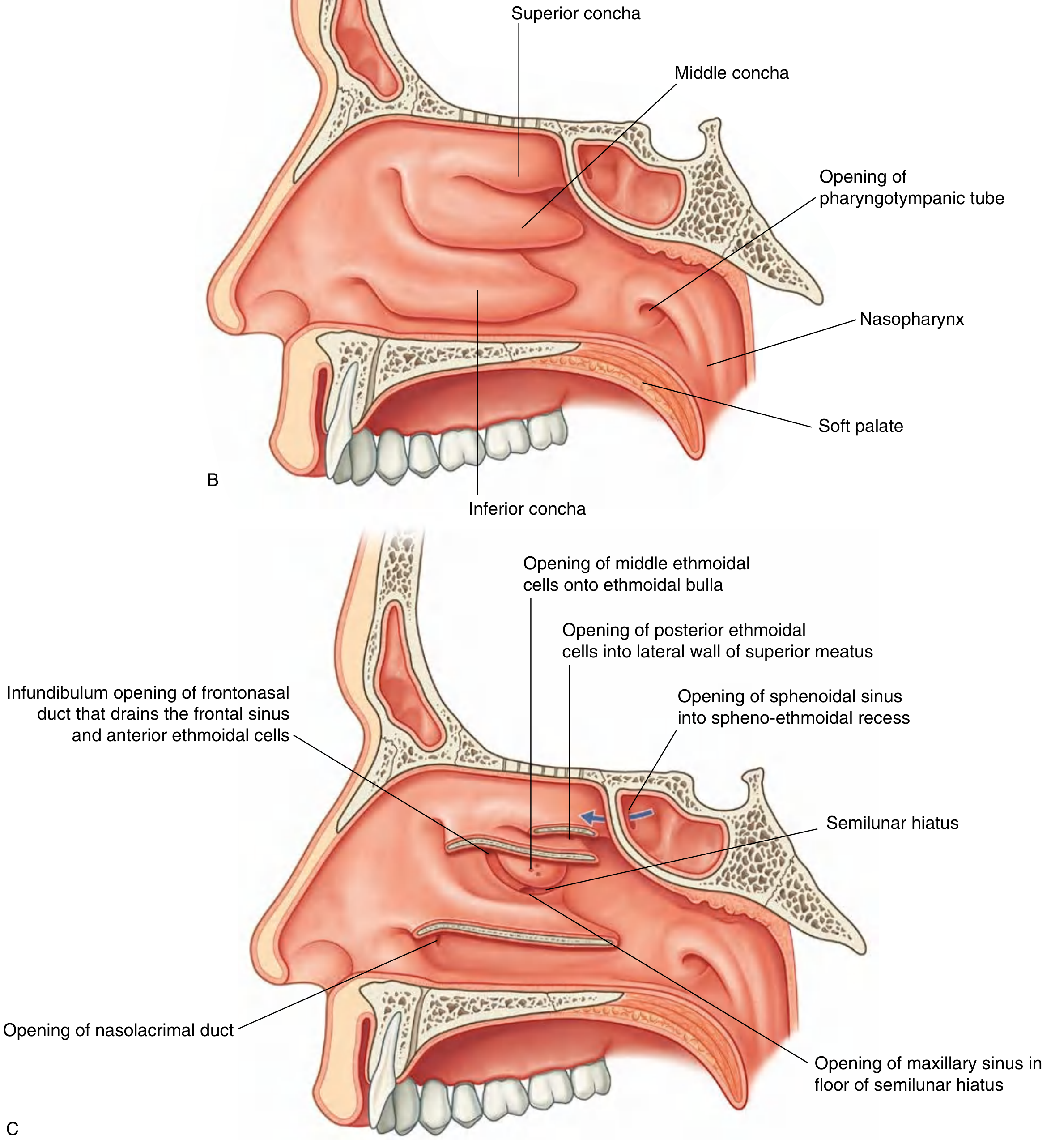
3. Openings on the Lateral Wall
This is a high-yield topic. Each meatus/recess receives specific drainage:
Inferior Meatus
- Nasolacrimal duct — opens under the anterior lip of the inferior concha (drains tears from the conjunctival sac)
Middle Meatus (most clinically important — the "ostiomeatal complex")
Contains two key mucosal features:
- Ethmoidal bulla — dome-shaped elevation formed by middle ethmoidal cells
- Semilunar hiatus — curved gutter inferior to the ethmoidal bulla, between the bulla above and the uncinate process below
- Ethmoidal infundibulum — the anterior end of the semilunar hiatus; leads superiorly to the frontal sinus via the frontonasal duct
Structures draining into the middle meatus:
- Frontal sinus — via frontonasal duct → ethmoidal infundibulum → anterior end of semilunar hiatus
- Anterior ethmoidal cells — into the frontonasal duct or infundibulum
- Maxillary sinus — into the floor of the semilunar hiatus (near its roof; this is why maxillary sinusitis is difficult to drain — the ostium is near the roof)
- Middle ethmoidal cells — onto or just above the ethmoidal bulla
Superior Meatus
- Posterior ethmoidal cells — open onto the lateral wall of the superior meatus
Spheno-ethmoidal Recess
- Sphenoidal sinus — opens into the spheno-ethmoidal recess (the only paranasal sinus that does not drain onto the lateral wall proper, but onto the sloping posterior roof)
4. Neurovascular Supply
Arterial Supply
- Anterior and posterior ethmoidal arteries (branches of ophthalmic artery) — supply the anterosuperior parts
- Sphenopalatine artery (branch of maxillary artery; enters through the sphenopalatine foramen posterior to the middle turbinate) — supplies the posterior and inferior lateral wall including the lateral turbinates; most common source of posterior epistaxis
Venous Drainage
Runs parallel to arteries; drains via ethmoidal veins into ophthalmic vein, and through the sphenopalatine notch into the pterygoid venous plexus.
Nerve Supply
- Anterior ethmoidal nerve (from ophthalmic division of CN V) — anterosuperior mucosa
- Posterior superior and inferior nasal branches of the maxillary nerve (CN V₂) via the pterygopalatine ganglion — posterior and inferior parts
5. Clinical Relevance
- Kiesselbach's (Little's) area: Not on the lateral wall, but the watershed anastomotic zone on the anterior septum — the most common site of anterior epistaxis.
- Posterior epistaxis: Most commonly from the sphenopalatine artery as it emerges posterior to the middle turbinate on the lateral wall.
- Ostiomeatal complex (OMC): The middle meatus and its associated structures (ethmoidal bulla, semilunar hiatus, infundibulum, uncinate process) form the functional drainage pathway for the frontal, maxillary, and anterior ethmoidal sinuses — blockage here causes recurrent sinusitis.
- Nasolacrimal duct obstruction: Leads to epiphora (overflow of tears) since drainage is via the inferior meatus.
Sources: Gray's Anatomy for Students, pp. 1210–1219; Color Atlas of Human Anatomy Vol. 2, pp. 174–175; Roberts & Hedges' Clinical Procedures in Emergency Medicine
This is a shared conversation. Sign in to Orris to start your own chat.