
Safety features of contemporary anesthesia machine in detail
Safety Features of the Contemporary Anesthesia Machine
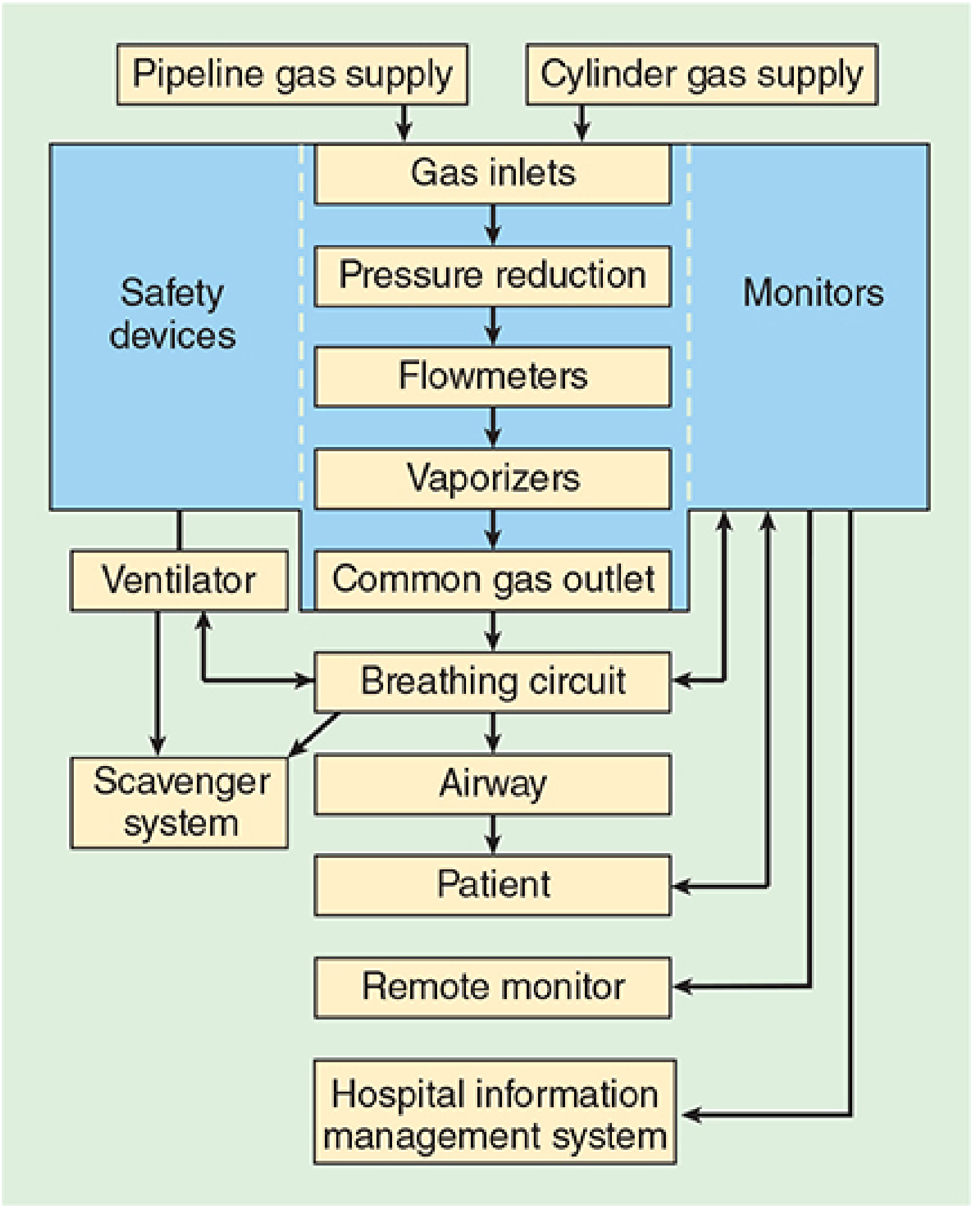
1. Gas Supply Safety (High- and Intermediate-Pressure Section)
1.1 Diameter Index Safety System (DISS) and Pin Index Safety System (PISS)
- DISS applies to pipeline connections (wall outlets). Each gas has a unique, non-interchangeable threaded connector diameter. This prevents incorrect pipeline attachment (e.g., plugging N2O into the oxygen inlet).
- PISS applies to E-cylinders. Each cylinder yoke has a unique pin pattern matching only the correct gas. Oxygen cylinders have pins at positions 2 and 5; nitrous oxide at 3 and 5. This prevents wrong-cylinder use.
- Both systems have integrated pressure gauges, filters, and check valves to detect depletion or pressure fluctuation and prevent retrograde gas flow.
"Noninterchangeable gas-specific connections to pipeline inlets (DISS) with pressure gauges, filter, and check valve - Prevent incorrect pipeline attachments; detect failure, depletion, or fluctuation." - Morgan & Mikhail's Clinical Anesthesiology, 7e, Table 4-1
1.2 Pressure Regulators
- First-stage regulators on cylinder inlets reduce high cylinder pressure (~2200 psi for O2) to a working intermediate pressure (~45 psig), below pipeline pressure (~50-55 psig). This ensures the pipeline is preferentially used while the cylinder serves as a backup.
- Second-stage regulators (on some machines) are placed downstream in the intermediate-pressure circuit, supplying a constant, lower pressure (14-35 psig) to flow control valves regardless of pipeline fluctuations.
1.3 Oxygen Supply Failure Alarm Sensor
"The alarm is an ISO requirement and is triggered by a loss of or significant decrease in pipeline pressure, or a nearly empty oxygen tank." - Miller's Anesthesia, 10e
1.4 Oxygen Supply Failure Protection Device ("Fail-Safe" Valve)
"If a gas other than oxygen pressurizes the oxygen circuit because of hospital pipeline contamination or crossover, the fail-safe valves will remain open." - Miller's Anesthesia, 10e
2. Flow Control Safety (Low-Pressure Section)
2.1 Flow Control Knob Design Features
- The oxygen knob is distinctively fluted, projects beyond other gas knobs, and is larger in diameter
- All knobs are color-coded (oxygen = green/white; N2O = blue; air = yellow/white depending on regional standards)
- The chemical formula or name of each gas is permanently marked on its knob
- Knobs are recessed or shielded to minimize inadvertent position changes
2.2 Minimum Oxygen Flow
2.3 Oxygen Downstream Position (Eger Flow Sequence)
2.4 Electronic Flow Sensors
3. Proportioning Systems (Anti-Hypoxia Devices / Hypoxic Guards)
3.1 North American Dräger - Sensitive Oxygen Ratio Controller (SORC)
3.2 GE/Datex-Ohmeda - Link-25 System
Both systems prevent hypoxic delivery at the fresh gas outlet but behave differently when the operator subsequently corrects settings. The oxygen analyzer in the breathing circuit remains the last line of defense for hypoxia protection.
4. Vaporizer Safety Features
4.1 Vaporizer Interlock Device
4.2 Agent-Specific Filling Systems
4.3 Desflurane Vaporizer ("Tec 6 / D-Vapor") Safety
- Has a SAF-T-FILL adapter system preventing use with standard vaporizers and atmospheric leakage
- Has an electrically heated sump maintaining a constant 39°C (vapor pressure ~1500 mmHg)
- Contains a shut-off valve downstream from the sump that closes and activates a no-output alarm if: (1) anesthetic level falls below low alarm threshold, (2) the vaporizer is tilted, (3) power failure occurs, or (4) pressure difference between vapor and fresh gas circuits exceeds tolerance
4.4 Cassette Vaporizer Safety (GE Aisys - Aladin/Aladin2)
4.5 Outlet Check Valve
4.6 Temperature Compensation
5. Breathing Circuit Safety
5.1 Adjustable Pressure-Limiting (APL) Valve
5.2 Breathing Circuit Pressure Monitor and Alarm
- High peak airway pressure - signals worsening compliance, tube obstruction
- Sustained high pressure - prevents barotrauma
- Low/sub-atmospheric pressure (disconnect alarm) - detects circuit disconnection, which is the most common cause of critical incidents
5.3 Unidirectional (Check) Valves in the Circle System
5.4 CO2 Absorber
5.5 Exhaled Volume Monitor (Spirometry)
5.6 Oxygen Concentration Monitor and Alarm
6. Monitoring and Alarm Integration
6.1 Capnography and Anesthetic Gas Analysis
- Capnography (EtCO2) guides ventilation and confirms tracheal intubation vs. esophageal placement. It also detects rebreathing, exhausted CO2 absorber, and circulatory compromise.
- Anesthetic gas analysis (mainstream or sidestream infrared analyzers) monitors inhaled and exhaled agent concentrations to prevent overdose or awareness, and guides economical use of volatile agents.
6.2 Automatically Enabled Essential Alarms
6.3 Oxygen Flush Valve
7. Anti-Pollution / Scavenging System
8. Electrical and Software Safety
- Uninterruptible power supply (UPS) / battery backup: Many modern workstations have backup batteries to maintain ventilator function during power outages. Mechanical (pneumatically driven) ventilators remain operable on gas pressure alone.
- Software interlocks: On fully electronic (e.g., GE Aisys, Dräger Perseus A500) workstations, the machine's CPU integrates all sensor inputs and prevents configuration of dangerous settings (e.g., it will not allow hypoxic gas mixtures even if the operator attempts to dial them in).
- Self-test / Automated Pre-Use Check (PAC): Contemporary machines run an automated pre-use checkout on startup, verifying gas pressures, vaporizer seating, leak detection, and alarm function. This supplements (but does not replace) the provider's manual checklist (e.g., MS MAIDS mnemonic - Machine, Suction, Monitors, Airway, IV, Drugs, Special).
Summary Table
| Safety Feature | Primary Hazard Prevented |
|---|---|
| DISS / PISS connectors | Wrong gas supply connection |
| Oxygen supply failure alarm | Undetected O2 loss |
| Fail-safe (O2 failure protection) valve | N2O delivery without O2 |
| Minimum O2 flow resistor | Zero oxygen delivery |
| Oxygen downstream position | Hypoxia from flowmeter leak |
| Proportioning system (SORC / Link-25) | Hypoxic gas mixture |
| O2 concentration analyzer + alarm | Hypoxia (last line of defense) |
| Vaporizer interlock | Simultaneous multi-agent delivery |
| Agent-specific filling systems | Vaporizer misfilling |
| Desflurane SAF-T-FILL / heated vaporizer | Desflurane overdose |
| APL valve pressure limit (70-80 cmH2O) | Pulmonary barotrauma |
| Breathing circuit pressure monitor | Barotrauma / disconnect |
| Exhaled volume monitor | Hypo/hyperventilation |
| Capnography | Esophageal intubation / hypoventilation |
| Scavenging system with pressure relief | OR pollution / circuit pressure extremes |
| Automated pre-use self-test | Equipment fault going undetected |
- Miller's Anesthesia, 2-Volume Set, 10e - Chapter 20 (Anesthesia Delivery Systems)
- Morgan and Mikhail's Clinical Anesthesiology, 7e - Chapter 4 (The Anesthesia Workstation)
- Barash, Cullen, and Stoelting's Clinical Anesthesia, 9e - Chapter on the Anesthesia Machine
Give pdf
ls /home/daytona/workspace/ 2>/dev/null || mkdir -p /home/daytona/workspace/
~/anesthesia-machine-safety/generate_pdf.py
from reportlab.lib.pagesizes import A4
from reportlab.lib.styles import getSampleStyleSheet, ParagraphStyle
from reportlab.lib.units import cm
from reportlab.lib import colors
from reportlab.platypus import (
    SimpleDocTemplate, Paragraph, Spacer, Table, TableStyle,
    HRFlowable, KeepTogether
)
from reportlab.lib.enums import TA_LEFT, TA_CENTER, TA_JUSTIFY
from reportlab.platypus import PageBreak

OUTPUT = "/home/daytona/workspace/anesthesia-machine-safety/Anesthesia_Machine_Safety_Features.pdf"

doc = SimpleDocTemplate(
    OUTPUT,
    pagesize=A4,
    leftMargin=2*cm, rightMargin=2*cm,
    topMargin=2.2*cm, bottomMargin=2.2*cm,
    title="Safety Features of the Contemporary Anesthesia Machine",
    author="Orris Medical Reference"
)

W = A4[0] - 4*cm  # usable width

styles = getSampleStyleSheet()

# Custom styles
TITLE = ParagraphStyle("TITLE", parent=styles["Title"],
    fontSize=20, textColor=colors.HexColor("#1a3a5c"),
    spaceAfter=4, spaceBefore=0, leading=24, alignment=TA_CENTER)

SUBTITLE = ParagraphStyle("SUBTITLE", parent=styles["Normal"],
    fontSize=10, textColor=colors.HexColor("#4a6fa5"),
    spaceAfter=14, alignment=TA_CENTER, italics=1)

H1 = ParagraphStyle("H1", parent=styles["Heading1"],
    fontSize=13, textColor=colors.white,
    backColor=colors.HexColor("#1a3a5c"),
    spaceBefore=14, spaceAfter=4, leading=18,
    leftIndent=-0.3*cm, rightIndent=-0.3*cm,
    borderPadding=(4,6,4,6))

H2 = ParagraphStyle("H2", parent=styles["Heading2"],
    fontSize=11, textColor=colors.HexColor("#1a3a5c"),
    spaceBefore=10, spaceAfter=2, leading=14,
    borderPadding=(2,0,2,0))

H3 = ParagraphStyle("H3", parent=styles["Heading3"],
    fontSize=10, textColor=colors.HexColor("#2e6da4"),
    spaceBefore=7, spaceAfter=1, leading=13, fontName="Helvetica-Bold")

BODY = ParagraphStyle("BODY", parent=styles["Normal"],
    fontSize=9.5, leading=14, spaceAfter=5, alignment=TA_JUSTIFY,
    textColor=colors.HexColor("#222222"))

BULLET = ParagraphStyle("BULLET", parent=BODY,
    leftIndent=16, bulletIndent=4, spaceAfter=3, leading=13)

NOTE = ParagraphStyle("NOTE", parent=BODY,
    fontSize=8.8, textColor=colors.HexColor("#555555"),
    backColor=colors.HexColor("#f0f4f8"),
    borderPadding=(5,6,5,6), leftIndent=4, rightIndent=4,
    spaceAfter=6, leading=13)

SOURCE = ParagraphStyle("SOURCE", parent=styles["Normal"],
    fontSize=8, textColor=colors.HexColor("#666666"),
    spaceAfter=2, leading=11, italics=1)

WARN = ParagraphStyle("WARN", parent=BODY,
    fontSize=9, textColor=colors.HexColor("#7a2b00"),
    backColor=colors.HexColor("#fff4e0"),
    borderPadding=(5,6,5,6), leftIndent=4, rightIndent=4,
    spaceAfter=6, leading=13)

story = []

# ── TITLE PAGE ──────────────────────────────────────────────────
story.append(Spacer(1, 1.2*cm))
story.append(Paragraph("Safety Features of the", TITLE))
story.append(Paragraph("Contemporary Anesthesia Machine", TITLE))
story.append(Spacer(1, 0.3*cm))
story.append(HRFlowable(width="100%", thickness=2, color=colors.HexColor("#4a6fa5")))
story.append(Spacer(1, 0.2*cm))
story.append(Paragraph(
    "A Comprehensive Reference | Based on Miller's Anesthesia 10e & Morgan and Mikhail's Clinical Anesthesiology 7e",
    SUBTITLE))
story.append(Spacer(1, 0.5*cm))

# Intro paragraph
story.append(Paragraph(
    "The primary safety goal of the contemporary anesthesia workstation is to prevent delivery of a hypoxic "
    "gas mixture to the patient. ISO and ASTM F1850 standards mandate a layered, defense-in-depth approach "
    "encompassing gas supply, flow control, proportioning systems, vaporizer design, breathing circuit monitoring, "
    "and integrated software safeguards. The safety features are organized below by functional section of the machine.",
    BODY))
story.append(Spacer(1, 0.3*cm))

# ── SECTION 1 ────────────────────────────────────────────────────
story.append(Paragraph("1. Gas Supply Safety — High- and Intermediate-Pressure Section", H1))
story.append(Spacer(1, 0.1*cm))

story.append(Paragraph("1.1 Diameter Index Safety System (DISS) and Pin Index Safety System (PISS)", H2))
story.append(Paragraph(
    "<b>DISS</b> (pipeline connections): Each gas has a unique, non-interchangeable threaded connector "
    "diameter that prevents incorrect pipeline attachment — e.g., plugging N₂O into the oxygen inlet. "
    "Each connection includes a pressure gauge, filter, and check valve to detect depletion or pressure "
    "fluctuation and to prevent retrograde gas flow.", BODY))
story.append(Paragraph(
    "<b>PISS</b> (E-cylinder yokes): Each cylinder yoke has a unique pin pattern matching only the "
    "correct gas. Oxygen cylinders use pin positions 2 and 5; nitrous oxide uses positions 3 and 5. "
    "This physically prevents wrong-cylinder installation.", BODY))

story.append(Paragraph("1.2 Pressure Regulators", H2))
story.append(Paragraph(
    "<b>First-stage regulators</b> on cylinder inlets reduce high cylinder pressure (~2200 psi for O₂) "
    "to a working intermediate pressure (~45 psig), which is below pipeline pressure (~50-55 psig). "
    "This ensures the pipeline is preferentially used while the cylinder serves as automatic backup.", BODY))
story.append(Paragraph(
    "<b>Second-stage regulators</b> (present on some machines) are placed downstream in the "
    "intermediate-pressure circuit, supplying a constant, lower pressure (14-35 psig) to the flow "
    "control valves regardless of pipeline fluctuations.", BODY))

story.append(Paragraph("1.3 Oxygen Supply Failure Alarm Sensor", H2))
story.append(Paragraph(
    "Mandatory by ISO standards. Located within the oxygen circuit of the intermediate-pressure section, "
    "this sensor triggers an <b>audible and visual alarm</b> when oxygen pressure drops below a "
    "manufacturer-specified minimum. It activates on loss of or significant decrease in pipeline "
    "pressure, or when the O₂ cylinder is nearly empty. The minimum threshold pressure for alarm "
    "condition differs among manufacturers because pipeline pressure standards vary internationally.",
    BODY))

story.append(Paragraph("1.4 Oxygen Supply Failure Protection Device ('Fail-Safe' Valve)", H2))
story.append(Paragraph(
    "In response to low O₂ pressure, these devices either <b>shut off (binary valve)</b> or "
    "<b>proportionally reduce (proportional valve)</b> the flow of other gases such as N₂O and air, "
    "thereby preventing N₂O delivery without oxygen. They are an ISO standard on all machines.", BODY))
story.append(Paragraph(
    "<b>Critical limitation:</b> The term 'fail-safe' is a misnomer. If a gas other than oxygen "
    "pressurizes the oxygen circuit (e.g., due to hospital pipeline contamination or crossover), "
    "these valves will remain open. In that scenario, only the inspired oxygen concentration monitor "
    "and clinical acumen would protect the patient.",
    WARN))

# ── SECTION 2 ────────────────────────────────────────────────────
story.append(Paragraph("2. Flow Control Safety — Low-Pressure Section", H1))
story.append(Spacer(1, 0.1*cm))

story.append(Paragraph("2.1 Flow Control Knob Design", H2))
items = [
    "The <b>oxygen flow control knob</b> is distinctively fluted, projects beyond other gas knobs, and is larger in diameter.",
    "All knobs are <b>color-coded</b> for the appropriate gas (oxygen = green/white by convention).",
    "The chemical formula or name of each gas is <b>permanently marked</b> on its knob.",
    "Knobs are <b>recessed or shielded</b> by a guard/barrier to minimize inadvertent position changes.",
]
for item in items:
    story.append(Paragraph(f"• {item}", BULLET))

story.append(Paragraph("2.2 Minimum Oxygen Flow", H2))
story.append(Paragraph(
    "Flow control valves are commonly designed to deliver a <b>minimum oxygen flow</b> (typically "
    "~200 mL/min) when the machine is turned on, via a minimum flow resistor. This ensures some "
    "oxygen enters the breathing circuit even if the operator forgets to set it.", BODY))

story.append(Paragraph("2.3 Oxygen Downstream Position (Eger Flow Sequence)", H2))
story.append(Paragraph(
    "In multi-gas flowmeter banks, <b>oxygen is positioned downstream</b> of all other gases. "
    "If a leak occurs in the nitrous oxide flow tube, the downstream oxygen dilutes the escaping gas "
    "before it reaches the patient. Had oxygen been upstream and leaked, undiluted N₂O could reach "
    "the manifold — a potentially hypoxic scenario. ISO standards require oxygen at either end of "
    "the flowmeter bank.", BODY))

story.append(Paragraph("2.4 Electronic Flow Sensors", H2))
story.append(Paragraph(
    "Modern workstations increasingly use electronic flow sensors (hot-wire anemometers, differential "
    "pressure transducers, mass flow sensors) integrated with the machine's CPU. These allow "
    "programmed prevention of any hypoxic mixture selection and offer more precise gas delivery "
    "control than traditional glass rotameter tubes. Backup mechanical oxygen flow control is usually "
    "available if electrical power is lost.", BODY))

# ── SECTION 3 ────────────────────────────────────────────────────
story.append(Paragraph("3. Proportioning Systems — Hypoxic Guard Devices", H1))
story.append(Spacer(1, 0.1*cm))

story.append(Paragraph(
    "These systems link N₂O flow to O₂ flow, ensuring a minimum oxygen concentration at the fresh "
    "gas outlet (25% per ASTM; 21% per ISO). Two major implementations are in widespread use:", BODY))

story.append(Paragraph("3.1 North American Dräger — Sensitive Oxygen Ratio Controller (SORC)", H2))
story.append(Paragraph(
    "A <b>pneumatic-mechanical</b> interlock. An O₂ chamber diaphragm and an N₂O chamber diaphragm "
    "are interconnected by a mobile horizontal shaft. Backpressure from O₂ flow opens the N₂O "
    "proportioning valve. If O₂ flow is reduced, the shaft moves and restricts N₂O flow. "
    "If O₂ drops below 200 mL/min, the N₂O proportioning valve closes completely.", BODY))

story.append(Paragraph("3.2 GE/Datex-Ohmeda — Link-25 System", H2))
story.append(Paragraph(
    "A <b>mechanical chain-link</b> between the O₂ and N₂O flow control valve sprockets "
    "(29-tooth O₂ sprocket; 15-tooth N₂O sprocket). When N₂O exceeds the 3:1 ratio limit, "
    "the chain physically increases O₂ flow by rotating the O₂ control valve. The N₂O needle "
    "valve taper is faster than that of O₂, resulting in a maximum 3:1 (N₂O:O₂) mixture.", BODY))

story.append(Paragraph(
    "<b>Important:</b> Both proportioning systems protect only at the <i>fresh gas outlet</i>. "
    "The oxygen concentration delivered to the patient via the circle system may differ significantly. "
    "The <b>oxygen analyzer in the breathing circuit remains the last mechanical line of defense</b> "
    "against a hypoxic gas mixture reaching the patient.",
    NOTE))

# ── SECTION 4 ────────────────────────────────────────────────────
story.append(Paragraph("4. Vaporizer Safety Features", H1))
story.append(Spacer(1, 0.1*cm))

story.append(Paragraph("4.1 Vaporizer Interlock Device", H2))
story.append(Paragraph(
    "All anesthesia workstations must prevent simultaneous flow through more than one vaporizer at a "
    "time. Mechanical interlock systems (exclusion bars, locking levers) ensure that selecting one "
    "vaporizer physically locks all others off. These devices can fail, and anesthetic overdose is a "
    "potential consequence of such failure.", BODY))

story.append(Paragraph("4.2 Agent-Specific Filling Systems", H2))
story.append(Paragraph(
    "Each volatile agent vaporizer uses a keyed, agent-specific filler adapter that prevents misfilling "
    "with the wrong agent. Color-coding provides an additional check: isoflurane (orange/purple), "
    "sevoflurane (yellow), desflurane (blue), halothane (red).", BODY))

story.append(Paragraph("4.3 Desflurane Vaporizer Safety (Tec 6 / D-Vapor type)", H2))
story.append(Paragraph(
    "Because desflurane's vapor pressure is nearly 1 atm (~669 mmHg at 20°C, boiling point 22.8°C), "
    "it cannot be used in a standard variable-bypass vaporizer — misfilling would cause massive "
    "overdose. The dedicated desflurane vaporizer incorporates:", BODY))
items = [
    "<b>SAF-T-FILL adapter:</b> Agent-specific bottle connector preventing use with standard vaporizers and minimizing atmospheric leakage.",
    "<b>Electrically heated sump:</b> Maintains a constant 39°C, creating a stable reservoir vapor pressure of ~1500 mmHg.",
    "<b>Automatic shut-off valve</b> downstream from the sump that closes and triggers a no-output alarm if: (1) anesthetic level falls below low alarm threshold, (2) the vaporizer is tilted, (3) power failure occurs, or (4) pressure difference between vapor and fresh gas circuits exceeds tolerance.",
]
for item in items:
    story.append(Paragraph(f"• {item}", BULLET))

story.append(Paragraph("4.4 Cassette Vaporizer Safety (GE Aisys — Aladin/Aladin2)", H2))
story.append(Paragraph(
    "Uses magnetically coded, color-coded, agent-specific cassettes. The workstation reads the "
    "magnetic code to identify the inserted agent and adjusts delivery algorithms accordingly. "
    "A one-way check valve within the cassette prevents retrograde flow of vapor into the bypass "
    "chamber, essential for precise desflurane delivery.", BODY))

story.append(Paragraph("4.5 Temperature Compensation", H2))
story.append(Paragraph(
    "All modern variable-bypass vaporizers incorporate temperature-compensating mechanisms (bimetallic "
    "strips or expansion elements) that automatically adjust the bypass/vaporizing chamber flow ratio "
    "as ambient temperature changes, maintaining accurate output across a wide range of conditions. "
    "Without this, output would fall as the liquid cools during vaporization.", BODY))

story.append(Paragraph("4.6 Outlet Check Valve", H2))
story.append(Paragraph(
    "Some machines (e.g., GE Aestiva/Aespire) place a one-way check valve between the vaporizer "
    "outlet and the common gas outlet, preventing backflow from positive-pressure ventilation into "
    "the vaporizer. This minimizes the 'pumping effect' — intermittent backpressure that would "
    "otherwise alter output concentration unpredictably.", BODY))

# ── SECTION 5 ────────────────────────────────────────────────────
story.append(Paragraph("5. Breathing Circuit Safety", H1))
story.append(Spacer(1, 0.1*cm))

story.append(Paragraph("5.1 Adjustable Pressure-Limiting (APL) Valve", H2))
story.append(Paragraph(
    "The APL valve (also called 'pop-off' or pressure-relief valve) is used during manual and "
    "spontaneous ventilation. As a critical safety design, <b>modern APL valves cannot be "
    "completely closed</b> — the upper pressure limit is typically <b>70-80 cm H₂O</b>. "
    "This prevents pulmonary barotrauma even if the valve is accidentally turned to the fully "
    "closed position.", BODY))

story.append(Paragraph("5.2 Breathing Circuit Pressure Monitor and Alarms", H2))
story.append(Paragraph(
    "Continuous pressure monitoring in the breathing circuit triggers alarms for:", BODY))
items = [
    "<b>High peak airway pressure:</b> Signals worsening pulmonary compliance, tube obstruction, or excessive tidal volume.",
    "<b>Sustained high pressure:</b> Prevents barotrauma from sustained positive pressure.",
    "<b>Disconnect / low pressure alarm:</b> Detects circuit disconnection — the most common cause of critical ventilation incidents.",
    "<b>Sub-atmospheric (negative) pressure:</b> Detects excessive scavenger suction or circuit malfunction.",
]
for item in items:
    story.append(Paragraph(f"• {item}", BULLET))

story.append(Paragraph("5.3 Unidirectional (Check) Valves", H2))
story.append(Paragraph(
    "Inspiratory and expiratory one-way valves in the circle system ensure unidirectional gas flow, "
    "preventing rebreathing of exhaled CO₂-laden gas and maintaining the efficiency of the CO₂ "
    "absorber. Valve failure (sticking open or closed) can cause rebreathing or complete circuit "
    "obstruction.", BODY))

story.append(Paragraph("5.4 CO₂ Absorber", H2))
story.append(Paragraph(
    "Soda lime or Amsorb removes exhaled CO₂, enabling low fresh gas flow (economical) anesthesia. "
    "Visual color indicators (white → purple/violet) warn of absorber exhaustion. Modern machines "
    "integrate capnographic waveform trending to alert providers to absorber failure early.", BODY))

story.append(Paragraph("5.5 Exhaled Volume Monitor (Spirometry)", H2))
story.append(Paragraph(
    "A spirometer (commonly a rotating vane anemometer / Wright respirometer in the expiratory limb, "
    "or ultrasonic flow sensor at the Y-piece) measures exhaled tidal volume. Alarms trigger for "
    "hypoventilation, hyperventilation, circuit leaks, or disconnection. Note that these devices "
    "measure volume at the expiratory limb and do not account for gas compressing the circuit "
    "tubing — actual delivered volume to the patient may be less.", BODY))

story.append(Paragraph("5.6 Oxygen Concentration Monitor and Alarm", H2))
story.append(Paragraph(
    "Mandatory by ISO/ASTM standards. An oxygen analyzer (typically electrochemical/galvanic or "
    "paramagnetic cell) with a low-oxygen alarm is placed in the inspiratory limb and is "
    "<b>automatically enabled when the machine is turned on</b>. It cannot be disabled without "
    "active acknowledgment. This is the <b>last mechanical protection</b> against a hypoxic gas "
    "mixture reaching the patient — it catches failures of proportioning systems, fail-safe valves, "
    "and pipeline crossover scenarios alike.", BODY))

# ── SECTION 6 ────────────────────────────────────────────────────
story.append(Paragraph("6. Monitoring and Alarm Integration", H1))
story.append(Spacer(1, 0.1*cm))

story.append(Paragraph("6.1 Capnography and Anesthetic Gas Analysis", H2))
story.append(Paragraph(
    "<b>Capnography (EtCO₂):</b> Confirms tracheal vs. esophageal intubation, guides ventilation, "
    "detects rebreathing (exhausted absorber), and reflects circulatory compromise (sudden drop "
    "in EtCO₂ suggests cardiac arrest or pulmonary embolism). The capnogram waveform pattern "
    "provides additional diagnostic information.", BODY))
story.append(Paragraph(
    "<b>Anesthetic gas analysis</b> (sidestream or mainstream infrared): Monitors inhaled and "
    "exhaled volatile agent concentrations to prevent overdose or awareness, and helps guide "
    "economical low-flow use of volatile agents.", BODY))

story.append(Paragraph("6.2 Automatically Enabled Essential Alarms", H2))
story.append(Paragraph(
    "Modern workstations are designed so that essential monitors and alarms <b>activate "
    "automatically</b> at startup — including the oxygen analyzer, circuit pressure alarm, and "
    "ventilator disconnect alarm. Silencing alarms requires active acknowledgment and is subject "
    "to defined maximum silence durations (typically 2 minutes), after which they re-sound.", BODY))

story.append(Paragraph("6.3 Oxygen Flush Valve", H2))
story.append(Paragraph(
    "Delivers oxygen at <b>35-75 L/min</b> directly from the intermediate-pressure section, "
    "bypassing the vaporizer and flowmeters entirely, to rapidly flush or refill the breathing "
    "circuit. It remains active even when the machine is off, as long as an O₂ source is connected. "
    "<b>Hazard:</b> Prolonged activation during positive-pressure ventilation can cause barotrauma; "
    "many machines include a protective guard or barrier around the flush button to prevent "
    "accidental activation.", BODY))

# ── SECTION 7 ────────────────────────────────────────────────────
story.append(Paragraph("7. Waste Anesthetic Gas Scavenging System (WAGS)", H1))
story.append(Spacer(1, 0.1*cm))

story.append(Paragraph(
    "The scavenging system collects waste gases from the APL valve (during spontaneous/manual "
    "ventilation) and the ventilator relief valve (during mechanical ventilation), channeling them "
    "to either an active (vacuum-driven) or passive (pressure-differential) disposal system.", BODY))
story.append(Paragraph(
    "Both active and passive scavenging interfaces incorporate <b>positive- and negative-pressure "
    "relief valves</b> to protect the breathing circuit from excessive pressure generated by the "
    "scavenger. Without these, an over-pressurized scavenger could cause barotrauma; an "
    "excessively negative scavenger could cause negative pressure injury or collapse of the circuit.", BODY))

# ── SECTION 8 ────────────────────────────────────────────────────
story.append(Paragraph("8. Electrical, Software, and Pre-Use Checkout Safety", H1))
story.append(Spacer(1, 0.1*cm))

story.append(Paragraph("8.1 Battery Backup / Uninterruptible Power Supply", H2))
story.append(Paragraph(
    "Many modern workstations incorporate battery backup to maintain ventilator, monitor, and alarm "
    "function during power outages. Pneumatically driven (non-electronic) ventilator modes remain "
    "operable on gas pressure alone even with complete electrical failure.", BODY))

story.append(Paragraph("8.2 Software Interlocks and CPU Integration", H2))
story.append(Paragraph(
    "On fully electronic workstations (e.g., GE Aisys, Dräger Perseus A500, Mindray A9), the "
    "machine's CPU integrates all sensor inputs and <b>prevents configuration of dangerous "
    "settings</b> through software logic — it will not allow a hypoxic gas mixture to be dialed in, "
    "even if the operator attempts to do so. Sensor redundancy and cross-checking between flow "
    "sensors, pressure transducers, and gas analyzers provides additional integrity.", BODY))

story.append(Paragraph("8.3 Automated Pre-Use Checkout (PAC)", H2))
story.append(Paragraph(
    "Contemporary machines run an automated pre-use checkout on startup, verifying gas supply "
    "pressures, vaporizer seating, low-pressure system leak status, and alarm function. Key "
    "limitations to be aware of:", BODY))
items = [
    "Automated checks differ significantly between manufacturers and models.",
    "No machine automatically checks all items — at least some manual steps are always required.",
    "Many providers incorrectly assume the automated checkout is comprehensive.",
    "Conventional vaporizers should be opened during the leak test of the low-pressure system, as this is often not mandated by automated checks.",
]
for item in items:
    story.append(Paragraph(f"• {item}", BULLET))

story.append(Paragraph(
    "The <b>MS MAIDS mnemonic</b> (Machine, Suction, Monitors, Airway, IV access, Drugs, Special "
    "items) serves as a structured 'anesthesia time-out' to ensure all checks are complete and "
    "equipment is ready before induction.", NOTE))

# ── SUMMARY TABLE ────────────────────────────────────────────────
story.append(PageBreak())
story.append(Paragraph("Summary: Safety Features at a Glance", H1))
story.append(Spacer(1, 0.3*cm))

table_data = [
    ["Safety Feature", "Primary Hazard Prevented"],
    ["DISS / PISS connectors", "Wrong gas supply connection"],
    ["Pressure regulators (1st & 2nd stage)", "Pressure fluctuation / cylinder depletion"],
    ["O₂ supply failure alarm sensor", "Undetected oxygen loss"],
    ["Fail-safe (O₂ failure protection) valve", "N₂O delivery without oxygen"],
    ["Minimum O₂ flow resistor", "Zero oxygen delivery at startup"],
    ["Oxygen downstream position (Eger sequence)", "Hypoxia from flowmeter tube leak"],
    ["Proportioning system (SORC / Link-25)", "Hypoxic gas mixture at fresh gas outlet"],
    ["O₂ concentration analyzer + alarm (auto-enabled)", "Hypoxia — last line of defense"],
    ["Vaporizer interlock device", "Simultaneous multi-agent delivery"],
    ["Agent-specific filling systems", "Vaporizer misfilling with wrong agent"],
    ["Desflurane SAF-T-FILL + heated vaporizer", "Desflurane overdose / misfilling"],
    ["Temperature-compensated vaporizers", "Concentration error with temperature change"],
    ["APL valve pressure limit (70-80 cmH₂O)", "Pulmonary barotrauma"],
    ["Breathing circuit pressure monitor/alarm", "Barotrauma / circuit disconnect"],
    ["Unidirectional check valves", "CO₂ rebreathing"],
    ["Exhaled volume monitor", "Hypo- / hyperventilation"],
    ["Capnography", "Esophageal intubation / hypoventilation"],
    ["Scavenging system with pressure relief", "OR pollution / circuit pressure extremes"],
    ["Battery backup / UPS", "Ventilator failure during power loss"],
    ["Software interlocks (CPU integration)", "Dangerous setting selection on electronic machines"],
    ["Automated pre-use checkout (PAC)", "Undetected equipment fault before use"],
]

col_widths = [W * 0.52, W * 0.48]
t = Table(table_data, colWidths=col_widths, repeatRows=1)
t.setStyle(TableStyle([
    # Header
    ("BACKGROUND", (0,0), (-1,0), colors.HexColor("#1a3a5c")),
    ("TEXTCOLOR", (0,0), (-1,0), colors.white),
    ("FONTNAME", (0,0), (-1,0), "Helvetica-Bold"),
    ("FONTSIZE", (0,0), (-1,0), 9.5),
    ("ALIGN", (0,0), (-1,0), "CENTER"),
    ("VALIGN", (0,0), (-1,-1), "MIDDLE"),
    ("BOTTOMPADDING", (0,0), (-1,0), 7),
    ("TOPPADDING", (0,0), (-1,0), 7),
    # Body rows alternating
    ("ROWBACKGROUNDS", (0,1), (-1,-1), [colors.white, colors.HexColor("#eef3f8")]),
    ("FONTNAME", (0,1), (-1,-1), "Helvetica"),
    ("FONTSIZE", (0,1), (-1,-1), 9),
    ("TOPPADDING", (0,1), (-1,-1), 5),
    ("BOTTOMPADDING", (0,1), (-1,-1), 5),
    ("LEFTPADDING", (0,0), (-1,-1), 8),
    ("RIGHTPADDING", (0,0), (-1,-1), 8),
    # Grid
    ("GRID", (0,0), (-1,-1), 0.4, colors.HexColor("#aabbcc")),
    ("BOX", (0,0), (-1,-1), 1, colors.HexColor("#1a3a5c")),
    # Bold first column
    ("FONTNAME", (0,1), (0,-1), "Helvetica-Bold"),
    ("TEXTCOLOR", (0,1), (0,-1), colors.HexColor("#1a3a5c")),
]))
story.append(t)

story.append(Spacer(1, 0.6*cm))
story.append(HRFlowable(width="100%", thickness=0.8, color=colors.HexColor("#aabbcc")))
story.append(Spacer(1, 0.2*cm))
story.append(Paragraph(
    "Sources: Miller's Anesthesia, 2-Volume Set, 10e (Chapter 20 — Anesthesia Delivery Systems); "
    "Morgan and Mikhail's Clinical Anesthesiology, 7e (Chapter 4 — The Anesthesia Workstation); "
    "Barash, Cullen, and Stoelting's Clinical Anesthesia, 9e. | Compiled by Orris Medical Reference.",
    SOURCE))

# ── BUILD ─────────────────────────────────────────────────────────
def on_page(canvas, doc):
    canvas.saveState()
    canvas.setFont("Helvetica", 7.5)
    canvas.setFillColor(colors.HexColor("#888888"))
    canvas.drawString(2*cm, 1.2*cm, "Safety Features of the Contemporary Anesthesia Machine | Orris Medical Reference")
    canvas.drawRightString(A4[0]-2*cm, 1.2*cm, f"Page {doc.page}")
    canvas.restoreState()

doc.build(story, onFirstPage=on_page, onLaterPages=on_page)
print("PDF generated:", OUTPUT)
cd /home/daytona/workspace/anesthesia-machine-safety && python generate_pdf.py
Anesthesia Machine Safety Features
PDF Document · PDF
-
8 numbered sections covering every layer of machine safety
-
Gas supply safety (DISS/PISS, pressure regulators, fail-safe valves, O₂ failure alarm)
-
Flow control safety (knob design, minimum O₂ flow, Eger sequence, electronic sensors)
-
Proportioning systems (Dräger SORC and GE Link-25 - with a clear explanation of how each behaves)
-
Vaporizer safety (interlocks, agent-specific filling, desflurane SAF-T-FILL, temperature compensation)
-
Breathing circuit safety (APL valve limits, pressure alarms, check valves, CO₂ absorber, spirometry, O₂ analyzer)
-
Monitoring and alarm integration (capnography, auto-enabled alarms, oxygen flush valve)
-
Scavenging system safety
-
Electrical/software/pre-use checkout safety
-
A full 22-row color-coded summary table at the end mapping each safety feature to the hazard it prevents
-
Sourced from Miller's Anesthesia 10e, Morgan & Mikhail 7e, and Barash Clinical Anesthesia 9e
-
Page numbers and a running footer on every page
There is dark squares inside the pdf where numericals are to be present, please use numericals instead of dark squares for future PDFs and give me coloured headings and highlight the doses or cautions or important points whenever needed also include flowcharts or tables whenever needed and save this pdf preferences for my future pdf whenever I say pdf.
~/pdf_preferences.md
# Orris PDF Preferences (User Saved)

## Typography & Encoding
- Use ASCII numerals only (1, 2, 3 — never Unicode bullets like ₁ ₂ or special chars that render as black squares)
- Subscripts/superscripts: use plain text equivalents (e.g., O2 not O₂, CO2 not CO₂) OR ensure font supports Unicode before using Unicode chars
- Safe Unicode characters that work in ReportLab with Helvetica: standard ASCII only
- For subscript numbers (e.g., H2O, CO2): write as plain ASCII "H2O", "CO2" OR use a registered Unicode-capable font (e.g., DejaVuSans)
- ALWAYS register and use DejaVuSans for body text to support Unicode subscripts/superscripts

## Headings
- Section headings (H1): Colored background with white text — use bold color bands (e.g., deep blue #1a3a5c, teal, or section-specific colors)
- Sub-headings (H2): Colored text, no background — use bold colored text (e.g., #1a3a5c or #2e6da4)
- Sub-sub-headings (H3): Slightly lighter colored bold text
- All headings should be visually distinct and colored — never plain black

## Highlights & Callout Boxes
- Important points / key facts: Light blue background box (#e8f0fb), dark blue text
- Cautions / warnings / limitations: Amber/orange background box (#fff4e0), dark brown text (#7a2b00), with a bold "CAUTION:" or "NOTE:" prefix
- Doses / critical values / numbers: Yellow highlight background (#fff9c4) on inline text OR boxed with yellow border
- Clinical pearls: Light green background (#eaf7ea), dark green text
- Contraindications / dangers: Light red/pink background (#fdecea), dark red text (#8b0000)

## Tables
- Include summary tables whenever content has multiple items that can be compared
- Header row: Dark colored background (#1a3a5c) with white bold text
- Alternating row colors: white and light blue (#eef3f8)
- Grid lines: subtle (#aabbcc)
- Bold first column for feature/item names

## Flowcharts / Diagrams
- Use ReportLab Table-based flowchart style (boxes + arrows drawn with canvas lines)
- Include flowcharts for: clinical decision pathways, step-by-step processes, algorithms
- Box style: rounded corners where possible, color-coded by step type (decision = yellow, action = blue, outcome = green)

## Layout
- Page size: A4
- Margins: 2cm all sides
- Footer: Document title (left) + page number (right) on every page
- Font: Register and use DejaVuSans for Unicode support; fallback to Helvetica for ASCII-only content
- Justify body text
- Source citation at the end of every document

## General Rules
- NEVER use raw Unicode subscripts/superscripts without first verifying font support — use DejaVuSans
- ALWAYS test that special characters render (no black squares)
- Include a summary table at the end of every multi-section document
- Highlight all doses, cautions, and critical values prominently
- Include flowcharts or process tables wherever a workflow/algorithm is described
python3 -c "from reportlab.pdfbase.ttfonts import TTFont; from reportlab.pdfbase import pdfmetrics; import os; paths=['/usr/share/fonts/truetype/dejavu/DejaVuSans.ttf','/usr/share/fonts/dejavu/DejaVuSans.ttf','/usr/share/fonts/truetype/DejaVuSans.ttf']; [print(p, os.path.exists(p)) for p in paths]"
~/anesthesia-machine-safety/generate_pdf_v2.py
from reportlab.lib.pagesizes import A4
from reportlab.lib.styles import getSampleStyleSheet, ParagraphStyle
from reportlab.lib.units import cm, mm
from reportlab.lib import colors
from reportlab.platypus import (
    SimpleDocTemplate, Paragraph, Spacer, Table, TableStyle,
    HRFlowable, PageBreak, KeepTogether
)
from reportlab.lib.enums import TA_LEFT, TA_CENTER, TA_JUSTIFY, TA_RIGHT
from reportlab.pdfbase.ttfonts import TTFont
from reportlab.pdfbase import pdfmetrics
from reportlab.platypus.flowables import Flowable
import os

# ── Register DejaVuSans for full Unicode support ──────────────────
FONT_PATH = "/usr/share/fonts/truetype/dejavu/"
pdfmetrics.registerFont(TTFont("DJV", FONT_PATH + "DejaVuSans.ttf"))
pdfmetrics.registerFont(TTFont("DJV-Bold", FONT_PATH + "DejaVuSans-Bold.ttf"))
pdfmetrics.registerFont(TTFont("DJV-Italic", FONT_PATH + "DejaVuSans-Oblique.ttf"))
pdfmetrics.registerFont(TTFont("DJV-BoldItalic", FONT_PATH + "DejaVuSans-BoldOblique.ttf"))
pdfmetrics.registerFontFamily("DJV", normal="DJV", bold="DJV-Bold",
                               italic="DJV-Italic", boldItalic="DJV-BoldItalic")

OUTPUT = "/home/daytona/workspace/anesthesia-machine-safety/Anesthesia_Machine_Safety_Features_v2.pdf"
PAGE_W, PAGE_H = A4
LM = RM = 2*cm
TM = BM = 2.2*cm
W = PAGE_W - LM - RM   # usable width ~17 cm

# ── Color palette ─────────────────────────────────────────────────
C_DARK_BLUE   = colors.HexColor("#1a3a5c")
C_MID_BLUE    = colors.HexColor("#2e6da4")
C_LIGHT_BLUE  = colors.HexColor("#4a90d9")
C_TEAL        = colors.HexColor("#0e6a6e")
C_GREEN_DARK  = colors.HexColor("#1e6b2e")
C_GREEN_BG    = colors.HexColor("#eaf7ea")
C_AMBER_BG    = colors.HexColor("#fff4e0")
C_AMBER_TEXT  = colors.HexColor("#7a2b00")
C_YELLOW_BG   = colors.HexColor("#fff9c4")
C_RED_BG      = colors.HexColor("#fdecea")
C_RED_TEXT    = colors.HexColor("#8b0000")
C_INFO_BG     = colors.HexColor("#e8f0fb")
C_TABLE_ALT   = colors.HexColor("#eef3f8")
C_GRID        = colors.HexColor("#aabbcc")
C_FOOTER      = colors.HexColor("#888888")
C_SECTION_COLORS = [
    colors.HexColor("#1a3a5c"),  # 1 dark blue
    colors.HexColor("#0e6a6e"),  # 2 teal
    colors.HexColor("#4a3580"),  # 3 purple
    colors.HexColor("#1e6b2e"),  # 4 green
    colors.HexColor("#8b4513"),  # 5 brown
    colors.HexColor("#b5451b"),  # 6 rust
    colors.HexColor("#1a5c3a"),  # 7 dark green
    colors.HexColor("#2c4f7c"),  # 8 navy
]

styles = getSampleStyleSheet()

def make_h1(color):
    return ParagraphStyle("H1c", fontName="DJV-Bold",
        fontSize=12.5, textColor=colors.white,
        backColor=color, spaceBefore=14, spaceAfter=5, leading=18,
        leftIndent=-0.2*cm, rightIndent=-0.2*cm,
        borderPadding=(5, 8, 5, 8))

H2 = ParagraphStyle("H2", fontName="DJV-Bold",
    fontSize=10.5, textColor=C_MID_BLUE,
    spaceBefore=10, spaceAfter=2, leading=14)

H3 = ParagraphStyle("H3", fontName="DJV-Bold",
    fontSize=9.5, textColor=C_TEAL,
    spaceBefore=7, spaceAfter=1, leading=13)

BODY = ParagraphStyle("BODY", fontName="DJV",
    fontSize=9.5, leading=14.5, spaceAfter=5,
    alignment=TA_JUSTIFY, textColor=colors.HexColor("#1a1a1a"))

BULLET = ParagraphStyle("BULLET", parent=BODY,
    leftIndent=18, bulletIndent=6, spaceAfter=3, leading=13.5)

# Callout boxes
NOTE = ParagraphStyle("NOTE", fontName="DJV",
    fontSize=9, textColor=C_DARK_BLUE, backColor=C_INFO_BG,
    borderPadding=(6, 8, 6, 8), leftIndent=4, rightIndent=4,
    spaceAfter=7, leading=13.5, spaceBefore=4)

WARN = ParagraphStyle("WARN", fontName="DJV",
    fontSize=9, textColor=C_AMBER_TEXT, backColor=C_AMBER_BG,
    borderPadding=(6, 8, 6, 8), leftIndent=4, rightIndent=4,
    spaceAfter=7, leading=13.5, spaceBefore=4)

DANGER = ParagraphStyle("DANGER", fontName="DJV",
    fontSize=9, textColor=C_RED_TEXT, backColor=C_RED_BG,
    borderPadding=(6, 8, 6, 8), leftIndent=4, rightIndent=4,
    spaceAfter=7, leading=13.5, spaceBefore=4)

PEARL = ParagraphStyle("PEARL", fontName="DJV",
    fontSize=9, textColor=C_GREEN_DARK, backColor=C_GREEN_BG,
    borderPadding=(6, 8, 6, 8), leftIndent=4, rightIndent=4,
    spaceAfter=7, leading=13.5, spaceBefore=4)

TITLE_STYLE = ParagraphStyle("TITLE", fontName="DJV-Bold",
    fontSize=22, textColor=C_DARK_BLUE,
    spaceAfter=4, spaceBefore=0, leading=28, alignment=TA_CENTER)

SUBTITLE_STYLE = ParagraphStyle("SUBTITLE", fontName="DJV-Italic",
    fontSize=10, textColor=C_MID_BLUE,
    spaceAfter=14, alignment=TA_CENTER)

SOURCE_STYLE = ParagraphStyle("SOURCE", fontName="DJV-Italic",
    fontSize=8, textColor=C_FOOTER,
    spaceAfter=2, leading=11)

FLOW_CELL = ParagraphStyle("FLOW_CELL", fontName="DJV",
    fontSize=8.5, leading=12, alignment=TA_CENTER,
    textColor=colors.white)

FLOW_CELL_DARK = ParagraphStyle("FLOW_CELL_DARK", fontName="DJV",
    fontSize=8.5, leading=12, alignment=TA_CENTER,
    textColor=C_DARK_BLUE)

def b(text):
    return f'<font face="DJV-Bold">{text}</font>'

def it(text):
    return f'<font face="DJV-Italic">{text}</font>'

def colored(text, hex_color):
    return f'<font color="{hex_color}">{text}</font>'

# ── Flowable: arrow line ──────────────────────────────────────────
class Arrow(Flowable):
    def __init__(self, width=W, color=C_MID_BLUE):
        super().__init__()
        self.width = width
        self.height = 16
        self._color = color
    def draw(self):
        c = self.canv
        c.setStrokeColor(self._color)
        c.setFillColor(self._color)
        c.setLineWidth(1.5)
        mid = self.width / 2
        c.line(mid, self.height - 2, mid, 4)
        # arrow head
        c.beginPath()
        c.moveTo(mid, 0)
        c.lineTo(mid - 5, 8)
        c.lineTo(mid + 5, 8)
        c.closePath()
        c.fill()

def flowchart_box(text, bg_color, text_style, width=None):
    w = width or W * 0.55
    t = Table([[Paragraph(text, text_style)]], colWidths=[w])
    t.setStyle(TableStyle([
        ("BACKGROUND", (0,0), (-1,-1), bg_color),
        ("BOX", (0,0), (-1,-1), 1.2, colors.white),
        ("TOPPADDING", (0,0), (-1,-1), 7),
        ("BOTTOMPADDING", (0,0), (-1,-1), 7),
        ("LEFTPADDING", (0,0), (-1,-1), 8),
        ("RIGHTPADDING", (0,0), (-1,-1), 8),
        ("ROUNDEDCORNERS", [4, 4, 4, 4]),
    ]))
    # Center the box on the page
    outer = Table([[t]], colWidths=[W])
    outer.setStyle(TableStyle([
        ("ALIGN", (0,0), (-1,-1), "CENTER"),
        ("TOPPADDING", (0,0), (-1,-1), 0),
        ("BOTTOMPADDING", (0,0), (-1,-1), 0),
        ("LEFTPADDING", (0,0), (-1,-1), 0),
        ("RIGHTPADDING", (0,0), (-1,-1), 0),
    ]))
    return outer

def decision_box(text, width=None):
    w = width or W * 0.55
    t = Table([[Paragraph(text, FLOW_CELL_DARK)]], colWidths=[w])
    t.setStyle(TableStyle([
        ("BACKGROUND", (0,0), (-1,-1), C_YELLOW_BG),
        ("BOX", (0,0), (-1,-1), 1.5, C_AMBER_TEXT),
        ("TOPPADDING", (0,0), (-1,-1), 7),
        ("BOTTOMPADDING", (0,0), (-1,-1), 7),
        ("LEFTPADDING", (0,0), (-1,-1), 8),
        ("RIGHTPADDING", (0,0), (-1,-1), 8),
    ]))
    outer = Table([[t]], colWidths=[W])
    outer.setStyle(TableStyle([
        ("ALIGN", (0,0), (-1,-1), "CENTER"),
        ("TOPPADDING", (0,0), (-1,-1), 0),
        ("BOTTOMPADDING", (0,0), (-1,-1), 0),
        ("LEFTPADDING", (0,0), (-1,-1), 0),
        ("RIGHTPADDING", (0,0), (-1,-1), 0),
    ]))
    return outer

# ── Build story ───────────────────────────────────────────────────
story = []

# TITLE
story.append(Spacer(1, 1*cm))
story.append(Paragraph("Safety Features of the Contemporary", TITLE_STYLE))
story.append(Paragraph("Anesthesia Machine", TITLE_STYLE))
story.append(Spacer(1, 0.3*cm))
story.append(HRFlowable(width="100%", thickness=2.5, color=C_DARK_BLUE))
story.append(Spacer(1, 0.15*cm))
story.append(Paragraph(
    "A Comprehensive Reference | Miller's Anesthesia 10e · Morgan & Mikhail's Clinical Anesthesiology 7e · Barash Clinical Anesthesia 9e",
    SUBTITLE_STYLE))

story.append(Paragraph(
    "The primary safety goal of the contemporary anesthesia workstation is to prevent delivery of a "
    "hypoxic gas mixture to the patient. ISO and ASTM F1850 standards mandate a layered, "
    "defense-in-depth approach encompassing gas supply, flow control, proportioning systems, "
    "vaporizer design, breathing circuit monitoring, and integrated software safeguards.",
    BODY))
story.append(Spacer(1, 0.3*cm))

# =====================================================================
# SECTION 1
# =====================================================================
story.append(KeepTogether([
    Paragraph("1.  Gas Supply Safety — High- and Intermediate-Pressure Section",
              make_h1(C_SECTION_COLORS[0])),
]))

story.append(Paragraph(b("1.1  Diameter Index Safety System (DISS) — Pipeline Connections"), H2))
story.append(Paragraph(
    "Each gas has a unique, non-interchangeable threaded connector diameter at the pipeline "
    "wall outlet, preventing incorrect attachment (e.g., N\u2082O into the O\u2082 inlet). "
    "Each connection includes a pressure gauge, inline filter, and check valve to detect "
    "depletion or pressure fluctuation and to prevent retrograde gas flow.", BODY))

story.append(Paragraph(b("1.2  Pin Index Safety System (PISS) — E-Cylinders"), H2))
story.append(Paragraph(
    "Each cylinder yoke carries a unique two-pin pattern matching only the correct gas. "
    "Oxygen uses pin positions 2 and 5; N\u2082O uses 3 and 5; air uses 1 and 5. "
    "This physically prevents wrong-cylinder installation.", BODY))

story.append(Paragraph(b("1.3  Pressure Regulators"), H2))
story.append(Paragraph(
    b("First-stage regulators") + " on cylinder inlets reduce cylinder pressure to ~45 psig "
    "(below pipeline pressure of ~50-55 psig), ensuring the pipeline is preferentially used "
    "while the cylinder auto-switches in as backup when pipeline fails.", BODY))
story.append(Paragraph(
    b("Second-stage regulators") + " (present on some machines, e.g., Drager Fabius) provide "
    "a constant 14-35 psig to flow control valves regardless of pipeline fluctuations.", BODY))

story.append(Paragraph(b("1.4  Oxygen Supply Failure Alarm Sensor"), H2))
story.append(Paragraph(
    "Mandatory by ISO standards. Triggers an " + b("audible + visual alarm") + " when O\u2082 "
    "pressure drops below the manufacturer-specified minimum. Activates on loss or significant "
    "decrease of pipeline pressure, or a nearly empty O\u2082 cylinder.", BODY))
story.append(Paragraph(
    "\u26a0  NOTE: Because pipeline pressure standards vary internationally, the minimum alarm "
    "threshold differs between manufacturers and models.", WARN))

story.append(Paragraph(b("1.5  Oxygen Supply Failure Protection Device ('Fail-Safe' Valve)"), H2))
story.append(Paragraph(
    "In response to low O\u2082 pressure, these devices either " + b("shut off (binary valve)") +
    " or " + b("proportionally reduce (proportional valve)") + " flow of other gases "
    "(N\u2082O, air), preventing N\u2082O delivery without oxygen. ISO-mandated on all machines.", BODY))
story.append(Paragraph(
    "\u26d4  CAUTION: The term 'fail-safe' is a misnomer. If a gas OTHER than O\u2082 pressurizes "
    "the oxygen circuit (e.g., hospital pipeline crossover/contamination), the fail-safe valves "
    "remain OPEN. Only the inspired O\u2082 concentration monitor and clinical acumen protect "
    "the patient in this scenario.", DANGER))

# =====================================================================
# SECTION 2
# =====================================================================
story.append(KeepTogether([
    Paragraph("2.  Flow Control Safety — Low-Pressure Section",
              make_h1(C_SECTION_COLORS[1])),
]))

story.append(Paragraph(b("2.1  Flow Control Knob Design Features"), H2))
items = [
    "The O\u2082 flow control knob is " + b("distinctively fluted") + ", projects beyond other knobs, and is larger in diameter.",
    "All knobs are " + b("color-coded") + " for the appropriate gas (O\u2082 = green/white; N\u2082O = blue; air = yellow/white).",
    "The chemical formula or name of each gas is " + b("permanently engraved") + " on its knob — cannot be rubbed off.",
    "Knobs are " + b("recessed or shielded") + " by a guard or barrier to prevent inadvertent position changes.",
]
for item in items:
    story.append(Paragraph(f"\u2022  {item}", BULLET))

story.append(Paragraph(b("2.2  Minimum Oxygen Flow Resistor"), H2))
story.append(Paragraph(
    "Flow control valves are designed to deliver a " + b("minimum O\u2082 flow of ~200 mL/min") +
    " when the machine is turned on. This ensures oxygen always enters the circuit even if the "
    "operator forgets to set it.", BODY))
story.append(Paragraph(
    "\u2139  KEY VALUE: Minimum O\u2082 flow = ~200 mL/min (varies by manufacturer). "
    "If O\u2082 drops below this threshold, the N\u2082O proportioning valve on Drager SORC closes completely.",
    NOTE))

story.append(Paragraph(b("2.3  Oxygen Downstream Position (Eger Flow Sequence)"), H2))
story.append(Paragraph(
    "In multi-gas flowmeter banks, O\u2082 is positioned " + b("downstream") + " of all other gases. "
    "In the event of a flowmeter tube leak, the downstream O\u2082 dilutes the escaping gas. "
    "If O\u2082 were upstream and leaked, undiluted N\u2082O could reach the manifold. "
    "ISO standards require O\u2082 at either end of the flowmeter bank.", BODY))

story.append(Paragraph(b("2.4  Electronic Flow Sensors"), H2))
story.append(Paragraph(
    "Modern workstations use hot-wire anemometers, differential pressure transducers, or mass "
    "flow sensors integrated with the CPU, allowing " + b("software-enforced prevention") + " of "
    "hypoxic mixture selection. Backup mechanical O\u2082 flow control is maintained if electrical "
    "power is lost.", BODY))

# =====================================================================
# SECTION 3
# =====================================================================
story.append(KeepTogether([
    Paragraph("3.  Proportioning Systems — Anti-Hypoxia / Hypoxic Guard Devices",
              make_h1(C_SECTION_COLORS[2])),
]))

story.append(Paragraph(
    "These systems link N\u2082O flow to O\u2082 flow, ensuring a minimum O\u2082 concentration at "
    "the fresh gas outlet: " + b("25% by ASTM") + " | " + b("21% by ISO") + ".", BODY))
story.append(Paragraph(
    "\u2139  CRITICAL THRESHOLD: O\u2082 concentration at fresh gas outlet must never drop below "
    "21% (ISO) or 25% (ASTM). Both the SORC and Link-25 enforce this limit mechanically.",
    NOTE))

story.append(Paragraph(b("3.1  North American Drager — Sensitive Oxygen Ratio Controller (SORC)"), H2))
story.append(Paragraph(
    b("Mechanism:") + " Pneumatic-mechanical. An O\u2082-chamber diaphragm and N\u2082O-chamber "
    "diaphragm are interconnected by a mobile horizontal shaft. O\u2082 backpressure opens the "
    "N\u2082O proportioning valve. If O\u2082 flow is reduced, the shaft restricts N\u2082O flow. "
    "If O\u2082 drops below " + b("200 mL/min") + ", the N\u2082O valve closes completely.", BODY))
story.append(Paragraph(
    b("Behavior on correction:") + " When O\u2082 is restored, N\u2082O returns to its previously "
    "set value (the SORC did not physically move the N\u2082O knob).", BODY))

story.append(Paragraph(b("3.2  GE/Datex-Ohmeda — Link-25 System"), H2))
story.append(Paragraph(
    b("Mechanism:") + " Mechanical chain-link between O\u2082 and N\u2082O flow control valve "
    "sprockets (29-tooth O\u2082 sprocket; 15-tooth N\u2082O sprocket). Enforces a maximum " +
    b("3:1 N\u2082O:O\u2082 ratio") + " (max 75% N\u2082O). When N\u2082O exceeds the limit, "
    "the chain physically turns up the O\u2082 control valve.", BODY))
story.append(Paragraph(
    b("Behavior on correction:") + " If O\u2082 was increased by the chain, it remains at the "
    "new higher level even when N\u2082O is subsequently reduced (the O\u2082 knob was physically "
    "moved).", BODY))

story.append(Paragraph(
    "\u26a0  IMPORTANT LIMITATION: Both systems protect only at the " + it("fresh gas outlet") + ". "
    "The O\u2082 concentration at the " + it("patient") + " (within the circle system) may differ "
    "significantly. The O\u2082 ANALYZER IN THE BREATHING CIRCUIT is the last mechanical protection "
    "against a hypoxic mixture reaching the patient.",
    WARN))

# =====================================================================
# SECTION 4
# =====================================================================
story.append(KeepTogether([
    Paragraph("4.  Vaporizer Safety Features",
              make_h1(C_SECTION_COLORS[3])),
]))

story.append(Paragraph(b("4.1  Vaporizer Interlock Device"), H2))
story.append(Paragraph(
    "All workstations must prevent simultaneous fresh gas flow through more than one vaporizer. "
    "Mechanical exclusion bars or locking levers ensure that selecting one vaporizer physically "
    "locks all others. These devices " + b("can fail") + " — anesthetic overdose is a potential "
    "consequence; operators should verify function during pre-use checkout.", BODY))

story.append(Paragraph(b("4.2  Agent-Specific Filling Systems"), H2))
story.append(Paragraph(
    "Keyed, agent-specific bottle adapters prevent misfilling with the wrong agent. "
    "Color-coding provides an additional visual check:", BODY))
color_table_data = [
    [b("Agent"), b("Color Code")],
    ["Isoflurane", "Purple / Orange"],
    ["Sevoflurane", "Yellow"],
    ["Desflurane", "Blue"],
    ["Halothane", "Red"],
    ["Enflurane", "Orange"],
]
ct = Table(color_table_data, colWidths=[W*0.4, W*0.4])
ct.setStyle(TableStyle([
    ("BACKGROUND", (0,0), (-1,0), C_DARK_BLUE),
    ("TEXTCOLOR", (0,0), (-1,0), colors.white),
    ("FONTNAME", (0,0), (-1,0), "DJV-Bold"),
    ("FONTNAME", (0,1), (-1,-1), "DJV"),
    ("FONTSIZE", (0,0), (-1,-1), 9),
    ("ROWBACKGROUNDS", (0,1), (-1,-1), [colors.white, C_TABLE_ALT]),
    ("GRID", (0,0), (-1,-1), 0.4, C_GRID),
    ("BOX", (0,0), (-1,-1), 1, C_DARK_BLUE),
    ("TOPPADDING", (0,0), (-1,-1), 5),
    ("BOTTOMPADDING", (0,0), (-1,-1), 5),
    ("LEFTPADDING", (0,0), (-1,-1), 8),
    ("ALIGN", (0,0), (-1,-1), "LEFT"),
]))
outer_ct = Table([[ct]], colWidths=[W])
outer_ct.setStyle(TableStyle([("ALIGN",(0,0),(-1,-1),"LEFT"),("LEFTPADDING",(0,0),(-1,-1),18),
    ("TOPPADDING",(0,0),(-1,-1),2),("BOTTOMPADDING",(0,0),(-1,-1),6)]))
story.append(outer_ct)

story.append(Paragraph(b("4.3  Desflurane Vaporizer Safety (Tec 6 / D-Vapor Type)"), H2))
story.append(Paragraph(
    b("Why special?") + " Desflurane vapor pressure \u2248 1 atm (boiling point " +
    b("22.8\u00b0C") + "). A standard variable-bypass vaporizer would cause massive overdose if "
    "misfilled with desflurane. The dedicated vaporizer incorporates:", BODY))
items = [
    b("SAF-T-FILL adapter:") + " Agent-specific bottle connector prevents use with standard vaporizers and atmospheric leakage.",
    b("Electrically heated sump:") + " Maintained at " + b("39\u00b0C") + ", creating stable reservoir vapor pressure of ~" + b("1500 mmHg") + ".",
    b("Automatic shut-off valve") + " downstream from sump + no-output alarm activates if: (1) anesthetic level below low threshold, (2) vaporizer tilted, (3) power failure, (4) pressure differential between vapor and fresh gas circuits exceeds tolerance.",
]
for item in items:
    story.append(Paragraph(f"\u2022  {item}", BULLET))
story.append(Paragraph(
    "\u26d4  CAUTION: If a previous-generation Datex-Ohmeda desflurane vaporizer is used on a "
    "Drager machine with fresh gas decoupling, the purposeful fresh gas flow interruptions during "
    "inspiration can trigger false alarms and inappropriate vaporizer shutdown. Always verify "
    "vaporizer-machine compatibility.", DANGER))

story.append(Paragraph(b("4.4  Cassette Vaporizer Safety — GE Aisys (Aladin2 System)"), H2))
story.append(Paragraph(
    "Uses " + b("magnetically coded, color-coded, agent-specific cassettes") + ". The workstation "
    "reads the magnetic code and adjusts delivery algorithms for the specific agent. A one-way "
    "check valve within the cassette prevents retrograde vapor flow into the bypass chamber.", BODY))

story.append(Paragraph(b("4.5  Temperature Compensation"), H2))
story.append(Paragraph(
    "All modern variable-bypass vaporizers incorporate bimetallic strips or wax-filled "
    "expansion elements that automatically adjust the bypass/vaporizing ratio as temperature "
    "changes. Without this, output concentration would fall as the liquid cools during "
    "vaporization (latent heat of vaporization effect).", BODY))

story.append(Paragraph(b("4.6  Outlet Check Valve"), H2))
story.append(Paragraph(
    "Present on some machines (e.g., GE Aestiva/Aespire). Placed between the vaporizer outlet "
    "and the common gas outlet. Prevents backflow from positive-pressure ventilation into the "
    "vaporizer, eliminating the 'pumping effect' that would otherwise cause unpredictable "
    "concentration surges.", BODY))

# =====================================================================
# SECTION 5
# =====================================================================
story.append(KeepTogether([
    Paragraph("5.  Breathing Circuit Safety",
              make_h1(C_SECTION_COLORS[4])),
]))

story.append(Paragraph(b("5.1  Adjustable Pressure-Limiting (APL) Valve"), H2))
story.append(Paragraph(
    "The APL valve (pop-off valve) vents excess pressure during spontaneous/manual ventilation. "
    "Critically, " + b("modern APL valves cannot be completely closed") + " — the upper pressure "
    "limit is fixed at " + b("70-80 cmH\u2082O") + ". This prevents pulmonary barotrauma even if "
    "the valve is accidentally turned fully closed.", BODY))
story.append(Paragraph(
    "\u2139  KEY VALUE: APL valve maximum limit = " + b("70-80 cmH\u2082O") + ". "
    "This is a hard mechanical stop — it CANNOT be overridden.", NOTE))

story.append(Paragraph(b("5.2  Breathing Circuit Pressure Monitoring and Alarms"), H2))
story.append(Paragraph(
    "Continuous pressure monitoring triggers alarms for:", BODY))
alarm_data = [
    [b("Alarm Condition"), b("Threshold / Significance")],
    ["High peak airway pressure", "Suggests obstruction, worsened compliance, or large tidal volume"],
    ["Sustained high pressure", "Risk of barotrauma; triggers pressure-relief response"],
    ["Disconnect / low pressure", "Most common critical ventilation incident; indicates circuit separation"],
    ["Sub-atmospheric (negative) pressure", "Suggests excessive scavenger suction or circuit collapse"],
]
at = Table(alarm_data, colWidths=[W*0.38, W*0.62])
at.setStyle(TableStyle([
    ("BACKGROUND", (0,0), (-1,0), C_SECTION_COLORS[4]),
    ("TEXTCOLOR", (0,0), (-1,0), colors.white),
    ("FONTNAME", (0,0), (-1,0), "DJV-Bold"),
    ("FONTNAME", (0,1), (-1,-1), "DJV"),
    ("FONTSIZE", (0,0), (-1,-1), 9),
    ("ROWBACKGROUNDS", (0,1), (-1,-1), [colors.white, C_TABLE_ALT]),
    ("GRID", (0,0), (-1,-1), 0.4, C_GRID),
    ("BOX", (0,0), (-1,-1), 1, C_SECTION_COLORS[4]),
    ("TOPPADDING", (0,0), (-1,-1), 5),
    ("BOTTOMPADDING", (0,0), (-1,-1), 5),
    ("LEFTPADDING", (0,0), (-1,-1), 8),
    ("VALIGN", (0,0), (-1,-1), "MIDDLE"),
]))
story.append(at)
story.append(Spacer(1, 0.2*cm))

story.append(Paragraph(b("5.3  Unidirectional (Check) Valves"), H2))
story.append(Paragraph(
    "Inspiratory and expiratory one-way valves in the circle system ensure unidirectional gas "
    "flow, preventing rebreathing of exhaled CO\u2082-laden gas and maintaining CO\u2082 absorber "
    "efficiency. Valve failure (stuck open or closed) causes rebreathing or complete obstruction.", BODY))

story.append(Paragraph(b("5.4  CO\u2082 Absorber (Soda Lime / Amsorb)"), H2))
story.append(Paragraph(
    "Removes exhaled CO\u2082, enabling low fresh gas flow anesthesia. Color indicator changes "
    "(white \u2192 purple/violet on exhaustion). Modern machines integrate capnographic trending "
    "for early absorber failure detection.", BODY))
story.append(Paragraph(
    "\u26a0  NOTE: Desiccated soda lime can react with sevoflurane to produce " +
    b("Compound A") + " (nephrotoxic in rats; clinical significance in humans debated) and with "
    "desflurane/isoflurane to produce " + b("carbon monoxide") + ". Avoid desiccation by "
    "maintaining adequate fresh gas flow and replacing absorber regularly.", WARN))

story.append(Paragraph(b("5.5  Exhaled Volume Monitor (Spirometry)"), H2))
story.append(Paragraph(
    "A spirometer in the expiratory limb (rotating vane / Wright respirometer, or ultrasonic "
    "flow sensor at the Y-piece) measures exhaled tidal volume. Alarms trigger for hypo- or "
    "hyperventilation, circuit leaks, or disconnection.", BODY))

story.append(Paragraph(b("5.6  Oxygen Concentration Monitor and Alarm (Mandatory)"), H2))
story.append(Paragraph(
    "An O\u2082 analyzer (electrochemical/galvanic cell or paramagnetic) with a low-O\u2082 alarm "
    "is placed in the inspiratory limb and is " + b("automatically enabled at startup") + " "
    "(cannot be disabled without active acknowledgment). This is the " +
    b("LAST LINE OF MECHANICAL DEFENSE") + " against a hypoxic gas mixture — it catches failures "
    "of proportioning systems, fail-safe valves, AND pipeline crossover scenarios.", BODY))
story.append(Paragraph(
    "\u2139  ALARM THRESHOLD: O\u2082 analyzer low alarm typically set at " +
    b("18% O\u2082") + " (or 25% in some configurations). Below this, alarm sounds and cannot be "
    "silenced permanently.", NOTE))

# =====================================================================
# SECTION 6
# =====================================================================
story.append(KeepTogether([
    Paragraph("6.  Monitoring and Alarm Integration",
              make_h1(C_SECTION_COLORS[5])),
]))

story.append(Paragraph(b("6.1  Capnography (EtCO\u2082)"), H2))
story.append(Paragraph(
    "Confirms tracheal vs. esophageal intubation, guides ventilation, detects rebreathing "
    "(exhausted CO\u2082 absorber), reflects circulatory compromise (sudden drop in EtCO\u2082 "
    "suggests cardiac arrest or massive pulmonary embolism), and identifies bronchospasm via "
    "waveform pattern analysis.", BODY))
story.append(Paragraph(
    b("Normal EtCO\u2082 = 35-45 mmHg") + " | " +
    b("Sudden drop to zero") + " = esophageal intubation / cardiac arrest / circuit disconnect | " +
    b("Elevated EtCO\u2082") + " = hypoventilation / CO\u2082 absorber failure / rebreathing",
    NOTE))

story.append(Paragraph(b("6.2  Anesthetic Gas Analysis"), H2))
story.append(Paragraph(
    "Sidestream or mainstream infrared spectrometry monitors inhaled and exhaled volatile agent "
    "concentrations. Prevents overdose, guides economical low-flow use, helps reduce awareness "
    "under anesthesia, and verifies vaporizer function.", BODY))

story.append(Paragraph(b("6.3  Automatically Enabled Essential Alarms"), H2))
story.append(Paragraph(
    "Essential monitors and alarms (O\u2082 analyzer, circuit pressure alarm, ventilator "
    "disconnect alarm) " + b("activate automatically at startup") + " and cannot be "
    "permanently silenced. Alarm silence durations are defined (typically max 2 minutes) "
    "after which they automatically re-sound.", BODY))

story.append(Paragraph(b("6.4  Oxygen Flush Valve"), H2))
story.append(Paragraph(
    "Delivers O\u2082 at " + b("35-75 L/min") + " directly from the intermediate-pressure "
    "section, bypassing all vaporizers and flowmeters. Always active while O\u2082 supply is "
    "connected, even when machine is off.", BODY))
story.append(Paragraph(
    "\u26d4  CAUTION: Prolonged flush activation during positive-pressure ventilation can cause "
    b("pulmonary barotrauma") + ". Most machines include a protective guard/barrier around the "
    "flush button to prevent accidental activation.", DANGER))

# =====================================================================
# SECTION 7
# =====================================================================
story.append(KeepTogether([
    Paragraph("7.  Waste Anesthetic Gas Scavenging System (WAGS)",
              make_h1(C_SECTION_COLORS[6])),
]))

story.append(Paragraph(
    "Collects waste gases from the APL valve (spontaneous/manual ventilation) and the ventilator "
    "relief valve (mechanical ventilation), routing them to an active (vacuum) or passive "
    "(pressure-differential) disposal system.", BODY))

items = [
    b("Active scavenging:") + " Uses hospital vacuum. Interface has a reservoir bag and both positive- and negative-pressure relief valves.",
    b("Passive scavenging:") + " Uses pressure-differential; relies on hospital exhaust piping. Simpler but requires adequate expiratory driving pressure.",
    b("Pressure relief valves:") + " Both interfaces include positive-pressure relief (~+5 cmH\u2082O) and negative-pressure relief (~-0.5 cmH\u2082O) valves to protect the breathing circuit from scavenger-generated pressures.",
]
for item in items:
    story.append(Paragraph(f"\u2022  {item}", BULLET))
story.append(Paragraph(
    "\u26a0  Excessive scavenger suction (active system with no relief valve) can entrain gas "
    "from the breathing circuit, causing " + b("sub-atmospheric airway pressures") + " and "
    "atelectasis. Always verify scavenger connections during pre-use checkout.", WARN))

# =====================================================================
# SECTION 8
# =====================================================================
story.append(KeepTogether([
    Paragraph("8.  Electrical, Software, and Pre-Use Checkout Safety",
              make_h1(C_SECTION_COLORS[7])),
]))

story.append(Paragraph(b("8.1  Battery Backup / Uninterruptible Power Supply (UPS)"), H2))
story.append(Paragraph(
    "Many modern workstations (e.g., Drager Perseus, GE Aisys) incorporate battery backup "
    "to maintain ventilator, monitor, and alarm function during power outages. "
    "Pneumatically-driven ventilator modes remain operable on gas pressure alone with complete "
    "electrical failure.", BODY))

story.append(Paragraph(b("8.2  Software Interlocks and CPU Integration"), H2))
story.append(Paragraph(
    "On fully electronic workstations, the CPU integrates all sensor inputs and " +
    b("prevents dangerous setting configuration through software logic") + " — it will not "
    "allow a hypoxic gas mixture to be dialed in even if the operator attempts to do so. "
    "Redundant cross-checking between flow sensors, pressure transducers, and gas analyzers "
    "provides additional integrity verification.", BODY))

story.append(Paragraph(b("8.3  Automated Pre-Use Checkout (PAC)"), H2))
story.append(Paragraph(
    "Contemporary machines run an automated self-test at startup, verifying gas pressures, "
    "vaporizer seating, low-pressure system leak status, and alarm function. "
    b("Important limitations:"), BODY))
items = [
    "Automated checks differ significantly between manufacturers and models.",
    "No machine automatically checks ALL items — some manual steps are always required.",
    "Many providers incorrectly assume the automated checkout is comprehensive (closed-claims data).",
    "Conventional vaporizers should be " + b("opened during the low-pressure leak test") + " — automated checks often do not mandate this.",
]
for item in items:
    story.append(Paragraph(f"\u2022  {item}", BULLET))
story.append(Paragraph(
    "\u2139  MS MAIDS MNEMONIC — Anesthesia Time-Out: " +
    b("M") + "achine checkout complete | " +
    b("S") + "uction adequate | " +
    b("M") + "onitors ready | " +
    b("A") + "irway equipment ready | " +
    b("I") + "V access & fluids ready | " +
    b("D") + "rugs labeled & available | " +
    b("S") + "pecial items ready",
    PEARL))

# =====================================================================
# FLOWCHART: Layered Defense Against Hypoxia
# =====================================================================
story.append(PageBreak())
story.append(Paragraph("Flowchart: Layered Defense-in-Depth Against Hypoxia Delivery",
                        make_h1(C_DARK_BLUE)))
story.append(Spacer(1, 0.3*cm))
story.append(Paragraph(
    "The following flowchart shows the sequential safety barriers a machine must traverse "
    "before a hypoxic gas mixture could reach the patient. Each layer provides independent "
    "protection.", BODY))
story.append(Spacer(1, 0.3*cm))

fc_items = [
    ("GAS SUPPLY", "DISS / PISS connectors\nPrevent wrong gas connections at source", C_DARK_BLUE, False),
    ("", "", None, True),  # arrow
    ("PRESSURE", "O2 supply failure alarm sensor\nFail-safe (O2 failure protection) valves", C_SECTION_COLORS[1], False),
    ("", "", None, True),
    ("FLOW CONTROL", "O2 downstream position (Eger sequence)\nMinimum O2 flow resistor", C_SECTION_COLORS[2], False),
    ("", "", None, True),
    ("PROPORTIONING", "SORC (Drager) / Link-25 (GE)\nEnforces min. 25% O2 at fresh gas outlet", C_SECTION_COLORS[3], False),
    ("", "", None, True),
    ("CIRCUIT MONITOR", "O2 analyzer in inspiratory limb (AUTO-ENABLED)\nLAST LINE OF MECHANICAL DEFENSE", C_SECTION_COLORS[4], False),
    ("", "", None, True),
    ("CLINICIAN", "Vigilance + clinical acumen\n(Only protection in pipeline crossover scenarios)", colors.HexColor("#1e6b2e"), False),
]

for label, desc, bg, is_arrow in fc_items:
    if is_arrow:
        story.append(Arrow(W, C_MID_BLUE))
    else:
        lines = desc.split('\n')
        cell_text = f"<b>{label}</b><br/>{lines[0]}"
        if len(lines) > 1:
            cell_text += f"<br/><i>{lines[1]}</i>"
        story.append(flowchart_box(cell_text, bg, FLOW_CELL, width=W*0.65))

story.append(Spacer(1, 0.4*cm))
story.append(Paragraph(
    "\u2139  Even if all mechanical safeguards succeed, pipeline contamination/crossover bypasses "
    "ALL of layers 1-4. The O2 analyzer (layer 5) + clinician vigilance (layer 6) are the only "
    "remaining safeguards.", NOTE))

# =====================================================================
# SUMMARY TABLE
# =====================================================================
story.append(PageBreak())
story.append(Paragraph("Summary Table: All Safety Features at a Glance",
                        make_h1(C_DARK_BLUE)))
story.append(Spacer(1, 0.3*cm))

table_data = [
    [b("Safety Feature"), b("Section"), b("Primary Hazard Prevented")],
    ["DISS connectors (pipeline)", "1.1", "Wrong gas pipeline connection"],
    ["PISS (E-cylinder pins)", "1.2", "Wrong cylinder installation"],
    ["Pressure regulators (1st & 2nd stage)", "1.3", "Pressure fluctuation / depletion"],
    ["O2 supply failure alarm", "1.4", "Undetected O2 loss"],
    ["Fail-safe (O2 failure protection) valve", "1.5", "N2O delivery without O2"],
    ["Flow control knob design features", "2.1", "Inadvertent wrong-gas flow setting"],
    ["Minimum O2 flow resistor (~200 mL/min)", "2.2", "Zero O2 delivery at startup"],
    ["O2 downstream position (Eger sequence)", "2.3", "Hypoxia from flowmeter tube leak"],
    ["Electronic flow sensors + CPU logic", "2.4", "Software-prevented hypoxic selection"],
    ["Proportioning system (SORC / Link-25)", "3.1-3.2", "Hypoxic gas mixture at FGO (min 25% O2)"],
    ["Vaporizer interlock device", "4.1", "Simultaneous multi-agent delivery"],
    ["Agent-specific filling systems", "4.2", "Vaporizer misfilling with wrong agent"],
    ["Desflurane SAF-T-FILL + heated sump (39 deg C)", "4.3", "Desflurane overdose / misfilling"],
    ["Temperature compensation (bimetallic strip)", "4.5", "Concentration error with temp change"],
    ["Outlet check valve", "4.6", "Pumping effect / backflow into vaporizer"],
    ["APL valve pressure limit (70-80 cmH2O)", "5.1", "Pulmonary barotrauma"],
    ["Breathing circuit pressure alarms", "5.2", "Barotrauma / circuit disconnect"],
    ["Unidirectional check valves", "5.3", "CO2 rebreathing"],
    ["CO2 absorber + color indicator", "5.4", "Hypercarbia from absorber failure"],
    ["Exhaled volume monitor", "5.5", "Hypo-/hyperventilation, circuit leak"],
    ["O2 concentration analyzer + alarm (auto-enabled)", "5.6", "HYPOXIA — last mechanical defense"],
    ["Capnography (EtCO2 35-45 mmHg normal)", "6.1", "Esophageal intubation / hypoventilation"],
    ["Anesthetic gas analysis", "6.2", "Overdose / awareness under anesthesia"],
    ["Auto-enabled alarms (2-min silence max)", "6.3", "Monitoring gaps / undetected events"],
    ["O2 flush valve (35-75 L/min)", "6.4", "Circuit O2 depletion (use cautiously)"],
    ["WAGS pressure relief valves", "7", "OR pollution / circuit pressure extremes"],
    ["Battery backup / UPS", "8.1", "Ventilator failure during power loss"],
    ["Software interlocks / CPU integration", "8.2", "Hypoxic setting selection (electronic machines)"],
    ["Automated pre-use checkout (PAC)", "8.3", "Undetected equipment fault before use"],
]

col_widths = [W * 0.46, W * 0.1, W * 0.44]
t = Table(table_data, colWidths=col_widths, repeatRows=1)
t.setStyle(TableStyle([
    ("BACKGROUND", (0,0), (-1,0), C_DARK_BLUE),
    ("TEXTCOLOR", (0,0), (-1,0), colors.white),
    ("FONTNAME", (0,0), (-1,0), "DJV-Bold"),
    ("FONTSIZE", (0,0), (-1,-1), 8.5),
    ("ALIGN", (0,0), (-1,0), "CENTER"),
    ("VALIGN", (0,0), (-1,-1), "MIDDLE"),
    ("BOTTOMPADDING", (0,0), (-1,0), 6),
    ("TOPPADDING", (0,0), (-1,0), 6),
    ("ROWBACKGROUNDS", (0,1), (-1,-1), [colors.white, C_TABLE_ALT]),
    ("FONTNAME", (0,1), (-1,-1), "DJV"),
    ("TOPPADDING", (0,1), (-1,-1), 4),
    ("BOTTOMPADDING", (0,1), (-1,-1), 4),
    ("LEFTPADDING", (0,0), (-1,-1), 7),
    ("RIGHTPADDING", (0,0), (-1,-1), 7),
    ("GRID", (0,0), (-1,-1), 0.4, C_GRID),
    ("BOX", (0,0), (-1,-1), 1, C_DARK_BLUE),
    ("FONTNAME", (0,1), (0,-1), "DJV-Bold"),
    ("TEXTCOLOR", (0,1), (0,-1), C_DARK_BLUE),
    # Highlight O2 analyzer row (index 21 = row 22 in 0-based)
    ("BACKGROUND", (0,21), (-1,21), colors.HexColor("#fff9c4")),
    ("FONTNAME", (0,21), (-1,21), "DJV-Bold"),
    ("TEXTCOLOR", (0,21), (-1,21), C_RED_TEXT),
]))
story.append(t)

story.append(Spacer(1, 0.5*cm))
story.append(HRFlowable(width="100%", thickness=0.8, color=C_GRID))
story.append(Spacer(1, 0.2*cm))
story.append(Paragraph(
    "Sources: Miller's Anesthesia, 2-Volume Set, 10e (Chapter 20); "
    "Morgan and Mikhail's Clinical Anesthesiology, 7e (Chapter 4); "
    "Barash, Cullen, and Stoelting's Clinical Anesthesia, 9e. "
    "ISO 80601-2-13 / ASTM F1850 standards. | Compiled by Orris Medical Reference.",
    SOURCE_STYLE))

# ── PAGE TEMPLATE ─────────────────────────────────────────────────
def on_page(canvas, doc):
    canvas.saveState()
    canvas.setFont("DJV", 7.5)
    canvas.setFillColor(C_FOOTER)
    canvas.drawString(LM, 1.2*cm,
        "Safety Features of the Contemporary Anesthesia Machine | Orris Medical Reference")
    canvas.drawRightString(PAGE_W - RM, 1.2*cm, f"Page {doc.page}")
    canvas.restoreState()

doc = SimpleDocTemplate(
    OUTPUT, pagesize=A4,
    leftMargin=LM, rightMargin=RM,
    topMargin=TM, bottomMargin=BM,
    title="Safety Features of the Contemporary Anesthesia Machine",
    author="Orris Medical Reference"
)
doc.build(story, onFirstPage=on_page, onLaterPages=on_page)
print("PDF generated:", OUTPUT)
cd /home/daytona/workspace/anesthesia-machine-safety && python generate_pdf_v2.py 2>&1
b() call are on the same concatenation without a + operator.~/anesthesia-machine-safety/generate_pdf_v2.py
Successfully replaced 1 instance(s) of the string in '/home/daytona/workspace/anesthesia-machine-safety/generate_pdf_v2.py'
cd /home/daytona/workspace/anesthesia-machine-safety && python -c "import ast; ast.parse(open('generate_pdf_v2.py').read()); print('Syntax OK')"
cd /home/daytona/workspace/anesthesia-machine-safety && grep -n ' b("' generate_pdf_v2.py | head -40
b() function calls. Let me fix the script using a sed approach to identify all problem lines and rewrite the file cleanly.b() function calls on the same line. The fix is to always use explicit + concatenation. Let me fix all occurrences:cd /home/daytona/workspace/anesthesia-machine-safety && python3 - << 'PYEOF' import re with open("generate_pdf_v2.py", "r") as f: content = f.read() # Fix pattern: a string literal followed by a newline + spaces + b("...") # Pattern: ends with a regular string (no +) and next logical line starts with b( # We need to insert ' +' before b( when it starts a continuation after a string literal line # The problem: lines like: # "some text " # b("bold") + ... # Python sees "some text " b("bold") which is invalid (b is a function, not a string) # Fix: add ' +' at end of the preceding line when next line starts with spaces+b( lines = content.split('\n') fixed = [] for i, line in enumerate(lines): # Check if this line ends with a string literal (no trailing +) and next line starts with b( stripped = line.rstrip() if i + 1 < len(lines): next_stripped = lines[i+1].lstrip() # If current line ends with a quote char (after stripping) and doesn't end with +, ( # and next line starts with b( if (stripped.endswith('"') or stripped.endswith("'")) and \ not stripped.endswith('+') and not stripped.endswith(',') and \ not stripped.endswith('(') and \ next_stripped.startswith('b('): fixed.append(stripped + ' +') continue fixed.append(line) result = '\n'.join(fixed) with open("generate_pdf_v2.py", "w") as f: f.write(result) print("Done. Checking syntax...") import ast ast.parse(result) print("Syntax OK!") PYEOF
cd /home/daytona/workspace/anesthesia-machine-safety && python generate_pdf_v2.py 2>&1
ls /usr/share/fonts/truetype/dejavu/
~/anesthesia-machine-safety/generate_pdf_v2.py
Successfully replaced 1 instance(s) of the string in '/home/daytona/workspace/anesthesia-machine-safety/generate_pdf_v2.py'
cd /home/daytona/workspace/anesthesia-machine-safety && sed -i 's/fontName="DJV-Italic"/fontName="DJV"/g' generate_pdf_v2.py && sed -i 's/fontName="DJV-BoldItalic"/fontName="DJV-Bold"/g' generate_pdf_v2.py && python generate_pdf_v2.py 2>&1
-i here. Let me fix it with Python:cd /home/daytona/workspace/anesthesia-machine-safety && python3 -c " content = open('generate_pdf_v2.py').read() content = content.replace('fontName=\"DJV-Italic\"', 'fontName=\"DJV\"') content = content.replace('fontName=\"DJV-BoldItalic\"', 'fontName=\"DJV-Bold\"') open('generate_pdf_v2.py', 'w').write(content) print('Done') " && python generate_pdf_v2.py 2>&1
it() function still emits <font face="DJV-Italic"> tags which ReportLab can't resolve. Let me fix the it() helper and also remove any inline <font face="...Italic"> tags:cd /home/daytona/workspace/anesthesia-machine-safety && python3 -c " content = open('generate_pdf_v2.py').read() # Fix it() function to use underline instead of italic (since no italic font available) content = content.replace( 'def it(text):\n return f\'<font face=\"DJV-Italic\">{text}</font>\'', 'def it(text):\n return f\'<u>{text}</u>\'' ) # Also fix any remaining DJV-Italic references in font tags content = content.replace('face=\"DJV-Italic\"', 'face=\"DJV\"') content = content.replace('face=\"DJV-BoldItalic\"', 'face=\"DJV-Bold\"') open('generate_pdf_v2.py', 'w').write(content) print('Done') " && python generate_pdf_v2.py 2>&1
moveTo issue is from my arrow Flowable. Let me fix it:cd /home/daytona/workspace/anesthesia-machine-safety && python3 -c " content = open('generate_pdf_v2.py').read() # Fix Arrow.draw() - ReportLab canvas uses beginPath/lineTo/moveTo on pathObj, not canvas directly old = ''' def draw(self): c = self.canv c.setStrokeColor(self._color) c.setFillColor(self._color) c.setLineWidth(1.5) mid = self.width / 2 c.line(mid, self.height - 2, mid, 4) # arrow head c.beginPath() c.moveTo(mid, 0) c.lineTo(mid - 5, 8) c.lineTo(mid + 5, 8) c.closePath() c.fill()''' new = ''' def draw(self): c = self.canv c.setStrokeColor(self._color) c.setFillColor(self._color) c.setLineWidth(1.5) mid = self.width / 2 c.line(mid, self.height - 2, mid, 4) # arrow head using polygon p = c.beginPath() p.moveTo(mid, 0) p.lineTo(mid - 5, 8) p.lineTo(mid + 5, 8) p.close() c.drawPath(p, fill=1, stroke=0)''' content = content.replace(old, new) open('generate_pdf_v2.py', 'w').write(content) print('Fixed') " && python generate_pdf_v2.py 2>&1