
Biochemistry
I'd love to help with biochemistry! Could you tell me what you're looking for?
Asking for Preferences
What biochemistry topic do you need help with?
Great! Molecular biology is a broad area. Let me narrow it down a bit more.
Asking for Preferences
Which area of molecular biology are you interested in? · What do you need?
Translation (protein synthesis) it is! Let me pull up a thorough, textbook-backed explanation from the medical library.
Searching sources...
Reading File
Finding Sources
Finding Sources
Reading File
Finding Sources
Finding Sources
Finding Sources
Finding Sources
Excellent - I found dedicated sections in Basic Medical Biochemistry and Harper's Illustrated Biochemistry. Let me read those now.
Reading File
Reading File
Reading File
Reading File
Reading File
Reading File
I now have comprehensive material from both textbooks. Let me also fetch the key diagram.
Loading Image
Loading Image
I now have everything needed for a thorough, well-illustrated explanation. Here it is:
Translation (Protein Synthesis) - A Complete Guide
Translation is the process by which the nucleotide sequence encoded in mRNA is read by the ribosome and converted into a sequence of amino acids - a polypeptide chain. It takes place in the cytoplasm and has three main phases: Initiation, Elongation, and Termination.
Prerequisites: Key Molecules
Before translation can begin, three types of RNA and several accessory proteins must be in place:
| Molecule | Role |
|---|---|
| mRNA | Carries the genetic message (codons, read 5'→3') |
| tRNA | Adaptor molecules; each carries a specific amino acid and has an anticodon that pairs with the mRNA codon |
| rRNA | Structural and catalytic component of the ribosome |
| Aminoacyl-tRNA synthetases | Enzymes that attach ("charge") the correct amino acid to the correct tRNA, consuming 2 ATP equivalents per amino acid |
Charging tRNA: Each amino acid is first activated by reacting with ATP (forming aminoacyl-AMP), then transferred to the 3'-OH end of its specific tRNA. Recognition of the correct tRNA by its synthetase uses the anticodon sequence (and sometimes other positions on the tRNA molecule).
- Basic Medical Biochemistry, 6e, p. 480
Ribosomes
- Prokaryotes: 70S ribosome = 30S (small) + 50S (large) subunits
- Eukaryotes: 80S ribosome = 40S (small) + 60S (large) subunits
The ribosome has three tRNA binding sites:
- A site (aminoacyl) - where new aminoacyl-tRNA enters
- P site (peptidyl) - holds the tRNA attached to the growing chain
- E site (exit) - where the deacylated (empty) tRNA leaves
Phase 1: Initiation
The goal is to assemble the complete ribosome at the AUG start codon of the mRNA.
In Eukaryotes:
- The initiator methionyl-tRNA (Met-tRNA$_{Met}$) forms a ternary complex with eIF2-GTP
- This complex binds the small 40S subunit (along with eIF3, which prevents premature 60S joining) - forming the 43S preinitiation complex
- The 5' cap of the mRNA is recognized by the eIF4F cap-binding complex (eIF4E + eIF4A + eIF4G)
- The mRNA-eIF4F complex joins the 43S complex, forming the 48S initiation complex
- The ribosome scans the mRNA from the 5' cap toward the 3' end (using eIF4A helicase activity + ATP) until it reaches the AUG codon - guided by the Kozak consensus sequence (purine-CCAUGG)
- GTP is hydrolyzed, all initiation factors are released, and the 60S subunit joins - forming the complete 80S ribosome
- Met-tRNA$_{Met}$ occupies the P site, and the A site is empty, ready for elongation
In Prokaryotes (key differences):
-
Initiator tRNA is formyl-methionyl-tRNA (fMet-tRNA)
-
Only 3 initiation factors needed (IF1, IF2, IF3)
-
AUG is located by the Shine-Dalgarno sequence in mRNA, which base-pairs with the 3' end of 16S rRNA in the 30S subunit (no scanning)
-
Basic Medical Biochemistry, 6e, pp. 481-482
-
Harper's Illustrated Biochemistry, 32e, p. 421
Phase 2: Elongation
Each amino acid addition is a 3-step cycle, repeated for every residue. Each cycle consumes 2 GTP.
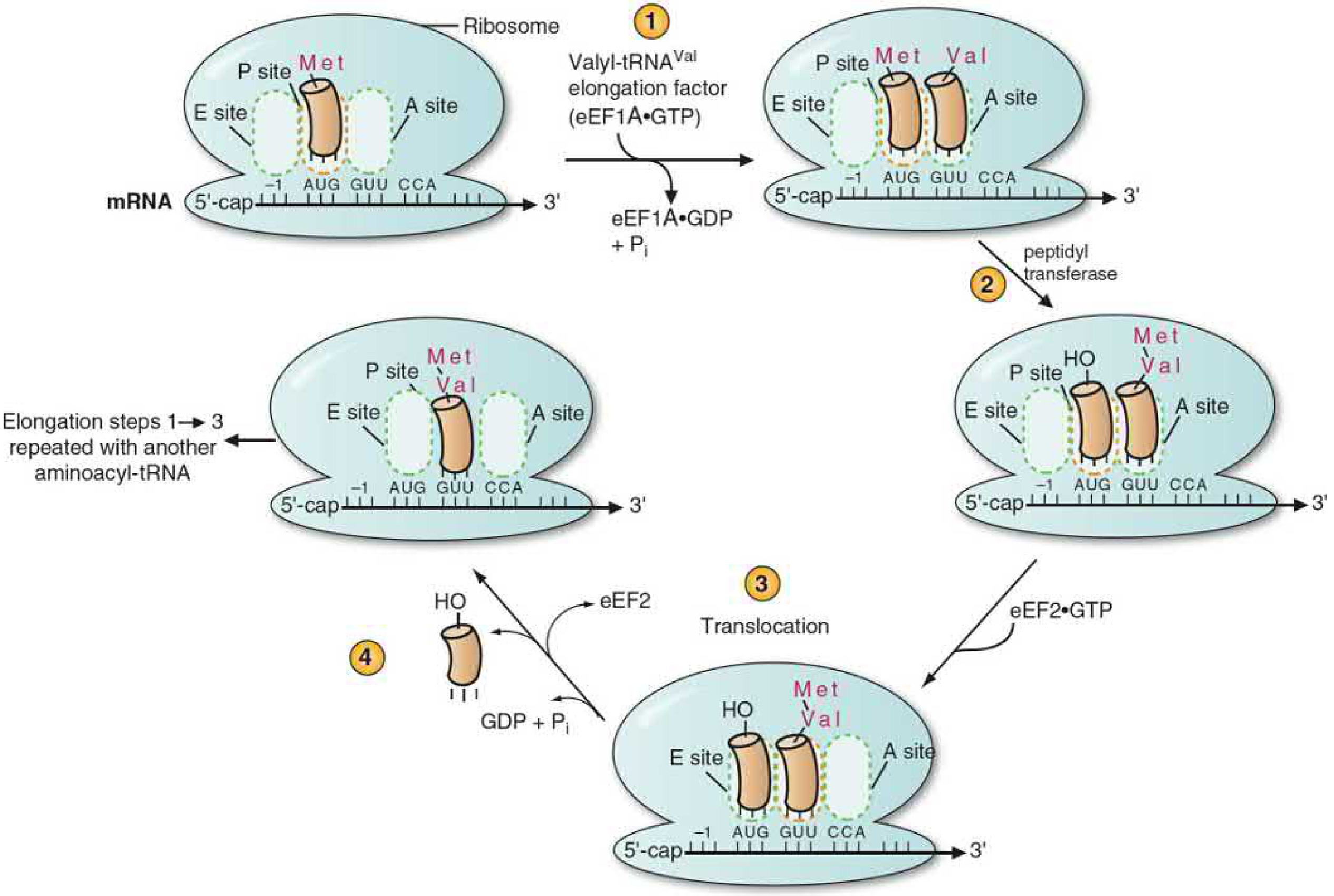
Step 1 - Aminoacyl-tRNA Binding at the A Site
- eEF1A-GTP (EF-Tu in prokaryotes) forms a ternary complex with the incoming aminoacyl-tRNA
- This complex delivers the correct aminoacyl-tRNA to the A site - correct codon-anticodon pairing triggers GTP hydrolysis
- eEF1A-GDP is released and recycled back to eEF1A-GTP
Step 2 - Peptide Bond Formation
- Peptidyl transferase (catalytic activity of the large rRNA - a ribozyme) transfers the growing polypeptide from the P-site tRNA onto the amino acid on the A-site tRNA
- The result: a peptidyl-tRNA (one residue longer) at the A site, and a deacylated tRNA at the P site
Step 3 - Translocation
- eEF2-GTP (EF-G in prokaryotes) binds the ribosome, causing a conformational change
- The ribosome shifts 3 nucleotides (one codon) in the 5'→3' direction:
- Deacylated tRNA moves P → E site (and is ejected when the next aminoacyl-tRNA enters)
- Peptidyl-tRNA moves A → P site
- A site is now empty, displaying the next codon
- GTP is hydrolyzed to GDP + Pi and eEF2 is released
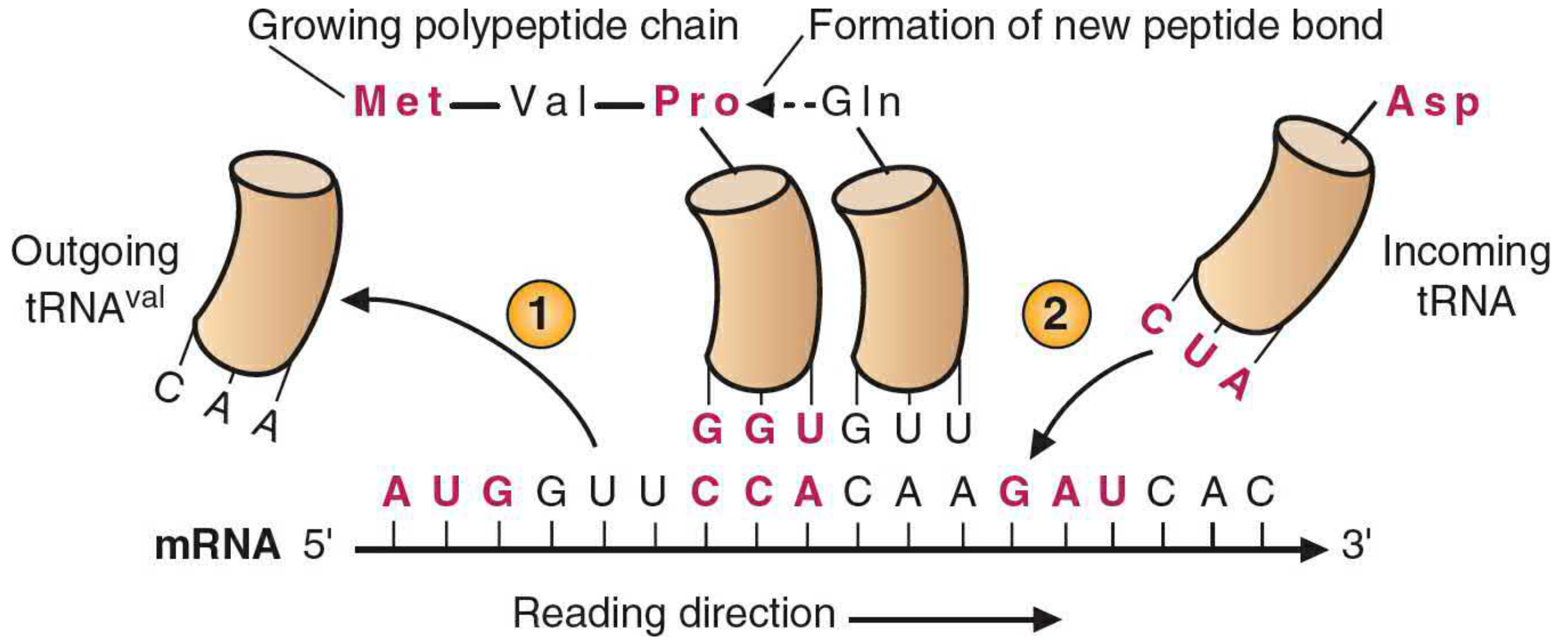
This cycle repeats until a stop codon is encountered.
- Basic Medical Biochemistry, 6e, pp. 484-486
Phase 3: Termination
-
When a stop codon (UAA, UAG, or UGA) enters the A site, no tRNA with a matching anticodon exists
-
Release factors (eRF1 and eRF3 in eukaryotes; RF1, RF2, RF3 in prokaryotes) bind to the ribosome at the stop codon
-
Peptidyl transferase hydrolyzes the bond between the polypeptide chain and the P-site tRNA - releasing the completed protein
-
The ribosome dissociates into its 40S + 60S subunits, releasing the mRNA
-
Subunits are recycled for the next round of translation
-
Basic Medical Biochemistry, 6e, p. 486
Energy Cost
| Step | Energy Used |
|---|---|
| Amino acid activation (tRNA charging) | 2 ATP equiv (ATP → AMP + PPi) per amino acid |
| Aminoacyl-tRNA binding (A site) | 1 GTP per amino acid |
| Translocation | 1 GTP per amino acid |
| Total | 4 high-energy bonds per amino acid added |
- Basic Medical Biochemistry, 6e, p. 486
Polysomes
Once one ribosome moves away from the 5' end of the mRNA, a second ribosome can attach. Multiple ribosomes translate the same mRNA simultaneously, forming a polysome (polyribosome). A single ribosome covers ~80 nucleotides, so ribosomes are spaced ~100 nucleotides apart. This dramatically increases the rate of protein production from a single mRNA molecule.
Prokaryote vs. Eukaryote Comparison
| Feature | Prokaryote | Eukaryote |
|---|---|---|
| Ribosome | 70S (30S + 50S) | 80S (40S + 60S) |
| Initiator tRNA | fMet-tRNA | Met-tRNA$_{Met}$ |
| Start codon ID | Shine-Dalgarno sequence | 5' cap scanning + Kozak sequence |
| Initiation factors | 3 (IF1, IF2, IF3) | 10+ (eIFs) |
| Elongation factor (A site) | EF-Tu | eEF1A |
| Translocation factor | EF-G | eEF2 |
| Coupled transcription/translation | Yes | No (compartmentalized) |
Clinically Relevant Points
-
Antibiotics exploit ribosome differences between prokaryotes and eukaryotes:
- Tetracyclines - block aminoacyl-tRNA binding to the 30S A site
- Aminoglycosides (streptomycin) - cause mRNA misreading at the 30S subunit
- Chloramphenicol - inhibits peptidyl transferase on the 50S subunit
- Linezolid - prevents formation of the 70S initiation complex (23S rRNA)
- Macrolides (erythromycin) - block the polypeptide exit tunnel in the 50S
-
Diphtheria toxin: The A subunit of Corynebacterium diphtheriae toxin ADP-ribosylates eEF2 (at a modified histidine called diphthamide), permanently inactivating it and halting protein synthesis - leading to cell death.
-
eIF2 regulation: Phosphorylation of eIF2 inactivates it, halting translation. This occurs during starvation, heat shock, and viral infection. In reticulocytes, heme inhibits eIF2 phosphorylation, promoting globin synthesis only when heme is available.
-
Basic Medical Biochemistry, 6e, pp. 482, 486
-
Harper's Illustrated Biochemistry, 32e, p. 421
-
Histology: A Text and Atlas, p. 175
This is a shared conversation. Sign in to Orris to start your own chat.