
How does hematoma resolves if produced by contusion injury
A hematoma from contusion resolves through a predictable sequence of events involving clot formation, breakdown, and tissue repair.
Searching sources...
Reading File
Now let me search the medical library for relevant content on hematoma resolution.
Finding Sources
Finding Sources
Searching PubMed
hematoma resolution resorption mechanisms
Let me search more specifically for the pathological process of blood/clot resolution and wound healing stages.
Finding Sources
Finding Sources
Finding Sources
Reading File
Finding Sources
Reading File
Finding Sources
Reading File
Finding Sources
Reading File
Finding Sources
Reading File
Finding Sources
Now let me fetch the key wound healing diagram and compile a comprehensive answer.
Loading Image
Loading Image
I now have comprehensive information to give a thorough, well-sourced answer. Here it is:
Resolution of a Hematoma from Contusion Injury
A contusion (blunt trauma without breaking the skin) ruptures small blood vessels in the soft tissue, causing blood to pool in the interstitial space. The hematoma that forms then resolves through four overlapping phases:
Phase 1 - Hemostasis (Minutes to Hours)
The moment blood escapes the vessel, the body initiates clotting:
- Injured endothelium exposes collagen (types I and IV), which binds platelets via the glycoprotein Ia/IIa receptor complex
- Platelets activate, flatten, and discharge their granule contents - releasing PDGF, TGF-β, VEGF, and von Willebrand factor (vWF)
- Platelet aggregation + circulating fibrinogen polymerizes into a stable fibrin clot (the hematoma itself)
- Concurrent local vasoconstriction limits further extravasation
The clot also serves as a scaffold for subsequent repair - it is not merely waste material.
Phase 2 - Inflammation: Clot and Debris Clearance (Day 1 - ~1 Week)
This is where active hematoma resorption begins:
Neutrophils (first 24-48 hours):
- First cells recruited to the site
- Release chemokines (CXCL12, etc.) that attract circulating monocytes
- Perform early débridement of dead cells and fibrin fragments
- Begin to undergo apoptosis by 48 hours, signaling monocyte arrival
Macrophages (days 2 onward - the KEY cells for hematoma resolution):
- Circulating monocytes recruited by neutrophil-derived chemokines differentiate into macrophages at the site
- M1-type macrophages (proinflammatory) phagocytose:
- Apoptotic neutrophils
- Red blood cells (RBCs) trapped in the clot
- Fibrin fragments
- Dead tissue and cell debris
- As apoptotic cells are cleared, macrophages transition to an M2-type (anti-inflammatory/reparative) phenotype, secreting IL-4, IL-10, IL-13, and TGF-β - signaling the wound to shift from destruction to repair
What happens to the hemoglobin?
RBCs in the clot are phagocytosed by macrophages and broken down:
- Hemoglobin → oxyhemoglobin (bright red, freshly bruised skin)
- → deoxyhemoglobin (dark blue-purple, ~1-2 days)
- → methemoglobin → biliverdin (green tinge, ~4-6 days)
- → bilirubin (yellow-brown tinge, ~6-10 days)
- The iron component is stored locally as hemosiderin (golden-brown granules) in macrophages, which may persist at the site for weeks to months
- These color changes on the skin surface are the visible clinical sign of hematoma resolution
Simultaneously, fibrinolysis begins - plasminogen activators convert plasminogen to plasmin, which digests the fibrin clot meshwork. This liquefies the hematoma and allows macrophage infiltration throughout it.
Phase 3 - Proliferation: Rebuilding (Days 3 - Weeks)
Once the hematoma is largely cleared:
- Fibroblasts are recruited by macrophage-derived growth factors (PDGF, TGF-β, VEGF)
- They deposit new collagen (type III initially, then type I) and extracellular matrix (ECM) to replace the clot scaffold
- Angiogenesis provides new microvasculature to support tissue repair
- The organizing clot is progressively replaced by granulation tissue - a provisional matrix of collagen, fibronectin, and new capillaries
Phase 4 - Remodeling and Maturation (Weeks to ~1 Year)
- Fibroblasts differentiate into myofibroblasts, which contract the repair zone
- Type III collagen is replaced by stronger type I collagen, cross-linked by lysyl oxidase
- Excess vasculature regresses
- Over 6-12 months, tensile strength increases toward - but does not fully reach - pre-injury levels (~80% of original)
Summary Table
| Phase | Timing | Key Process | Key Cells |
|---|---|---|---|
| Hemostasis | Minutes-hours | Clot (fibrin plug) formation | Platelets |
| Inflammation | Days 1-7 | Phagocytosis of RBCs/fibrin; Hgb degradation | Neutrophils, Macrophages |
| Proliferation | Days 3 - weeks | Collagen deposition, angiogenesis | Fibroblasts, endothelial cells |
| Remodeling | Weeks - 1 year | Collagen cross-linking, scar maturation | Myofibroblasts, fibroblasts |
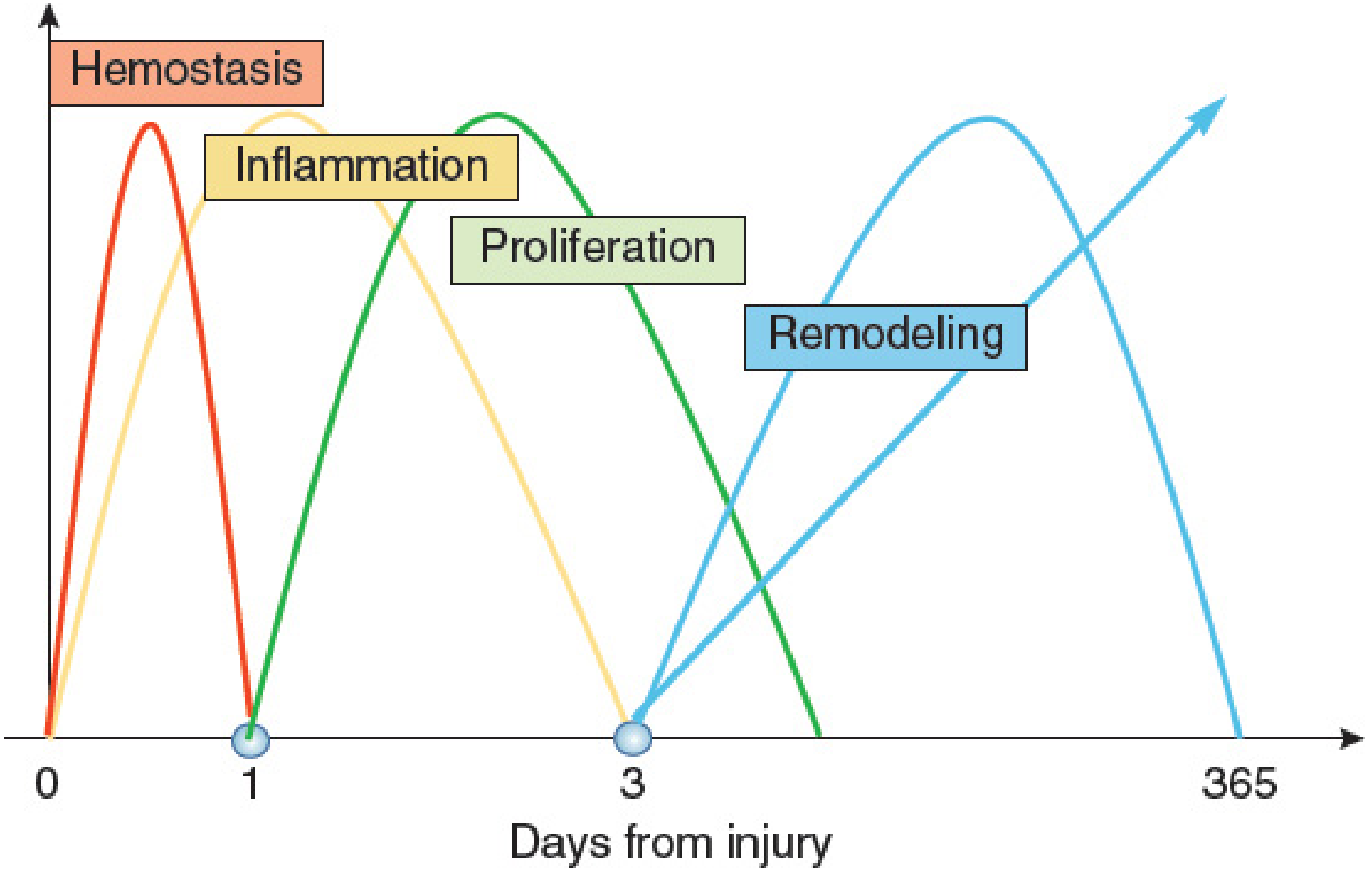
Figure: Four overlapping phases of wound healing plotted against time from injury (Mulholland and Greenfield's Surgery, 7e)
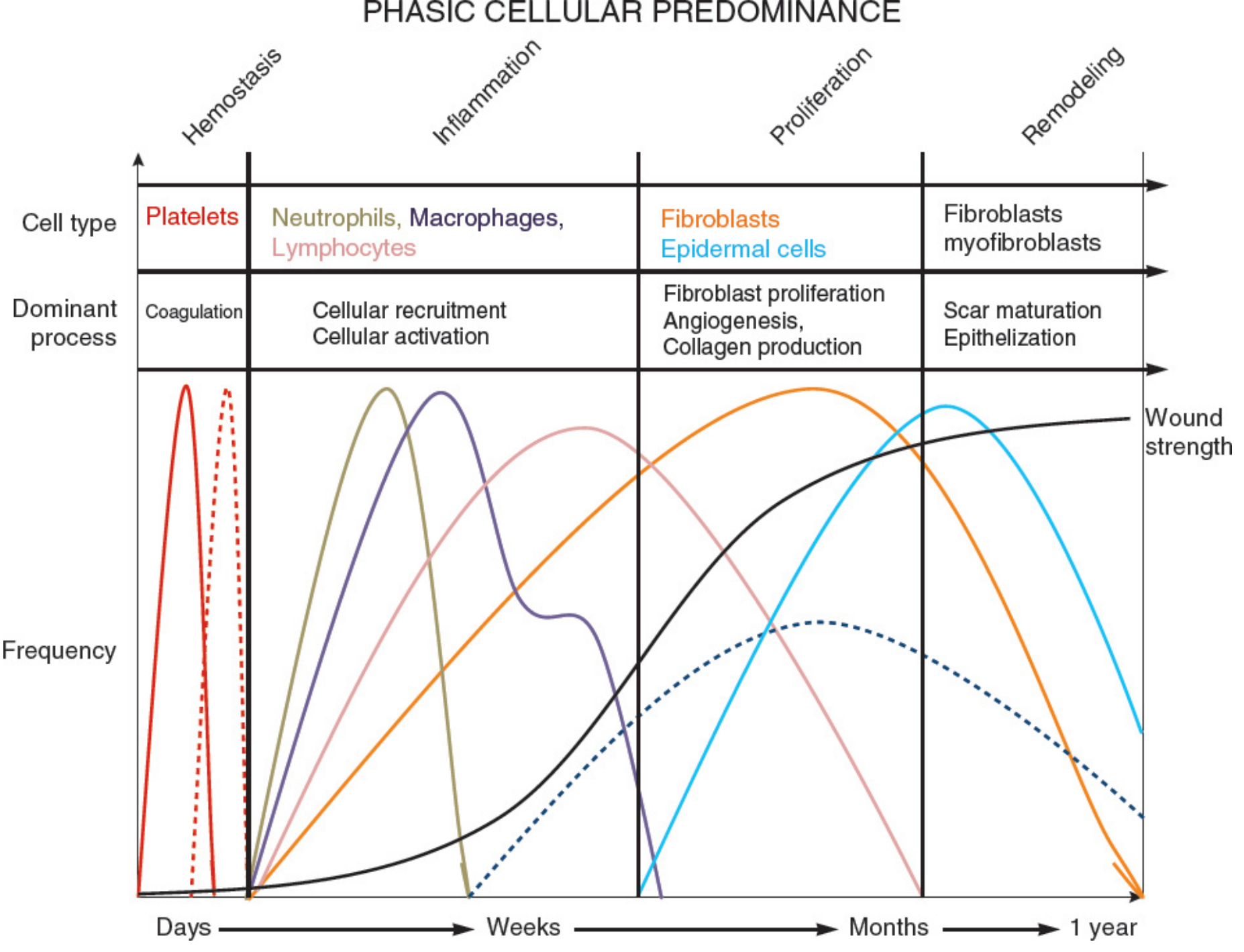
Figure: Dominant cell types and processes in each phase of wound healing (Mulholland and Greenfield's Surgery, 7e)
When Hematomas Fail to Resolve Normally
Large hematomas may not fully resorb and can instead:
- Organize - fibroblasts invade and replace the hematoma with fibrous/scar tissue
- Calcify - dystrophic calcification develops (myositis ossificans in muscle hematomas)
- Become infected (abscess formation)
- Liquefy into a seroma-like collection that may require aspiration
Factors that impair resolution include: large hematoma volume, continued bleeding, old age, anticoagulant use, diabetes, and poor nutritional status.
- Mulholland and Greenfield's Surgery: Scientific Principles and Practice, 7e - Chapter 5 (Wound Healing)
- SCHWARTZ'S Principles of Surgery, 11e - Chapter 9 (Wound Healing)
Colour of skin during healing process
The skin color changes over a bruise follow a predictable sequence tied to hemoglobin breakdown: red/purple initially, then blue-black, then green, then yellow, then normal skin tone.
Searching sources...
Finding Sources
Finding Sources
Finding Sources
Finding Sources
Finding Sources
Finding Sources
Finding Sources
Finding Sources
I found a direct textbook reference. Let me read that section from Pfenninger and Fowler's and also search for more detail.
Reading File
Finding Sources
Reading File
Searching the Web
bruise color change stages hemoglobin breakdown oxyhemoglobin biliverdin bilirubin hemosiderin timeline days
I now have excellent sources from both textbooks and web references to give a comprehensive, accurate answer with the biochemical basis of each color change.
Skin Color Changes During Hematoma/Bruise Healing
The color sequence of a bruise is a direct window into the biochemical breakdown of hemoglobin by tissue macrophages. Each color represents a different degradation product with a distinct light-absorption spectrum.
The Biochemical Pathway
When RBCs are trapped in the interstitium, macrophages phagocytose them and break down their hemoglobin through an enzymatic cascade:
Hemoglobin (red)
     ↓  [heme oxygenase]
  Heme + globin
     ↓
  Biliverdin (green) + CO + Fe²⁺
     ↓  [biliverdin reductase]
  Bilirubin (yellow)
     ↓  [cleared via lymphatics/venules]
  Normal skin color restored

  Fe²⁺ + ferritin → Hemosiderin (golden-brown) — may persist for weeks-months
Color Stages with Timeline
| Stage | Color | Timing | Cause |
|---|---|---|---|
| 1. Fresh injury | Bright red | Immediately (minutes) | Oxyhemoglobin in extravasated blood; also local vasodilation from inflammation |
| 2. Early bruise | Dark blue / purple | Hours to 1-2 days | Deoxygenation of hemoglobin → deoxyhemoglobin; oxygen released to surrounding tissue |
| 3. Established bruise | Blue-black | Days 1-3 | Continued deoxygenation; methemoglobin (oxidized Fe³⁺ state) contributes to darker discoloration |
| 4. Green tinge | Green | Days 4-6 | Heme oxygenase cleaves the heme ring → biliverdin (a green tetrapyrrole pigment) |
| 5. Yellow | Yellow / yellow-brown | Days 6-10 | Biliverdin reductase converts biliverdin → bilirubin (yellow pigment) |
| 6. Fading | Yellowish-brown / light brown | Days 10-14 | Residual bilirubin clearing; hemosiderin (iron-ferritin complex) leaves a transient brown stain |
| 7. Resolution | Normal skin tone | ~2 weeks (small bruise) to weeks-months (large hematoma) | All pigments cleared via lymphatics and local macrophage clearance |
Key Points on Each Color
Red (immediate)
- Reflects oxyhemoglobin - the same bright red of arterial blood
- Tissue vasodilation from the acute inflammatory response adds to the redness
- The skin may also look swollen and feel warm
Blue-Purple (days 1-2)
- Blood loses oxygen to the surrounding hypoxic tissue
- Deoxyhemoglobin absorbs red light, so it appears blue-purple through the skin
- This is often the most visually alarming stage - the "classic bruise" color
- Deeper bruises look bluer; more superficial ones look redder
Green (days 4-6)
- Heme oxygenase (induced in macrophages) cleaves the porphyrin ring of heme, releasing:
- Biliverdin - a water-soluble green pigment
- Carbon monoxide (CO)
- Free iron (Fe²⁺)
- Biliverdin has a distinct green color visible through the skin
Yellow (days 6-10)
- Biliverdin reductase rapidly converts biliverdin → bilirubin
- Bilirubin is yellow-orange; it is the same compound responsible for jaundice
- At this stage the bruise is fading and often tender no more
Brown (days 10-14, sometimes persisting)
- Some of the released iron combines with ferritin to form hemosiderin
- Hemosiderin is a golden-brown, insoluble iron-storage compound
- In large hematomas (e.g., traumatic muscle injury), hemosiderin may persist for months and is visible on MRI as a dark susceptibility artifact
Visual Summary
Day 0-1       Day 1-2          Day 4-6       Day 6-10      Day 10-14
  RED    →  BLUE/PURPLE  →    GREEN    →    YELLOW   →  BROWN/FADE  →  NORMAL
(OxyHb)   (DeoxyHb/MetHb)  (Biliverdin)  (Bilirubin)  (Hemosiderin)
Factors That Affect the Color Sequence
| Factor | Effect |
|---|---|
| Depth of blood | Deeper hematomas appear more blue/green; surface bleeds appear redder |
| Skin tone | Darker skin makes color changes harder to see; green and yellow stages may be missed |
| Size of hematoma | Larger hematomas take longer and the sequence is slower and more prolonged |
| Age | Elderly patients have thinner skin - bruises appear sooner and more dramatically |
| Anticoagulants | More extensive spread; slower resolution |
| Location | Bruises on the face and eyelids migrate distally by gravity (e.g., "black eye" may track down to the cheek) |
Clinical note: The color of a bruise is used in forensic medicine to approximately "age" an injury. However, the timeline is variable enough that color alone cannot precisely date a bruise - it can only indicate a minimum age. The presence of yellow/green indicates at least 4-6 days have passed since the injury.
- Pfenninger and Fowler's Procedures for Primary Care, 3e (ecchymosis color sequence)
- Dermatology 2-Volume Set, 5e (hematoma and ecchymosis management)
- StatPearls - Biochemistry, Biliverdin (NCBI Bookshelf)
- Journal of Indian Forensic Medicine & Toxicology - Ageing of Bruise: Review of Histo-Chemical Changes with Time
This is a shared conversation. Sign in to Orris to start your own chat.