
Teach me p53
I'll start with a quick overview while pulling detailed information from the medical library.
p53 is a tumor suppressor protein encoded by the TP53 gene on chromosome 17p13. Often called the "guardian of the genome," it responds to DNA damage by halting the cell cycle, triggering DNA repair, or initiating apoptosis. It is mutated in roughly 50% of all human cancers, making it the most commonly altered gene in cancer.
Searching sources...
Reading File
Now let me search the library and web in parallel for comprehensive p53 content.
Finding Sources
Finding Sources
Searching PubMed
p53 TP53 tumor suppressor cancer
Excellent results. Now let me read the key sections from Robbins Pathology, Basic Medical Biochemistry, and Harper's in parallel.
Reading File
Reading File
Reading File
I found a great diagram. Let me fetch it and also read the section on p53 from Scott-Brown's (which has the detailed "guardian of the genome" section) and Henry's for the clinical detection angle.
Loading Image
Reading File
Reading File
I now have rich material from multiple authoritative textbooks plus a clear diagram. Let me compile the comprehensive teaching response.
p53 - The Guardian of the Genome
1. What is p53?
p53 is a 393-amino acid nuclear phosphoprotein encoded by the TP53 gene located on chromosome 17p13.1. It functions as a transcription factor and the cell's central stress monitor. The nickname "guardian of the genome" captures its core role: detecting damage to the DNA, halting the cell cycle to allow repair, and - if repair fails - triggering either senescence or apoptosis to eliminate the damaged cell.
Key structural facts:
- Transactivation domain (aa 1-93): binds MDM2/HDM2
- DNA-binding domain (aa 93-312): most mutations cluster here ("hot spots" at R248, R249, R175, etc.)
- Tetramerization domain (aa 307-355): p53 works as a homotetramer
- Negative regulatory domain (aa 356-393)
2. The p53 Pathway - Step by Step
Here is the mechanism, summarized visually:
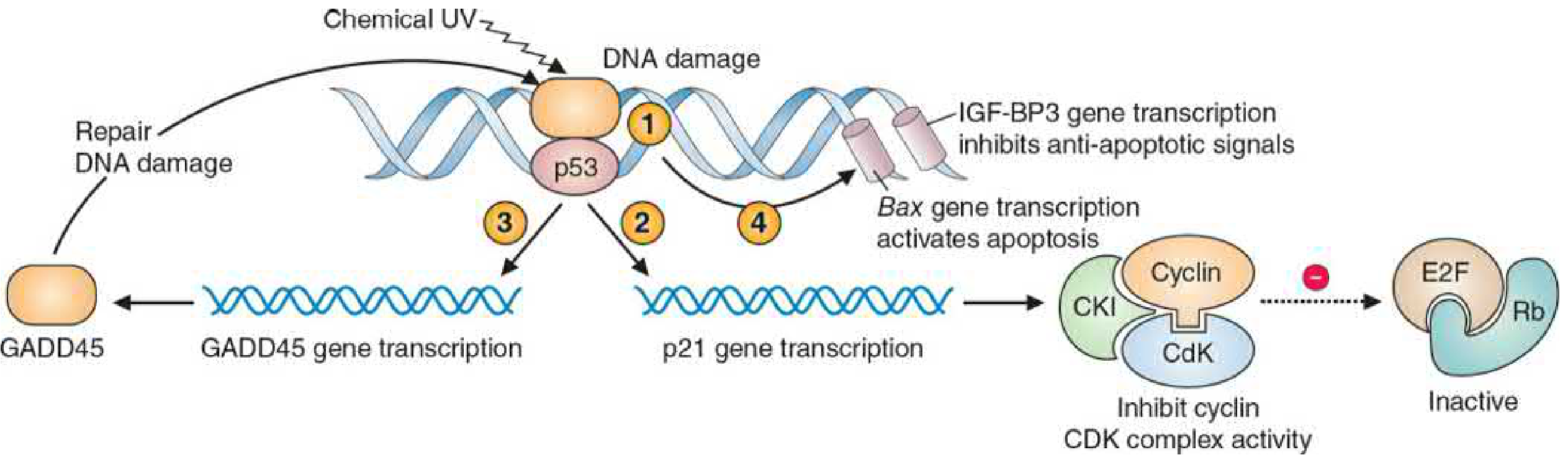
Figure: p53 and cell-cycle arrest pathway (Basic Medical Biochemistry, 6e, Fig. 17.10)
Step-by-step mechanism:
| Step | Event |
|---|---|
| Trigger | DNA damage from mutagens, UV, ionizing radiation, anoxia, oncogene activation |
| Sensing | ATM/ATR kinase complexes sense DNA double/single strand breaks |
| p53 stabilization | ATM/ATR phosphorylate p53, releasing it from MDM2/HDM2 (its ubiquitin ligase) - normally MDM2 constantly tags p53 for proteasomal degradation keeping levels low |
| p53 rises | Free, active p53 accumulates in the nucleus |
| Cell cycle arrest | p53 transcribes p21 (a CKI - cyclin-dependent kinase inhibitor) → p21 blocks cyclin-CDK complexes → Rb remains hypophosphorylated → E2F transcription factors stay inactive → cell cannot enter S phase (G1/S checkpoint blocked) |
| DNA repair | p53 also transcribes GADD45 (growth arrest and DNA damage gene) → DNA repair enzymes are recruited |
| If repaired | p53 activates the MDM2 gene → MDM2 protein re-degrades p53 → negative feedback restores normal cycle |
| If not repaired | p53 activates pro-apoptotic genes: Bax, Puma, Noxa, Apaf-1 (mitochondrial/intrinsic apoptosis) and Fas, TRAIL, TRAIL-R2 (death receptor/extrinsic apoptosis); also activates IGF-BP3 which blocks anti-apoptotic growth factor signaling |
| Senescence | Alternatively, p53 can trigger irreversible cell cycle arrest (senescence) |
"p53 is the central monitor of stress in the cell and can be activated by anoxia, inappropriate signaling by mutated oncoproteins, or DNA damage." - Robbins Pathologic Basis of Disease
3. MDM2 - The Key Regulator of p53
- MDM2 (mouse double minute 2, human homolog = HDM2) is the primary negative regulator of p53
- MDM2 is itself a transcriptional target of p53 - this creates an autoregulatory feedback loop
- MDM2 ubiquitinates p53 → marks it for proteasomal degradation → p53 half-life is very short (minutes) under normal conditions
- ATM phosphorylation of p53 disrupts the p53-MDM2 interaction → p53 is stabilized
- Clinical relevance: Some cancers overexpress MDM2 (gene amplified) as an alternative to mutating p53 itself - same net result (p53 inactivation)
4. p53 in Cancer - "Most Mutated Gene"
- >50% of all human cancers carry biallelic loss-of-function mutations in TP53 - the single most commonly mutated gene in cancer
- Follows the two-hit hypothesis (like Rb): both alleles must be inactivated
Mechanisms of p53 inactivation in cancer:
| Mechanism | Example |
|---|---|
| Point mutations in DNA-binding domain | Colorectal, lung, breast, bladder, etc. |
| Homozygous deletion | Colon, bladder cancers |
| MDM2 amplification/overexpression | Soft-tissue sarcomas (~30%) |
| Viral oncoprotein binding | HPV E6 binds p53 → ubiquitin degradation (cervical cancer) |
| Loss of ATM upstream | Ataxia-telangiectasia |
Common mutation "hot spots":
Point mutations H179L, R249W, and I255F are among the most frequent. Many mutant p53 proteins have increased half-lives and accumulate in tumor cells (gain-of-function mutations) - these mutant proteins can sometimes actively promote transformation.
5. Clinical Syndromes
Li-Fraumeni Syndrome
- Germline (inherited) heterozygous TP53 mutation
- Autosomal dominant, rare
- Very high lifetime cancer risk: sarcomas, breast cancer, brain tumors, leukemia, adrenocortical carcinoma (the "SBLA" cancers)
- Second-hit somatic mutation eliminates the remaining wild-type allele
Other cancers with prominent p53 mutation:
- Colorectal carcinoma - p53 mutation is a late event in the adenoma-carcinoma sequence
- Lung cancer - p53 mutation correlates with cigarette smoking (Goldman-Cecil Medicine)
- Cervical cancer - HPV E6 inactivation of p53
- Osteosarcoma - associated with RB1 and TP53 abnormalities (Li-Fraumeni)
- Uterine serous carcinoma - p53 overexpression (aberrant) is a defining molecular feature
6. p53 as a Transcription Factor - Key Target Genes
| Gene activated | Effect |
|---|---|
| p21 (CDKN1A) | Inhibits cyclin-CDK complexes → G1/S arrest |
| GADD45 | DNA repair |
| MDM2 | Negative feedback (p53 self-regulation) |
| Bax | Pro-apoptotic (BCL-2 family) |
| Puma / Noxa | Pro-apoptotic (BH3-only proteins) |
| Apaf-1 | Apoptosome formation |
| Fas / TRAIL-R2 | Death receptor pathway activation |
| IGF-BP3 | Blocks IGF-mediated survival signals |
| Autophagy regulators | Stress response (newly recognized role) |
7. p53 in the Lab / Diagnostics
From Henry's Clinical Diagnosis (clinical laboratory perspective):
- IHC (immunohistochemistry): Wild-type p53 is rapidly degraded and shows minimal/no nuclear staining. Mutant p53 accumulates → strong nuclear overexpression on IHC = surrogate for TP53 mutation (used in gynecologic oncology, especially uterine serous carcinoma and vulvar SCC)
- Serum anti-p53 antibodies: Detectable in cancer patients; their presence correlates with TP53 mutation. However, absence is not reassuring (homozygous deletions produce no p53 protein to generate antibodies)
- Serum p53 protein: Elevated in some cancers, but complex to interpret because different antibodies recognize different mutant forms
8. Oncogene vs. Tumor Suppressor - Where p53 Fits
| Feature | Oncogene | Tumor Suppressor (p53) |
|---|---|---|
| Alleles needed for effect | 1 (dominant) | 2 (both must be lost) |
| Effect | Gain-of-function → promotes growth | Loss-of-function → removes brakes |
| Inheritance | Somatic mutations only | Can be germline (Li-Fraumeni) |
| p53 classification | "Caretaker" and "Gatekeeper" gene |
Note: p53 is unusual - it functions as both a gatekeeper (regulates cell cycle and apoptosis) and a caretaker (preserves genomic integrity by coordinating DNA repair).
9. Summary Table
| Property | Detail |
|---|---|
| Gene | TP53, chromosome 17p13.1 |
| Protein | 393 aa, 53 kDa nuclear phosphoprotein |
| Function | Transcription factor, stress sensor, tumor suppressor |
| Active form | Homotetramer |
| Key activators | DNA damage, ATM/ATR kinases, oncogene activation, hypoxia |
| Key inhibitor | MDM2/HDM2 (ubiquitin ligase) |
| Main downstream effectors | p21, GADD45, Bax, Puma, MDM2 |
| Mutation frequency | >50% of all human cancers |
| Germline syndrome | Li-Fraumeni syndrome |
| Viral inactivation | HPV E6 protein |
| Cancer detection | IHC overexpression, serum anti-p53 antibodies |
Sources: Robbins, Cotran & Kumar Pathologic Basis of Disease; Basic Medical Biochemistry 6e; Harper's Illustrated Biochemistry 32e; Scott-Brown's Otorhinolaryngology; Henry's Clinical Diagnosis and Management by Laboratory Methods; Goldman-Cecil Medicine; Katzung's Basic & Clinical Pharmacology 16e.
This is a shared conversation. Sign in to Orris to start your own chat.