
from Guyton and Hall textbook of medical physiology, 4th South Asia edition write a 5 mark short note on .Thyroid Hormone Synthesis and Release-enumerate steps , diagram; AntiThyroid Drugs-action
Reading File
Finding Sources
Finding Sources
Finding Sources
Finding Sources
Finding Sources
Reading File
Reading File
Reading File
Loading Image
Loading Image
Reading File
I now have all the content needed from Guyton and Hall. Let me compose the complete 5-mark short note.
SHORT NOTE: Thyroid Hormone Synthesis, Release, and Antithyroid Drugs
(Guyton and Hall Textbook of Medical Physiology, 4th South Asia Edition - Chapter 77)
A. Thyroid Hormone Synthesis and Release
The thyroid gland consists of closed follicles (100-300 µm diameter) lined by cuboidal epithelial cells. The follicle lumen contains colloid, the major constituent of which is thyroglobulin - a large glycoprotein (MW ~335,000) carrying ~70 tyrosine residues that serve as the scaffold for hormone formation.
Steps of Synthesis (Enumerated)
Step 1 - Iodide Trapping (Active Transport)
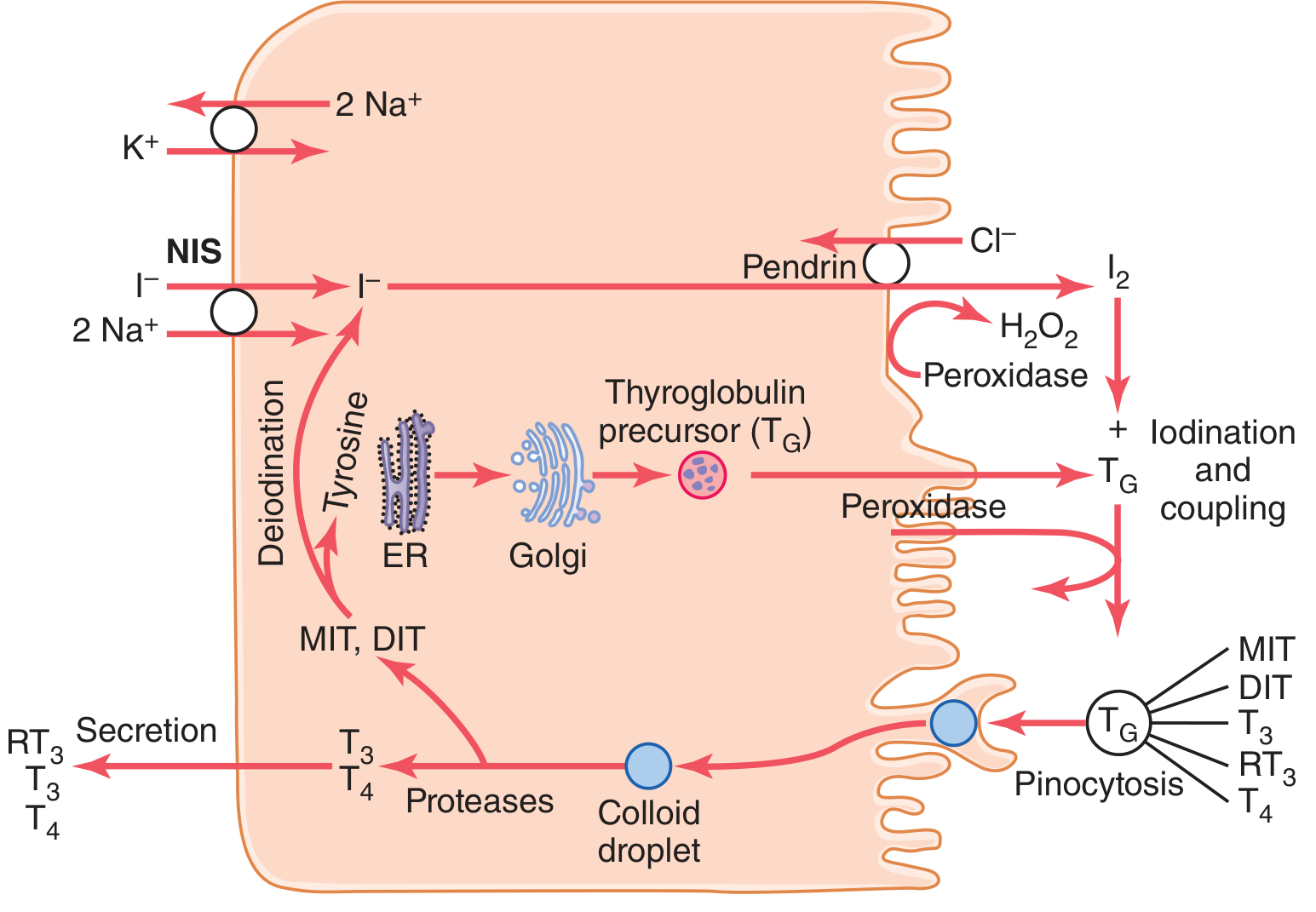
Iodide (I⁻) from the blood is actively pumped into the thyroid cell across the basolateral membrane by the Sodium-Iodide Symporter (NIS), co-transporting 1 I⁻ with 2 Na⁺. The energy comes from the Na⁺-K⁺ ATPase pump. This concentrates iodide to ~30× its plasma level (up to 250× when maximally stimulated by TSH). This is called iodide trapping.
Step 2 - Iodide Efflux into Follicle (Pendrin)
Iodide is then transported out of the thyroid cell across the apical membrane into the follicular lumen by a Cl⁻/I⁻ counter-transporter called pendrin.
Step 3 - Thyroglobulin Synthesis and Secretion
The thyroid cells synthesize thyroglobulin in the endoplasmic reticulum and Golgi apparatus, then secrete it into the follicular lumen as the colloid.
Step 4 - Oxidation of Iodide (I⁻ → I₂)
At the apical membrane, the enzyme thyroid peroxidase (TPO) (using H₂O₂ as cofactor) oxidizes I⁻ to active iodine (nascent I⁰ or I₃⁻). This is essential - blocking peroxidase stops hormone formation entirely.
Step 5 - Organification (Iodination of Tyrosine)
Active iodine binds to tyrosine residues within thyroglobulin, catalyzed by TPO. This produces:
- MIT - Monoiodotyrosine (1 iodine atom)
- DIT - Diiodotyrosine (2 iodine atoms)
Step 6 - Coupling Reaction
TPO also catalyzes the coupling of iodinated tyrosines within the thyroglobulin molecule:
- MIT + DIT → T₃ (triiodothyronine)
- DIT + DIT → T₄ (thyroxine)
The iodinated thyroglobulin is then stored in the follicular colloid.
Step 7 - Release: Pinocytosis and Proteolysis
When secretion is stimulated (by TSH):
- The apical surface of follicular cells sends out pseudopod extensions that engulf colloid → pinocytic vesicles form.
- Lysosomes fuse with these vesicles → proteases cleave thyroglobulin.
- Free T₃ and T₄ diffuse through the base of the cell into surrounding capillaries.
Step 8 - Iodine Recycling
MIT and DIT (which constitute ~75% of iodinated tyrosines) are not released into blood. Instead, a deiodinase enzyme cleaves iodine from them for recycling within the gland.
Secretion ratio: ~93% T₄, ~7% T₃ released; ~half of T₄ is peripherally deiodinated to T₃, which is the active form delivered to tissues.
Diagram (Fig. 77.2 - Guyton and Hall)
Figure 77.1 - Anatomy of the thyroid gland showing follicles, colloid, cuboidal epithelial cells, and C cells:
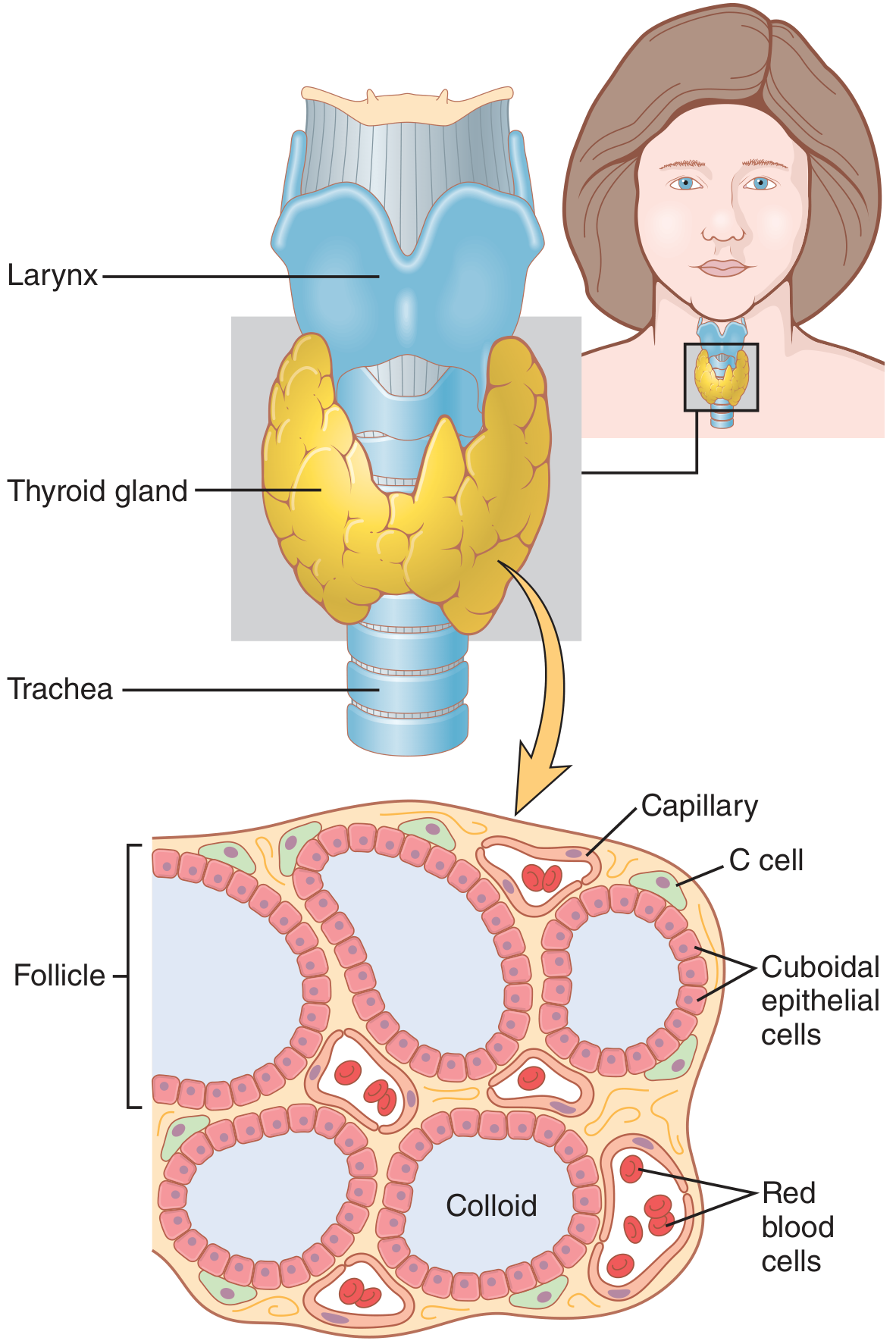
Figure 77.2 - Thyroid cellular mechanisms for iodine transport, T₃/T₄ formation and release (NIS, Pendrin, Peroxidase, Organification, Coupling, Pinocytosis, Proteolysis, Deiodination):
B. Antithyroid Drugs - Mechanism of Action
(Section: "Antithyroid Substances Suppress Thyroid Secretion" - Guyton & Hall, Ch. 77)
The three major classes of antithyroid drugs act at distinct steps:
1. Thiocyanate (and Perchlorate, Nitrate) - Block Iodide Trapping
- The NIS pump that transports I⁻ also transports SCN⁻, ClO₄⁻, and NO₃⁻.
- These ions competitively inhibit iodide transport - blocking the iodide-trapping mechanism.
- Thyroglobulin synthesis continues but it cannot be iodinated → no thyroid hormones form.
- Consequence: Low T₃/T₄ → increased TSH secretion (feedback) → goiter (thyroid enlargement without adequate hormone production).
2. Propylthiouracil (PTU), Methimazole, Carbimazole - Block Organification and Coupling
- These thionamide drugs act by two mechanisms:
- Inhibit thyroid peroxidase - blocking oxidation of iodide and therefore iodination of tyrosine.
- Block the coupling reaction - prevent two iodinated tyrosines from joining to form T₃ or T₄.
- Like thiocyanate, they do not prevent thyroglobulin synthesis.
- Absence of T₃/T₄ leads to strong TSH feedback → goiter formation.
- PTU additionally blocks peripheral conversion of T₄ → T₃ (by inhibiting deiodinase in peripheral tissues).
3. High-Concentration Iodides - Wolff-Chaikoff Effect
- When plasma iodide is ~100× normal levels:
- Rate of iodide trapping decreases.
- Iodination of tyrosine is reduced.
- Most importantly, endocytosis of colloid is paralyzed → the first step of hormone release is blocked → rapid shutdown of thyroid secretion.
- This is the Wolff-Chaikoff effect.
- After days to weeks, the gland "escapes" by downregulating NIS expression → resumes normal function.
- Unlike other antithyroid agents, high iodides decrease gland size and vascularity (opposite of goitrogenic drugs). This makes them useful for preoperative preparation (2-3 weeks before thyroidectomy) and treatment of thyroid storm.
Summary Table
| Drug | Site of Action | Mechanism | Clinical Use |
|---|---|---|---|
| Thiocyanate/Perchlorate | NIS (basolateral) | Competitive inhibition of iodide trapping | Research; rarely clinical |
| PTU / Methimazole | Thyroid peroxidase | Blocks oxidation, organification, and coupling (PTU also blocks peripheral T₄→T₃) | Hyperthyroidism, Graves' disease |
| High-dose Iodides (Lugol's) | Colloid endocytosis + trapping | Wolff-Chaikoff effect; paralysis of colloid uptake | Pre-op thyroidectomy; thyroid storm |
Reference: Guyton and Hall Textbook of Medical Physiology, 4th South Asia Edition, Chapter 77 - Thyroid Metabolic Hormones, pp. 930-933.
This is a shared conversation. Sign in to Orris to start your own chat.