
what are the ultra sound features of adenomyosis
Reading File
Finding Sources
Finding Sources
The best sources are Grainger & Allison (radiology textbook) and Berek & Novak's Gynecology. Let me read both simultaneously.
Reading File
Reading File
Now let me get the ultrasound image and look at the summary box and the Grainger text further for additional features.
Reading File
Searching Images
adenomyosis ultrasound transvaginal features
Searching PubMed
adenomyosis ultrasound diagnosis features
I now have comprehensive information. Let me fetch the key ultrasound image from Grainger & Allison and one of the excellent MUSA criteria images.
Loading Image
Loading Image
I have comprehensive textbook content and excellent images. Here is a thorough answer:
Ultrasound Features of Adenomyosis
Adenomyosis is the presence of endometrial glands and stroma within the myometrium, causing secondary smooth-muscle hyperplasia. Transvaginal ultrasound (TVUS) has a diagnostic accuracy of 68–86% for diffuse adenomyosis; accuracy falls with coexisting fibroids or focal disease.
Uterine Morphology
| Feature | Detail |
|---|---|
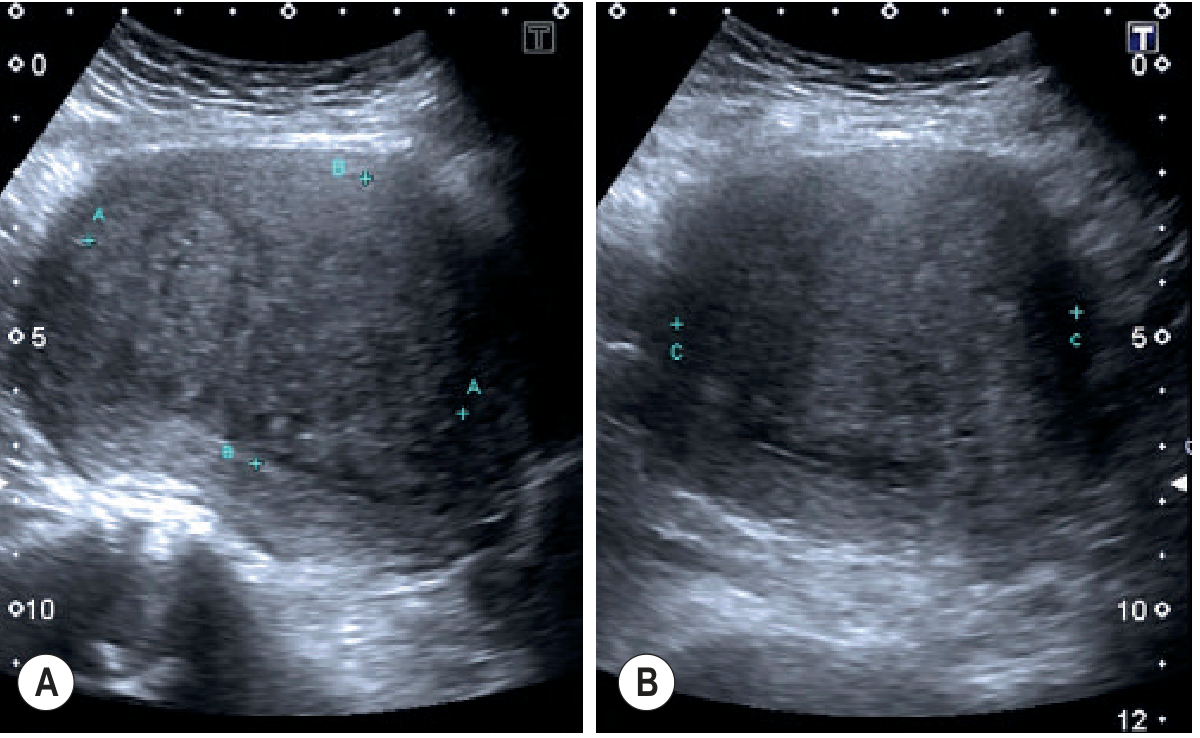
| Globular uterine enlargement | Uterus is diffusely enlarged but typically < 14 cm; adopts a rounded, globular shape |
| Asymmetric wall thickening | Anterior and posterior myometrial walls are unequal in thickness — a key indirect sign |
| "Question mark" uterus | On sagittal view, the uterus curves into a question-mark shape due to loss of normal contour |
Fig. 35.25 — Grainger & Allison's Diagnostic Radiology: Sagittal (A) and axial (B) TVUS showing a globular uterus with echogenic subendometrial striations and poor endomyometrial interface definition.
Myometrial Echotexture (Direct Features)
- Heterogeneous myometrium — Diffuse mixed echogenicity throughout the myometrium; mottled or "moth-eaten" texture
- Subendometrial echogenic nodules and linear striations — Hyperechoic foci and linear tracks projecting from the endometrium into the myometrium, representing ectopic endometrial tissue
- Subendometrial cysts (myometrial cysts) — Small anechoic cysts, 2–6 mm, present in ~50% of cases; represent haemorrhagic foci or dilated glands — the most specific TVUS sign
- Fan-shaped / "rain shower" shadowing — Multiple fine areas of acoustic attenuation radiating from the echogenic foci, creating vertical stripe-like shadowing through the myometrium
- Hyperechoic islands — Scattered bright islands within heterogeneous myometrium
Endometrial Interface
- Poor definition of the endomyometrial (junctional zone) interface — Irregular, blurred, or indistinct border between endometrium and myometrium
- Endometrial pseudowidening — The endometrium may appear falsely thickened due to irregular infiltration of the junctional zone
Colour / Power Doppler Features
- Translesional / diffuse internal vascularity — Colour Doppler shows a speckled pattern of increased vascularity within the heterogeneous myometrium, with vessels running through (not around) the lesion
- Distinguishes adenomyosis from fibroids, which typically show peripheral/circumferential flow
Focal Adenomyosis (Adenomyoma)
- Appears as an ill-defined, heterogeneous hypoechoic mass within the myometrium
- Lacks the well-defined, smooth echogenic pseudocapsule seen in fibroids
- Internal echogenic foci or small cysts may be present
- Margins are irregular and blend into surrounding myometrium
- Doppler shows internal rather than peripheral flow
Composite Image — MUSA Criteria
The image below illustrates the full spectrum of Morphological Uterus Sonographic Assessment (MUSA) features:
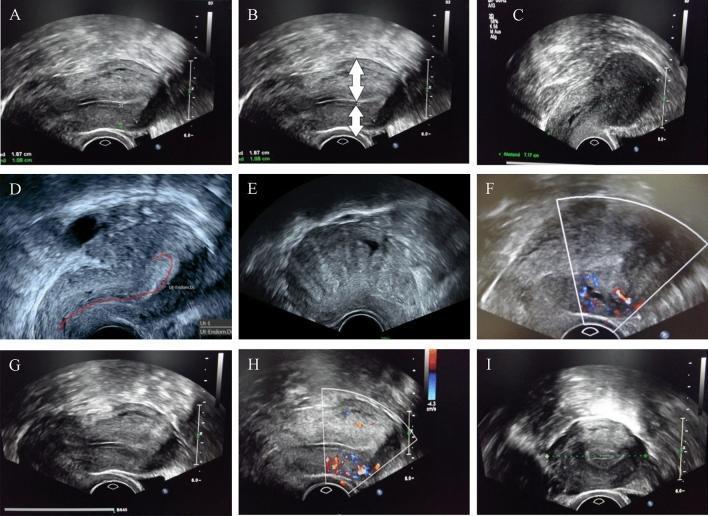
Panels: (A,B) AP wall asymmetry; (C) blurred junctional zone; (D) "question mark" uterus; (E) Rainforest phenomenon — linear subendometrial shadowing; (F,H) intramural lacunae and diffuse Doppler vascularity; (G) heterogeneous echogenicity; (I) globular fundus.
Summary Table
| Feature | Direct or Indirect | Specificity |
|---|---|---|
| Myometrial cysts (2–6 mm) | Direct | High |
| Subendometrial echogenic striations | Direct | High |
| Echogenic nodules | Direct | Moderate–High |
| Heterogeneous myometrium | Direct | Moderate |
| Globular uterine enlargement | Indirect | Low |
| AP wall asymmetry | Indirect | Moderate |
| Blurred endomyometrial interface | Direct | Moderate |
| Translesional Doppler flow | Direct | High (vs fibroids) |
| Fan/rain-shower shadowing | Direct | Moderate–High |
Diagnostic Notes
- TVUS is the first-line imaging modality; MRI is reserved for indeterminate cases or pre-operative planning
- Accuracy decreases with coexisting fibroids or focal (rather than diffuse) disease
- Definitive diagnosis remains histological (post-hysterectomy)
- No recent systematic reviews from 2024–2025 significantly alter or contradict established TVUS criteria
— Grainger & Allison's Diagnostic Radiology, p. 898; Berek & Novak's Gynecology, p. 581
This is a shared conversation. Sign in to Orris to start your own chat.