
Wnt signalling pathway in rheumatology ( from Kelleys or hochberg textbook of rheumatology )
Reading File
Now let me search for Wnt signalling in both Kelley's and Hochberg's rheumatology textbooks simultaneously.
Finding Sources
Finding Sources
Let me check what rheumatology books are available and search more specifically.
Finding Sources
Finding Sources
The library doesn't appear to have Kelley's or Hochberg's rheumatology textbooks directly indexed. Let me check the full catalog and search for Wnt in any rheumatology-related content.
Finding Sources
Finding Sources
The library doesn't have Kelley's or Hochberg's rheumatology textbooks. Let me check the full speciality list and search for any musculoskeletal/rheumatology related Wnt content, then supplement with the orthopedics content and a web search.
Finding Sources
Finding Sources
Searching the Web
Wnt signalling pathway rheumatology Kelley Hochberg textbook arthritis bone
The library does not have Kelley's or Hochberg's rheumatology textbooks. Let me read the relevant content from Rockwood & Green (orthopedics - Wnt Signaling section), Harrison's (RA pathogenesis with Wnt/DKK-1), and Robbins (bone biology), plus extract the MJR 2025 paper on Wnt in RA.
Reading File
Reading File
Reading File
Reading Web Page
https://www.mjrheum.org/assets/files/inpress/MJR%202025-0322…
Let me get the Harrison's RA section content with the DKK-1/Wnt detail, and fetch the Robbins diagram images. Also search for Wnt in spondyloarthritis and ankylosing spondylitis.
Reading File
Finding Sources
Finding Sources
Now let me read the Miller's Orthopedics content on Wnt/beta-catenin and Katzung pharmacology on sclerostin antibodies, and fetch the key diagram images from Robbins.
Reading File
Reading File
Reading File
Searching PubMed
Wnt signaling pathway rheumatoid arthritis DKK-1 sclerostin
Now let me fetch the key diagrams from Robbins and do a targeted PubMed search for Wnt in spondyloarthritis/RA.
Loading Image
Loading Image
Searching PubMed
Wnt signaling rheumatoid arthritis bone erosion
I now have comprehensive material from multiple authoritative sources. Let me compile a thorough answer. Note that the library does not contain Kelley's or Hochberg's rheumatology textbooks specifically, but I have content from Robbins Pathology, Harrison's Internal Medicine (2025), Rockwood & Green Fractures, Miller's Orthopaedics, and Katzung Pharmacology, plus a current 2025 review article on Wnt in RA.
Important note: Kelley's Textbook of Rheumatology and Hochberg's Rheumatology are not available in this textbook library. The following is compiled from closely related authoritative sources (Robbins Cotran & Kumar Pathologic Basis of Disease, Harrison's Principles of Internal Medicine 22E, Rockwood & Green's Fractures in Adults, Miller's Review of Orthopaedics, and Katzung's Basic and Clinical Pharmacology), supplemented by a 2025 peer-reviewed review article specifically on Wnt and RA bone pathology.
Wnt Signalling Pathway in Rheumatology
1. Overview of the Canonical Wnt/β-Catenin Pathway
The Wnt family comprises 19 highly conserved secreted glycoproteins rich in cysteine residues. The name derives from the fusion of two early-discovered members: wingless (Drosophila) and int-1 (mouse).
The canonical (β-catenin-dependent) cascade operates as follows:
-
Wnt OFF state: In the absence of Wnt ligand, a "destruction complex" - consisting of Axin, APC (adenomatous polyposis coli), CK1, and GSK-3β - phosphorylates β-catenin, targeting it for ubiquitin-mediated proteasomal degradation. β-catenin levels in the cytoplasm remain low, and Wnt target genes are transcriptionally repressed.
-
Wnt ON state: Wnt ligands bind to a co-receptor complex of Frizzled (FZD) and LRP5/6 (low-density lipoprotein receptor-related protein 5/6) on the cell surface. This activates Dishevelled (Dvl), which inhibits the destruction complex → GSK-3β is inactivated → β-catenin accumulates in the cytoplasm → translocates to the nucleus → forms a complex with TCF/LEF transcription factors → drives expression of target genes (cyclin D1, c-Myc, RUNX2, FOXO family, OPG, etc.).
Non-canonical pathways (β-catenin-independent):
- Wnt/PCP (planar cell polarity) pathway - activates Rho-GTPases and JNK
- Wnt/Ca²⁺ pathway - activates PKC and CaMKII These are less well-defined in rheumatology but implicated in synovial fibroblast invasion and cartilage degradation.
2. Wnt Signalling in Normal Bone Physiology
This is the most well-characterized role of Wnt in the musculoskeletal system (Robbins Cotran & Kumar, Robbins & Kumar, Rockwood & Green):
Osteoblastogenesis
- Wnt proteins produced by osteoprogenitor cells bind LRP5/LRP6 co-receptors on osteoblast precursors
- Activates β-catenin signalling → promotes osteoblast differentiation and maturation
- β-catenin is the major transcription factor driving cells toward the osteoblast lineage (rather than adipocyte lineage)
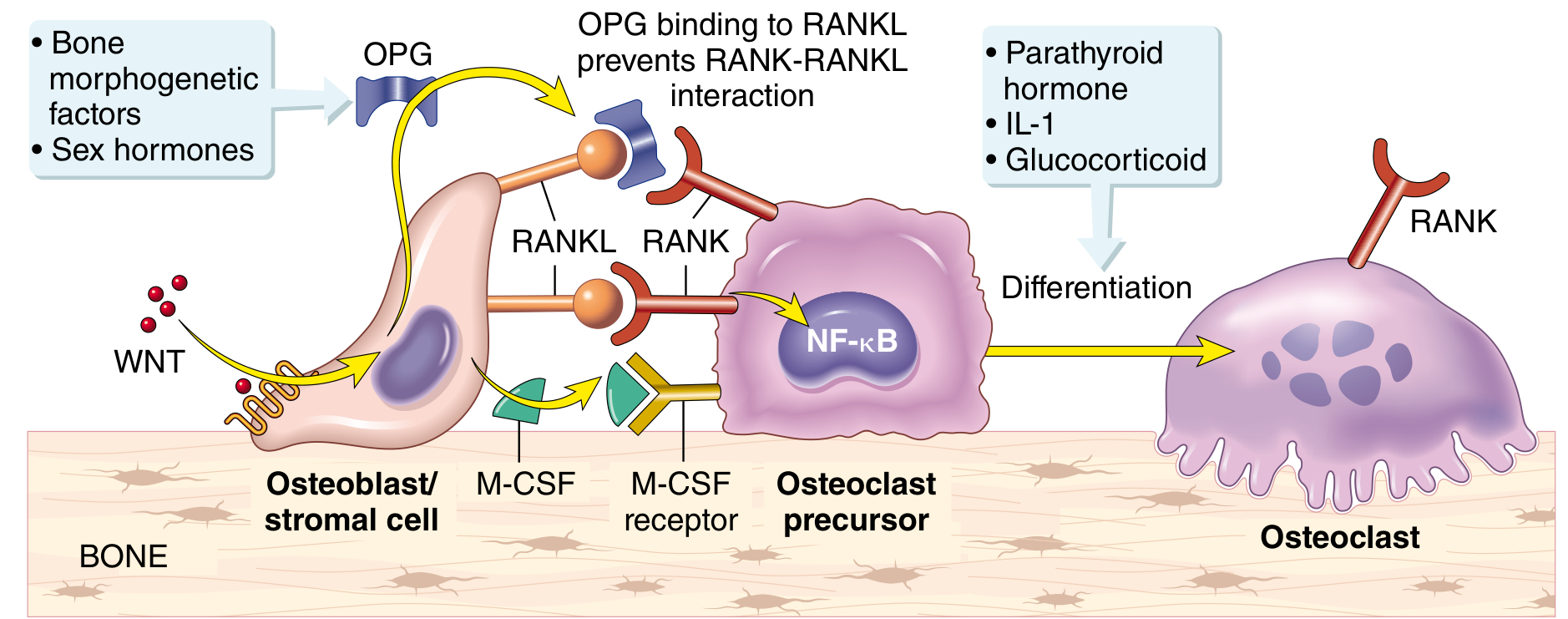
- Wnt signalling also stimulates osteoblasts to produce osteoprotegerin (OPG) - the decoy receptor for RANKL - thereby indirectly suppressing osteoclastogenesis
Sclerostin and DKK-1: Key Endogenous Inhibitors
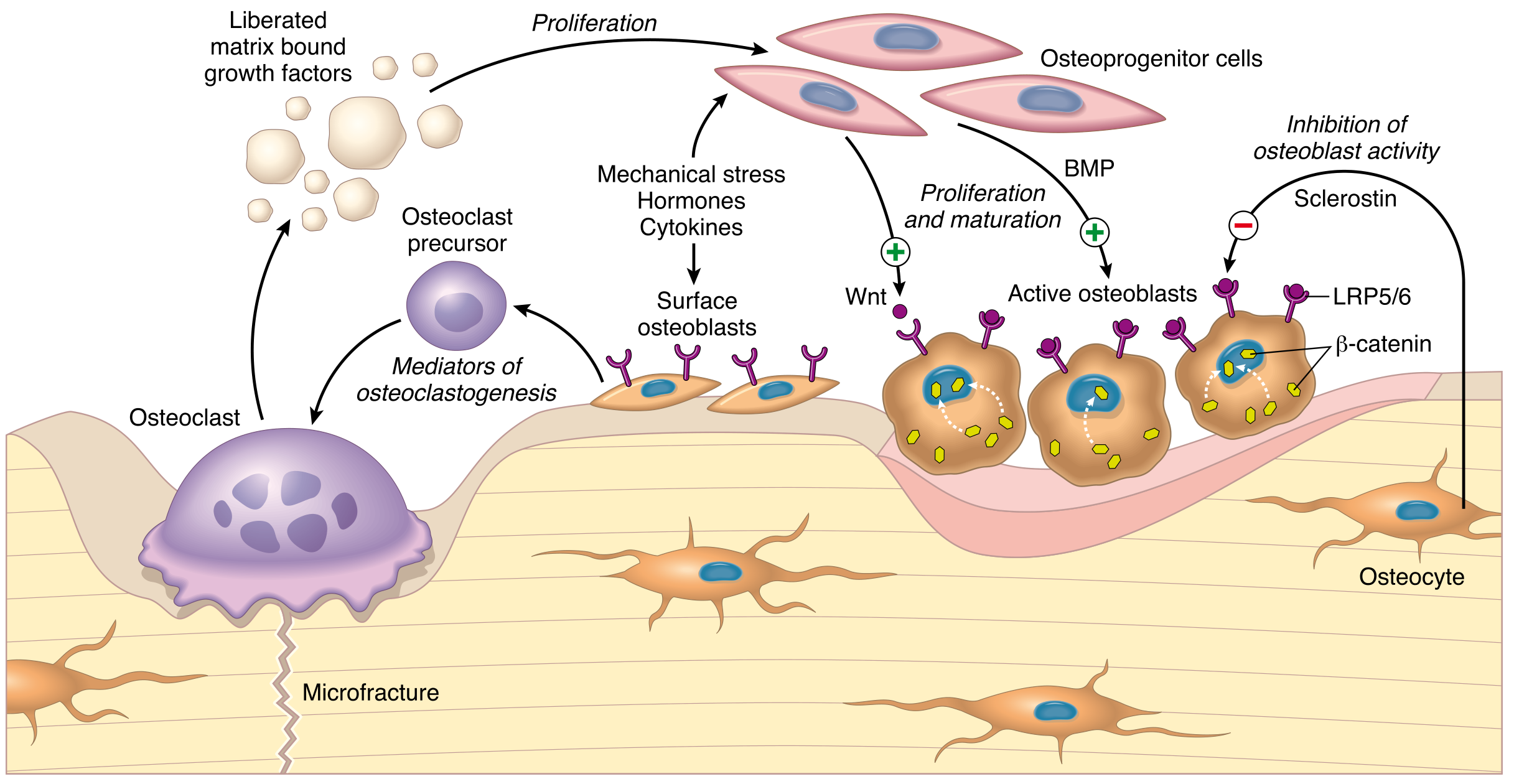
The two principal endogenous Wnt inhibitors relevant to rheumatology are:
| Inhibitor | Source | Mechanism |
|---|---|---|
| Sclerostin (SOST) | Osteocytes; also synovial fibroblasts in inflammation | Binds LRP5/6, blocks Wnt ligand-receptor interaction → reduces osteoblast activity + reduces OPG → indirectly increases osteoclast activity via RANKL/RANK |
| DKK-1 (Dickkopf-1) | Osteocytes, synoviocytes, tumour cells | Binds LRP5/6 + Kremen receptor → internalises the co-receptor → blocks Wnt signalling → reduces osteoblastogenesis |
The clinical importance of LRP5 was established when Boyden et al. described a family with high bone density carrying a gain-of-function LRP5 mutation that prevented DKK-1 from binding and inhibiting Wnt signalling. Conversely, loss-of-function LRP5 mutations cause osteoporosis-pseudoglioma syndrome (Rockwood & Green).
- Sclerostin and DKK-1 inhibit binding of Wnt to LRP5/6
- Inhibition of sclerostin or DKK-1 leads to increased bone mass (Miller's Review of Orthopaedics)
3. Wnt Pathway in Rheumatoid Arthritis (RA)
3a. DKK-1 and the "Repair Switch"
In RA, TNF-α (the master pro-inflammatory cytokine) directly upregulates the expression of DKK-1, which then internalises Wnt receptors on osteoblast precursors. Wnt is a soluble mediator that normally promotes osteoblastogenesis and bone formation. Its suppression by DKK-1 tips the balance toward bone erosion without repair (Harrison's Principles, 22E, 2025).
This DKK-1-mediated suppression is proposed as the "repair switch" - explaining the characteristic feature of RA erosions:
- RA → high DKK-1 → Wnt pathway suppressed → bone erosions form BUT periosteal new bone formation / osteophyte formation is absent
- Spondyloarthritis (SpA) → lower DKK-1 → Wnt pathway relatively active → syndesmophytes and new bone formation occur alongside erosions
This contrast is one of the most clinically relevant Wnt concepts in rheumatology.
3b. Sclerostin in RA
From the 2025 MJR review:
- Systemic inflammation in RA disrupts osteoblastogenesis through elevated sclerostin and DKK-1, which enhance inhibition of the Wnt signalling pathway
- Bone biopsies from RA patients undergoing joint replacement show excessive osteocyte apoptosis, high sclerostin expression, and empty osteocyte lacunae
- Both immature osteoblasts and osteocytes produce sclerostin under inflammatory conditions mediated by TNF-α family cytokines
- Fibroblast-like synoviocytes (FLS) in RA also express sclerostin, acting in a paracrine manner to suppress osteoblast activity in juxta-articular bone
3c. The RA Bone-Synovium-Muscle Crosstalk Axis
An integrated model of RA bone pathology (MJR, 2025):
- Inflammatory cytokines (TNF-α, IL-6, IL-17) → ↑ sclerostin and DKK-1 expression → suppressed Wnt signalling → ↓ osteoblast activity
- ACPAs directly hyperactivate osteoclasts → juxta-articular bone degradation
- Excess RANKL production → osteoclast-mediated systemic bone loss
- Sclerostin secreted into circulation may represent an endocrine mechanism connecting synovial inflammation, systemic osteoporosis, and muscle wasting (sarcopenia)
- In early RA: biological therapies (anti-TNF, anti-IL-6) can restore bone homeostasis by lowering sclerostin/DKK-1; in long-standing RA, persistent dysregulation suggests irreversible alterations in bone biology beyond inflammation alone
4. Wnt Pathway in Spondyloarthritis (SpA) / Ankylosing Spondylitis (AS)
The key distinction from RA:
- In AS/SpA, DKK-1 levels are lower (partly due to different cytokine milieu - IL-17 dominant rather than TNF-α dominant)
- Wnt signalling is therefore less suppressed → osteoblast/chondrocyte activity is permissive → new bone formation, syndesmophytes, and ankylosis result
- BMP (bone morphogenic protein) and Wnt pathways cooperate to drive entheseal new bone formation in SpA
- Anti-IL-17 therapy (secukinumab) may partly act by modulating this Wnt/DKK-1 balance
5. Wnt Pathway in Osteoarthritis (OA)
- Wnt/β-catenin signalling in chondrocytes is finely balanced - both excess activation and excess inhibition cause cartilage pathology
- Gain-of-function Wnt/β-catenin in chondrocytes → promotes chondrocyte hypertrophy, matrix degradation (MMP upregulation), and subchondral bone remodelling → OA phenotype
- Loss-of-function mutations in Wnt pathway components → impaired chondrocyte maturation
- Elevated canonical Wnt activity in synovial fibroblasts in OA contributes to synovitis
- FRZB (secreted Frizzled-related protein 3, an endogenous Wnt antagonist): polymorphisms in FRZB have been associated with increased hip OA susceptibility in women
6. Wnt Pathway in Osteoporosis and Therapeutic Implications
Romosozumab (anti-sclerostin antibody)
- Mechanism: inhibits sclerostin → relieves suppression of Wnt/β-catenin → increased osteoblast proliferation and activity → anabolic bone formation + reduces bone resorption
- FDA-approved for osteoporosis; dual mechanism (promotes formation AND inhibits resorption, though the anti-resorptive mechanism is not fully understood)
- Katzung: "Sclerostin blocks wnt activation, suppressing bone formation. Antibodies to sclerostin have been developed, of which only romosozumab has been FDA approved."
- Limitation: restricted to 1 year of use; after which transition to antiresorptive is recommended
- Black box warning: increased risk of MI, stroke, and cardiovascular death in patients with prior MI/stroke within past year
Anti-DKK-1 antibodies
- In development for RA-associated bone erosion and osteolytic lesions (e.g., multiple myeloma)
- Theoretically: blocking DKK-1 → restores Wnt signalling → promotes bone repair at erosion sites
7. Key Modulators Summary Table
| Component | Role in Wnt Pathway | Relevance in Rheumatology |
|---|---|---|
| LRP5/LRP6 | Co-receptor for Wnt | GOF mutation → high bone density; LOF → osteoporosis |
| β-catenin | Intracellular signal effector | Drives osteoblastogenesis; dysregulated in OA/RA |
| DKK-1 | Wnt inhibitor (binds LRP5/6) | Elevated in RA (via TNF-α) → erosions without repair; low in SpA → new bone formation |
| Sclerostin (SOST) | Wnt inhibitor (osteocyte-derived) | Elevated in RA → suppresses bone formation; target of romosozumab |
| Frizzled (FZD) | Cell-surface Wnt receptor | Multiple subtypes with distinct roles |
| GSK-3β | Destruction complex kinase | Phosphorylates β-catenin for degradation; blocked by Wnt activation |
| APC | Destruction complex scaffold | Mutations → familial adenomatous polyposis (CRC) |
| OPG | Downstream target of Wnt | Wnt-driven OPG suppresses osteoclastogenesis |
8. Therapeutic Targets in Rheumatology
| Target | Agent | Status | Disease |
|---|---|---|---|
| Sclerostin | Romosozumab | FDA-approved | Osteoporosis (including RA-associated) |
| DKK-1 | Anti-DKK-1 mAbs | Investigational | RA-associated bone erosion, MM |
| GSK-3β | Small molecule inhibitors | Experimental | RA, OA |
| β-catenin/TCF | Small molecule inhibitors | Experimental | OA, fibrosis |
Sources:
- Robbins, Cotran & Kumar - Pathologic Basis of Disease, Bone Homeostasis and Remodeling (Figs. 26.4, 26.5)
- Harrison's Principles of Internal Medicine, 22E (2025) - RA Pathogenesis
- Rockwood & Green's Fractures in Adults, 10th ed. (2025) - Wnt Signaling, Bone Formation
- Miller's Review of Orthopaedics, 9th ed. - Section I: Bone
- Katzung's Basic and Clinical Pharmacology, 16th ed. - Sclerostin Antibodies
- Padmanaban D, Krishnan M. "Targeting NAV2-mediated Wnt/β-catenin signaling in rheumatoid arthritis." Mol Biol Rep (2026) [PMID: 42047909]
- MJR 2025 In Press - "Impaired Bone Physiology in Rheumatoid Arthritis: Can the Wnt Pathway Be the Connecting Link?"
Note on library availability: Kelley's Textbook of Rheumatology and Hochberg's Rheumatology are not indexed in this textbook library. The content above draws from the most authoritative available sources covering the same topic. If you have access to a specific chapter or edition from Kelley's/Hochberg's, I can help extract and analyse specific passages.
This is a shared conversation. Sign in to Orris to start your own chat.