
Answer the LAQ : Why is levodopa combined with carbidopa?
Reading File
Now let me search the medical library for levodopa + carbidopa content in parallel.
Finding Sources
Finding Sources
Now let me read the detailed content from multiple textbooks in parallel:
Reading File
Reading File
Reading File
I now have rich content from three authoritative textbooks. Let me also fetch the key diagram and read a bit more from Goodman & Gilman for adverse effects and dose details.
Loading Image
Reading File
Reading File
I now have comprehensive content from three major pharmacology textbooks. Let me compile the full LAQ answer.
Why is Levodopa Combined with Carbidopa?
Introduction
Levodopa (L-DOPA) is the single most effective agent in the treatment of Parkinson's disease (PD). It is the immediate metabolic precursor of dopamine and, unlike dopamine itself, can cross the blood-brain barrier (BBB) via an L-amino acid transporter (LAT). However, levodopa is never used alone in clinical practice - it is always combined with carbidopa, a peripheral DOPA decarboxylase (DDC) inhibitor. The combination (Sinemet, Stalevo) addresses a critical pharmacokinetic and pharmacodynamic problem with levodopa monotherapy.
The Core Problem: Peripheral Metabolism of Levodopa
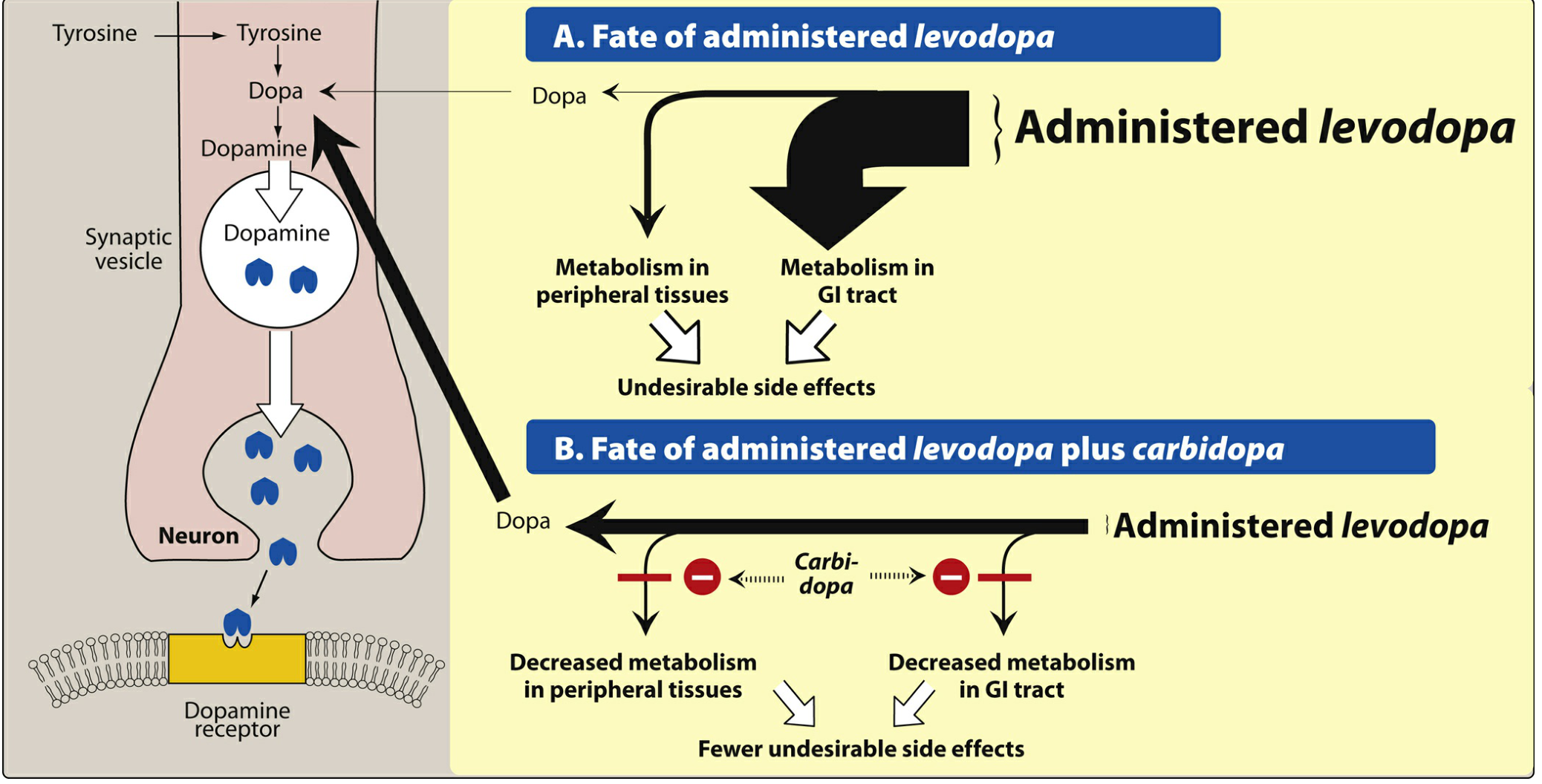
Figure: Fate of administered levodopa (A) vs. levodopa + carbidopa (B). Carbidopa blocks peripheral decarboxylation in both the GI tract and peripheral tissues, dramatically reducing side effects and increasing CNS delivery.
When levodopa is administered orally without carbidopa:
- It is rapidly absorbed from the small intestine but immediately subjected to decarboxylation by aromatic amino acid decarboxylase (AADC/DDC) in the intestinal mucosa and other peripheral tissues.
- Only ~1-3% of administered levodopa actually reaches the brain unchanged. The rest (~97-99%) is converted to dopamine in the periphery.
- This peripheral dopamine cannot cross the BBB and is therefore therapeutically useless.
- Worse, it causes a host of peripheral side effects (see below).
To achieve a therapeutic brain concentration, the patient would need very large (and toxic) doses of levodopa alone. - Goodman & Gilman's, p. 435-436
Mechanism of Carbidopa
Carbidopa is a competitive inhibitor of DOPA decarboxylase (DDC) in the peripheral tissues. Critically:
- Carbidopa does not cross the blood-brain barrier (it is a hydrazine derivative with poor lipophilicity). It therefore inhibits ONLY peripheral decarboxylation.
- Central conversion of levodopa to dopamine in striatal dopaminergic neurons is completely preserved.
- This selectively increases the availability of levodopa to the CNS.
Advantages of Adding Carbidopa
1. Dramatically Increases CNS Bioavailability
- Without carbidopa, <1-3% of levodopa enters the brain.
- With carbidopa, the fraction of administered levodopa that crosses the BBB increases markedly (estimated up to 10-fold).
- This means the required dose of levodopa is reduced by 4- to 5-fold. - Lippincott Pharmacology
2. Reduces Peripheral Side Effects
By blocking peripheral conversion of levodopa to dopamine, carbidopa greatly reduces the peripheral dopamine load, cutting:
| Side Effect | Mechanism | Reduced by Carbidopa? |
|---|---|---|
| Nausea & vomiting | Dopamine stimulates chemoreceptor trigger zone (CTZ) outside BBB | Yes |
| Cardiac arrhythmias | Peripheral dopamine stimulates cardiac adrenoreceptors | Yes |
| Orthostatic hypotension | Peripheral vasodilation by dopamine | Yes |
| Flushing, palpitations | Peripheral dopaminergic/adrenergic effects | Yes |
A daily dose of just 75 mg carbidopa is sufficient to prevent nausea in most patients. The most commonly prescribed formulation is carbidopa 25 mg / levodopa 100 mg (25/100), taken three or more times daily. - Goodman & Gilman's, p. 436
3. Allows Dose Reduction of Levodopa
The 4-5x reduction in the required levodopa dose proportionally reduces the risk of dose-dependent adverse effects and long-term motor complications (dyskinesias, on-off phenomenon).
4. Spares Peripheral Pyridoxine (Vitamin B6) Interaction
When levodopa is used alone, pyridoxine (Vit B6) enhances peripheral decarboxylation and can completely abolish its therapeutic effect. Carbidopa blocks this interaction, allowing patients to safely take B6 supplements or eat B6-containing foods.
Pharmacokinetics Summary
| Parameter | Levodopa Alone | Levodopa + Carbidopa |
|---|---|---|
| % reaching brain | ~1-3% | Dramatically increased |
| Required dose | Very high | Reduced 4-5x |
| GI side effects | Prominent | Greatly reduced |
| Peripheral dopamine load | High | Low |
| B6 interaction | Problematic | Abolished |
Why Carbidopa Does Not Block Central Action
This is the key pharmacological elegance of the combination:
- Carbidopa has no effect on central DDC because it cannot penetrate the BBB.
- Levodopa freely crosses the BBB via the L-amino acid transporter.
- Once inside the brain, levodopa is decarboxylated to dopamine in the presynaptic terminals of striatal dopaminergic neurons - restoring the deficit that underlies Parkinson's disease.
- Katzung, p. 775-776
Available Formulations
- Sinemet (carbidopa/levodopa) - available as 10/100, 25/100, 25/250 mg tablets
- Sinemet CR / Rhythmet - controlled-release for response fluctuations
- Rytary - extended-release capsules with beads releasing the combination at different rates (carbidopa:levodopa 1:4 ratio) over a prolonged period, useful for reducing wearing-off
- Stalevo - carbidopa + levodopa + entacapone (COMT inhibitor for further peripheral protection)
Limitations (Long-term Complications)
Despite the benefit of carbidopa, long-term levodopa therapy still leads to:
- Wearing-off phenomenon - each dose effectively improves mobility, but effect wanes before the next dose
- On-off phenomenon - unpredictable motor fluctuations unrelated to plasma levodopa levels
- Levodopa-induced dyskinesias (LID) - abnormal involuntary movements, often at peak dose
These arise from progressive loss of dopaminergic neurons (decreasing "buffering capacity") and pulsatile dopamine receptor stimulation - not from peripheral metabolism - so carbidopa cannot prevent them.
Summary Table
| Reason for Combining | Effect of Carbidopa |
|---|---|
| Prevent peripheral decarboxylation | Blocks DDC in gut, peripheral tissues |
| Increase CNS levodopa availability | 4-10x more levodopa reaches the brain |
| Reduce nausea/vomiting | Less peripheral dopamine at CTZ |
| Reduce cardiovascular side effects | Less peripheral dopamine stimulation |
| Allow lower levodopa dose | 4-5x dose reduction possible |
| Eliminate pyridoxine (B6) interaction | Peripheral DDC blocked |
| Selective action | Does NOT cross BBB, so central conversion preserved |
Sources:
- Lippincott Illustrated Reviews: Pharmacology - pp. 515-516
- Goodman & Gilman's The Pharmacological Basis of Therapeutics - pp. 435-436
- Katzung's Basic and Clinical Pharmacology, 16th Edition - pp. 775-777
This is a shared conversation. Sign in to Orris to start your own chat.