
Provide a short flashcard topics of the above pdf
python3 -c " import pdfplumber with pdfplumber.open('/home/daytona/workspace/attachments/67da897d-ef27-4521-b39a-bf4156f159d4/betalactams.pdf') as pdf: print(f'Pages: {len(pdf.pages)}') for i, page in enumerate(pdf.pages): text = page.extract_text() if text: print(f'--- PAGE {i+1} ---') print(text[:2000]) print() "
python3 -c " import pdfplumber with pdfplumber.open('/home/daytona/workspace/attachments/67da897d-ef27-4521-b39a-bf4156f159d4/betalactams.pdf') as pdf: all_text = '' for i, page in enumerate(pdf.pages): text = page.extract_text() if text: all_text += f'\n--- PAGE {i+1} ---\n' + text print(all_text[:8000]) "
python3 -c " from pypdf import PdfReader reader = PdfReader('/home/daytona/workspace/attachments/67da897d-ef27-4521-b39a-bf4156f159d4/betalactams.pdf') print(f'Pages: {len(reader.pages)}') # Try extracting text for i in range(min(5, len(reader.pages))): text = reader.pages[i].extract_text() print(f'Page {i+1}: {repr(text[:200]) if text else \"EMPTY\"}') "
python3 -c " from pdf2image import convert_from_path import os pdf_path = '/home/daytona/workspace/attachments/67da897d-ef27-4521-b39a-bf4156f159d4/betalactams.pdf' out_dir = '/home/daytona/workspace/betalactams_pages' os.makedirs(out_dir, exist_ok=True) # Convert first 10 pages pages = convert_from_path(pdf_path, dpi=150, first_page=1, last_page=10) for i, page in enumerate(pages): path = f'{out_dir}/page_{i+1:02d}.jpg' page.save(path, 'JPEG', quality=80) print(f'Saved {path}') print('Done') "
python3 -c " import pytesseract from pdf2image import convert_from_path pdf_path = '/home/daytona/workspace/attachments/67da897d-ef27-4521-b39a-bf4156f159d4/betalactams.pdf' pages = convert_from_path(pdf_path, dpi=200) print(f'Total pages: {len(pages)}') all_text = '' for i, page in enumerate(pages): text = pytesseract.image_to_string(page) all_text += f'\n=== PAGE {i+1} ===\n' + text # Save to file with open('/home/daytona/workspace/betalactams_text.txt', 'w') as f: f.write(all_text) print('OCR complete. Text saved.') print(f'Total chars: {len(all_text)}') " 2>&1 | tail -5
ls /home/daytona/workspace/ && python3 << 'EOF' import pytesseract from pdf2image import convert_from_path import os pdf_path = '/home/daytona/workspace/attachments/67da897d-ef27-4521-b39a-bf4156f159d4/betalactams.pdf' pages = convert_from_path(pdf_path, dpi=150) print(f'Total pages: {len(pages)}') all_text = '' for i, page in enumerate(pages): text = pytesseract.image_to_string(page) all_text += f'\n=== PAGE {i+1} ===\n' + text out = '/home/daytona/workspace/betalactams_text.txt' with open(out, 'w') as f: f.write(all_text) print(f'Saved to {out}, chars={len(all_text)}') EOF
A set of 10 clean, professional medical pharmacology flashcards about beta-lactam antibiotics, laid out in a grid. Each card has a bold QUESTION on the front side (shown) with these topics: 1) What are the 5 classes of beta-lactam drugs? 2) How do penicillins work (mechanism)? 3) What are penicillinase-resistant penicillins used for? 4) What is the clinical use of extended-spectrum penicillins? 5) Generations of cephalosporins with example drugs 6) Key difference: 1st vs 3rd generation cephalosporins 7) What are carbapenems and their clinical use? 8) What is aztreonam (monobactam) used for? 9) What do beta-lactamase inhibitors do? 10) Vancomycin: mechanism and key clinical use. White cards with blue headers, medical style.
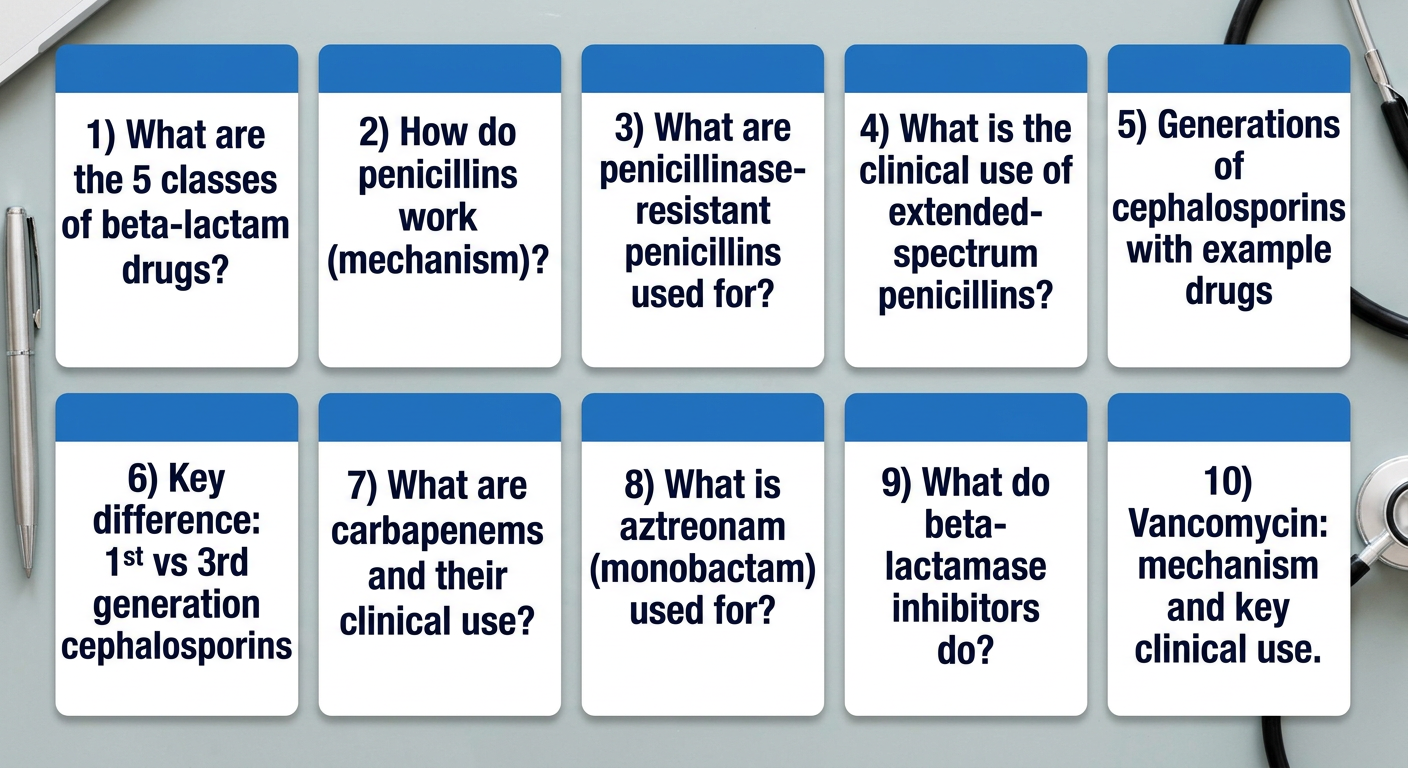
Beta-Lactam Antibiotics - Flashcard Topics
Card 1 - Classes of Beta-Lactam Drugs
Card 2 - Mechanism of Action
Card 3 - Penicillin G
Card 4 - Acid-Resistant Penicillins
Card 5 - Penicillinase-Resistant Penicillins
Card 6 - Extended-Spectrum Penicillins
Card 7 - Cephalosporin Generations
- 1st gen: Cephalexin, Cefazolin (gram+, E. coli, Klebsiella)
- 2nd gen: Cefuroxime, Cefoxitin (broader gram-)
- 3rd gen: Ceftriaxone, Cefotaxime, Ceftazidime (CNS penetration, antipseudomonal)
- 4th gen: Cefepime (broadest spectrum)