~/obg-nursing-notes/generate_notes.js
"use strict";
const {
Document, Packer, Paragraph, TextRun, Table, TableRow, TableCell,
HeadingLevel, AlignmentType, BorderStyle, WidthType, ShadingType,
VerticalAlign, PageNumber, Header, Footer, TableOfContents,
PageBreak, UnderlineType
} = require("docx");
const fs = require("fs");
// ─── Colour palette ────────────────────────────────────────────────────────
const NAVY = "1B3A6B"; // heading 1
const TEAL = "0F7B8A"; // heading 2
const PURPLE = "5B3B8C"; // heading 3
const LIGHT_BLUE = "D6EAF8"; // table header shading
const LIGHT_GRAY = "F2F3F4"; // alternating row
const ACCENT = "E8F4FD"; // note/tip boxes
const WHITE = "FFFFFF";
// ─── Helpers ───────────────────────────────────────────────────────────────
function h1(text) {
return new Paragraph({
text,
heading: HeadingLevel.HEADING_1,
spacing: { before: 400, after: 150 },
run: { color: NAVY, bold: true, size: 32 },
thematicBreak: false,
});
}
function h2(text) {
return new Paragraph({
text,
heading: HeadingLevel.HEADING_2,
spacing: { before: 300, after: 100 },
run: { color: TEAL, bold: true, size: 26 },
});
}
function h3(text) {
return new Paragraph({
text,
heading: HeadingLevel.HEADING_3,
spacing: { before: 200, after: 80 },
run: { color: PURPLE, bold: true, size: 24 },
});
}
function para(text, opts = {}) {
return new Paragraph({
children: [new TextRun({ text, size: 22, ...opts })],
spacing: { before: 60, after: 60 },
});
}
function bold(text) {
return new Paragraph({
children: [new TextRun({ text, bold: true, size: 22 })],
spacing: { before: 60, after: 60 },
});
}
function bullet(text, level = 0) {
return new Paragraph({
children: [new TextRun({ text, size: 22 })],
bullet: { level },
spacing: { before: 40, after: 40 },
});
}
function nbsp() {
return new Paragraph({ text: "", spacing: { before: 60, after: 60 } });
}
function pageBreak() {
return new Paragraph({ children: [new PageBreak()] });
}
// ─── Table builder ──────────────────────────────────────────────────────────
function makeTable(headers, rows, colWidths) {
const totalWidth = 9200; // twips
const widths = colWidths || headers.map(() => Math.floor(totalWidth / headers.length));
function cell(text, shade, bold = false, isHeader = false) {
return new TableCell({
children: [new Paragraph({
children: [new TextRun({ text: text || "", size: isHeader ? 20 : 19, bold: bold || isHeader, color: isHeader ? NAVY : "000000" })],
alignment: AlignmentType.LEFT,
spacing: { before: 50, after: 50 },
})],
shading: shade ? { fill: shade, type: ShadingType.CLEAR, color: "auto" } : undefined,
margins: { top: 80, bottom: 80, left: 120, right: 120 },
verticalAlign: VerticalAlign.CENTER,
});
}
return new Table({
width: { size: 100, type: WidthType.PERCENTAGE },
borders: {
top: { style: BorderStyle.SINGLE, size: 4, color: TEAL },
bottom: { style: BorderStyle.SINGLE, size: 4, color: TEAL },
left: { style: BorderStyle.SINGLE, size: 4, color: TEAL },
right: { style: BorderStyle.SINGLE, size: 4, color: TEAL },
insideH:{ style: BorderStyle.SINGLE, size: 2, color: "C0C0C0" },
insideV:{ style: BorderStyle.SINGLE, size: 2, color: "C0C0C0" },
},
rows: [
new TableRow({
tableHeader: true,
children: headers.map((h, i) => cell(h, LIGHT_BLUE, true, true)),
}),
...rows.map((row, ri) =>
new TableRow({
children: row.map((r, i) => cell(r, ri % 2 === 1 ? LIGHT_GRAY : WHITE)),
})
),
],
});
}
// ─── Cover page ─────────────────────────────────────────────────────────────
function coverPage() {
return [
nbsp(), nbsp(), nbsp(),
new Paragraph({
children: [new TextRun({ text: "B.Sc NURSING", bold: true, size: 52, color: NAVY })],
alignment: AlignmentType.CENTER, spacing: { before: 200, after: 100 },
}),
new Paragraph({
children: [new TextRun({ text: "Midwifery / OBG Nursing - I", bold: true, size: 44, color: TEAL })],
alignment: AlignmentType.CENTER, spacing: { before: 60, after: 60 },
}),
new Paragraph({
children: [new TextRun({ text: "INC Syllabus - Complete Unit-wise Notes", size: 28, color: PURPLE, italics: true })],
alignment: AlignmentType.CENTER, spacing: { before: 60, after: 60 },
}),
nbsp(), nbsp(),
new Paragraph({
children: [new TextRun({ text: "─────────────────────────────────────────", size: 24, color: TEAL })],
alignment: AlignmentType.CENTER,
}),
nbsp(),
new Paragraph({
children: [new TextRun({ text: "Semester V | Theory: 3 Credits (60 hrs) | Practicum: 4 Credits", size: 22, color: "444444" })],
alignment: AlignmentType.CENTER, spacing: { before: 60, after: 60 },
}),
new Paragraph({
children: [new TextRun({ text: "Sources: Creasy & Resnik's Maternal-Fetal Medicine • The Developing Human • Park's PSM", size: 20, color: "888888", italics: true })],
alignment: AlignmentType.CENTER, spacing: { before: 40, after: 40 },
}),
new Paragraph({
children: [new TextRun({ text: "Berek & Novak's Gynecology • Costanzo Physiology • Harriet Lane Handbook", size: 20, color: "888888", italics: true })],
alignment: AlignmentType.CENTER, spacing: { before: 20, after: 40 },
}),
nbsp(),
new Paragraph({
children: [new TextRun({ text: "─────────────────────────────────────────", size: 24, color: TEAL })],
alignment: AlignmentType.CENTER,
}),
nbsp(), nbsp(),
new Paragraph({
children: [new TextRun({ text: "Compiled: June 2026", size: 20, color: "999999" })],
alignment: AlignmentType.CENTER,
}),
pageBreak(),
];
}
// ─── UNIT I ─────────────────────────────────────────────────────────────────
function unit1() {
return [
h1("UNIT I – TRENDS, ISSUES & LEGAL ASPECTS IN MIDWIFERY"),
h2("1.1 Key Indicators in Maternal & Neonatal Health"),
makeTable(
["Indicator","Definition"],
[
["Maternal Mortality Rate (MMR)","Deaths per 1,00,000 live births due to pregnancy/childbirth"],
["Infant Mortality Rate (IMR)","Deaths per 1,000 live births in the first year of life"],
["Neonatal Mortality Rate (NMR)","Deaths per 1,000 live births in first 28 days"],
["Perinatal Mortality Rate","Stillbirths + deaths in first 7 days per 1,000 births"],
["Fertility Rate","Average number of children born per woman of reproductive age"],
]
),
nbsp(),
para("Maternal Death Audit – systematic review of every maternal death to identify avoidable causes; guides policy and training improvements."),
h2("1.2 National Health Programs – RMNCH+A"),
para("RMNCH+A = Reproductive, Maternal, Newborn, Child Health + Adolescent Health"),
bullet("R – Reproductive health: family planning, STI care"),
bullet("M – Maternal health: ANC, safe delivery, PNC"),
bullet("N – Newborn health: ENBC, NSSK module"),
bullet("C – Child health: immunization, nutrition"),
bullet("A – Adolescent health: RKSK, ARSH"),
nbsp(),
bullet("LaQshya Program – improves quality of care in labour rooms and maternity OTs in public health facilities"),
bullet("Dakshata Program – capacity-building for skilled birth attendance at delivery points"),
h2("1.3 Current Trends in Midwifery"),
makeTable(
["Trend","Description"],
[
["Respectful Maternity Care (RMC)","Care maintaining dignity, privacy, and informed consent"],
["Midwifery-Led Care Units (MLCU)","Midwife-managed units for low-risk births"],
["Woman-Centred Care","Care planned around the woman's needs and choices"],
["Physiologic Birth","Promotion of normal, intervention-free birth"],
["Birthing Centres","Low-intervention settings for uncomplicated births"],
["Water Birth","Labour/birth in a warm-water pool"],
["Lotus Birth","Delayed cord cutting until placenta separates naturally"],
["Demedicalization of Birth","Reducing unnecessary medical interventions"],
]
),
nbsp(),
para("ICM Essential Competencies – international framework defining minimum competency standards for midwives globally."),
h2("1.4 Legal Provisions in Midwifery Practice in India"),
makeTable(
["Law / Act","Key Provision"],
[
["INC Regulations","Governs nursing education and registration in India"],
["ICM Code of Ethics","International ethical standards for midwifery practice"],
["MTP Act 1971 (amended 2021)","Legal termination up to 24 weeks under specified conditions"],
["PNDT Act 1994 (PC&PNDT)","Prohibits sex determination; regulates prenatal diagnostic techniques"],
["Surrogacy Regulation Act 2021","Permits only altruistic surrogacy; commercial surrogacy banned"],
["Adoption Laws / CARA","Governs inter-country and domestic adoption under JJ Act"],
]
),
nbsp(),
bold("Roles and Scope of the Nurse/Midwife:"),
bullet("Conduct normal childbirth independently"),
bullet("Provide ANC and PNC in hospital and community settings"),
bullet("Essential newborn care and resuscitation"),
bullet("Family planning counseling and provision"),
bullet("Identify and refer high-risk cases"),
bullet("Health education and community outreach with ASHAs"),
pageBreak(),
];
}
// ─── UNIT II ────────────────────────────────────────────────────────────────
function unit2() {
return [
h1("UNIT II – ANATOMY & PHYSIOLOGY OF THE REPRODUCTIVE SYSTEM"),
h2("2.1 Female Organs of Reproduction"),
bold("External Genitalia (Vulva):"),
para("Mons pubis, labia majora, labia minora, clitoris, vestibule (urethral + vaginal openings), Bartholin's glands, hymen."),
bold("Internal Genitalia:"),
bullet("Vagina – muscular canal 8-10 cm; acid pH 3.5-4.5 (Doderlein's bacilli)"),
bullet("Uterus – pear-shaped; non-pregnant: 7.5 × 5 × 2.5 cm; parts: fundus, body, isthmus, cervix"),
bullet("Fallopian Tubes – 10 cm; parts: interstitial, isthmus, ampulla (fertilization site), infundibulum"),
bullet("Ovaries – almond-shaped, 3 × 2 × 1 cm; produce ova and sex hormones"),
h2("2.2 Female Pelvis"),
bold("Bones:"),
para("2 innominate bones (ilium + ischium + pubis), sacrum, coccyx."),
bold("Joints:"),
para("Sacroiliac (×2), sacrococcygeal, symphysis pubis (slight mobility in pregnancy due to relaxin)."),
nbsp(),
bold("Pelvic Planes & Diameters:"),
makeTable(
["Plane","AP Diameter","Transverse","Oblique"],
[
["Inlet (brim)","11 cm","13 cm","12 cm"],
["Mid cavity","12 cm","12 cm","12 cm"],
["Outlet","13 cm","11 cm","—"],
]
),
nbsp(),
bold("Pelvic Types – Caldwell-Moloy Classification:"),
bullet("Gynecoid (round) – most favourable for vaginal delivery – 50%"),
bullet("Android (heart-shaped/male type) – narrow, poor prognosis for vaginal birth"),
bullet("Anthropoid (oval AP) – posterior position common"),
bullet("Platypelloid (flat/wide) – rare; transverse arrest common"),
h2("2.3 Fetal Skull"),
bold("Bones:"),
para("2 frontal, 2 parietal, 2 temporal, 1 occipital, 1 sphenoid (base) – not fully fused at birth, allowing moulding."),
bold("Sutures:"),
para("Sagittal (between parietals), coronal (frontal-parietal), lambdoid (parietal-occipital), frontal (between frontals)."),
bold("Fontanelles:"),
bullet("Anterior (Bregma) – diamond-shaped; junction of sagittal + coronal + frontal sutures; closes at 18 months"),
bullet("Posterior (Lambda) – triangle; junction of sagittal + lambdoid sutures; closes at 6-8 weeks"),
nbsp(),
bold("Key Diameters of Fetal Skull:"),
makeTable(
["Diameter","Measurement","Clinical Significance"],
[
["Suboccipitobregmatic","9.5 cm","Fully flexed head – most favourable for delivery"],
["Suboccipitofrontal","10 cm","Partially deflexed head"],
["Occipitofrontal","11.5 cm","Average; vertex presentation"],
["Mentovertical","13.5 cm","Brow presentation – LARGEST – may need C-section"],
["Submentobregmatic","9.5 cm","Face presentation – favourable"],
]
),
nbsp(),
para("Moulding – temporary reshaping of fetal skull by overlapping of bones during passage through birth canal. Helps delivery; excessive moulding (3+ on partograph) is pathological."),
bold("Fetal Lie, Presentation & Position:"),
bullet("Lie – relationship of long axis of fetus to uterus (longitudinal, transverse, oblique)"),
bullet("Presentation – part in lower pole (cephalic, breech, shoulder)"),
bullet("Position – relationship of denominator (occiput in vertex) to maternal pelvis"),
bullet("Attitude – flexion (normal) vs extension"),
bullet("Engagement – widest diameter has passed through pelvic inlet"),
h2("2.4 Menstrual Cycle"),
makeTable(
["Phase","Days","Dominant Hormone","Endometrial Change","Cervical Mucus"],
[
["Menstrual","1–4","Low E + P","Shedding","Scanty"],
["Follicular (Proliferative)","5–13","Rising Estrogen","Proliferation; glands elongate","Watery, ferning, stretchy (spinnbarkeit)"],
["Ovulation","Day 14","LH surge","Mature; ready for implantation","Maximum, transparent"],
["Luteal (Secretory)","15–28","Progesterone dominant","Secretory; glycogen-rich, coiled glands","Thick, non-ferning"],
]
),
nbsp(),
para("If no fertilization: corpus luteum degenerates → progesterone/estrogen fall → menstruation on day 28."),
para("Progesterone raises basal body temperature ~0.5°C after ovulation – basis of BBT method of contraception."),
h2("2.5 Fertilization, Conception & Implantation"),
bullet("Fertilization – in the ampulla of fallopian tube, within 12-24 hrs of ovulation"),
bullet("Sperm viability: 2-5 days; Ovum viability: 12-24 hours"),
bullet("Only one sperm enters ovum → zona reaction prevents polyspermy"),
bullet("Zygote (2n = 46 chromosomes) → cleavage → morula (day 3-4) → blastocyst (day 4-5)"),
bullet("Implantation – day 6-10; posterior uterine wall; HCG secreted to maintain corpus luteum"),
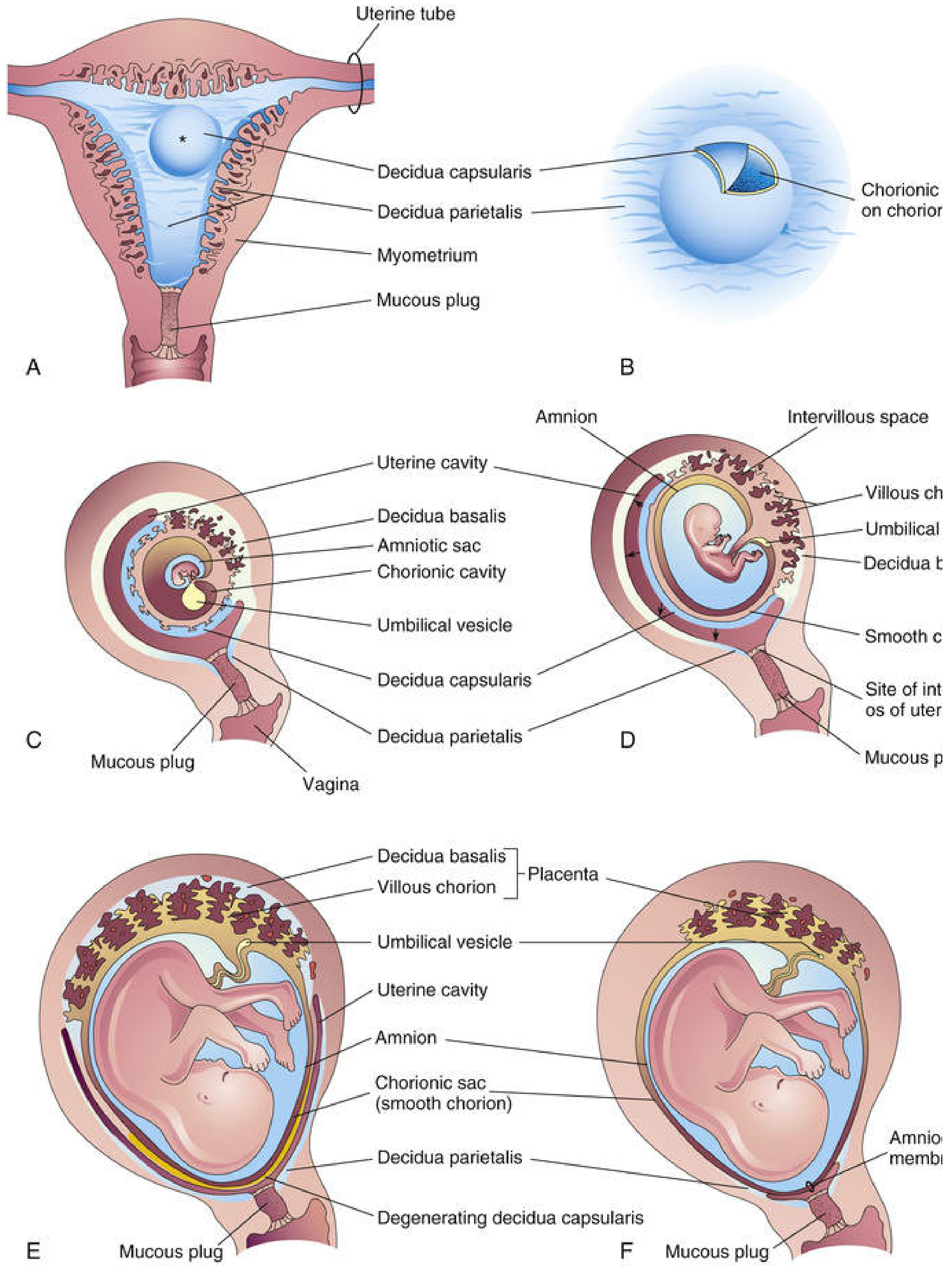
h2("2.6 Placental Development & Functions"),
para("The placenta is a fetomaternal organ with two components:"),
bullet("Fetal part – derived from chorionic sac (villous chorion)"),
bullet("Maternal part – derived from endometrium (decidua basalis)"),
nbsp(),
bold("Decidua Regions:"),
bullet("Decidua basalis – deep to conceptus; forms maternal side of placenta"),
bullet("Decidua capsularis – overlies and covers the conceptus"),
bullet("Decidua parietalis – remainder of uterine lining"),
nbsp(),
bold("Functions of the Placenta (NREEH):"),
makeTable(
["Function","Details"],
[
["Nutrition","Glucose, amino acids, fatty acids pass to fetus via active transport/diffusion"],
["Respiration","O₂ from mother to fetus; CO₂ from fetus to mother (diffusion)"],
["Excretion","Fetal waste products (urea, creatinine, bilirubin) pass to maternal blood"],
["Endocrine","Produces HCG, HPL, estrogen, progesterone, relaxin"],
["Host Defence / Immunological","Transmits IgG (passive immunity); partial barrier to infection"],
]
),
nbsp(),
bold("Placental Barrier (4 layers):"),
para("Syncytiotrophoblast → Cytotrophoblast → Connective tissue → Fetal capillary endothelium (thins as pregnancy advances)."),
para("At term: 500-600 g, 15-20 cm diameter, 2-3 cm thick (~1/6 fetal weight)."),
h2("2.7 Fetal Growth & Developmental Milestones"),
makeTable(
["Week","Key Development"],
[
["4","Heart begins beating; neural tube forms"],
["8","All major organs formed; embryo becomes fetus"],
["12","External genitalia differentiated; spontaneous movement begins"],
["16","Quickening felt by multiparae; lanugo appears; urine production starts"],
["20","Quickening in primiparae; vernix caseosa; myelination begins"],
["24","Viability with NICU support; surfactant production begins"],
["28","Eyelids open; ~1 kg; subcutaneous fat deposition starts"],
["36","Lanugo disappearing; sole creases appearing"],
["40","Full term; 3-3.5 kg, ~50 cm; lungs mature"],
]
),
h2("2.8 Fetal Circulation"),
bold("Three shunts that bypass lungs and liver:"),
bullet("Foramen ovale – right atrium → left atrium (bypasses lungs)"),
bullet("Ductus arteriosus – pulmonary artery → descending aorta (bypasses lungs)"),
bullet("Ductus venosus – umbilical vein → inferior vena cava (bypasses liver)"),
bullet("Umbilical vein (×1) – carries OXYGENATED blood from placenta to fetus"),
bullet("Umbilical arteries (×2) – carry DEOXYGENATED blood from fetus to placenta"),
para("At birth: lungs expand → pulmonary resistance falls → foramen ovale closes (becomes fossa ovalis), ductus arteriosus closes (becomes ligamentum arteriosum), ductus venosus closes (becomes ligamentum venosum)."),
pageBreak(),
];
}
// ─── UNIT III ───────────────────────────────────────────────────────────────
function unit3() {
return [
h1("UNIT III – ASSESSMENT & MANAGEMENT OF NORMAL PREGNANCY"),
h2("3.1 Pre-conception Care"),
para("Goals: optimize health BEFORE conception; identify and reduce risk factors."),
bullet("Folic acid 400 mcg/day – start 3 months before conception; prevents neural tube defects"),
bullet("Rubella immunization (2 doses if not immune; avoid pregnancy for 1 month after)"),
bullet("Manage chronic conditions: diabetes, hypertension, thyroid disorders"),
bullet("BMI optimization; weight loss if obese"),
bullet("Genetic counseling if family history of hereditary conditions"),
bullet("Avoidance of teratogens (alcohol, smoking, Category X drugs)"),
bullet("Psychosocial readiness; financial planning; dental care"),
h2("3.2 Diagnosis of Pregnancy"),
bold("Presumptive (Subjective) Signs:"),
bullet("Amenorrhoea"),
bullet("Nausea and vomiting (morning sickness – 6th to 12th week)"),
bullet("Breast changes – tingling, enlargement, darkening of areola, Montgomery's tubercles"),
bullet("Quickening – fetal movements felt (18-20 wks primi; 16-18 wks multi)"),
bullet("Frequency of micturition (1st and 3rd trimester)"),
bullet("Fatigue and weight gain"),
nbsp(),
bold("Probable (Objective) Signs:"),
bullet("Uterine enlargement proportional to gestational age"),
bullet("Hegar's sign – softening of lower uterine segment (6-10 wks)"),
bullet("Goodell's sign – softening of cervix"),
bullet("Chadwick's/Jacquemier's sign – bluish discoloration of vagina"),
bullet("Braxton Hicks contractions – painless, irregular (from 16 wks)"),
bullet("Positive urine/serum HCG pregnancy test"),
nbsp(),
bold("Positive (Diagnostic) Signs:"),
bullet("Fetal heart sounds (10-12 wks by Doppler; 20 wks by Pinard's stethoscope)"),
bullet("Fetal movements palpated by examiner"),
bullet("Ultrasound – gestational sac from 5-6 wks; fetal cardiac activity from 6 wks"),
h2("3.3 EDD Calculation – Naegele's Rule"),
para("EDD = LMP + 9 months + 7 days (or LMP + 280 days)"),
para("Example: LMP = 1 Jan 2025 → EDD = 8 Oct 2025"),
h2("3.4 Physiological Changes in Pregnancy"),
makeTable(
["System","Key Change"],
[
["Cardiovascular","Blood volume ↑ 40-50%; cardiac output ↑ 30-50%; physiological anaemia; systolic murmur common; BP slightly ↓ in 2nd trimester"],
["Respiratory","Tidal volume ↑ 40%; diaphragm raised → breathlessness; alkalosis (PCO₂ ↓)"],
["Renal","GFR ↑ 50%; glycosuria/proteinuria can be physiological; ureteral dilatation (R>L)"],
["GI","Nausea (HCG), constipation (progesterone), heartburn (relaxed LES), haemorrhoids"],
["Haematological","Hb falls to 10.5-11 g/dL (physiological dilution); WBC ↑; ESR ↑; hypercoagulable state (clotting factors ↑)"],
["Endocrine","HCG peaks 10-12 wks; HPL anti-insulin; progesterone maintains uterus; relaxin softens ligaments"],
["Musculoskeletal","Exaggerated lumbar lordosis; diastasis recti; carpal tunnel syndrome possible"],
["Skin","Chloasma (melasma); linea nigra; striae gravidarum; spider naevi"],
]
),
h2("3.5 Antenatal Care (ANC) – GoI Schedule"),
makeTable(
["Visit","Gestation","Key Actions"],
[
["1st (Booking)","≤12 weeks","Registration; history; Hb, blood group & Rh, VDRL, HIV, glucose, TSH, urine R/E; dating scan; TT immunization; IFA + calcium start"],
["2nd","14-26 weeks","Abdominal exam; anomaly scan 18-20 wks; blood glucose screen; weight; reassess risk"],
["3rd","28-34 weeks","Anaemia check; fetal growth; third trimester investigations; anti-D if Rh-ve; birth preparedness"],
["4th","36+ weeks","Presentation; engagement; birth plan; breastfeeding counseling; micro birth planning"],
]
),
h2("3.6 Abdominal Examination – 4 Manoeuvres of Leopold"),
bullet("1st Manoeuvre (Fundal) – both hands on fundus; identifies which fetal pole is at fundus"),
bullet("2nd Manoeuvre (Lateral/Umbilical) – both hands on sides of abdomen; identifies fetal back (firm, smooth) and limbs (knobby, irregular)"),
bullet("3rd Manoeuvre (Pawlik's Grip) – one hand above pubic symphysis; identifies presenting part; assesses engagement"),
bullet("4th Manoeuvre (Pelvic) – facing mother's feet; both hands descend into pelvis; assesses descent and attitude of head"),
bold("Fundal Height (McDonald's rule):"),
para("Height in cm ≈ weeks of gestation (after 24 weeks). At umbilicus = ~22 wks; at xiphisternum = ~36 wks."),
h2("3.7 Fetal Wellbeing Assessment"),
makeTable(
["Test","Method","Normal / Reassuring"],
[
["DFMC","Cardiff count-to-10 method; woman counts from 9 am","10 movements in ≤10 hours; alarm if <10"],
["NST (Non-Stress Test)","CTG tracing ≥20 min at rest","Reactive: ≥2 accelerations of 15 bpm for 15 sec in 20 min"],
["Biophysical Profile (BPP)","USG: breathing, movement, tone, AFV + NST","8-10/10 normal; ≤4/10 = deliver"],
["CTG","Continuous electronic FHR monitoring","Baseline 110-160; variability ≥5; accelerations present; no decelerations"],
["Umbilical Artery Doppler","Systolic/diastolic ratio","Absent or reversed end-diastolic flow = fetal compromise"],
["AFI","Sum of 4 quadrant depths by USG","Normal: 8-25 cm; <5 = oligohydramnios; >25 = polyhydramnios"],
]
),
h2("3.8 Danger Signs in Pregnancy"),
bullet("Severe headache / blurred vision / scotomata (pre-eclampsia)"),
bullet("Oedema of face, hands, legs – especially sudden onset"),
bullet("Vaginal bleeding at any trimester"),
bullet("Reduced or absent fetal movements"),
bullet("High fever / chills (infection)"),
bullet("Premature rupture of membranes"),
bullet("Severe abdominal pain"),
bullet("Convulsions"),
bullet("Breathlessness / chest pain"),
h2("3.9 Nutrition in Pregnancy"),
makeTable(
["Nutrient","Daily Requirement","Key Food Sources"],
[
["Iron","27 mg/day (IFA: 100 mg elemental Fe + 500 mcg folic acid daily)","Green leafy vegetables, jaggery, meat, eggs"],
["Folic Acid","400-600 mcg/day","Green leafy vegetables, fortified cereals, pulses"],
["Calcium","1200 mg/day","Milk, curd, paneer, ragi, sesame"],
["Protein","Extra 25 g/day above baseline","Pulses, eggs, meat, fish, dairy"],
["Calories","Extra 300 kcal/day","Balanced diet; avoid empty calories"],
["Vitamin D","600 IU/day","Sunlight, fortified milk, fatty fish"],
]
),
nbsp(),
bold("Rh-Negative Management:"),
bullet("Check indirect Coombs test (ICT) at booking and 28 weeks"),
bullet("Anti-D immunoglobulin 300 mcg given at 28-30 weeks (antenatal prophylaxis)"),
bullet("Anti-D within 72 hours of delivery/any sensitizing event (APH, amniocentesis, miscarriage)"),
bullet("Prevents Rh isoimmunization and hemolytic disease of newborn (HDN)"),
pageBreak(),
];
}
// ─── UNIT IV ────────────────────────────────────────────────────────────────
function unit4() {
return [
h1("UNIT IV – PHYSIOLOGY & MANAGEMENT OF LABOUR"),
h2("4.1 Onset of Labour"),
bold("True vs False Labour:"),
makeTable(
["Feature","True Labour","False Labour"],
[
["Contractions","Regular, increasing frequency","Irregular, no pattern"],
["Interval","Decreasing","No change"],
["Intensity","Progressively increasing","No change"],
["Cervical effacement/dilation","Progressive","None"],
["Show","Usually present","Absent"],
["Relief with analgesia","No relief","Often relieved"],
]
),
nbsp(),
bold("Signs of onset of labour:"),
bullet("Show – blood-stained mucus plug expelled"),
bullet("Regular painful uterine contractions occurring <10 min apart"),
bullet("Lightening – descent of presenting part into pelvis (2-4 wks before in primi)"),
bullet("Rupture of membranes may occur"),
h2("4.2 Stages of Labour"),
makeTable(
["Stage","Definition","Duration (Primi / Multi)"],
[
["1st Stage (Dilation)","Onset of regular contractions → full cervical dilation (10 cm)","~12 hrs / ~7 hrs"],
[" Latent phase","0–4 cm dilation","Up to 20 hrs primi / 14 hrs multi"],
[" Active phase","4–10 cm at ≥1 cm/hr","6-8 hrs / 2-4 hrs"],
["2nd Stage (Expulsion)","Full dilation → delivery of baby","~50 min / ~20 min (up to 2 hrs with epidural)"],
["3rd Stage (Placental)","Delivery of baby → expulsion of placenta","Normally ≤30 min (90% within 15 min)"],
["4th Stage (Recovery)","First 1-2 hours after placenta delivery","Intensive monitoring period"],
]
),
h2("4.3 Mechanism of Labour – Cardinal Movements (Vertex Presentation)"),
bullet("1. Engagement – widest fetal head diameter (biparietal) passes through pelvic inlet"),
bullet("2. Descent – progressive downward movement throughout all stages"),
bullet("3. Flexion – chin on chest; smallest diameter (suboccipitobregmatic 9.5 cm) presents"),
bullet("4. Internal Rotation – occiput rotates from transverse to anterior under symphysis"),
bullet("5. Extension – head is born by extension as it passes under the pubic arch"),
bullet("6. External Rotation (Restitution) – head rotates to align with shoulders (back to transverse)"),
bullet("7. Expulsion – anterior shoulder then posterior shoulder delivered; rest of body follows"),
h2("4.4 Monitoring Labour – Partograph"),
para("The partograph is a graphical record of labour progress used to detect deviations from normal."),
nbsp(),
bold("Components of the Partograph:"),
bullet("Fetal heart rate – every 30 min in 1st stage; every 5 min in 2nd stage"),
bullet("Amniotic fluid (colour): C = clear / M = meconium / A = absent / B = blood"),
bullet("Moulding: 0 / + / ++ / +++"),
bullet("Cervical dilation – plotted against ALERT and ACTION lines"),
bullet("Descent of head – in fifths above pelvic brim: 5/5 (free) → 0/5 (fully engaged)"),
bullet("Uterine contractions – frequency and duration in 10 min window"),
bullet("Oxytocin dosage, drugs given"),
bullet("Maternal vitals: BP, pulse, temperature, urine output"),
nbsp(),
para("Alert line – starts at 4 cm, advances at 1 cm/hour. Action line – 4 hours to the right of alert line."),
para("Cervical dilation crossing to the right of alert line = slow progress → review management."),
h2("4.5 First Stage Care"),
bullet("IV access, baseline vitals, auscultate FHS every 30 min"),
bullet("Per vaginal examination to assess dilation, station, effacement, membrane status"),
bullet("Plot on partograph; reassess if slow progress"),
bullet("Encourage ambulation and upright positions (lateral, walking, sitting)"),
bold("Non-pharmacological pain relief:"),
bullet("Controlled breathing techniques (Lamaze)"),
bullet("Counter pressure – sacral massage"),
bullet("Warm compresses / warm bath / hydrotherapy"),
bullet("TENS (Transcutaneous Electrical Nerve Stimulation)"),
bullet("Emotional support – birth companion (doula/family member)"),
bullet("Oral hydration; light diet in early labour; IV fluids if prolonged"),
bullet("Bladder care – encourage void every 2 hours"),
h2("4.6 Second Stage Care"),
bullet("Confirm full dilation before pushing"),
bullet("Coach woman with breathing; support her birth position of choice"),
bullet("Birth positions: upright, lateral, squatting, hands-and-knees"),
bullet("Perineal support and warm compresses to reduce tears"),
bullet("Watchful waiting – avoid fundal pressure (Kristeller)"),
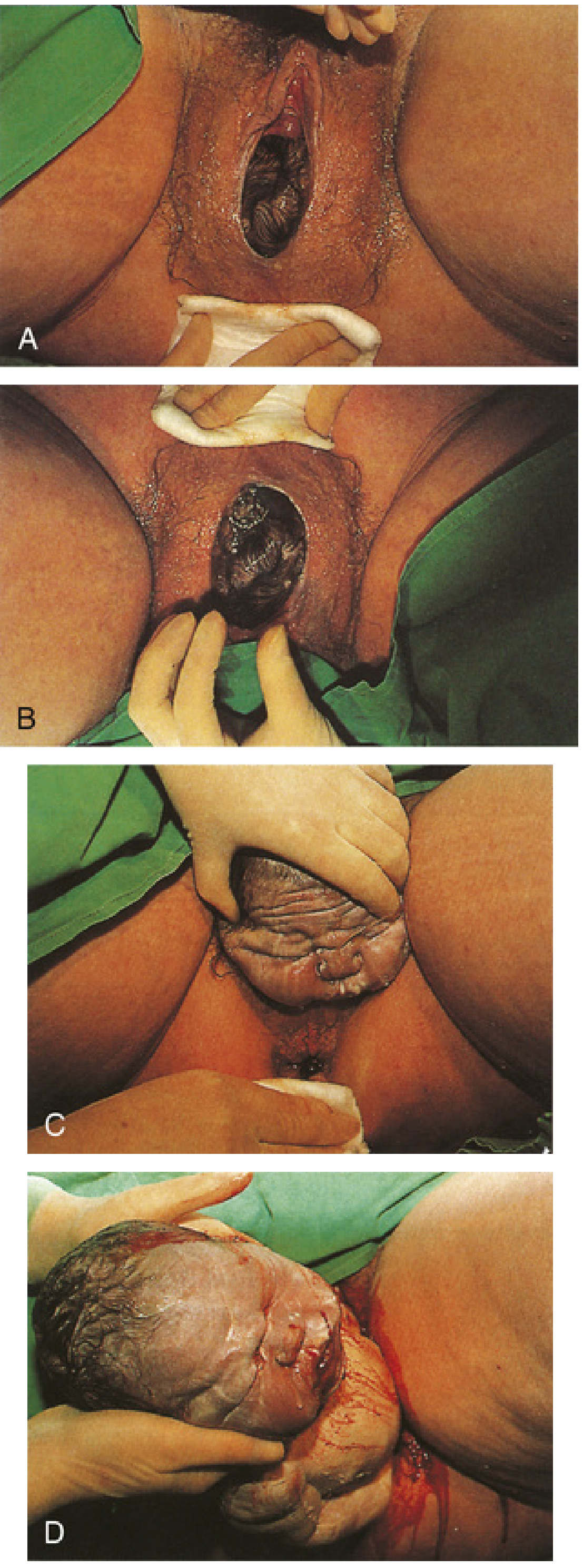
bullet("Crowning → gentle head delivery with perineal protection → check for nuchal cord"),
bullet("Note exact time of birth; assess need for episiotomy (only if necessary)"),
nbsp(),
bold("Immediate Newborn Care (after birth):"),
bullet("Dry and stimulate vigorously with clean dry cloth"),
bullet("Skin-to-skin contact on mother's chest within 30 seconds"),
bullet("Delayed cord clamping (1-3 min or until cord stops pulsating)"),
bullet("Assess breathing – if not breathing → resuscitation"),
bullet("Initiate breastfeeding within 1 hour of birth"),
h2("4.7 Third Stage – Active Management (AMTSL)"),
bold("Components of AMTSL (WHO recommended):"),
bullet("1. Oxytocin 10 IU IM within 1 minute of baby's birth"),
bullet("2. Controlled cord traction (Brandt-Andrews method) after signs of separation"),
bullet("3. Uterine massage after delivery of placenta"),
nbsp(),
bold("Signs of placental separation:"),
bullet("Uterus becomes globular and firmer"),
bullet("Sudden gush of blood"),
bullet("Cord lengthens at vulva"),
bullet("Uterus rises in abdomen"),
nbsp(),
bold("Examination of placenta:"),
bullet("Maternal surface – 15-20 cotyledons; dull red/grey; inspect for completeness"),
bullet("Fetal surface – shiny, covered by amnion; vessels visible"),
bullet("Membranes – amnion and chorion; check for completeness"),
bullet("Umbilical cord – 3 vessels (2 arteries + 1 vein); normal length 50-60 cm"),
h2("4.8 Fourth Stage – Recovery"),
bullet("Close observation every 15 min for first 2 hours post-delivery"),
bullet("Monitor: BP, pulse, fundal height, uterine tone, lochia, perineal site"),
bullet("Uterus should be firm and contracted at or below umbilicus"),
bullet("If uterus soft/boggy → bimanual uterine massage → oxytocin"),
bullet("Ensure breastfeeding initiated; promote mother-baby bonding"),
bullet("Document birth record completely"),
h2("4.9 Drugs Used in Labour (GoI Guidelines)"),
makeTable(
["Drug","Indication","Dose"],
[
["Oxytocin","3rd stage AMTSL; augmentation; PPH","10 IU IM; 2-5 IU slow IV (augmentation: 2.5-5 mIU/min titrated)"],
["Misoprostol","3rd stage if oxytocin not available; PPH","600 mcg sublingual or oral"],
["Magnesium Sulphate","Eclampsia/severe pre-eclampsia","Pritchard: 4g IV + 5g IM each buttock loading; 5g IM 4-hrly maintenance"],
["Lignocaine","Perineal infiltration for repair","1% solution up to 20 mL"],
["Methylergometrine","PPH (after placenta delivery)","0.2 mg IM; not in hypertension"],
["Tranexamic Acid","PPH (within 3 hrs of birth)","1g IV; repeat after 30 min if needed"],
]
),
pageBreak(),
];
}
// ─── UNIT V ─────────────────────────────────────────────────────────────────
function unit5() {
return [
h1("UNIT V – NORMAL PUERPERIUM / POSTNATAL CARE"),
h2("5.1 Definition & Duration"),
para("Puerperium – period from delivery of the placenta until the return of the reproductive organs to their pre-pregnant state."),
para("Duration: 6 weeks (42 days) after delivery."),
h2("5.2 Physiological Changes – Involution"),
bold("Uterus:"),
makeTable(
["Time","Uterine Status"],
[
["Immediately post-delivery","1 kg; at level of umbilicus; firm"],
["Day 7-10","Midway between symphysis pubis and umbilicus"],
["Day 14","No longer palpable abdominally"],
["6 weeks","Returns to pre-pregnant size (~60 g)"],
]
),
nbsp(),
bold("Lochia (Uterine Discharge):"),
makeTable(
["Type","Duration","Colour","Composition"],
[
["Lochia Rubra","Days 1-4","Bright red","Blood, decidua, mucus, epithelial cells"],
["Lochia Serosa","Days 5-14","Pink / brownish","Serous exudate, WBCs, few RBCs"],
["Lochia Alba","Day 14 onward","Pale yellow / white","Leucocytes, decidua, mucus, microorganisms"],
]
),
para("Note: Offensive or purulent lochia = endometritis. Heavy fresh bleeding persisting = subinvolution or retained products."),
nbsp(),
bold("Other changes:"),
bullet("Cervix – soft immediately; internal os closed by day 3"),
bullet("Vagina – oedematous; regains tone by 6 weeks"),
bullet("Perineum – oedema and bruising; heals by 2 weeks"),
bullet("WBC leukocytosis (up to 20,000/µL) in first 24 hrs – physiological"),
bullet("Diuresis increases in first few days as pregnancy-related oedema resolves"),
bullet("Hematocrit rises transiently then normalises"),
h2("5.3 Breasts & Lactation"),
bold("Stages of milk:"),
bullet("Colostrum (Days 1-3) – thick, yellow; rich in sIgA, proteins, fat-soluble vitamins A, E, K"),
bullet("Transitional milk (Day 4-10) – increasing lactose and fat"),
bullet("Mature milk (Day 10 onward) – foremilk (watery, thirst-quenching); hindmilk (fat-rich, satisfying)"),
nbsp(),
bold("Physiology of Lactation:"),
bullet("Prolactin (anterior pituitary) – stimulates milk production; surges with each feeding"),
bullet("Oxytocin (posterior pituitary) – milk ejection (let-down reflex); also promotes uterine involution"),
bullet("Suckling stimulus → hypothalamus → inhibits dopamine → prolactin released"),
nbsp(),
bold("Benefits of Breastfeeding:"),
bullet("Passive immunity via sIgA; protects against diarrhoea, respiratory infections"),
bullet("Optimal nutrition; easily digestible; correct temperature and composition"),
bullet("Mother-infant bonding and emotional security"),
bullet("Reduces maternal risk of breast and ovarian cancer"),
bullet("LAM (Lactational Amenorrhea Method) – 98% effective if: <6 months old + exclusive BF + amenorrhea"),
bullet("WHO recommendation: Exclusive breastfeeding for 6 months; continue up to 2 years with complementary feeds"),
h2("5.4 Postnatal Care Schedule"),
makeTable(
["Time","Assessment","Interventions"],
[
["1st hour","Fundus, lochia, BP, pulse, perineum every 15 min","Uterine massage if boggy; oxytocin; initiate breastfeeding"],
["2-24 hrs","Vitals, voiding, lochia, breastfeeding","Encourage ambulation; perineal care; adequate analgesia"],
["Day 1-3","Lochia, breast, bowel function, wound","Sitz bath; hygiene education; observe for milk coming in"],
["Day 4-7","Breastfeeding, baby weight, emotional state","Support breastfeeding; screen for PPD (Edinburgh scale)"],
["6 weeks","Full postnatal check; cervical smear","Contraception counseling; return of menstruation discussion"],
]
),
h2("5.5 Minor Disorders of Puerperium"),
makeTable(
["Disorder","Cause","Management"],
[
["After-pains","Uterine contractions; worse in multiparae and breastfeeding","Analgesics (ibuprofen, paracetamol); reassurance"],
["Perineal discomfort","Episiotomy / tear repair","Ice packs, sitz bath, topical anaesthetics, analgesics"],
["Breast engorgement","Milk accumulation Days 2-4","Frequent feeding, warm compresses, manual expression"],
["Cracked nipples","Poor latch technique","Correct latch; lanolin cream; express and feed"],
["Haemorrhoids","Pregnancy/delivery straining","Sitz bath, stool softeners, topical steroids"],
["Urinary retention","Perineal pain, oedema","Encourage void; catheterize if >500 mL retained"],
["Constipation","Dehydration, reduced mobility, opioids","Increase fluids, fibre; laxatives if needed"],
]
),
h2("5.6 Postnatal Mental Health"),
makeTable(
["Condition","Onset","Features","Management"],
[
["Baby Blues","Day 3-5","Tearfulness, anxiety, mood swings; self-limiting within 2 weeks","Reassurance, support, rest"],
["Postnatal Depression","Weeks 2-8","Persistent low mood, anxiety, poor bonding, sleep disturbance","Edinburgh EPDS scale; counseling; antidepressants; refer psychiatry"],
["Postpartum Psychosis","Days 1-14","Confusion, hallucinations, delusions, mania","Psychiatric emergency; hospital admission; antipsychotics"],
]
),
h2("5.7 Postpartum Family Planning"),
bullet("Progestogen-only pill – safe from day 21 postpartum; suitable for breastfeeding mothers"),
bullet("PPIUCD – copper T inserted within 10 min of placenta delivery (or 48 hrs); highly effective"),
bullet("Condoms – from first intercourse postpartum"),
bullet("Sterilisation – may be done at caesarean or from 6 weeks postpartum"),
bullet("COC (combined pill) – avoid for 6 months if breastfeeding (reduces milk supply)"),
pageBreak(),
];
}
// ─── UNIT VI ────────────────────────────────────────────────────────────────
function unit6() {
return [
h1("UNIT VI – ASSESSMENT & CARE OF THE NORMAL NEONATE"),
h2("6.1 Newborn Assessment – APGAR Score"),
para("Assessed at 1 minute (guides resuscitation) and 5 minutes (prognosis)."),
makeTable(
["Sign","Score 0","Score 1","Score 2"],
[
["Appearance (colour)","Blue / pale all over","Body pink, extremities blue","Completely pink"],
["Pulse (heart rate)","Absent","< 100 bpm","≥ 100 bpm"],
["Grimace (reflex irritability)","No response","Grimace only","Cry, cough, sneeze"],
["Activity (muscle tone)","Limp / absent","Some flexion of limbs","Active flexion; vigorous movement"],
["Respiration","Absent","Slow, irregular, weak cry","Strong regular cry"],
]
),
nbsp(),
bold("Interpretation:"),
bullet("7-10 = Normal (no action beyond routine care)"),
bullet("4-6 = Moderate asphyxia → stimulate, provide oxygen by mask"),
bullet("0-3 = Severe asphyxia → immediate resuscitation (PPV, chest compressions, drugs)"),
h2("6.2 Normal Neonate – Characteristics at Term"),
makeTable(
["Parameter","Normal Value"],
[
["Birth weight","2.5 – 4.0 kg (average 3.0-3.5 kg)"],
["Length","48 – 52 cm"],
["Head circumference","33 – 37 cm (average 34-35 cm)"],
["Chest circumference","30 – 33 cm (HC > CC at birth)"],
["Pulse","120 – 160 bpm"],
["Respiratory rate","40 – 60 breaths/min"],
["Temperature","36.5 – 37.5°C"],
["Blood glucose (after 24 hrs)","≥ 2.6 mmol/L (47 mg/dL)"],
]
),
h2("6.3 Physiological Adaptations at Birth"),
bullet("Respiratory – lungs expand with first cry; surfactant reduces alveolar surface tension; fluid cleared from lungs"),
bullet("Cardiovascular – fetal shunts close; pulmonary circulation established; Hb shifts from fetal (HbF) to adult type (HbA)"),
bullet("Thermoregulation – cold stress at delivery; non-shivering thermogenesis via brown adipose tissue (BAT)"),
bullet("Metabolic – glucose stores mobilised; liver starts conjugating bilirubin"),
bullet("Physiological jaundice – bilirubin peaks Day 3-4 (≤15 mg/dL); resolves by Day 10 in term babies"),
h2("6.4 Essential Newborn Care (ENBC) – WARMTH Principle"),
makeTable(
["Letter","Component","Action"],
[
["W","Warmth","Dry immediately; skin-to-skin contact; KMC for LBW; warm room (25°C); prevent hypothermia"],
["A","Airway","Position head neutral; suction only if airways blocked; avoid deep suction"],
["R","Resuscitation","If no breathing at 30 sec → PPV; 40-60 breaths/min; room air first"],
["M","Mother's Milk","Initiate breastfeeding within 1 hour; exclusive breastfeeding; no prelacteal feeds"],
["T","Treatment / Prevention of Infection","Cord care (dry); eye prophylaxis; hygiene; isolate infection"],
["H","Hepatitis B + Vit K","Hep B birth dose; Vit K1 1 mg IM – prevents haemorrhagic disease of newborn"],
]
),
h2("6.5 Newborn Resuscitation (NRP Algorithm)"),
bold("Initial Steps (0-30 seconds):"),
bullet("Warm, dry, stimulate, clear airway (position head; wipe mouth and nose)"),
bullet("Assess: breathing? heart rate?"),
nbsp(),
bold("If HR <100 or gasping/apnea:"),
bullet("Positive Pressure Ventilation (PPV) with room air – 40-60 breaths/min"),
bullet("Good chest rise confirms adequate ventilation"),
nbsp(),
bold("Re-assess at 30 seconds:"),
bullet("If HR <60 despite effective PPV → start chest compressions (3:1 ratio with PPV)"),
bullet("Increase to 100% O₂"),
nbsp(),
bold("If HR remains <60:"),
bullet("Epinephrine 0.1-0.3 mL/kg of 1:10,000 IV/IO"),
bullet("Consider volume expansion if blood loss suspected: 10 mL/kg NS IV"),
h2("6.6 Minor Disorders of the Newborn"),
makeTable(
["Condition","Features","Management"],
[
["Physiological jaundice","Appears Day 2-3; peaks Day 3-4; resolves Day 10 (term)","Adequate feeds; phototherapy if bilirubin >threshold"],
["Milia","Tiny white sebaceous cysts on nose and cheeks","Disappear spontaneously by 2-4 weeks"],
["Erythema toxicum neonatorum","Blotchy erythematous rash with central white/yellow papule","Self-limiting; no treatment needed"],
["Neonatal breast swelling","Maternal oestrogen effect; may express milk (witch's milk)","Resolves by 2-3 weeks; do NOT squeeze"],
["Caput succedaneum","Oedema of scalp crossing suture lines","Resolves in 1-2 days"],
["Cephalohaematoma","Subperiosteal haematoma; does NOT cross suture lines; firm","Resolves in 6-8 weeks; monitor jaundice"],
["Mongolian spots","Blue-grey sacral pigmentation; commoner in Indian babies","Fade by age 5; document to avoid abuse confusion"],
["Umbilical hernia","Periumbilical fascial defect","Usually closes by 2 years; refer if persists"],
]
),
h2("6.7 Immunization Schedule – National Immunization Schedule (NIS)"),
makeTable(
["Age","Vaccine(s)"],
[
["At Birth","BCG, OPV-0, Hepatitis B-1"],
["6 Weeks","Pentavalent-1 (DPT+HepB+Hib), OPV-1, IPV-1, Rotavirus-1, PCV-1"],
["10 Weeks","Pentavalent-2, OPV-2, Rotavirus-2, PCV-2"],
["14 Weeks","Pentavalent-3, OPV-3, IPV-2, Rotavirus-3, PCV-3"],
["9-12 Months","Measles/MR-1, Vitamin A (1st dose – 1 lakh IU)"],
["16-24 Months","DPT booster, OPV booster, MR-2, Vitamin A (2nd dose)"],
["5 Years","DPT 2nd booster"],
["10 & 16 Years","Td vaccine"],
["Pregnant women","TT/Td (2 doses + 1 booster)"],
]
),
pageBreak(),
];
}
// ─── UNIT VII ───────────────────────────────────────────────────────────────
function unit7() {
return [
h1("UNIT VII – FAMILY WELFARE SERVICES"),
h2("7.1 Methods of Contraception"),
h3("A. Hormonal Methods"),
makeTable(
["Method","Composition","Mechanism","Effectiveness (perfect use)"],
[
["Combined OCP (Mala-N/Mala-D)","Estrogen + progestin","Inhibits ovulation; thickens cervical mucus; atrophies endometrium","99.7%"],
["Progestogen-only pill (POP / Mini-pill)","Progestogen only","Thickens mucus; thin endometrium; may inhibit ovulation","99% (if taken strictly same time daily)"],
["DMPA (Depo-Provera)","Injectable medroxyprogesterone acetate","Inhibits ovulation; 3-monthly injection","99.7%"],
["Implant (Implanon/Jadelle)","Etonogestrel subdermal rod","Inhibits ovulation; valid 3-5 years",">99%"],
["Emergency Contraception – LNG","Levonorgestrel 1.5 mg","Delays/inhibits ovulation; NOT abortifacient","95% (within 72 hrs)"],
["Emergency Contraception – UPA","Ulipristal acetate 30 mg","Delays ovulation; progesterone receptor modulator","98% (within 120 hrs)"],
]
),
h3("B. Barrier & Non-hormonal Methods"),
makeTable(
["Method","Description","Effectiveness"],
[
["Male condom (latex)","Covers penis; prevents sperm entering vagina; prevents STIs","98% (perfect use); 85% (typical)"],
["Female condom (FC2)","Polyurethane liner inserted into vagina; can be placed in advance","95% (perfect)"],
["Diaphragm + spermicide","Dome over cervix; used with nonoxynol-9","88-92%"],
["Spermicide alone","Gel/foam/suppository; disrupts sperm membrane","70-80%"],
["Copper IUD (Cu-T 380A)","Copper ions toxic to sperm; prevents implantation; 10-yr duration","99.4%"],
["PPIUCD","Cu-T inserted within 10 min of placenta delivery","99.4% (same as standard IUD)"],
["LNG-IUS (Mirena)","Levonorgestrel-releasing IUD; reduces menstrual blood loss; 5-yr",">99%"],
]
),
h3("C. Natural / Traditional Methods"),
makeTable(
["Method","Basis","Reliability / Notes"],
[
["Calendar / Rhythm","Avoid fertile days 10-17 of cycle","Unreliable for irregular cycles; 76-88% typical use"],
["Basal Body Temperature (BBT)","Temperature rises ~0.5°C after ovulation","Only retrospective; requires daily measurement"],
["Cervical Mucus (Billings)","Spinnbarkeit (stretchy, slippery) near ovulation","Requires 3 months of charting; training needed"],
["LAM","Exclusive BF suppresses GnRH/ovulation","98% if: baby <6 months + exclusive BF + amenorrhea (all 3 must apply)"],
["Withdrawal (Coitus Interruptus)","Withdrawal before ejaculation","~78% typical; unreliable; pre-ejaculatory fluid contains sperm"],
["Abstinence","Avoiding intercourse","100% if consistent; challenging adherence"],
]
),
h2("7.2 Permanent Methods"),
bold("Female Sterilisation (Tubectomy / Tubal Ligation):"),
bullet("Mini-laparotomy – Pomeroy's method (ligate and excise loop of tube); most common in India post-delivery"),
bullet("Laparoscopic sterilisation – Filshie clip, Fallope ring, electrocoagulation; preferred for interval sterilisation"),
bullet("PPTL – postpartum tubectomy; within 48 hrs of delivery (mini-laparotomy)"),
bullet("Failure rate: 0.5 per 100 woman-years; reversal successful in <30%"),
nbsp(),
bold("Male Sterilisation – No-Scalpel Vasectomy (NSV):"),
bullet("Vas deferens isolated and occluded through tiny puncture; no scalpel needed"),
bullet("Performed under local anaesthesia; day-care procedure"),
bullet("Does NOT affect sexual function or testosterone levels"),
bullet("NOT immediately effective – use contraception for 3 months / 20 ejaculations"),
bullet("Confirm azoospermia by semen analysis before declaring effective"),
bullet("Failure rate: 0.1-0.15 per 100 woman-years (more effective than female sterilisation)"),
h2("7.3 Medical Eligibility Criteria (MEC) – WHO Categories"),
makeTable(
["Category","Meaning","Action"],
[
["1","No restriction – method can be used","Use freely"],
["2","Advantages outweigh risks","Generally use; monitor"],
["3","Risks outweigh advantages","Generally do NOT use; only if no alternative"],
["4","Unacceptable health risk","DO NOT USE"],
]
),
nbsp(),
bold("Example MEC 4 contraindications:"),
bullet("COC contraindicated (MEC 4) in: current DVT/PE, stroke, migraine with aura, lactating mother <6 wks, uncontrolled hypertension"),
bullet("IUCD contraindicated (MEC 4) in: current PID, unexplained vaginal bleeding, uterine cavity distortion"),
h2("7.4 Balanced Counseling Strategy (BCS)"),
para("A counseling job-aid tool to ensure informed choice:"),
bullet("Step 1 – Rule out current pregnancy"),
bullet("Step 2 – Ask about desire for future children"),
bullet("Step 3 – Discuss all available methods appropriate to the client"),
bullet("Step 4 – Confirm the client's choice"),
bullet("Step 5 – Provide or refer for the chosen method"),
bullet("Step 6 – Schedule follow-up and counsel on side effects"),
h2("7.5 Role of Nurse / Midwife in Family Planning"),
bullet("Maintain eligible couple register; update regularly"),
bullet("Provide IEC (Information, Education, Communication) in community"),
bullet("Distribute oral contraceptive pills and condoms"),
bullet("Insert IUCD (after training and certification)"),
bullet("Conduct PPIUCD insertion post-delivery"),
bullet("Refer clients for permanent methods (NSV, laparoscopic sterilisation)"),
bullet("Follow up acceptors; identify and manage side effects"),
bullet("Motivate community through ASHA / ANM network"),
bullet("Maintain accurate records and submit monthly reports"),
h2("7.6 Gender-Based Violence (GBV) in SRH"),
bold("Types of GBV:"),
bullet("Physical abuse"),
bullet("Sexual abuse / rape"),
bullet("Psychological / emotional abuse"),
bullet("Economic / financial abuse"),
bullet("Child marriage; female genital mutilation"),
nbsp(),
bold("Key Legislation in India:"),
makeTable(
["Law","Key Provision"],
[
["Protection of Women from Domestic Violence Act 2005","Civil remedies; protection orders; shelter homes"],
["IPC 376 (Rape)","Minimum 7 years imprisonment; aggravated cases: 10 yrs to life"],
["POCSO Act 2012","Protection of children from sexual offences; mandatory reporting"],
["Sexual Harassment at Workplace Act 2013 (POSH)","Internal complaints committee in every organisation"],
["IPC 304B (Dowry Death)","Mandatory minimum 7 years; death linked to dowry harassment"],
]
),
nbsp(),
bold("Role of Nurse/Midwife in GBV:"),
bullet("Universal screening for GBV at every ANC and PNC visit (non-judgmental questions)"),
bullet("Maintain confidentiality; document injuries objectively"),
bullet("Provide immediate support: listen, believe, validate"),
bullet("Know and refer to local support resources, helplines (Childline 1098; Women Helpline 181)"),
bullet("Mandatory reporting if child is the victim (POCSO)"),
h2("7.7 Youth-Friendly Services – SRHR"),
bullet("RKSK (Rashtriya Kishor Swasthya Karyakram) – national adolescent health programme"),
bullet("ARSH (Adolescent Reproductive and Sexual Health) clinics – confidential; free; one-stop shop"),
bullet("Services: menstrual health; safe sex; contraception information; STI screening; nutrition; mental health"),
bullet("Nurses must provide NON-JUDGMENTAL, CONFIDENTIAL care to adolescents"),
bullet("For MTP under 18 years: parental/guardian consent required; report to police in rape cases"),
pageBreak(),
];
}
// ─── QUICK REVISION ─────────────────────────────────────────────────────────
function quickRevision() {
return [
h1("QUICK REVISION – MNEMONICS & KEY VALUES"),
h2("Mnemonics"),
makeTable(
["Topic","Mnemonic / Memory Aid"],
[
["APGAR score","Appearance, Pulse, Grimace, Activity, Respiration"],
["Placenta functions","NREEH – Nutrition, Respiration, Excretion, Endocrine, Host defence"],
["Mechanism of labour","ED FI EE – Engagement, Descent, Flexion, Internal rotation, Extension, External rotation (Expulsion)"],
["Lochia sequence","RuSA – Rubra → Serosa → Alba"],
["Stages of labour","1=Dilation, 2=Expulsion, 3=Placental, 4=Recovery"],
["Danger signs in pregnancy","SHARP – Swelling (face/hands), Headache severe, Absent FMs, Rupture of membranes, Pain/Bleeding"],
["Fetal shunts","FDA – Foramen ovale, Ductus arteriosus, Ductus venosus"],
["AMTSL components","OCM – Oxytocin, Controlled cord traction, Massage"],
]
),
h2("Key Values to Remember"),
makeTable(
["Parameter","Normal Value"],
[
["Pregnancy duration","40 weeks (280 days) from LMP"],
["Blood volume increase in pregnancy","40-50% (plasma 50%; RBC 20-30%)"],
["Fundal height at term","36-37 cm"],
["Normal FHR (intrapartum)","110-160 bpm"],
["Cervical dilation rate (active phase)","≥ 1 cm / hour"],
["Placenta weight at term","500-600 g"],
["AFI (normal)","8-25 cm; <5 = oligohydramnios; >25 = polyhydramnios"],
["Hb in pregnancy (normal)","≥ 11 g/dL; mild anaemia 7-10.9; severe < 7 g/dL"],
["Neonatal temperature (normal)","36.5-37.5°C"],
["Normal birth weight","≥ 2.5 kg; LBW < 2.5 kg; VLBW < 1.5 kg"],
["Head circumference (term neonate)","33-37 cm"],
["Apgar score (normal at 5 min)","7-10"],
["Duration of puerperium","6 weeks (42 days)"],
["Colostrum secretion duration","Days 1-3"],
["Third stage duration (normal)","≤ 30 min (90% within 15 min)"],
["Umbilical cord length","50-60 cm; 3 vessels (2 arteries + 1 vein)"],
["Cervical dilation at end of 1st stage","10 cm (full dilation)"],
["Anti-D prophylaxis dose","300 mcg IM within 72 hours of sensitizing event"],
]
),
h2("Important Drug Doses"),
makeTable(
["Drug","Dose","Indication"],
[
["Folic acid","400 mcg/day pre-conception; 500 mcg in IFA tablet","NTD prevention; anaemia"],
["Elemental iron (IFA)","100 mg/day from 14 wks","Iron-deficiency anaemia"],
["Calcium","500 mg BD (1000 mg total)","Pre-eclampsia prevention; bone health"],
["Vitamin K1","1 mg IM at birth","Haemorrhagic disease of newborn"],
["Oxytocin (AMTSL)","10 IU IM within 1 min of birth","3rd stage management"],
["Magnesium sulphate","4g IV + 5g IM each buttock (Pritchard)","Eclampsia / severe pre-eclampsia"],
["LNG emergency contraception","1.5 mg oral within 72 hours","Emergency contraception"],
["Epinephrine (neonatal)","0.1-0.3 mL/kg of 1:10,000 solution IV","Neonatal resuscitation (HR <60)"],
]
),
];
}
// ─── MAIN ────────────────────────────────────────────────────────────────────
const children = [
...coverPage(),
...unit1(),
...unit2(),
...unit3(),
...unit4(),
...unit5(),
...unit6(),
...unit7(),
...quickRevision(),
];
const doc = new Document({
creator: "Orris AI – B.Sc Nursing Notes",
title: "Midwifery OBG Nursing-I – INC Syllabus Notes",
description: "Complete unit-wise notes for B.Sc Nursing Semester V, Midwifery/OBG Nursing-I",
styles: {
default: {
document: { run: { font: "Calibri", size: 22 } },
heading1: { run: { font: "Calibri", bold: true, size: 32, color: NAVY }, paragraph: { spacing: { before: 400, after: 150 } } },
heading2: { run: { font: "Calibri", bold: true, size: 26, color: TEAL }, paragraph: { spacing: { before: 300, after: 100 } } },
heading3: { run: { font: "Calibri", bold: true, size: 24, color: PURPLE }, paragraph: { spacing: { before: 200, after: 80 } } },
},
},
sections: [{
properties: {
page: {
margin: { top: 1000, bottom: 1000, left: 1000, right: 1000 },
},
},
headers: {
default: new Header({
children: [new Paragraph({
children: [
new TextRun({ text: "B.Sc Nursing – Midwifery / OBG Nursing-I | INC Syllabus Notes", size: 18, color: "888888" }),
],
alignment: AlignmentType.RIGHT,
border: { bottom: { style: BorderStyle.SINGLE, size: 4, color: TEAL } },
})],
}),
},
footers: {
default: new Footer({
children: [new Paragraph({
children: [
new TextRun({ text: "Page ", size: 18, color: "888888" }),
new TextRun({ children: [PageNumber.CURRENT], size: 18, color: "888888" }),
new TextRun({ text: " of ", size: 18, color: "888888" }),
new TextRun({ children: [PageNumber.TOTAL_PAGES], size: 18, color: "888888" }),
new TextRun({ text: " | Sources: Creasy & Resnik • The Developing Human • Park's PSM • Berek & Novak's Gynecology", size: 18, color: "888888" }),
],
alignment: AlignmentType.CENTER,
border: { top: { style: BorderStyle.SINGLE, size: 4, color: TEAL } },
})],
}),
},
children,
}],
});
Packer.toBuffer(doc).then((buffer) => {
fs.writeFileSync("/home/daytona/workspace/obg-nursing-notes/OBG_Nursing_I_Notes.docx", buffer);
console.log("SUCCESS: OBG_Nursing_I_Notes.docx created");
}).catch(err => {
console.error("ERROR:", err);
process.exit(1);
});