
Types of receptors (physio) laq and it's properties
Reading File
Now let me search the medical library for receptor types and properties in physiology.
Finding Sources
Finding Sources
Reading File
Reading File
Reading File
Reading File
Reading File
Reading File
Reading File
Finding Sources
Reading File
Finding Sources
Reading File
Reading File
Reading File
Loading Image
I now have comprehensive information from Costanzo Physiology and Ganong's Review. Let me compose the full LAQ answer.
Types of Receptors (Physiology) - Long Answer Question
Introduction
A receptor is a specialized structure that detects a specific type of environmental stimulus and transduces it into an electrical signal (receptor potential), which can then trigger action potentials in sensory nerves to transmit information to the CNS.
Classification of Receptors
A. By Type of Stimulus (Primary Classification)
There are 5 main types of sensory receptors, classified by the stimulus that activates them:
| Type | Stimulus | Examples | Location |
|---|---|---|---|
| Mechanoreceptors | Pressure / stretch / movement | Pacinian corpuscle, Meissner corpuscle, Merkel cells, Ruffini corpuscle, hair follicle receptors, baroreceptors, hair cells | Skin, subcutaneous tissue, joints, inner ear |
| Photoreceptors | Light | Rods, Cones | Retina |
| Chemoreceptors | Chemicals (O2, CO2, taste, smell) | Olfactory receptors, taste buds, carotid body | Olfactory mucosa, tongue, carotid/aortic bodies, ventrolateral medulla |
| Thermoreceptors | Temperature change | Cold receptors, Warm receptors | Skin |
| Nociceptors | Noxious/damaging stimuli (extreme pressure, temperature, chemicals) | Thermal nociceptors, Polymodal nociceptors | Skin, viscera |
(Costanzo Physiology 7th Ed., Table 3.2; Guyton & Hall, Table 47.1)
B. By Adaptation (Phasic vs. Tonic)
Adaptation = when a constant stimulus is maintained, the firing frequency of the sensory receptor declines over time. Based on adaptation, receptors are:
1. Phasic (Rapidly Adapting) Receptors
- Respond at the onset and offset of a stimulus
- Detect change in stimulus (velocity/movement), NOT sustained intensity
- Fire a brief burst of action potentials at onset, then go silent even if stimulus continues; fire again at offset
- Examples: Pacinian corpuscle (very rapidly - detects vibration/tapping), Meissner corpuscle (rapidly - flutter, tapping), Hair follicle receptors (rapidly - velocity, direction of movement)
2. Tonic (Slowly Adapting) Receptors
- Respond throughout the duration of a sustained stimulus
- Encode both intensity and duration
- Fire continuously as long as stimulus persists; rate proportional to stimulus strength
- Examples: Merkel receptors / Tactile discs (vertical indentation), Ruffini corpuscle (stretch, joint rotation), Muscle spindles, Nociceptors
(Costanzo Physiology 7th Ed., p. 85; Ganong's Review, p. 173)
Detailed Properties of Each Receptor Type
1. Mechanoreceptors
These are activated by pressure or changes in pressure.
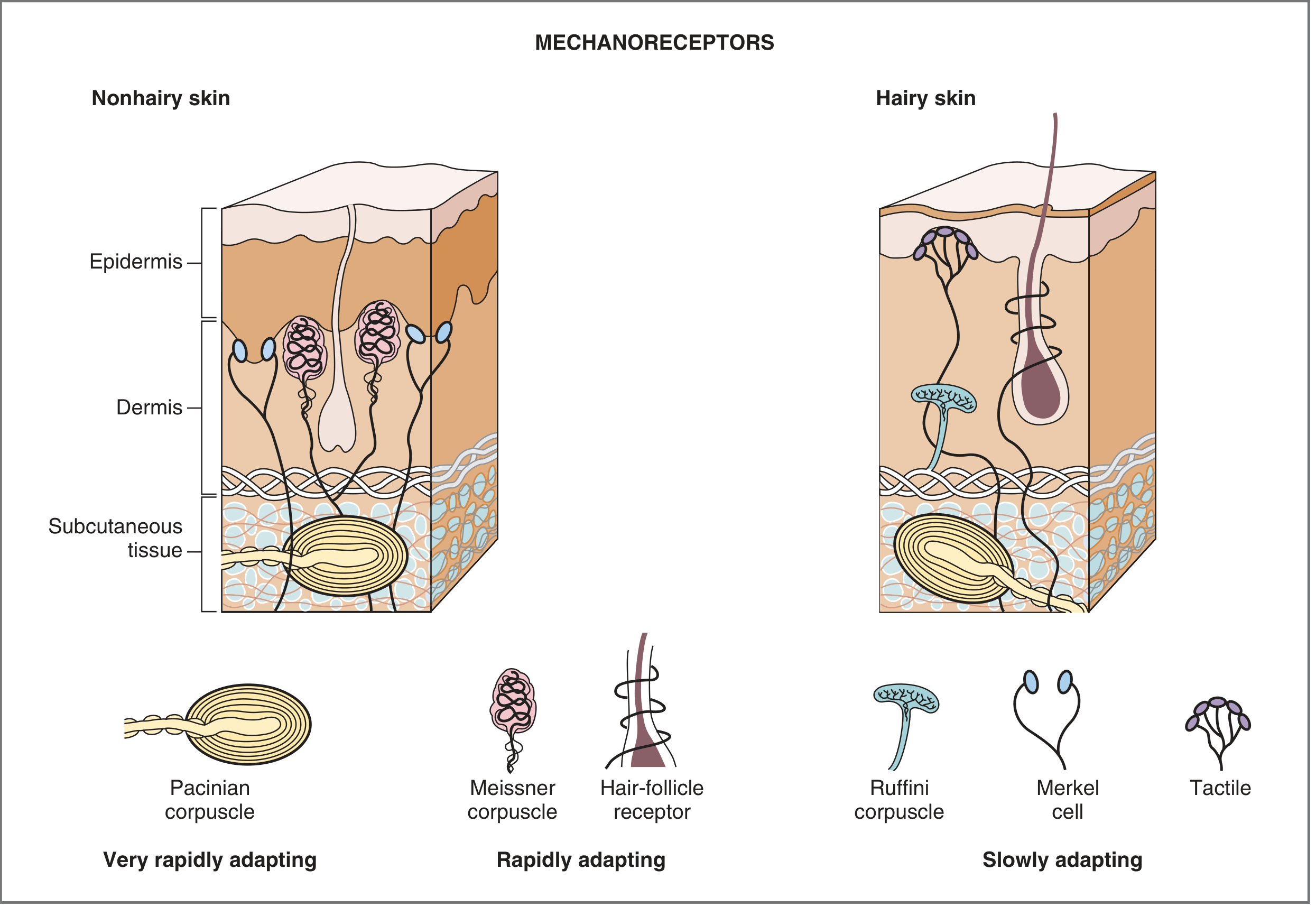
| Receptor | Location | Adaptation | Sensation Encoded |
|---|---|---|---|
| Pacinian corpuscle | Subcutaneous tissue; intramuscular | Very rapidly (phasic) | Vibration, tapping |
| Meissner corpuscle | Dermis of nonhairy skin (fingertips, lips) | Rapidly (phasic) | Point/two-point discrimination, tapping, flutter |
| Hair follicle receptors | Around hair follicles in hairy skin | Rapidly (phasic) | Velocity and direction of movement |
| Ruffini corpuscle | Dermis of hairy/nonhairy skin; joint capsules | Slowly (tonic) | Skin stretch, joint rotation |
| Merkel receptors | Nonhairy skin (very small receptive fields) | Slowly (tonic) | Vertical indentation of skin; proportional to intensity |
| Tactile discs | Hairy skin | Slowly (tonic) | Vertical indentation of skin |
(Costanzo Physiology 7th Ed., Table 3.3)
Key points:
- Pacinian corpuscles are the largest and most readily identifiable mechanoreceptors
- Meissner corpuscles are most prominent at fingertips and enable fine two-point discrimination
- Ruffini corpuscles have large receptive fields - stimuli at a distance can activate them
- Merkel receptors and Meissner corpuscles have small receptive fields - good for fine spatial discrimination
2. Photoreceptors
- Activated by light energy (electromagnetic spectrum)
- Located in the retina of the eye
- Types: Rods (dim light/night vision, no color) and Cones (bright light, color vision - 3 subtypes for red, green, blue)
3. Chemoreceptors
- Activated by chemicals
- Include:
- Olfactory receptors (smell) - olfactory mucosa
- Taste buds (taste) - tongue
- Peripheral chemoreceptors at carotid and aortic bodies (detect arterial PO2, PCO2, pH)
- Central chemoreceptors in ventrolateral medulla (detect pH of CSF/PCO2)
4. Thermoreceptors
- Slowly adapting receptors that detect skin temperature changes
- Two classes:
- Cold receptors - active below 36°C (become quiescent when skin warms above 36°C)
- Warm receptors - active above 36°C (become quiescent when skin cools below 36°C)
- Both types overlap activity in the moderate range (~36°C)
- At temperatures above 45°C, warm receptors become inactive; polymodal nociceptors take over
- Transduction mechanisms:
- Warm: TRPV channels (transient receptor potential - vanilloid family); also activated by capsaicin
- Cold: TRPM8 channels; also activated by menthol
(Costanzo Physiology 7th Ed., p. 86)
5. Nociceptors
- Respond to noxious/damaging stimuli
- Slowly adapting - prolonged signaling warns of ongoing injury
- Two major classes:
- Thermal/Mechanical nociceptors - respond to sharp pricking pain; supplied by Aδ myelinated fibers (fast, sharp pain)
- Polymodal nociceptors - respond to high-intensity mechanical, chemical, hot AND cold stimuli; supplied by unmyelinated C fibers (slow, burning/aching pain)
- Sensitization: damaged tissue releases bradykinin, prostaglandins, substance P, K+, H+, histamine → hyperalgesia (reduced threshold for pain)
General Properties of Sensory Receptors
1. Differential (Adequate) Sensitivity
Each receptor is highly sensitive to one specific stimulus (its "adequate stimulus") and nearly nonresponsive to others. Example: rods/cones respond to light but not to heat or pressure.
2. Sensory Transduction
The process by which a stimulus is converted to an electrical signal:
- Stimulus interacts with receptor, causing structural/chemical change
- Ion channels open/close → change in membrane ion current
- Change in membrane potential = receptor potential (= generator potential)
- Depolarizing receptor potential → increases likelihood of action potentials
- Hyperpolarizing receptor potential → decreases likelihood
- Receptor potential is graded (proportional to stimulus strength) - unlike action potentials which are all-or-none
3. Receptive Field
- Area of the body that when stimulated results in a change in firing rate of a sensory neuron
- Small receptive fields = high spatial resolution (fingertips, lips) - Meissner, Merkel
- Large receptive fields = lower resolution (back) - Ruffini
4. Receptor Adaptation
- When a constant stimulus is applied, firing frequency initially high → gradually declines
- Phasic receptors: adapt rapidly, detect stimulus onset/offset and velocity of change (e.g., Pacinian, Meissner, hair follicle)
- Tonic receptors: adapt slowly, detect stimulus intensity and duration (e.g., Merkel, Ruffini, nociceptors, muscle spindles)
5. Labeled Line Coding
- Each sensory modality is carried by a specific nerve tract to a specific brain area
- The type of sensation felt depends on which brain region is activated, NOT the type of stimulus
- Example: stimulating a pain fiber electrically still produces pain (labeled line principle)
6. Population Coding
- Some modalities (e.g., color vision) require input from a population of receptors; no single receptor uniquely codes for the sensation
Autonomic Receptor Types (ANS Context)
In addition to sensory receptors, the autonomic nervous system uses specific receptor subtypes:
| Division | Neurotransmitter | Receptor Type | Location |
|---|---|---|---|
| Parasympathetic (postganglionic) | ACh | Muscarinic | Effector organs |
| Sympathetic (preganglionic) | ACh | Nicotinic (N2) | Ganglia |
| Sympathetic (postganglionic) | Norepinephrine | α1, α2, β1, β2 (adrenoceptors) | Effector organs |
| Sympathetic (sweat glands) | ACh | Muscarinic | Sweat glands |
(Costanzo Physiology 7th Ed., p. 58-64)
Summary Table: Receptor Types at a Glance
| Feature | Phasic | Tonic |
|---|---|---|
| Adaptation speed | Rapid | Slow |
| What they detect | Change, velocity, onset/offset | Duration, intensity |
| Examples | Pacinian, Meissner, Hair follicle | Merkel, Ruffini, Nociceptors, Muscle spindles |
| Receptor potential | Returns quickly to baseline | Stays elevated for duration of stimulus |
Sources: Costanzo Physiology 7th Edition (pp. 82-88); Guyton & Hall Textbook of Medical Physiology (Ch. 47); Ganong's Review of Medical Physiology 26th Edition (pp. 173-174)
This is a shared conversation. Sign in to Orris to start your own chat.