
Dietary fibers
Reading File
Finding Sources
Searching PubMed
"dietary fiber" AND health
Reading File
Reading File
Reading File
Reading File
Reading File
Finding Sources
Reading File
Finding Sources
Reading File
Reading File
Loading Image
Here is a comprehensive overview of dietary fibers drawn from authoritative medical textbooks.
Dietary Fibers
Definition
Dietary fiber is the portion of the diet resistant to digestion by human digestive enzymes. It consists principally of plant-derived polysaccharide derivatives and lignin. These components pass largely unchanged through the small intestine and reach the colon.
— Basic Medical Biochemistry, 6e
Classification
Dietary fibers are broadly divided into two categories based on water solubility:
Insoluble Fibers (poorly/non-fermentable)
| Type | Chemical Nature | Food Sources |
|---|---|---|
| Cellulose | β-1,4 linked glucosyl polysaccharide | Whole wheat flour, unprocessed bran, vegetables |
| Hemicellulose | Arabinoxylans or galactomannans | Bran cereals, whole grains |
| Lignin | Non-carbohydrate; polymeric phenylpropane derivatives | Fruits, edible seeds, mature vegetables |
Soluble Fibers (fermentable)
| Type | Chemical Nature | Food Sources |
|---|---|---|
| Pectins | Galacturonans, arabinogalactans, β-glucans | Apples, strawberries, carrots, citrus |
| Gums | Galactomannans, arabinogalactans | Oats, legumes, guar, barley |
| Mucilages | Branched and substituted galactans | Flaxseed, psyllium, mustard seed |
Fermentation rates: Lignin — 0%; Cellulose — 15%; Hemicellulose — 56–87%; Mucilages/Gums — 85–95%; Pectins — 90–95%. — Goodman & Gilman's Pharmacological Basis of Therapeutics
Metabolism: Bacterial Fermentation & SCFAs
Human digestive enzymes cannot break down fiber, but colonic bacteria ferment the soluble fractions, producing:
- Short-chain fatty acids (SCFAs) — primarily acetate, propionate, and butyrate (2–4 carbon atoms)
- Gases — methane, hydrogen, CO₂
These fermentation products account for up to 10% of total caloric intake.
SCFA Transport & Signaling in the Colon
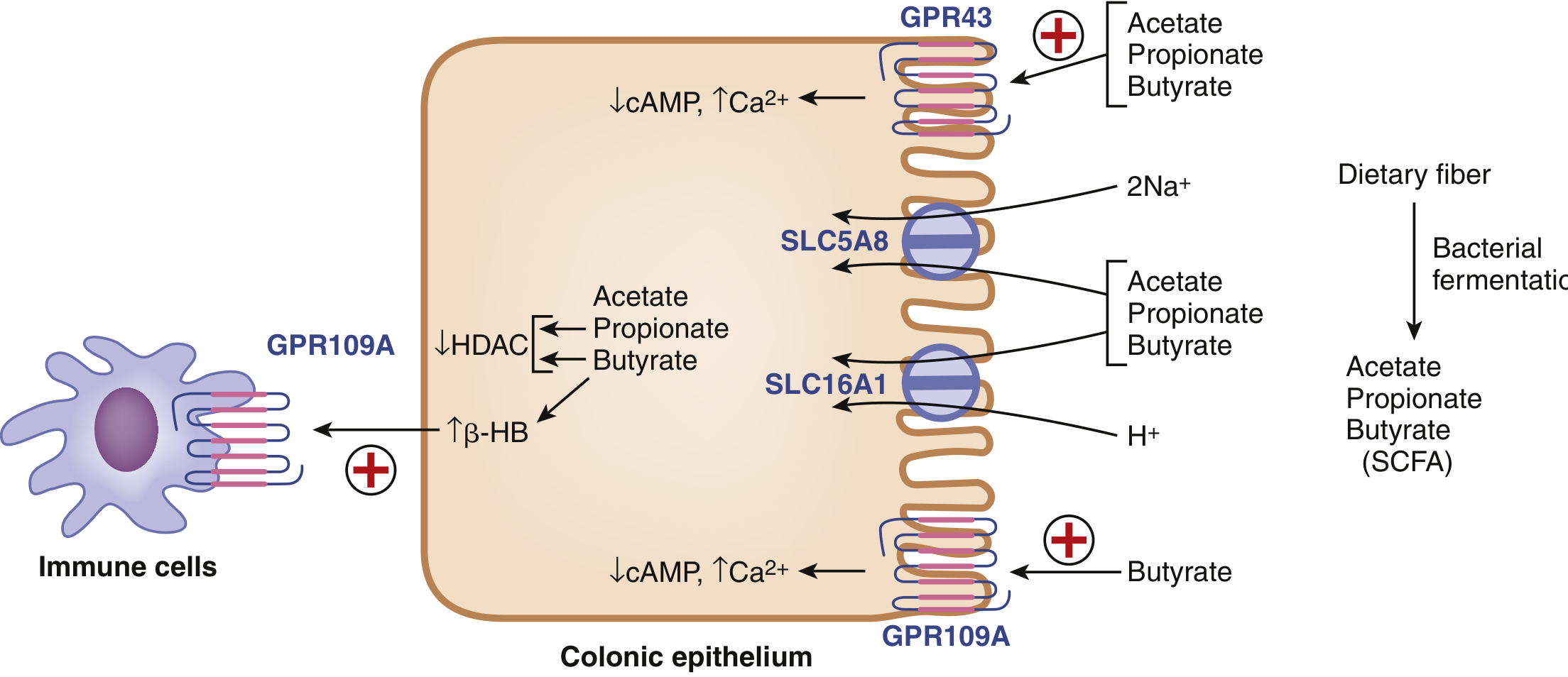
SCFAs are absorbed via:
- SLC16A1 (MCT1) — proton-coupled monocarboxylate transporter
- SLC5A8 (SMCT1) — sodium-coupled monocarboxylate transporter
Once inside colonocytes, SCFAs act through:
- GPR43 (activated by acetate, propionate, butyrate) → ↓cAMP, ↑Ca²⁺
- GPR109A (activated by butyrate and β-hydroxybutyrate) → ↓cAMP, ↑Ca²⁺
Butyrate is the preferred energy substrate for colonocytes and acts as a histone deacetylase (HDAC) inhibitor, modulating epigenetic gene expression (e.g., cell-cycle regulator p21, transcription factor CDX2, kinase p38). SCFAs also function as effective tumor suppressors in the colon and influence immune tolerance through dendritic cell development inhibition.
— Sleisenger & Fordtran's Gastrointestinal and Liver Disease
Physiological Functions & Clinical Relevance
1. Stool Bulk and Constipation
- Insoluble fiber (especially wheat bran/lignin) increases stool bulk and accelerates transit by attracting water
- Soluble fiber increases bacterial mass and SCFAs, which have a prokinetic effect
- Psyllium husk (ispaghula) contains a hydrophilic muciloid — widely used as a bulk-forming laxative
2. Cardiovascular Disease
- Soluble fiber (pectins, β-glucans from oats) reduces plasma total and LDL cholesterol without affecting HDL cholesterol by binding bile acids in the intestine, reducing their resorption, and forcing hepatic cholesterol conversion to new bile acids
- Dietary fiber intake correlates inversely with cardiovascular disease risk, including coronary heart disease — Tietz Textbook of Laboratory Medicine, 7e
3. Diabetes Mellitus
- Pectins slow the rate of absorption of simple sugars from the gut, blunting postprandial blood glucose spikes — beneficial in diabetes management — Basic Medical Biochemistry, 6e
4. Diverticular Disease
- High-fiber diets (>25–30 g/day) are associated with less symptomatic diverticular disease, reduced hospital admissions, and reduced mortality
- A 2019 meta-analysis of 5 prospective cohorts found that 30 g/day of fiber reduces the risk of diverticular disease by 41%
- Fiber "softens" stool, reducing intraluminal pressure on the colonic wall — Yamada's Textbook of Gastroenterology, 7e
5. Colorectal Cancer
- SCFAs (especially butyrate) act as tumor suppressors in the colon via HDAC inhibition and G-protein-coupled receptor activation
- There is evidence suggesting high-fiber diets may reduce colonic tumor burden; fermented starch preferentially produces SCFA in the colon, reducing intestinal tumor burden in animal models — Sleisenger & Fordtran's GI and Liver Disease
6. Gut Microbiome
- Soluble fiber provides the primary substrate for beneficial gut bacteria (e.g., Clostridium cluster IV, Akkermansia species)
- Depleted fiber → gut dysbiosis → loss of anti-inflammatory microbial species, contributing to IBD and diverticular disease
Daily Recommended Intake (2015 Dietary Guidelines Advisory Committee)
| Group | Age | Recommended Fiber/Day |
|---|---|---|
| Adult males | 19–30 yr | 34 g |
| Adult males | 31–50 yr | 30.8 g |
| Adult males | >51 yr | 28 g |
| Adult females | 19–30 yr | 28 g |
| Adult females | 31–50 yr | 25.2 g |
| Adult females | >51 yr | 22 g |
Increased during pregnancy and lactation. No distinction was made between soluble and insoluble fiber types.
— Basic Medical Biochemistry, 6e
Key Food Sources Summary
- Wheat bran — >40% dietary fiber; highest in lignin; most effective for stool weight (1–3 g up to 3×/day)
- Fruits & vegetables — predominantly pectins and hemicelluloses (more fermentable, less stool transit effect)
- Oats, barley, legumes — rich in β-glucans and gums (cholesterol-lowering)
- Psyllium husk — muciloid; significant colonic fermentation; used therapeutically for constipation
Recent Evidence (2025)
A large umbrella systematic review (Veronese et al., Clinical Nutrition, 2025) analyzed data from 17,155,277 individuals and confirmed broad health benefits of dietary fiber consumption across cardiovascular, metabolic, and GI outcomes [PMID: 40651334]. The gut microbiome appears to be a major mediating mechanism, with fiber intake shaping microbial composition, metabolite production, and systemic inflammatory tone [PMID: 40362352].
Summary: Dietary fibers are non-digestible plant polysaccharides broadly classified as soluble (fermentable → SCFAs → colonic epithelial fuel, immune modulation) and insoluble (stool bulking, transit). Their health benefits span cardiovascular protection, glycemic control, reduced colorectal cancer risk, gut microbiome health, and prevention of symptomatic diverticular disease. Recommended intake is 22–34 g/day in adults.
Why comparatively high incidence of colon cancers in developed countries and low incidence in vegetarian population like indians
Finding Sources
Searching PubMed
"colorectal cancer" AND "dietary fiber" AND "red meat"
Searching the Web
colon cancer incidence developed countries vs India vegetarian diet epidemiology
Reading File
Finding Sources
Reading Web Page
https://pmc.ncbi.nlm.nih.gov/articles/PMC11953156/
Reading File
Finding Sources
Finding Sources
Reading File
Finding Sources
Reading File
Reading File
Reading File
Loading Image
You've run out of free credits. Sign up for a free account to continue using Orris.
This is a shared conversation. Sign in to Orris to start your own chat.