
Hyperthyroidism and hypothyroidism treatment
Reading File
Now I'll search the medical library for both hyperthyroidism and hypothyroidism treatment simultaneously.
Finding Sources
Finding Sources
Searching PubMed
hyperthyroidism treatment guidelines
Searching PubMed
hypothyroidism levothyroxine treatment
Good results. Now let me read the key sections in parallel - Pharmacology (both hyper and hypothyroidism), and Braunwald's for cardiology context.
Reading File
Reading File
Reading File
I have rich content from the textbooks. Let me also fetch the Braunwald's treatment flowchart image and read the remaining pharmacology content.
Loading Image
Reading File
I now have comprehensive information to provide a detailed, well-structured answer. Let me compile it.
Hyperthyroidism and Hypothyroidism: Treatment
HYPOTHYROIDISM
First-Line Treatment: Levothyroxine (T4)
Levothyroxine (LT4) is the treatment of choice for hypothyroidism. It is preferred over T3 (liothyronine) or T3/T4 combination products (liotrix) because:
- Better tolerated
- Longer half-life (~7 days)
- Once-daily dosing
- Steady state achieved in 6-8 weeks
The American Thyroid Association (ATA) does not recommend routine combination therapy (LT4 + liothyronine), as evidence of superiority over monotherapy is inconsistent. However, a 2026 meta-analysis (PMID: 40579157) found that liothyronine-containing regimens were associated with reduced risk of dementia and mortality - this emerging evidence may influence future guidelines.
Dosing
| Population | Typical Dose |
|---|---|
| Standard adults | ~1.8 mcg/kg/day |
| Elderly (>65) | ~0.5 mcg/kg/day |
| Ischemic heart disease | Start low, titrate slowly |
| Infants/young children | Higher doses (per kg) |
- Start at the lower end of the expected optimal dose
- Exception: in longstanding disease or ischemic heart disease, always start low and titrate up
Timing of Administration
- Take 30-60 minutes before breakfast (food and caffeine impair absorption)
- Bedtime administration is equally effective and may improve compliance
Monitoring Goals
- Primary hypothyroidism: target TSH within reference interval
- Central hypothyroidism: target free T4 toward the upper end of reference interval
- Check TSH no earlier than 4-6 weeks after dose change
- Repeat at 4-6 months, then annually once stable
Subclinical Hypothyroidism (SCH)
- TSH >10 mIU/L: treat with LT4 (especially in patients <65-70 years)
- TSH <10 mIU/L with symptoms: consider LT4; stop if symptoms don't improve
- Age >80-85 years with TSH ≤10: wait-and-see approach recommended
Drug Interactions (reduce LT4 efficacy)
| Category | Examples |
|---|---|
| CYP450 inducers | Phenytoin, rifampin, phenobarbital |
| Absorption reducers | Iron, calcium carbonate, cholestyramine, sucralfate |
| Dietary inhibitors | Coffee, fiber, soy, grapes, papaya |
Toxicity Signs (excess dosing = mimics hyperthyroidism)
Nervousness, palpitations, tachycardia, heat intolerance, weight loss
Special caution: In central hypothyroidism, always exclude concomitant adrenal insufficiency before starting LT4 - precipitating an adrenal crisis is a real risk.
Sources: Tietz Textbook of Laboratory Medicine, 7th Ed.; Lippincott Illustrated Reviews: Pharmacology
HYPERTHYROIDISM
Three Main Treatment Strategies
| Approach | Methods |
|---|---|
| Ablation of gland | Radioactive iodine (RAI / ¹³¹I), surgery |
| Inhibit hormone synthesis | Thioamides (methimazole, PTU) |
| Block hormone release | Iodide (short-term), beta-blockers |
1. Radioactive Iodine (RAI / ¹³¹I)
- Selectively taken up by thyroid follicular cells and destroys them
- Most patients develop hypothyroidism afterward and require LT4 long-term
- Preferred for:
- Older adults (>65) with persistent Graves disease + comorbidities
- Toxic multinodular goiter (TMNG) or autonomously functioning solitary nodule
- Patients where definitive therapy is needed to prevent cardiac progression
2. Thioamides - Methimazole and PTU
Both drugs inhibit:
- Iodination of tyrosyl groups (oxidative process)
- Coupling of iodotyrosines to form T3 and T4
PTU additionally blocks peripheral conversion of T4 → T3.
Important: Neither drug affects pre-formed thyroglobulin already stored in the gland. Clinical effects are delayed until stores are depleted (weeks).
| Feature | Methimazole | PTU |
|---|---|---|
| Dosing frequency | Once daily (longer half-life) | Multiple times daily |
| Preferred agent | Yes (first-line) | Second-line |
| Agranulocytosis risk | Yes (both agents) | Yes (both agents) |
| Hepatotoxicity | Mild-moderate | Severe (potentially fatal liver failure) |
| Use in pregnancy | Avoid 1st trimester | Preferred in 1st trimester |
| Mechanism | Synthesis inhibition | Synthesis + peripheral T4→T3 block |
Adverse effects: Rash, pruritus, arthralgia, agranulocytosis, hepatotoxicity
3. Iodide (Short-term use only)
- Inhibits iodination ("Wolff-Chaikoff effect") - lasts only a few days
- Inhibits release of thyroid hormones from thyroglobulin
- Uses: Thyroid storm, pre-operative preparation (reduces vascularity)
- Not for long-term use
- Adverse effects: Sore mouth/throat, tongue swelling, metallic taste, mucosal ulcerations
4. Beta-Blockers (Symptom control)
Propranolol, metoprolol, atenolol - blunt the widespread sympathetic stimulation.
- Reduce palpitations, tremor, anxiety, tachycardia
- Do NOT reduce thyroid hormone levels
- Also used in thyroid storm
Treatment Selection by Etiology (Braunwald's Algorithm)
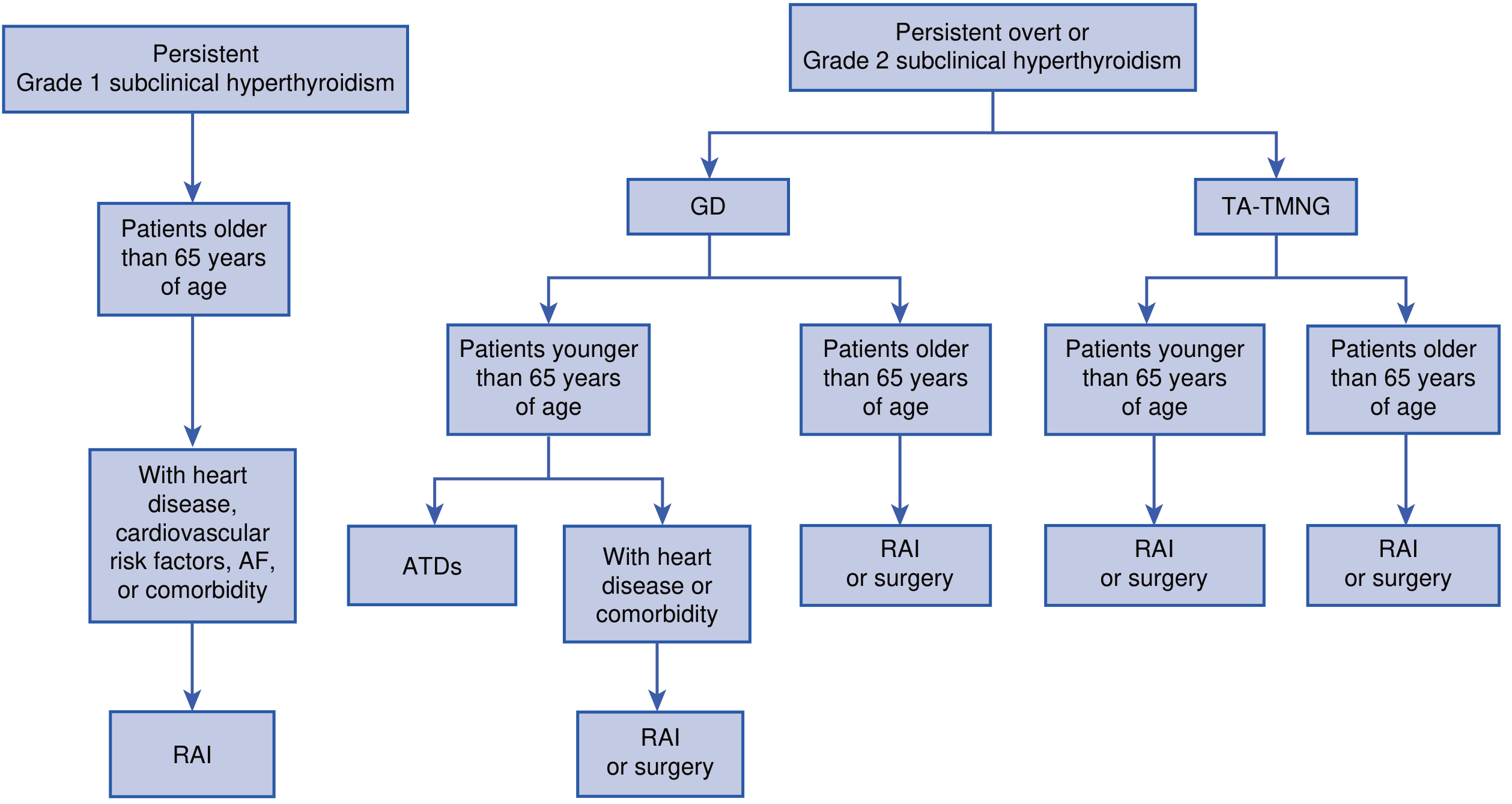
Figure: Treatment decision flowchart for hyperthyroidism - GD = Graves Disease, TA-TMNG = Toxic Adenoma/Toxic Multinodular Goiter, ATDs = Antithyroid Drugs, RAI = Radioactive Iodine. (Braunwald's Heart Disease)
Key decision points:
- Graves disease, patient <65, no comorbidities: Antithyroid drugs (methimazole) - may remit spontaneously
- Graves disease, patient >65 or with heart disease: RAI or surgery (definitive therapy)
- TMNG or solitary toxic nodule, any age: RAI or surgery
- Grade 1 subclinical hyperthyroidism (TSH 0.1-0.4), asymptomatic young/premenopausal: No treatment needed (insufficient evidence of harm)
Thyroid Storm (Hyperthyroid Emergency)
Thyroid storm is the most severe form of hyperthyroidism. Mortality can reach 50%.
Clinical features: Altered mental status, high fever, GI symptoms, extreme tachycardia, new atrial fibrillation, hypotension, cardiovascular collapse.
Treatment (same drugs as for hyperthyroidism, but higher doses, more frequent):
- High-dose thioamides (PTU preferred - also blocks T4→T3 conversion)
- Potassium iodide (given AFTER thioamides to avoid iodine fueling synthesis)
- Beta-blockers (IV esmolol with caution; avoid if heart failure or hypotension)
- ICU monitoring
- Treat precipitating cause (infection, trauma, amiodarone)
Summary Comparison
| Feature | Hypothyroidism Tx | Hyperthyroidism Tx |
|---|---|---|
| First-line drug | Levothyroxine (T4) | Methimazole |
| Monitoring | TSH (every 4-6 weeks until stable) | TSH (low = response) |
| Definitive cure | Lifelong LT4 replacement | RAI or thyroidectomy |
| Pregnancy | Continue LT4 (increase dose) | PTU in 1st trimester |
| Emergency | Myxedema coma: IV T4 ± T3 | Thyroid storm: PTU + iodide + beta-blocker + ICU |
Recent evidence note (PubMed, 2025-2026):
- A 2026 network meta-analysis (PMID: 39290156) found patients prefer combination LT4+T3 over LT4 alone, despite current ATA guidelines favoring monotherapy - watch for guideline updates.
- A 2026 meta-analysis (PMID: 40579157) suggests liothyronine-containing regimens reduce dementia risk and mortality compared to LT4 alone, which may support a role for combination therapy in select patients.
Sources: Lippincott Illustrated Reviews: Pharmacology; Braunwald's Heart Disease, 2-Vol Set; Tietz Textbook of Laboratory Medicine, 7th Ed.
Create a clinical reference guide comparing hyperthyroid treatment options
Asking for Preferences
What format should the clinical reference guide be in?
This is a shared conversation. Sign in to Orris to start your own chat.