
Anatomy of nose
Reading File
Finding Sources
Searching Images
anatomy of the nose nasal cavity
Reading File
Reading File
Loading Image
Finding Sources
Reading File
Finding Sources
Finding Sources
Reading File
Reading File
Reading File
Reading File
Loading Image
Now I have comprehensive information from multiple authoritative textbooks. Let me compile a thorough answer.
Anatomy of the Nose
Overview
The nose consists of three parts: the external nose, the nasal vestibule, and the nasal cavity (which communicates posteriorly with the nasopharynx via the choanae).
1. External Nose
The external nose is divided into three aesthetic thirds on frontal view:
- Upper third — nasal bones
- Middle third — upper lateral cartilages and septum
- Lower third — lower lateral cartilages (alar cartilages) and septum
Key external landmarks include:
- Nasion — the nasofrontal angle (normally 115–130°); its depth should be 9–14 mm from the anterior corneal plane
- Rhinion — the osseocartilaginous junction over the dorsum (skin is thinnest here)
- Supratip — just above the nasal tip (skin thicker)
- Columella — separates the two nostrils
- Alar-columellar margin — forms a "gull in flight" outline on frontal view
The external nose is covered by skin that is thick and sebaceous at the nasion, thin over the rhinion, and thick again over the supratip and tip.
2. Nasal Vestibule & Epithelium
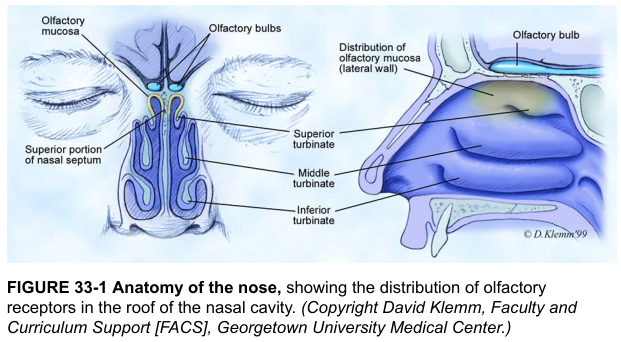
The nasal vestibule is a cutaneous structure lined by keratinizing squamous epithelium with sebaceous glands, sweat glands, and hair follicles (vibrissae). At the limen nasi (mucocutaneous junction), the epithelium transitions to ciliated pseudostratified columnar (respiratory) epithelium, which lines the rest of the nasal cavity and paranasal sinuses. The roof of the nasal cavity carries specialized olfactory epithelium containing bipolar olfactory neurons with odorant receptors on cilia; their axons coalesce to form CN I and pass through the cribriform plate.
3. Nasal Septum
The nasal septum divides the right and left nasal cavities:
- Anteriorly: quadrilateral (septal) cartilage
- Superoposteriorly: perpendicular plate of the ethmoid
- Inferoposteriorly: vomer
The septum develops embryologically from the merged medial nasal processes, and the perpendicular plates do not fully ossify until puberty. Septal deviation is common in adults; the more patent side should be assessed before nasal instrumentation.
4. Lateral Nasal Wall & Turbinates (Conchae)
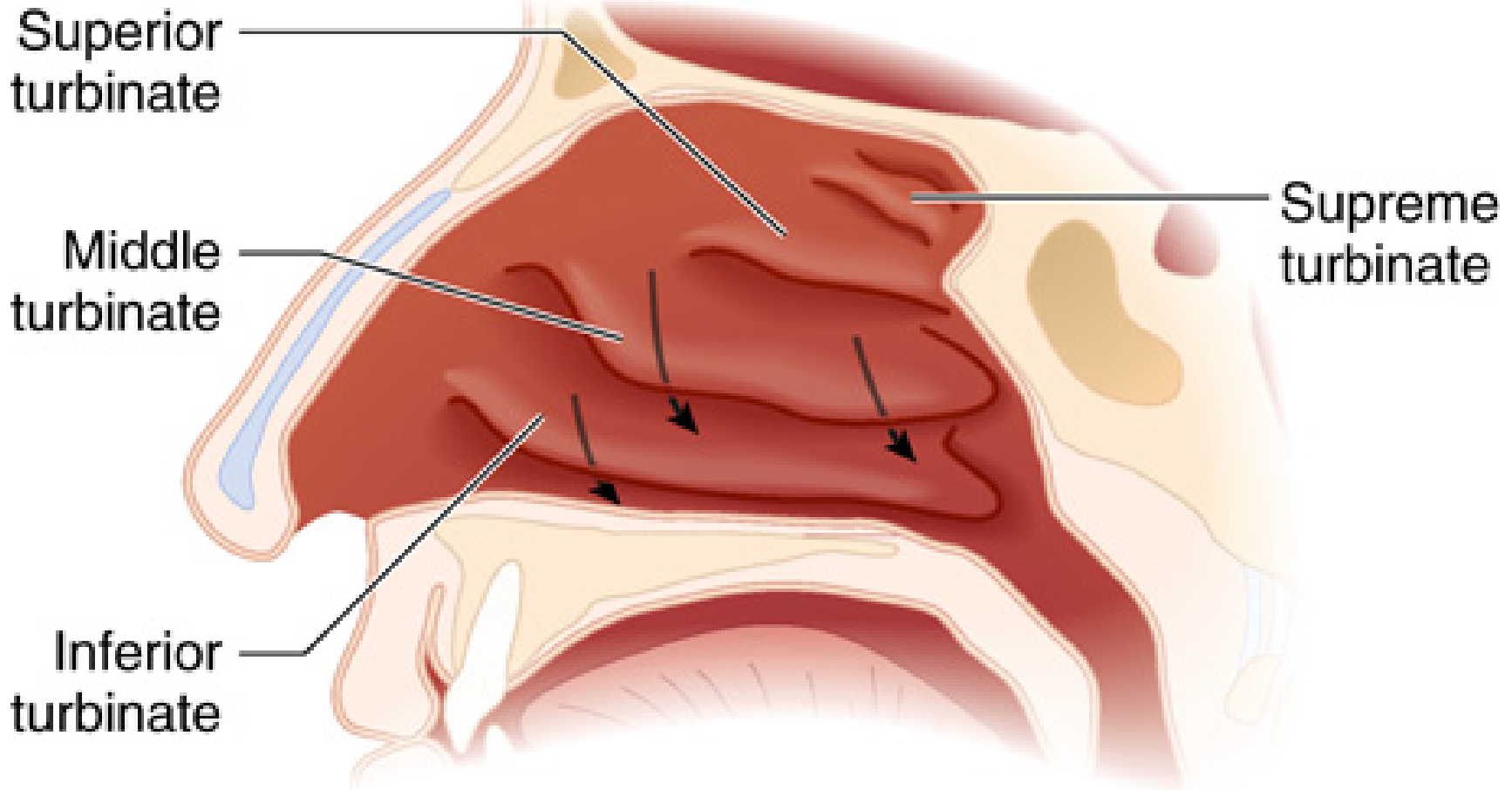
The lateral wall carries three (sometimes four) turbinates (conchae) that greatly increase the surface area for air conditioning:
| Turbinate | Meatus Below | Drainage |
|---|---|---|
| Inferior | Inferior meatus | Nasolacrimal duct |
| Middle | Middle meatus | Maxillary sinus, anterior ethmoid, frontal sinus (via infundibulum) |
| Superior | Superior meatus | Posterior ethmoid cells |
| (Supreme — variable) | Sphenoethmoidal recess | Sphenoid sinus |
The inferior meatus (between the inferior turbinate and the nasal floor) is the preferred pathway for nasal airway devices. Improper placement can avulse a turbinate.
The middle meatus is surgically critical — it receives drainage from three sinuses and is the focus of functional endoscopic sinus surgery (FESS). The ostiomeatal complex here connects the anterior sinuses to the nasal cavity.
5. Roof and Floor
- Roof: Formed by the cribriform plate of the ethmoid bone. This is fragile — fracture communicates the nasal and intracranial cavities, causing CSF rhinorrhoea. The olfactory mucosa and olfactory bulbs lie just superior to the cribriform plate.
- Floor: Formed by the hard palate (palatine process of maxilla + horizontal plate of palatine bone).
6. Blood Supply
Arterial Supply
The nose has a dual arterial supply from the internal and external carotid systems:
Internal carotid artery (via ophthalmic artery):
- Anterior ethmoidal artery (AEA) → supplies anterosuperior nasal cavity and septum; also supplies nasal dorsum and tip via the external nasal branch
- Posterior ethmoidal artery → supplies posterior nasal cavity
External carotid artery (via internal maxillary artery):
- Sphenopalatine artery (SPA) — the principal supply to the nasal cavity; enters via the sphenopalatine foramen in the superior meatus
- Posterior septal branch → nasal septum (pedicle of nasoseptal flap)
- Posterior lateral nasal branch → middle and inferior turbinates
- Greater palatine artery → anteroinferior nasal cavity and septum (via incisive foramen)
- Superior labial artery (facial artery) → nasal vestibule and anterior cavity
Clinically important vascular plexuses:
| Plexus | Location | Significance |
|---|---|---|
| Kiesselbach's plexus (Little's area) | Anterior nasal septum | Most common site of anterior epistaxis |
| Woodruff's plexus | Posterior inferior meatus | Site of posterior epistaxis (venous in nature) |
Venous Drainage
- Anterior/posterior ethmoidal veins → superior ophthalmic vein → cavernous sinus (valveless — allows spread of infection intracranially)
- Sphenopalatine vein → pterygoid plexus
- Diploic veins of Breschet → communicate with dural sinuses (route for intracranial spread from frontal sinuses)
7. Nerve Supply
Sensory Innervation
External nose:
- V1 (ophthalmic): Infratrochlear nerve (lateral nose above medial canthus); External nasal branch of anterior ethmoidal nerve (tip, dorsum, ala)
- V2 (maxillary): Infraorbital nerve (lateral nose and ala)
Nasal cavity:
- V1: Internal nasal branch of anterior ethmoidal nerve (anterior and superior cavity); Posterior ethmoidal nerve (posterior cavity)
- V2: Sphenopalatine (nasopalatine) nerve (posterior cavity); Anterior superior alveolar nerve (anterior cavity and floor)
Autonomic Innervation
| Division | Function | Pathway |
|---|---|---|
| Sympathetic | Vasoconstriction | Superior cervical ganglion → deep petrosal nerve + GSPN → vidian nerve → nasal mucosa |
| Parasympathetic | Vasodilation + nasal secretion | Superior salivary nucleus (CN VII) → GSPN → vidian nerve → sphenopalatine ganglion → nasal mucosa |
Special Sensory
- CN I (Olfactory nerve): Bipolar neurons in the olfactory epithelium at the roof → axons pass through the cribriform plate to the olfactory bulbs
8. Cartilaginous Framework
The nasal skeleton consists of:
- Nasal bones (upper third)
- Upper lateral cartilages (middle third) — fused to the caudal edge of the nasal bones superiorly and to the septal cartilage medially
- Lower lateral cartilages / alar cartilages (lower third) — each has a medial crus, intermediate crus, and lateral crus
- Accessory/sesamoid cartilages — extend support of lateral crura to the piriform aperture
Tip support depends on:
- Major mechanisms: Shape/strength of lower lateral cartilages; attachment of medial crural footplates to caudal septum; attachment of upper to lower lateral cartilage junction
- Minor mechanisms: Interdomal ligament; septal dorsum; anterior nasal spine; membranous septum
9. Paranasal Sinuses (Drainage Summary)
| Sinus | Drainage Site |
|---|---|
| Maxillary | Middle meatus (via infundibulum) |
| Anterior ethmoid | Middle meatus |
| Frontal | Middle meatus (via frontal recess) |
| Posterior ethmoid | Superior meatus |
| Sphenoid | Sphenoethmoidal recess |
| Nasolacrimal duct | Inferior meatus |
Sources:
- Cummings Otolaryngology Head and Neck Surgery — Anatomy and Embryology of the Nose
- K.J. Lee's Essential Otolaryngology — Surgical Anatomy of the Nose
- Miller's Anesthesia, 10e — Nasal Cavity Anatomy
- Sabiston Textbook of Surgery — Normal Anatomy and Histology
- Harrison's Principles of Internal Medicine, 21e — Olfactory anatomy
This is a shared conversation. Sign in to Orris to start your own chat.