
DETAILED PATHOPHYSIOLOGY OF BLOOD PRESSURE IN AURUM METALLICUM HOMEOPATHIC REMEDY
Reading File
Reading File
Searching the Web
NCCIH homeopathy effectiveness evidence high blood pressure
Searching PubMed
homeopathy hypertension
Finding Sources
Finding Sources
Finding Sources
Reading File
Reading File
Reading Web Page
https://www.nccih.nih.gov/health/homeopathy
Reading File
Reading File
Searching the Web
American Heart Association hypertension pathophysiology blood pressure cardiac output peripheral vascular resistance
Aurum metallicum and blood pressure: what is scientifically known
Aurum metallicum is a homeopathic preparation made from metallic gold. There is no established physiological or pharmacological mechanism by which highly diluted Aurum metallicum lowers, raises, or otherwise regulates blood pressure. Homeopathy's proposed principles, including “like cures like” and increasing efficacy with increasing dilution, are not supported by accepted cardiovascular physiology. Many homeopathic remedies are diluted to the point that no molecules of the starting substance remain, as explained by NCCIH's homeopathy review.
Therefore, it is not scientifically accurate to describe a specific “pathophysiology of blood pressure in Aurum metallicum.” What can be described is:
- Normal and abnormal blood-pressure physiology
- Homeopathic claims about Aurum metallicum
- Why those claims do not demonstrate a biological BP mechanism
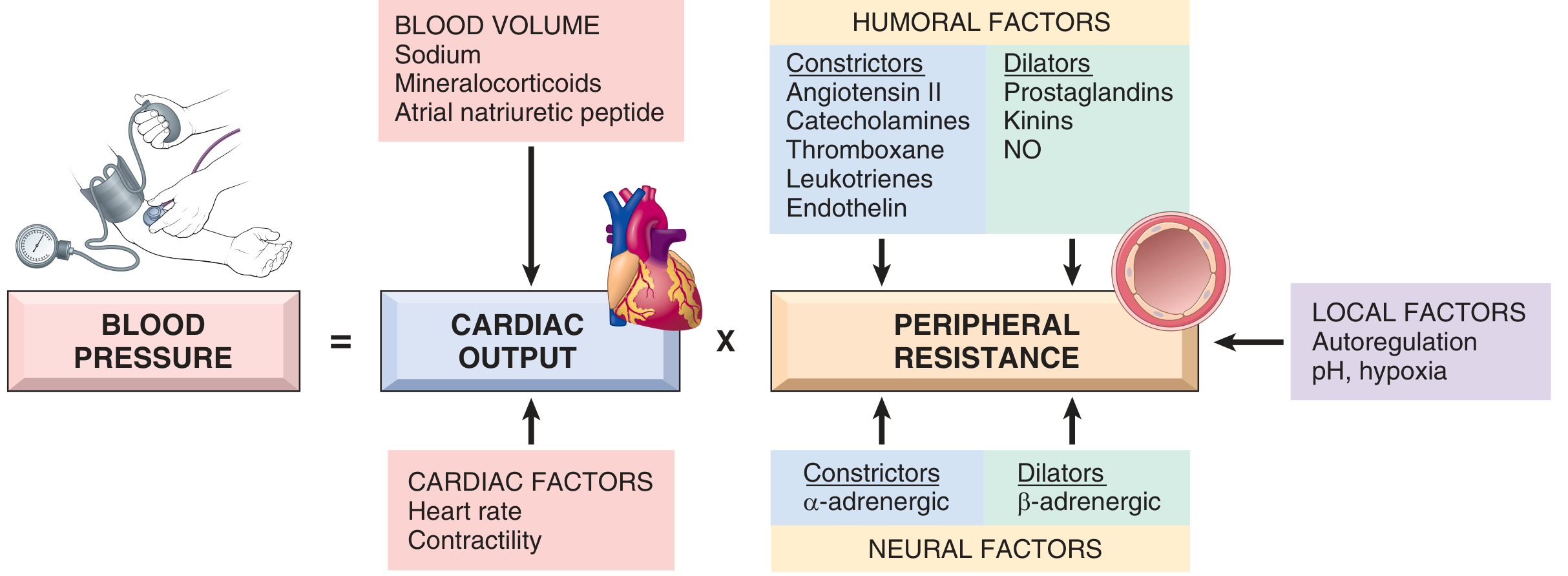
Blood pressure regulation figure from Robbins & Kumar Basic Pathology.
1. Normal physiological control of blood pressure
A useful approximation is:
[
\textbf{Mean arterial pressure (MAP)} \approx \textbf{Cardiac output (CO)} \times \textbf{Systemic vascular resistance (SVR)}
]
and:
[
\textbf{CO} = \textbf{Heart rate (HR)} \times \textbf{Stroke volume (SV)}
]
Thus arterial pressure rises when there is an increase in cardiac output, systemic arteriolar constriction, circulating blood volume, or a combination of these factors.
A. Cardiac output
Cardiac output rises through:
- Increased heart rate, usually from sympathetic beta-1 receptor activation
- Increased contractility, also mainly mediated by beta-1 adrenergic stimulation
- Increased venous return and ventricular filling
- Increased blood volume, commonly due to sodium and water retention
Sympathetic activation increases heart rate, conduction, and myocardial contractility. Increased sympathetic vascular activity also constricts arterioles and veins, increasing both SVR and venous return. Ganong's Review of Medical Physiology, p. 588.
B. Systemic vascular resistance
The arterioles are the principal resistance vessels. Their tone is determined by a balance of:
Vasoconstrictors
- Angiotensin II
- Norepinephrine and epinephrine
- Endothelin
- Vasopressin in selected settings
Vasodilators
- Nitric oxide
- Prostacyclin and other prostaglandins
- Kinins
- Local metabolic factors such as increased carbon dioxide, hydrogen ions, and hypoxia in active tissues
Hypertension commonly involves persistent elevation of arteriolar resistance, endothelial dysfunction with reduced nitric-oxide bioavailability, vascular remodeling, or all of these. Robbins & Kumar Basic Pathology, p. 309.
C. Autonomic nervous system and baroreflex
The carotid sinus and aortic arch contain stretch-sensitive baroreceptors.
- When BP rises: baroreceptor firing increases, brainstem sympathetic output falls, vagal activity rises, heart rate and vascular tone decline.
- When BP falls: baroreceptor firing decreases, sympathetic output rises, heart rate and contractility increase, and arterioles constrict.
This is a rapid, short-term buffering system. It does not fully prevent chronic hypertension because baroreceptors can reset to operate around a higher pressure over time. Ganong's Review of Medical Physiology, p. 588.
D. Kidney, sodium balance, and RAAS
The kidney is central to long-term arterial-pressure regulation.
Low renal perfusion pressure, reduced sodium chloride delivery to the macula densa, and sympathetic beta-1 stimulation cause juxtaglomerular cells to release renin:
[
\text{Renin} \rightarrow \text{Angiotensin I} \rightarrow \text{Angiotensin II}
]
Angiotensin II raises BP by:
- Constricting arterioles, increasing SVR
- Stimulating aldosterone secretion
- Increasing renal sodium reabsorption
- Increasing thirst and vasopressin activity
- Facilitating sympathetic activity
Aldosterone increases distal nephron sodium reabsorption. Water follows sodium, expanding extracellular and intravascular volume, raising venous return, stroke volume, cardiac output, and blood pressure. Robbins & Kumar Basic Pathology, pp. 309-310.
Conversely, atrial and brain natriuretic peptides promote sodium excretion and vasodilation when cardiac chambers are stretched by excess volume.
2. Pathophysiology of chronic hypertension
Persistent high blood pressure is not usually due to one isolated defect. Important interacting processes include:
- Renal sodium retention and impaired pressure natriuresis
- RAAS overactivity
- Persistent sympathetic overactivity
- Increased arteriolar tone and vascular structural remodeling
- Endothelial dysfunction
- Obesity, insulin resistance, sleep apnea, alcohol excess, high dietary sodium, and chronic kidney disease
- Genetic predisposition
Over time, hypertension causes endothelial injury, left ventricular hypertrophy, nephrosclerosis, retinopathy, stroke risk, coronary disease, heart failure, and aortic disease.
3. What homeopathy claims about Aurum metallicum
In traditional homeopathic materia medica, Aurum metallicum is associated with a pattern of low mood, guilt, irritability, palpitations, headache, and a perceived tendency to high blood pressure or cardiovascular disease.
These are homeopathic symptom associations, not evidence of a demonstrated mechanism. They do not establish that Aurum metallicum:
- Alters sympathetic activity
- Blocks angiotensin II
- Produces diuresis or natriuresis
- Reduces vascular resistance
- Improves endothelial nitric-oxide signaling
- Lowers cardiac output
- Prevents hypertensive organ damage
No accepted molecular pathway connects highly diluted Aurum metallicum with any of these physiological regulatory systems.
4. Why there is no plausible remedy-specific BP mechanism
Highly diluted products
Many homeopathic preparations are diluted beyond the point at which measurable starting material is expected to remain. Without a bioavailable active substance, there is no dose-dependent receptor, enzyme, renal, or vascular mechanism expected to alter BP.
Less-diluted or contaminated products
A product labeled homeopathic may sometimes contain measurable active constituents. In that situation, it could potentially cause adverse effects or drug interactions, but this would not validate homeopathic theory or establish safe antihypertensive treatment. NCCIH warns that some products marketed as homeopathic contain significant amounts of active ingredients and may cause side effects or interactions, particularly if they replace effective treatment. See NCCIH safety information.
Gold is not the same as prescribed gold drugs
Aurum metallicum should not be confused with conventional gold-containing drugs formerly used for rheumatoid arthritis, such as gold salts. Those drugs have measurable pharmacology and toxicity, but they are not evidence that homeopathic Aurum metallicum can treat hypertension.
Clinical bottom line
There is no reliable evidence that Aurum metallicum treats high blood pressure, and no validated pathophysiological mechanism supports its use as an antihypertensive. It should not replace BP monitoring, lifestyle measures, prescribed medication, or evaluation for secondary causes of hypertension. A quick recent PubMed screen did not identify a relevant modern systematic review specifically supporting Aurum metallicum for hypertension.
If blood pressure is 180/120 mmHg or higher, especially with chest pain, breathlessness, weakness, confusion, vision change, or severe headache, seek emergency medical care immediately.
This is a shared conversation. Sign in to Orris to start your own chat.