
What is biscopan what is mechanism of it normal dose how to give indications and contraindications in eat words
- It blocks muscarinic receptors on smooth muscle (anticholinergic)
- Dose: 10-20 mg orally or 20 mg IV/IM
- Used for abdominal cramps, IBS, renal/biliary colic
- Avoid in glaucoma, prostate enlargement, bowel obstruction
Buscopan hyoscine butylbromide mechanism dose indications contraindications
💊 What is Buscopan?
⚙️ Mechanism (How it Works)
- Blocks muscarinic receptors on smooth muscle
- Also blocks nicotinic receptors at nerve ganglia
- Result: muscles relax, spasm stops, pain goes away
- Does NOT enter the brain - so no drowsiness or central side effects (unlike scopolamine)
💉 Normal Dose
| Route | Dose | Frequency |
|---|---|---|
| Oral (tablets) | 10-20 mg | 3-4 times daily |
| IV / IM (injection) | 20 mg | Repeat after 30 min if needed |
| Max daily dose (injection) | 100 mg/day | - |
| Children (IV) | 0.3 mg/kg | up to max 20 mg |
Tablets: Adults and children over 6 years - 2 tablets (20 mg) four times daily
✅ How to Give It
- Oral tablets: Swallow with water. Can be taken with or without food.
- IV injection: Give slowly (slow IV push) to avoid sudden drop in blood pressure or fast heart rate.
- IM injection: Inject into muscle. Avoid in patients on blood thinners (risk of bruising/hematoma - use IV instead).
📋 Indications (When to Use It)
- Irritable Bowel Syndrome (IBS) - stomach cramps and pain
- Renal colic - painful kidney stone spasm
- Biliary colic - gallbladder/bile duct spasm
- Dysmenorrhea - painful period cramps
- Diverticular disease - colon spasms
- Endoscopy / radiology prep - to stop gut movement during procedures (e.g., colonoscopy, barium studies, MRI)
- Gastroduodenal spasm - general gut cramps
- Genitourinary spasm - bladder/ureter cramps
🚫 Contraindications (When NOT to Use)
- Myasthenia gravis - already weak muscles, this makes it worse
- Narrow-angle glaucoma - can increase eye pressure dangerously
- Mechanical bowel obstruction / paralytic ileus - gut is already blocked, relaxing it more is dangerous
- Megacolon - very enlarged colon
- Tachycardia (fast heart rate) - Buscopan speeds up heart rate, so avoid if already fast
- Achalasia (swallowing disorder)
- Hypersensitivity to the drug
- Prostatic hypertrophy with urinary retention - can make it impossible to urinate
- Pregnancy - only if clearly needed
- Patients on anticoagulants (blood thinners) - avoid IM route; use IV instead
- Patients with unstable heart disease (acute coronary syndrome, uncontrolled heart failure)
⚠️ Side Effects (in Easy Words)
- Dry mouth (most common)
- Fast heartbeat (tachycardia)
- Constipation
- Difficulty urinating
- Blurred vision
- Dizziness
- Rarely: allergic reaction (rash, swelling)
🔑 Key Points to Remember
| Feature | Detail |
|---|---|
| Drug class | Anticholinergic / Antispasmodic |
| Acts on | Smooth muscle (gut, bladder, bile duct) |
| Enters brain? | NO - peripheral action only |
| Oral dose | 10-20 mg, 3-4x/day |
| IV/IM dose | 20-40 mg, max 100 mg/day |
| Main use | Gut/urinary/biliary cramps |
| Key contraindication | Glaucoma, tachycardia, bowel obstruction, myasthenia gravis |
How cramps cause in muscle of gur and work muscarine receptors
muscarinic receptor mechanism smooth muscle contraction gut diagram
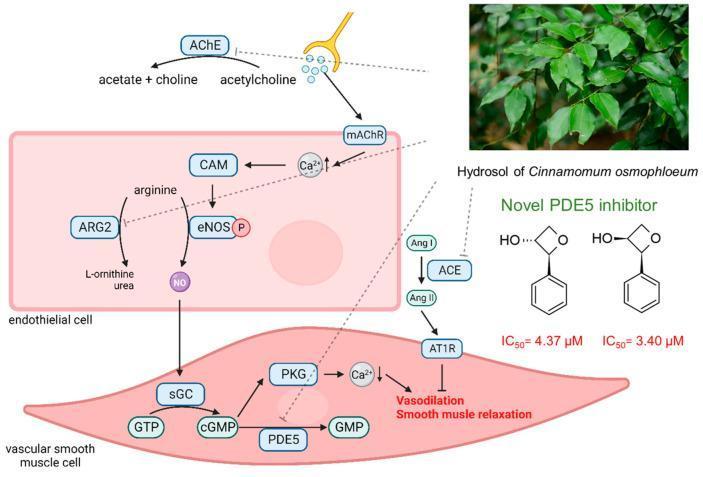
This pathophysiology diagram illustrates the biochemical mechanism by which Cinnamomum osmophloeum hydrosol influences erectile function through multi-pathway enzymatic inhibition within endothelial and vascular smooth muscle cells (VSMCs). The flowchart highlights four primary inhibitory targets: AChE (acetylcholinesterase), which breaks down acetylcholine into acetate and choline; ARG2 (arginase 2), which competes for arginine to produce L-ornithine and urea; ACE (angiotensin-converting enzyme), which converts Angiotensin I to the vasoconstrictor Angiotensin II; and PDE5 (phosphodiesterase type 5), which degrades cGMP. The diagram depicts the positive signaling cascade where acetylcholine activates muscarinic receptors (mAChR), increasing calcium and calmodulin (CAM) to activate phosphorylated eNOS (eNOS-P). This results in nitric oxide (NO) production, which diffuses to VSMCs to stimulate soluble guanylate cyclase (sGC). The sGC converts GTP to cGMP, activating protein kinase G (PKG) and leading to smooth muscle relaxation and vasodilation. Two novel PDE5 inhibitor isomers (trans- and cis-phenyloxetan-3-ol) are shown with their respective IC50 values (4.37 µM and 3.40 µM), demonstrating their structural role in maintaining cGMP levels to treat erectile dysfunction.
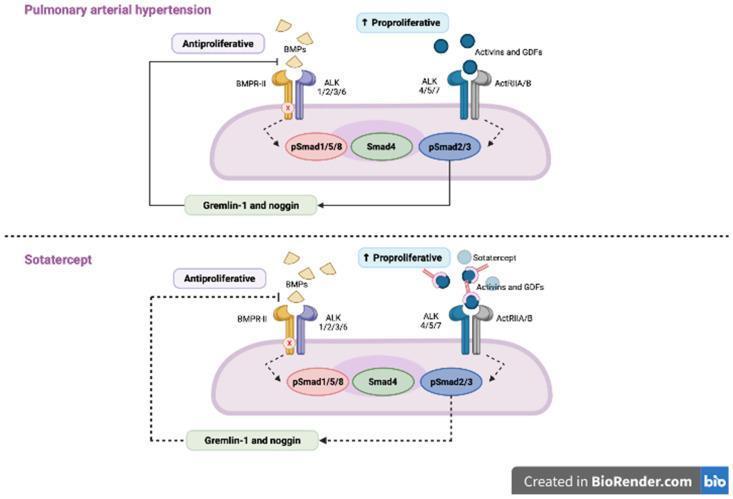
A comparative pathophysiology diagram illustrating the intracellular signaling pathways in pulmonary arterial smooth muscle cells during Pulmonary Arterial Hypertension (PAH) and the restorative effect of Sotatercept treatment. The upper panel depicts the PAH state, characterized by an imbalance between antiproliferative and pro-proliferative signaling. Impaired BMP signaling through BMPR-II/ALK 1/2/3/6 receptors leads to reduced pSmad1/5/8 activity. Concurrently, excessive Activins and GDFs bind to ActRIIA/B and ALK 4/5/7 receptors, upregulating pro-proliferative pSmad2/3 signaling. A feedback loop involving Gremlin-1 and Noggin further inhibits BMP signaling. The lower panel illustrates the mechanism of Sotatercept, a recombinant fusion protein. Sotatercept acts as a ligand trap, binding to Activins and GDFs to prevent their interaction with ActRIIA/B. This intervention suppresses the excessive pro-proliferative Smad2/3 pathway, indicated by dashed lines, thereby rebalancing the TGF-beta superfamily signaling toward an antiproliferative state. The diagram highlights key molecular targets in PAH therapy, including SMAD proteins and the ALK receptor family.
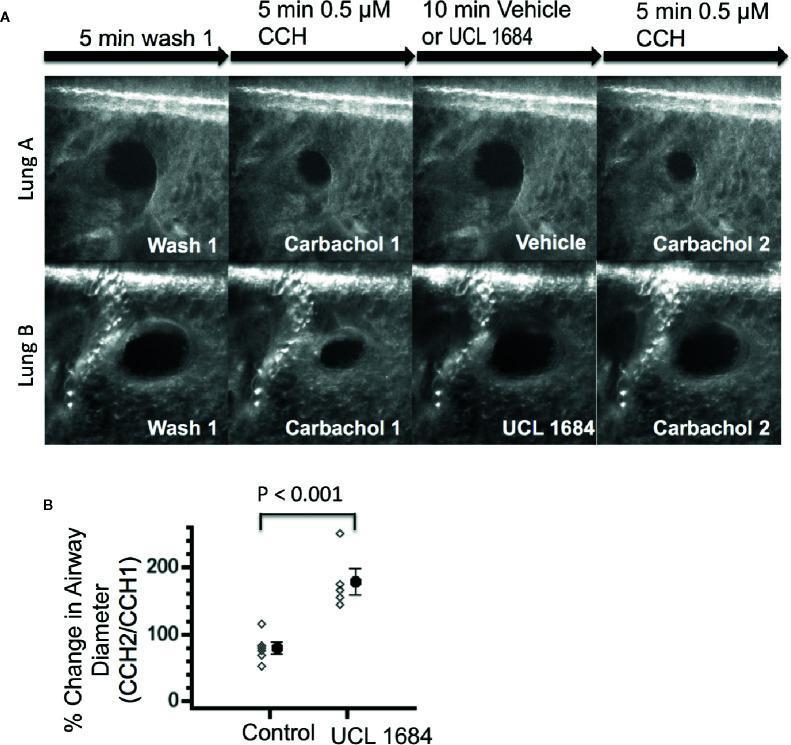
This medical research graphic illustrates the effects of the M3 muscarinic receptor antagonist UCL 1684 on bronchial smooth muscle contractility using mouse lung slices. Panel A presents two rows of phase-contrast or similar medical imaging of precision-cut lung slices (Lung A and Lung B). The sequences demonstrate airway responses to carbachol (CCH), a cholinergic agonist that induces bronchoconstriction. In the control row (Lung A), the airway constricts after CCH exposure and remains narrowed despite vehicle application. In the treatment row (Lung B), the application of UCL 1684 reverses the CCH-induced constriction and effectively prevents subsequent bronchoconstriction during a second CCH challenge, maintaining a dilated bronchial diameter. Panel B shows a quantitative bar graph summarizing the percentage change in airway diameter. It compares the control group to the UCL 1684-treated group, demonstrating a statistically significant difference (P < 0.001) in airway patency. The content focuses on pharmacology, pulmonology, and the physiological mechanisms of M3 muscarinic receptor antagonism in managing airway hyperresponsiveness.
🫄 Step 1 - How the Gut Muscle Works Normally
- Squeezes and relaxes in a wave-like rhythm called peristalsis - this pushes food forward
- It is controlled by the parasympathetic nervous system (the "rest and digest" system)
- The main messenger chemical (neurotransmitter) is Acetylcholine (ACh)
🔌 Step 2 - What are Muscarinic Receptors?
| Receptor | Location | Job |
|---|---|---|
| M3 | Gut smooth muscle | Main one - directly causes muscle to CONTRACT |
| M2 | Gut smooth muscle | Helper - blocks relaxation (so contraction lasts longer) |
⚡ Step 3 - How Cramping/Spasm Happens (Step by Step)
NERVE SIGNAL
     ↓
Nerve releases ACETYLCHOLINE (ACh)
     ↓
ACh binds to M3 receptor on gut muscle cell
     ↓
M3 receptor activates a G-protein (Gq protein)
     ↓
Gq protein activates enzyme → makes IP3 + DAG
     ↓
IP3 opens calcium (Ca²⁺) stores inside the cell
     ↓
Calcium floods into muscle cell + enters from outside
     ↓
Calcium activates myosin (muscle protein)
     ↓
Muscle CONTRACTS strongly
     ↓
Too much contraction = SPASM = CRAMP = PAIN 😣
🔥 Step 4 - Why Does Cramping Cause Pain?
- Blood flow to the area decreases
- The squeezing of the intestinal wall activates pain nerve fibers (nociceptors)
- The colon/gut wall is also stretched from gas/contents building up behind the spasm
- Brain receives the pain signal as crampy, colicky pain (comes and goes in waves)
- IBS (irritable gut - overactive nerve signals)
- Renal colic (ureter spasm around a kidney stone)
- Period pain (uterus muscle spasm)
💊 Step 5 - How Buscopan (Hyoscine) Stops the Cramp
Buscopan occupies M3 receptor
     ↓
Acetylcholine CANNOT bind anymore
     ↓
NO signal sent to muscle
     ↓
Calcium does NOT flood in
     ↓
Muscle RELAXES
     ↓
Cramp stops → Pain goes away ✅
🧠 Easy Summary Table
| Step | What Happens |
|---|---|
| 1 | Nerve releases acetylcholine |
| 2 | ACh binds M3 receptor on gut muscle |
| 3 | Calcium floods into muscle cell |
| 4 | Muscle contracts strongly = CRAMP |
| 5 | Buscopan blocks M3 receptor |
| 6 | No calcium entry = muscle relaxes = pain gone |
How cramps cause in muscle of gur and work muscarine receptors
🫄 How Gut Cramps Happen - Super Simple Version
The Gut is a Muscle Tube
The Nerve Controls the Muscle
Muscarinic Receptors - The "ON Switch"
ACh presses M3 receptor button
        ↓
Signal goes inside the cell
        ↓
Calcium (Ca²⁺) rushes into the muscle cell
        ↓
Muscle CONTRACTS (squeezes)
When it Becomes a CRAMP
- The nerve fires too much
- Or the gut is irritated (infection, IBS, gas, kidney stone pressing on ureter)
- Too much acetylcholine is released
- M3 receptors are over-stimulated
- Muscle contracts too hard, too long - this is a SPASM
The Two Key Receptors in the Gut
| Receptor | Role |
|---|---|
| M3 | Main one - directly tells muscle to CONTRACT |
| M2 | Helper - blocks relaxation so cramp LASTS LONGER |
How Buscopan Fixes It
Buscopan blocks M3 button
        ↓
ACh cannot bind
        ↓
No calcium enters muscle
        ↓
Muscle RELAXES
        ↓
Cramp STOPS ✅
🧠 One Line Summary
Nerve releases ACh → ACh hits M3 receptor → Calcium enters muscle → Muscle over-contracts → CRAMP. Buscopan blocks M3 → no cramp.
Vancomycin mechanism of it and indications contraindications how to give how munch dilute
vancomycin dilution infusion rate preparation IV administration guidelines
💊 What is Vancomycin?
⚙️ Mechanism - How it Kills Bacteria (Easy Words)
Vancomycin enters the bacterial cell wall area
        ↓
It GRABS and BINDS tightly to D-Ala-D-Ala units
        ↓
The building blocks of the cell wall are BLOCKED
        ↓
Bacteria CANNOT build or repair its cell wall
        ↓
Cell wall becomes WEAK and BREAKS
        ↓
Bacteria DIES 💀
Source: Jawetz Medical Microbiology - "Vancomycin interferes with cell wall synthesis by interacting with the D-alanyl-D-alanine (D-Ala-D-Ala) group of the pentapeptide chains of peptidoglycan precursors."
✅ Indications - When to Use It
| Indication | Route |
|---|---|
| MRSA infections (skin, blood, bone, lung) | IV |
| Infective endocarditis (heart valve infection) due to staph/strep | IV |
| Septicemia (blood poisoning) by gram-positive bacteria | IV |
| Meningitis (with cefotaxime for pneumococcus) | IV |
| Pneumonia due to MRSA | IV |
| Osteomyelitis (bone infection) by MRSA | IV |
| Clostridium difficile (C. diff) colitis - severe/recurrent | ORAL only |
| Surgical prophylaxis in penicillin-allergic patients | IV |
| Febrile neutropenia with suspected gram-positive source | IV |
| Dialysis patients with catheter infections | IV |
Remember: Vancomycin only works on GRAM-POSITIVE bacteria. It does NOT work on gram-negative bacteria.
🚫 Contraindications - When NOT to Use
| Contraindication | Reason |
|---|---|
| Known hypersensitivity/allergy to vancomycin | Anaphylaxis risk |
| Severe renal failure (without dose adjustment) | Drug accumulates, causes more kidney damage |
| Hearing impairment (use with extreme caution) | Can worsen deafness (ototoxicity) |
| Avoid rapid IV push | Causes Red Man Syndrome (see below) |
| Do NOT mix with other IV drugs in same line | Precipitation occurs |
💉 How to Give Vancomycin - Step by Step
Step 1 - Reconstitution (Dissolving the powder)
- Add 10 mL sterile water to 500 mg vial → gives 50 mg/mL solution
- Add 20 mL sterile water to 1 g vial → gives 50 mg/mL solution
Step 2 - Dilution (MUST dilute further before giving!)
| Dose | Dilute in | Minimum infusion time |
|---|---|---|
| 500 mg | 100-250 mL NS or D5W | 60 minutes |
| 750 mg | 250 mL NS or D5W | 90 minutes |
| 1 g | 250 mL NS or D5W | 60-120 minutes |
| 1.25 g | 250 mL NS or D5W | 90 minutes |
| 1.5 g | 500 mL NS or D5W | 90 minutes |
| 2 g | 500 mL NS or D5W | 120 minutes |
Step 3 - Administration Rules
- Max concentration: 5 mg/mL via peripheral IV line
- Max concentration: 10 mg/mL via central line only
- Max infusion rate: 10 mg/minute (NEVER faster!)
- Diluent: Normal saline (NS 0.9%) or Dextrose 5% (D5W)
- Monitor the IV site every 30 min - watch for redness/swelling (phlebitis)
- Consider central line for long-term therapy
📏 Normal Dose
| Patient | Dose | Frequency |
|---|---|---|
| Adults (normal renal function) | 15-20 mg/kg (usually 500 mg - 1 g) | Every 6-12 hours |
| Serious infections (MRSA) | 25-30 mg/kg loading dose, then 15-20 mg/kg | Every 8-12 hours |
| Children | 10-15 mg/kg | Every 6 hours |
| C. diff (oral) | 125 mg orally | Every 6 hours x 10 days |
| Renal impairment | Dose REDUCED and interval INCREASED | Monitor levels |
Monitor vancomycin blood levels (trough levels) especially in renal patients to avoid toxicity.
⚠️ Major Side Effects
1. 🔴 Red Man Syndrome (Most Common)
- NOT an allergy - caused by too fast infusion
- Symptoms: flushing, red rash on face/neck/chest, itching, low blood pressure
- Prevention: Always infuse slowly (over 60-120 mins), give antihistamine before if history
- Treatment: Slow down or stop infusion, give antihistamine (diphenhydramine)
2. 🫘 Nephrotoxicity (Kidney Damage)
- Especially when combined with aminoglycosides (gentamicin)
- Monitor creatinine and urine output regularly
3. 👂 Ototoxicity (Ear/Hearing Damage)
- Can cause hearing loss or tinnitus (ringing in ears)
- More common with high doses and kidney impairment
- Mostly reversible if caught early
4. Other
- Thrombophlebitis (vein inflammation at injection site)
- Leukopenia (low white cells with prolonged use)
🧠 Quick Memory Summary
| Feature | Detail |
|---|---|
| Drug class | Glycopeptide antibiotic |
| Kills | Gram-POSITIVE bacteria only |
| Mechanism | Blocks D-Ala-D-Ala → stops cell wall building |
| Main use | MRSA, endocarditis, C. diff (oral) |
| IV dose | 15-20 mg/kg every 8-12 hrs |
| Dilution | 5 mg/mL max (peripheral), 10 mg/mL (central) |
| Infusion rate | NEVER faster than 10 mg/min |
| 1g dose | Dilute in 250 mL, infuse over 60-120 min |
| Main danger | Red Man Syndrome (fast infusion), kidney damage |
| Monitor | Blood levels (trough), kidney function, hearing |