
ABG analysis from basic to clinical.
Reading File
Now let me search the library for ABG analysis content in parallel:
Finding Sources
Finding Sources
Finding Sources
Excellent finds. Now let me read the most comprehensive sources in parallel:
Reading File
Reading File
Reading File
Reading File
Good content coming in. Let me now fetch the acid-base nomogram image and read more detailed content including compensation formulas and clinical approach:
Loading Image
Reading File
Reading File
Let me get the stepwise approach flowchart and the compensation formulas from Harrison's:
Loading Image
Reading File
Reading File
I now have the key images and content. Let me read the Harrison's compensation formulas table and the oxygenation parameters:
Reading File
Finding Sources
I now have comprehensive content from multiple authoritative sources. Let me read the oxygenation parameters and the delta-delta ratio:
Finding Sources
Finding Sources
Reading File
Reading File
Reading File
I now have all the content needed for a comprehensive, well-organized response. Let me compile everything into a thorough ABG analysis guide.
Arterial Blood Gas (ABG) Analysis: Basic to Clinical
1. What Is an ABG?
An ABG is a blood sample drawn from an artery (typically the radial artery) that reports the partial pressures of oxygen and carbon dioxide, the direct serum pH, and a calculated bicarbonate. Modern analyzers also report lactate, total hemoglobin, and electrolytes.
"An arterial blood sample is the reference standard for pH, oxygen, carbon dioxide, and lactate content providing a description of the oxygen and carbon dioxide content of the blood after leaving the pulmonary circulation and before any gas exchange in the peripheral tissues has occurred."
- Tintinalli's Emergency Medicine
2. Normal Reference Values
| Parameter | Normal Value |
|---|---|
| pH | 7.35 - 7.45 |
| PaO₂ | 80 - 100 mmHg (room air) |
| PaCO₂ | 35 - 45 mmHg |
| HCO₃⁻ | 22 - 26 mEq/L |
| SaO₂ | ≥ 95% |
| Base excess (BE) | -2 to +2 mEq/L |
3. Basic Physiology: The Henderson-Hasselbalch Equation
The arterial pH is governed by the ratio of bicarbonate to dissolved CO₂:
pH = 6.1 + log₁₀ ( [HCO₃⁻] / [0.03 × PaCO₂] )
This reveals the two systems controlling pH:
- Respiratory system controls PaCO₂ (lungs)
- Renal system controls HCO₃⁻ (kidneys)
The fundamental equilibrium is:
CO₂ + H₂O ⇌ H₂CO₃ ⇌ HCO₃⁻ + H⁺
- Increased PaCO₂ → pushes reaction right → more H⁺ → pH falls (respiratory acidosis)
- Decreased PaCO₂ → pushes reaction left → less H⁺ → pH rises (respiratory alkalosis)
- Decreased HCO₃⁻ → more H⁺ generated → pH falls (metabolic acidosis)
- Increased HCO₃⁻ → H⁺ consumed → pH rises (metabolic alkalosis)
Medical Physiology (Boron): Protons are present in exceedingly low concentrations, yet have a major impact on biochemical reactions because pH-sensitive molecules include enzymes, receptors, ion channels, and structural proteins.
4. The 7-Step Systematic Approach
Use this stepwise approach every time - it prevents errors and catches mixed disorders.
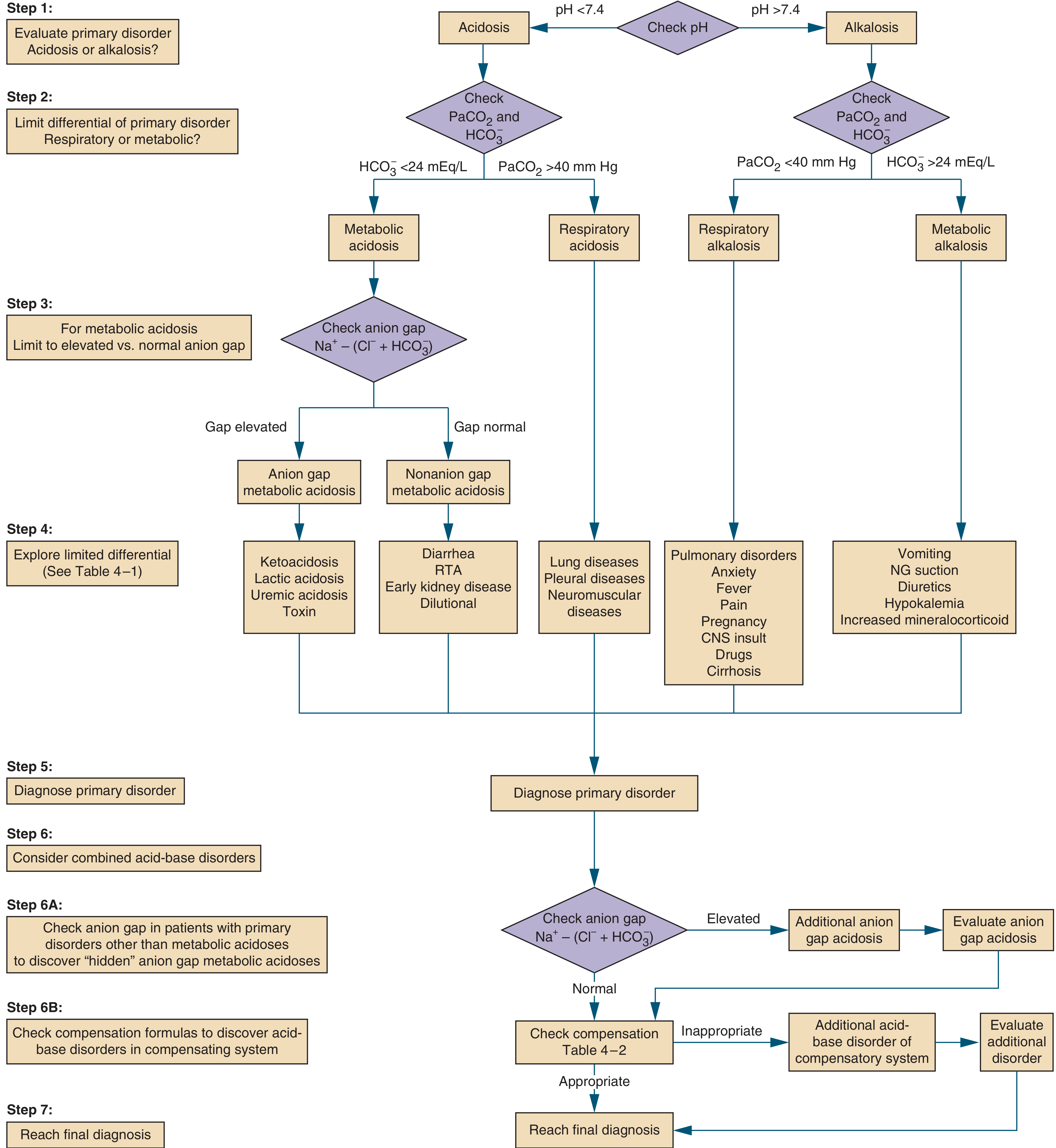
Step 1: Is it Acidosis or Alkalosis?
Check pH:
- pH < 7.35 = Acidemia (primary process is an acidosis)
- pH > 7.45 = Alkalemia (primary process is an alkalosis)
- pH 7.35-7.45 = Can still have a primary disorder with full compensation, or a mixed disorder
Step 2: Is It Respiratory or Metabolic?
Check PaCO₂ and HCO₃⁻:
| pH | PaCO₂ | HCO₃⁻ | Primary Disorder |
|---|---|---|---|
| Low | High (>40) | High (compensation) | Respiratory acidosis |
| Low | Low (compensation) | Low (<24) | Metabolic acidosis |
| High | Low (<40) | Low (compensation) | Respiratory alkalosis |
| High | High (compensation) | High (>24) | Metabolic alkalosis |
Key rule: Whatever matches the pH direction is the primary disorder.
Step 3: Anion Gap (for Metabolic Acidosis)
Anion Gap (AG) = Na⁺ - (Cl⁻ + HCO₃⁻)
Normal = 12 ± 4 mEq/L (some labs use 7-9 mEq/L depending on method)
"An elevated anion gap suggests one of those processes is the cause of the metabolic acidosis. Processes that lose HCO₃⁻ do not generate unmeasured anions and the anion gap remains normal." - Symptom to Diagnosis, 4th Ed.
Important: Always correct the AG for albumin:
- Corrected AG = Measured AG + 2.5 × (4.0 - measured albumin)
- For every 1 g/dL drop in albumin, the AG falls ~2.5 mEq/L
High Anion Gap Metabolic Acidosis (HAGMA) - Mnemonics:
MUDPILES or GOLD MARK:
- Methanol
- Uremia
- Diabetic ketoacidosis (DKA)
- Propylene glycol / Paracetamol
- Isoniazid / Iron
- Lactic acidosis
- Ethylene glycol
- Salicylates
Normal Anion Gap Metabolic Acidosis (NAGMA) - "HARD UP":
- Hyperchloremia
- Adrenal insufficiency
- Renal tubular acidosis (RTA)
- Diarrhea (bicarbonate loss from gut)
- Ureterodiversion
- Pancreatic fistula
Step 4: Check Compensation (Are the Compensatory Responses Appropriate?)
Compensation never fully normalizes pH (except chronic respiratory alkalosis). If compensation is inappropriate, a second primary disorder co-exists.
Compensation Formulas (from Harrison's Principles, 22nd Ed.):
| Primary Disorder | Expected Compensation |
|---|---|
| Metabolic acidosis | PaCO₂ = (1.5 × HCO₃⁻) + 8 ± 2 (Winter's equation) |
| Metabolic alkalosis | PaCO₂ increases 0.7 mmHg per 1 mEq/L rise in HCO₃⁻ (or: PaCO₂ = 40 + 0.7 × [HCO₃⁻ - 24] ± 5) |
| Acute respiratory acidosis | HCO₃⁻ rises 1 mEq/L per 10 mmHg rise in PaCO₂ |
| Chronic respiratory acidosis | HCO₃⁻ rises 3.5 mEq/L per 10 mmHg rise in PaCO₂ |
| Acute respiratory alkalosis | HCO₃⁻ falls 2 mEq/L per 10 mmHg fall in PaCO₂ |
| Chronic respiratory alkalosis | HCO₃⁻ falls 4-5 mEq/L per 10 mmHg fall in PaCO₂ |
Clinical Interpretation of Winter's formula:
- Measured PaCO₂ = predicted → appropriate compensation only; simple metabolic acidosis
- Measured PaCO₂ > predicted → concurrent respiratory acidosis
- Measured PaCO₂ < predicted → concurrent respiratory alkalosis
Step 5: Delta-Delta Ratio (Δ/Δ) - for High AG Metabolic Acidosis
This checks whether a concurrent metabolic alkalosis or non-AG metabolic acidosis is hiding behind the anion gap acidosis.
Δ/Δ = (Measured AG - 12) / (24 - Measured HCO₃⁻)
| Δ/Δ Ratio | Interpretation |
|---|---|
| < 1 | Concurrent non-AG metabolic acidosis (gap doesn't account for all the HCO₃⁻ fall) |
| 1 - 2 | Pure HAGMA |
| > 2 | Concurrent metabolic alkalosis or compensated chronic respiratory acidosis |
Step 6: Assess Oxygenation
A-a Gradient (Alveolar-Arterial Oxygen Gradient)
PAO₂ = [FiO₂ × (Patm - PH₂O)] - (PaCO₂ / 0.8)
At sea level on room air:
- Patm = 760 mmHg, PH₂O = 47 mmHg, FiO₂ = 0.21
- PAO₂ ≈ 150 - (PaCO₂ / 0.8)
P(A-a)O₂ = PAO₂ - PaO₂
Normal A-a gradient:
- Young adult: < 10-15 mmHg
- Age-adjusted: age/4 + 4 mmHg
Elevated A-a gradient suggests V/Q mismatch, shunt, or diffusion defect (NOT simple hypoventilation alone).
PaO₂/FiO₂ Ratio (P/F Ratio)
P/F = PaO₂ / FiO₂
| P/F Ratio | Clinical Significance |
|---|---|
| > 400 | Normal |
| 200-300 | Mild ARDS |
| 100-200 | Moderate ARDS |
| < 100 | Severe ARDS |
"A healthy person on 40% oxygen would be expected to have a ratio of approximately 600, representing a normal physiologic shunt of approximately 5%. As the shunt increases, the ratio decreases." - Tintinalli's Emergency Medicine
Step 7: Reach Final Diagnosis
Integrate all findings. Consider the clinical context. Now refer to the acid-base nomogram:
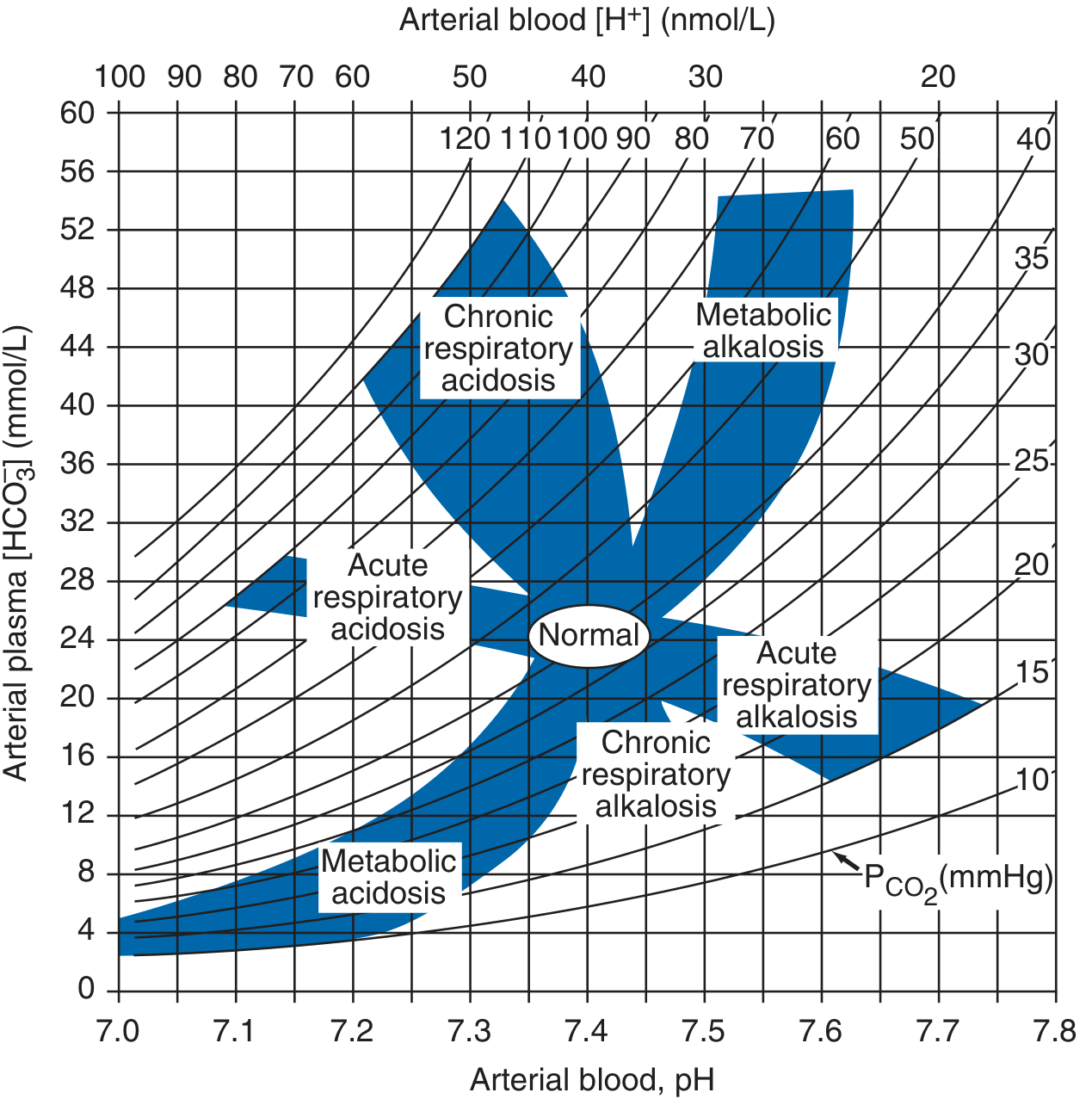
5. The Four Primary Disorders - Details
Metabolic Acidosis
Definition: Primary HCO₃⁻ fall (< 22 mEq/L), leading to low pH.
Causes:
- HAGMA: Lactic acidosis (sepsis, shock, ischemia), DKA, uremia, toxins
- NAGMA: Diarrhea, RTA types 1/2/4, saline infusion (dilutional), early CKD
Compensation: Kussmaul breathing (deep, rapid breathing = hyperventilation), driven by medullary chemoreceptors. Use Winter's formula to verify.
Urine Anion Gap (for NAGMA): = Na⁺ + K⁺ - Cl⁻ (urine)
- Negative (< 0): GI loss of HCO₃⁻ (diarrhea) - kidneys working normally
- Positive (> 0): Renal loss - suggests RTA or renal insufficiency
Metabolic Alkalosis
Definition: Primary HCO₃⁻ rise (> 26 mEq/L), leading to high pH.
Causes:
- Chloride-responsive (urine Cl⁻ < 25 mEq/L): Vomiting, NG suction, diuretics, post-hypercapnia
- Chloride-resistant (urine Cl⁻ > 25 mEq/L): Hyperaldosteronism, Cushing's, hypokalemia, increased mineralocorticoids, Bartter/Gitelman syndrome
Compensation: Hypoventilation (CO₂ retention). Expected PaCO₂ = 40 + 0.7 × (HCO₃⁻ - 24).
"Metabolic alkalosis is the most common acid-base disorder in hospitalized patients." - Harrison's Principles
Respiratory Acidosis
Definition: Primary PaCO₂ rise (> 45 mmHg) due to hypoventilation.
Causes:
- CNS depression (opioids, sedatives, stroke)
- Neuromuscular disorders (GBS, MG, ALS)
- Obstructive lung disease (COPD, severe asthma)
- Thoracic cage abnormalities
- Obesity hypoventilation
- Pneumothorax / pleural effusion
Compensation (renal):
- Acute: HCO₃⁻ ↑ 1 mEq/L per 10 mmHg ↑ PaCO₂
- Chronic: HCO₃⁻ ↑ 3.5 mEq/L per 10 mmHg ↑ PaCO₂ (takes 3-5 days)
"Respiratory acidosis incurs some beneficial effects: increased catecholamine release leading to increased cardiac output; it shifts the oxygen dissociation curve of hemoglobin to the right (Bohr effect), which increases oxygen unloading to the tissues." - Barash Clinical Anesthesia, 9th Ed.
Respiratory Alkalosis
Definition: Primary PaCO₂ fall (< 35 mmHg) due to hyperventilation.
Causes:
- Hypoxemia (high altitude, pulmonary embolism, pneumonia)
- Anxiety, pain, fever
- Pregnancy (progesterone stimulates respiration)
- Liver failure (cirrhosis)
- CNS insults (meningitis, stroke, tumor)
- Drugs (salicylates - early phase)
- Mechanical ventilation (iatrogenic)
Compensation (renal):
- Acute: HCO₃⁻ ↓ 2 mEq/L per 10 mmHg ↓ PaCO₂
- Chronic: HCO₃⁻ ↓ 4-5 mEq/L per 10 mmHg ↓ PaCO₂ (may normalize pH)
6. Mixed Acid-Base Disorders
Mixed disorders are two or more independent primary disorders occurring simultaneously (not just compensation). These are common in critically ill patients.
"The diagnosis of mixed acid-base disorders requires consideration of the anion gap... Changes in PaCO₂ and [HCO₃⁻] in opposite directions indicate a mixed acid-base disturbance." - Harrison's Principles, 22nd Ed.
Common clinically important mixed disorders:
| Mixed Disorder | Key Clue | Example |
|---|---|---|
| Metabolic acidosis + respiratory alkalosis | PaCO₂ below predicted (Winter's) | Sepsis, salicylate toxicity |
| Metabolic acidosis + respiratory acidosis | PaCO₂ above predicted | Cardiorespiratory arrest |
| Metabolic acidosis + metabolic alkalosis | Near-normal pH with AG; Δ/Δ > 2 | DKA with vomiting |
| Metabolic alkalosis + respiratory acidosis | PaCO₂ above predicted | COPD + diuretics |
| Metabolic alkalosis + respiratory alkalosis | Markedly high pH | Liver failure + NG suction |
7. Venous vs. Arterial Blood Gas
| Parameter | Arterial | Venous (peripheral) | Venous (central) |
|---|---|---|---|
| pH | Reference standard | ~0.05 lower | ~0.03 lower |
| PaCO₂ | Reference | Up to ±20 mmHg | ~5 mmHg higher |
| HCO₃⁻ | Reference | Close correlation | Close correlation |
| PaO₂ / O₂ saturation | Required for oxygenation | Cannot use | Cannot use |
"Normal venous carbon dioxide is predictive of normal PaCO₂; however, the clinical outcomes of substituting venous carbon dioxide for evaluation of hypercarbia have not been described." - Tintinalli's Emergency Medicine
Bottom line: VBG is acceptable for pH and CO₂ monitoring. ABG is mandatory for oxygenation assessment.
8. Worked Clinical Example (DKA)
Values: Na⁺ 138, K⁺ 6.2, HCO₃⁻ 6, Cl⁻ 100, glucose 389 mg/dL, pH 7.18, PaCO₂ 20 mmHg
| Step | Action | Result |
|---|---|---|
| 1. pH | 7.18 | Acidemia |
| 2. HCO₃⁻ vs PaCO₂ | HCO₃⁻ low (6) with acidemia | Metabolic acidosis (PaCO₂ low = compensation) |
| 3. Anion gap | 138 - (6+100) = 32 (normal ~12) | High AG metabolic acidosis |
| 4. Winter's formula | Expected PaCO₂ = 1.5×6 + 8 ± 2 = 17-19 mmHg | Measured PaCO₂ = 20; slightly above range = borderline; appropriate compensation |
| 5. Δ/Δ | (32-12) / (24-6) = 20/18 = 1.1 | Pure HAGMA |
| 6. Diagnosis | DKA (type 1 DM history, glucose 389, HAGMA, appropriate compensation) | High AG metabolic acidosis due to DKA |
9. Quick Reference Summary Table
| Disorder | pH | PaCO₂ | HCO₃⁻ |
|---|---|---|---|
| Metabolic acidosis | ↓ | ↓ (compensation) | ↓ (primary) |
| Metabolic alkalosis | ↑ | ↑ (compensation) | ↑ (primary) |
| Respiratory acidosis | ↓ | ↑ (primary) | ↑ (compensation) |
| Respiratory alkalosis | ↑ | ↓ (primary) | ↓ (compensation) |
Sources
- Harrison's Principles of Internal Medicine, 22nd Edition (2025) - Chapter 58: Acidosis and Alkalosis
- Tintinalli's Emergency Medicine: A Comprehensive Study Guide - ABG Analysis, Alveolar Gas Exchange
- Symptom to Diagnosis: An Evidence-Based Guide, 4th Ed. - Stepwise Acid-Base Approach
- Barash, Cullen & Stoelting's Clinical Anesthesia, 9th Ed. - ABG Interpretation table, Delta-Delta
- Medical Physiology (Boron & Boulpaep) - Acid-Base Physiology chapter
- Comprehensive Clinical Nephrology, 7th Ed. - Mixed Acid-Base Disorders
This is a shared conversation. Sign in to Orris to start your own chat.