
Synapse and there types
A synapse is a junction where a neuron communicates with another neuron, muscle cell, or gland cell. There are two main types: electrical synapses (gap junctions, fast and bidirectional) and chemical synapses (use neurotransmitters, slower but more versatile). Chemical synapses can be further divided by location (axodendritic, axosomatic, axoaxonic) and by the neurotransmitter used (glutamatergic, GABAergic, cholinergic, etc.).
Searching sources...
Reading File
Finding Sources
Searching the Web
types of synapses electrical chemical classification neuroscience
Reading File
Reading File
Reading File
Finding Sources
Reading File
Reading File
Now let me fetch the key synapse diagrams:
Loading Image
Loading Image
Loading Image
I now have comprehensive textbook content and diagrams. Here is the full answer:
The Synapse and Its Types
A synapse is a specialized junction where a neuron communicates with a target cell - another neuron, a muscle fiber, or a gland cell. The word comes from the Greek synapsis meaning "conjunction." Each synapse has two sides: the presynaptic terminal (the sending end, usually an axon terminal) and the postsynaptic membrane (the receiving end), separated by a narrow gap called the synaptic cleft.
Broad Classification: Two Main Types
1. Chemical Synapse
The most common type in the nervous system. Signal transmission involves a chemical messenger (neurotransmitter).
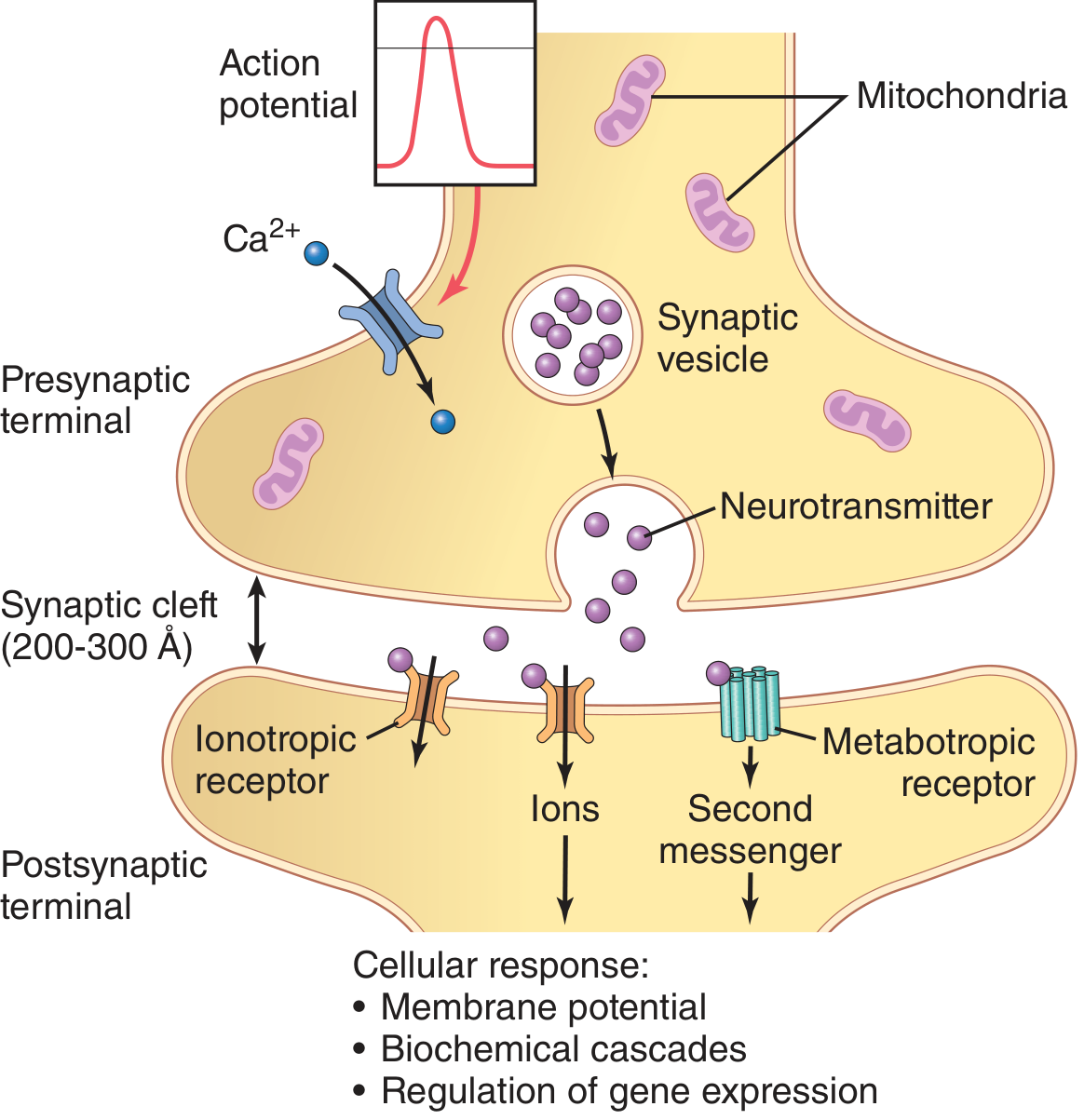
How it works:
- An action potential arrives at the presynaptic terminal
- Voltage-gated Ca²+ channels open; Ca²+ flows in
- Ca²+ triggers SNARE proteins to fuse synaptic vesicles with the presynaptic membrane
- Neurotransmitter is released into the synaptic cleft (200-300 Å wide)
- Neurotransmitter binds to postsynaptic receptors (ionotropic or metabotropic)
- This generates an electrical response in the postsynaptic cell
Key features:
- One-way (unidirectional) transmission only
- Has a synaptic delay (~0.5 ms) due to the chemical steps
- Highly amplifiable and modifiable (basis of learning and memory)
- Can be excitatory or inhibitory
2. Electrical Synapse
Less common; uses direct ionic coupling through gap junctions.
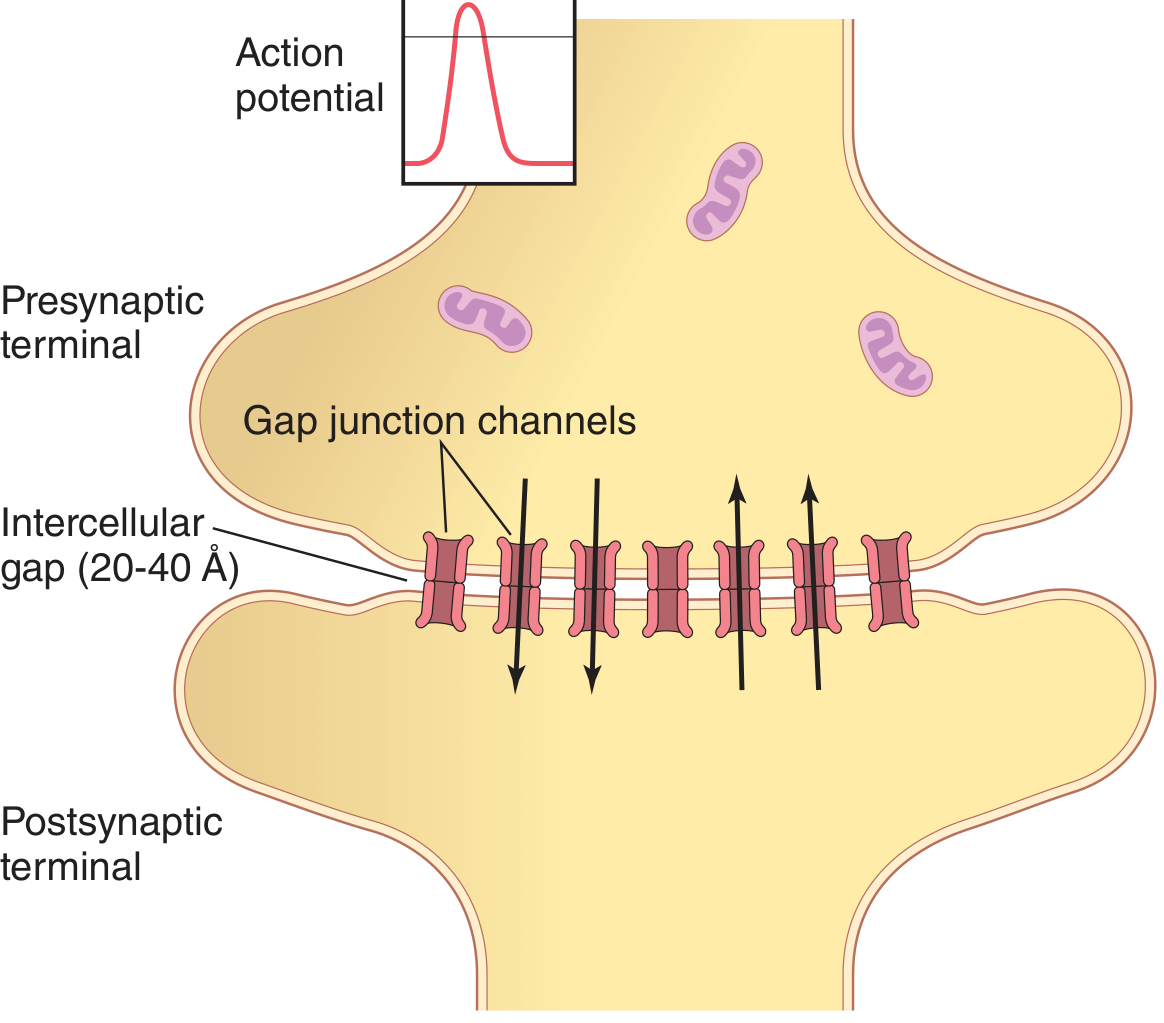
How it works:
- The pre- and postsynaptic membranes are linked by connexin proteins forming gap junctions
- Ions flow directly between the two cells through pores
- The intercellular gap is only 20-40 Å (compared to 200-300 Å at chemical synapses)
Key features:
- Usually bidirectional transmission
- Virtually no synaptic delay - almost instantaneous
- Synchronizes groups of neurons (e.g., hypothalamic hormone-secreting neurons fire together)
- Less versatile than chemical synapses
- Found in cardiac muscle, smooth muscle, and certain CNS neurons
| Feature | Chemical Synapse | Electrical Synapse |
|---|---|---|
| Cleft width | 200-300 Å | 20-40 Å |
| Direction | One-way | Bidirectional |
| Delay | ~0.5 ms | Near zero |
| Mechanism | Neurotransmitters | Gap junctions (connexins) |
| Modifiability | High | Low |
| Effect | Excitatory or inhibitory | Usually excitatory |
Classification by Location (Morphological Types)
Based on where the axon terminal contacts the postsynaptic neuron:
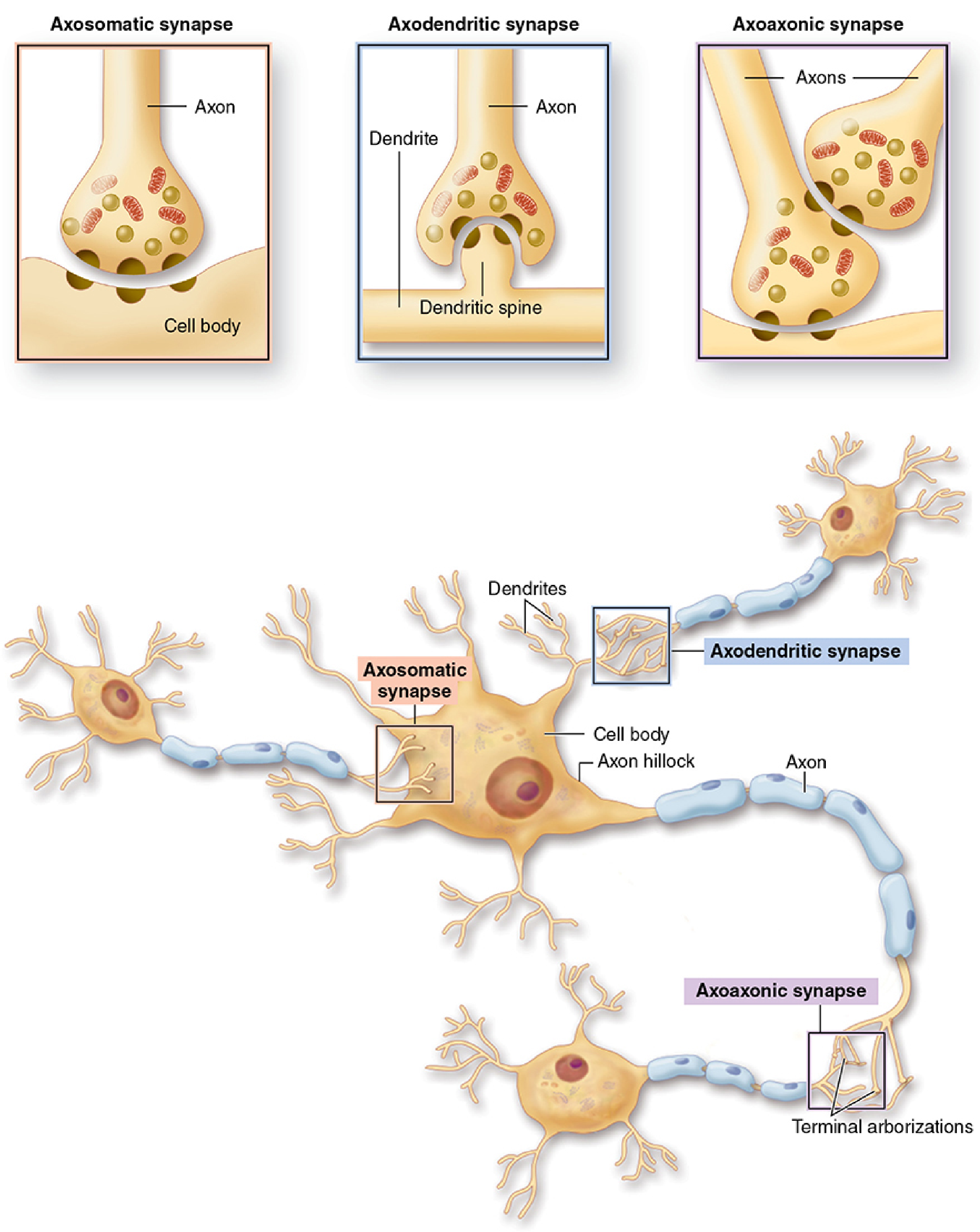
1. Axodendritic Synapse
- Axon terminal synapses onto a dendrite or dendritic spine
- Most common type in the CNS
- Usually excitatory
- About 80-95% of all synaptic contacts on a motor neuron are on dendrites
2. Axosomatic Synapse
- Axon terminal synapses onto the cell body (soma) of the postsynaptic neuron
- Makes up 5-20% of contacts on a motor neuron
- Frequently inhibitory (close to the axon hillock, where action potentials are generated)
3. Axoaxonic Synapse
- Axon terminal synapses onto another axon (usually near its terminal)
- Functions to modulate the output of the other synapse - can increase (presynaptic facilitation) or decrease (presynaptic inhibition) neurotransmitter release
4. Dendrodendritic Synapse
- Dendrite-to-dendrite contact
- Found in specialized areas like the olfactory bulb
- Can be bidirectional
Classification by Function
| Type | Effect | Example Neurotransmitter |
|---|---|---|
| Excitatory | Depolarizes postsynaptic cell (EPSP) | Glutamate, Acetylcholine |
| Inhibitory | Hyperpolarizes postsynaptic cell (IPSP) | GABA, Glycine |
Classification by Neurotransmitter Used
- Cholinergic - uses acetylcholine (ACh); at neuromuscular junctions and CNS
- Glutamatergic - uses glutamate; most common excitatory synapse in brain; important in learning and memory
- GABAergic - uses GABA; most common inhibitory synapse in brain
- Glycinergic - uses glycine; inhibitory, especially in spinal cord and brainstem
- Dopaminergic - uses dopamine; reward pathways, motor control
- Serotonergic - uses serotonin (5-HT); mood, sleep regulation
- Adrenergic - uses norepinephrine; autonomic and CNS functions
Gray's Classification (Ultrastructural)
Based on electron microscopy appearance of the synaptic membrane differentiations:
| Type | Appearance | Function |
|---|---|---|
| Gray's Type 1 (Asymmetrical) | Postsynaptic membrane thicker than presynaptic | Usually excitatory |
| Gray's Type 2 (Symmetrical) | Both membranes of similar thickness | Usually inhibitory |
The Neuromuscular Junction (NMJ)
A specialized type of chemical synapse where motor neuron axons synapse on skeletal muscle fibers. The postsynaptic region is a highly folded motor end plate, and the neurotransmitter is acetylcholine acting on nicotinic receptors. It is the prototype synapse studied in pharmacology due to the number of drugs that act there (e.g., curare, neostigmine, succinylcholine).
Sources: Guyton and Hall Textbook of Medical Physiology; Neuroscience: Exploring the Brain, 5th Ed.; Junqueira's Basic Histology, 17th Ed.
This is a shared conversation. Sign in to Orris to start your own chat.