
Centipede bite management
I'll start by reading the medical library skill, then search for centipede bite management information.
Quick answer: Centipede bites cause local pain, swelling, and erythema. Management is largely supportive - wound cleaning, local analgesia (heat application or local anesthetic), antihistamines for pruritus, and tetanus prophylaxis. Systemic reactions are rare but can include anaphylaxis.
Searching sources...
Reading File
Now I'll run parallel searches across the library and PubMed simultaneously.
Finding Sources
Finding Sources
Searching PubMed
centipede envenomation management
Searching Images
centipede bite wound clinical appearance
Excellent - I found dedicated sections in multiple textbooks. Let me read them all in parallel.
Reading File
Reading File
Reading File
Reading File
I now have rich content from four major textbooks plus PubMed data. Let me also quickly fetch the centipede bite image from Andrews' and check for a figure.
Finding Sources
Searching the Web
centipede bite management 2025 guidelines treatment hot water immersion
I now have the centipede bite image URL from Andrews'. Let me fetch it.
Loading Image
I now have comprehensive information from four major textbooks plus PubMed and web sources. Here is the full synthesized answer:
Centipede Bite Management
Background
Centipedes (class Chilopoda) have one pair of legs per body segment and are fast-moving, aggressive carnivores. They inject venom through ducts in their modified front legs (forcipules/fangs), not true jaws. The genus Scolopendra is medically most important and found worldwide - including S. subspinipes (Vietnamese/giant centipede, now popular as a pet), S. heros (giant desert centipede, SW United States), and various tropical species. Centipede bites account for approximately 17% of all envenomations in some tropical/subtropical regions.
Clinical Presentation
Local Features (present in up to 96% of patients)
| Feature | Details |
|---|---|
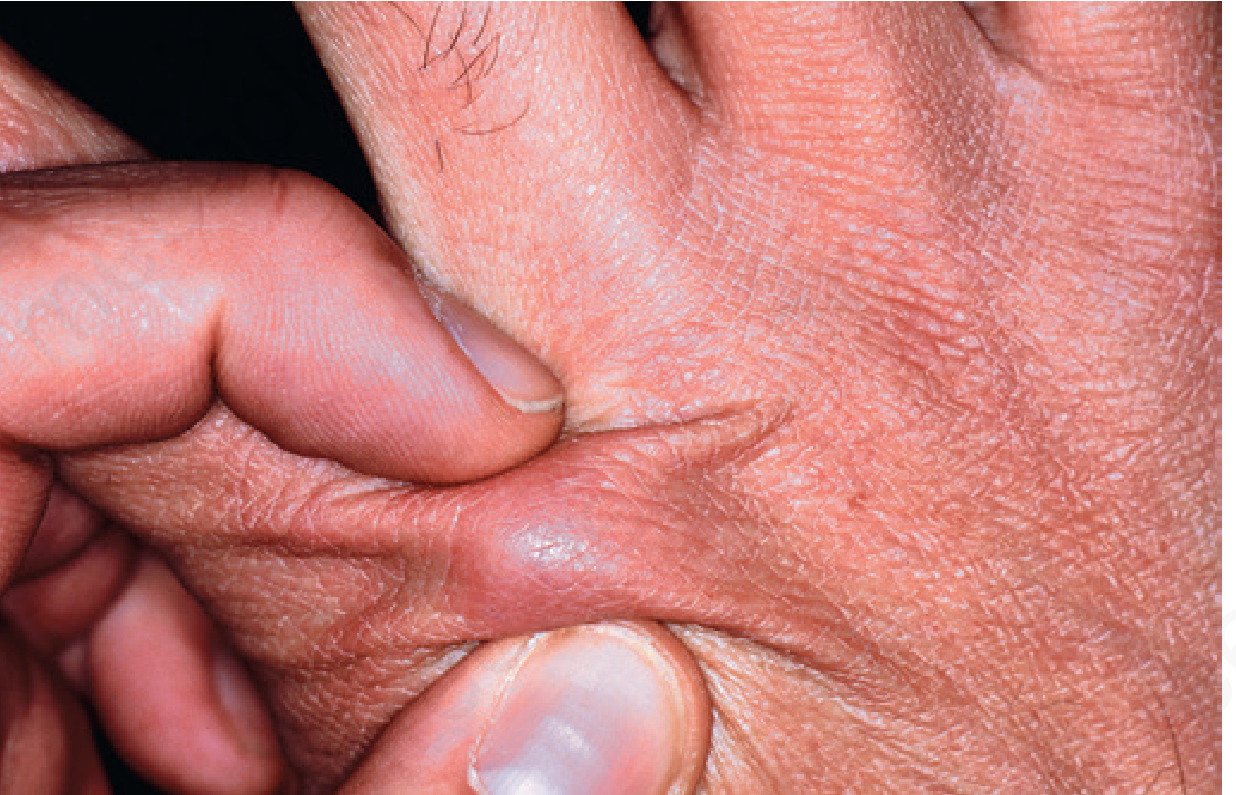
| Wound morphology | Paired hemorrhagic puncture marks in a chevron (V) shape - pathognomonic |
| Pain | Intense burning, immediate onset |
| Swelling | Erythematous swelling progressing to brawny edema |
| Lymphangitis | Sterile lymphangitis may develop |
| Pruritus | Local itching common |
| Paresthesia | Numbness/tingling at bite site |
| Bleeding | Bites can bleed profusely |
Systemic Features (uncommon)
- Dizziness, nausea, anxiety
- Localized sweating
- Wells syndrome (eosinophilic cellulitis) - rare
Serious/Rare Systemic Complications
These are reported mainly with large Scolopendra species:
- Rhabdomyolysis
- Acute renal failure / proteinuria
- Myocardial ischemia / myocardial infarction (rare case reports)
- Anaphylaxis (case reports - 2024 report, PMID 39723015)
Mortality is extremely rare. The course is usually benign and self-limited.
Differential Diagnosis
- Snake bite (the chevron shape + relatively minor edema vs. the much greater swelling from snakebite helps distinguish; children may misidentify large centipedes as snakes)
- Other arthropod bites/stings
- Cellulitis
- Tetanus
- Contact dermatitis
Management
1. Wound Care
- Wash the bite site thoroughly with soap and water
- Do not apply undiluted alcohol to the wound
2. Analgesia (first-line, pick one or combine)
- Ice packs (wrapped in cloth, 10 minutes on / 10 minutes off) - safe, inexpensive, non-invasive; reduces pain and swelling
- Hot water immersion - centipede venom is heat-labile; shown to provide comparable pain relief to ice packs in a Taiwanese clinical study (PMID 19640231)
- Oral analgesics - NSAIDs (ibuprofen) or acetaminophen for mild-moderate pain
- Local anesthetic infiltration - lidocaine injection for severe local pain; intralesional or regional nerve block
- Rest, elevation of the affected limb
Ice packs, hot water immersion, and analgesic injection provide similar improvements in pain control. - Dermatology 2-Volume Set 5e
3. Antihistamines
- Oral antihistamines for pruritus and urticarial reactions
4. Tetanus Prophylaxis
- Update tetanus immunization if not vaccinated within the past 10 years (puncture wound)
5. Corticosteroids
- Topical or intralesional corticosteroids if the bite results in Wells syndrome (eosinophilic cellulitis)
6. Antibiotics
- Only if secondary bacterial infection develops (expanding cellulitis, pus, fever)
- Routine prophylactic antibiotics are not indicated
7. Monitoring / Escalation
- Most patients can be managed in the ED and discharged within hours
- Admit / observe if systemic features (rhabdomyolysis, renal dysfunction, cardiac symptoms)
- Check CK, creatinine, urinalysis if systemic symptoms are present
- Anaphylaxis: treat with standard protocol (epinephrine, antihistamines, IV fluids, corticosteroids)
No Antivenom Available
There is no commercially available antivenom for centipede envenomation. Management is entirely supportive.
Special Considerations
| Scenario | Note |
|---|---|
| Children | Often bitten while handling centipedes; may describe large specimens as snakes - recognize chevron pattern to avoid unnecessary antivenom |
| Exotic pet owners | S. subspinipes (Vietnamese centipede) and other large tropical species cause more severe local reactions |
| Ingestion by children | Usually transient, self-limited toxic effects; supportive care |
| Eye exposure | Rare (centipede venom contact); irrigate with copious saline |
Sources
- Harrison's Principles of Internal Medicine, 22E (2025), p. centipede section
- Andrews' Diseases of the Skin, Clinical Dermatology
- Dermatology 2-Volume Set, 5e
- Fitzpatrick's Dermatology, Volumes 1 & 2
- Systemic anaphylaxis following centipede envenomation (2024), PMID 39723015
- 10-year retrospective study, Bangkok (2021), PMID 33475426
- Retrospective study, Guadeloupe (2026), PMID 41524529
- Ice packs vs hot water vs analgesia (Taiwan), PMID 19640231 via Poison Control summary
This is a shared conversation. Sign in to Orris to start your own chat.