
Lung histology
Reading File
This is a visual/broad topic - lung histology. I'll run parallel searches across the library for headings, paragraphs, and images.
Finding Sources
Finding Sources
Finding Sources
Reading File
Good content found. Now let me search for more histology content from pathology/anatomy textbooks and fetch the image.
Finding Sources
Finding Sources
Loading Image
Finding Sources
Finding Sources
Excellent - there's a dedicated histology textbook. Let me read the respiratory section from it.
Reading File
Finding Sources
Reading File
Loading Image
Reading File
Reading File
Loading Image
Loading Image
I now have excellent histology images and comprehensive content. Let me compile the full answer.
Lung Histology
The lung is divided into two functional components: the conducting airways (tracheobronchial tree) and the respiratory portion (gas exchange). Each has distinct histological features.
1. Overview: Conducting vs. Respiratory Portions
| Component | Conducting Portion | Respiratory Portion |
|---|---|---|
| Structures | Trachea, bronchi, bronchioles, terminal bronchioles | Respiratory bronchioles, alveolar ducts, alveolar sacs, alveoli |
| Function | Air conduction & filtration | Gas exchange |
| Epithelium | Pseudostratified ciliated columnar (PCCE) | Squamous (Type I pneumocytes) |
2. Tracheobronchial Tree
Trachea and Bronchi
The trachea and bronchi are lined by pseudostratified ciliated columnar epithelium (PCCE) - also called "respiratory epithelium." It contains five cell types:
- Ciliated columnar cells - predominant; beat to move mucus toward the pharynx ("mucociliary escalator")
- Goblet cells - secrete mucus; increase dramatically after cigarette smoke exposure or acute bronchial injury
- Brush cells - sensory innervation
- Small granule (Kulchitsky) cells - neuroendocrine cells; secrete hormones and cytokines; can give rise to small cell carcinoma
- Basal cells - stem cells that give rise to ciliated cells and goblet cells
The bronchial wall also contains:
- Submucosal glands - mixed salivary-type glands (mucous + serous cells + neuroendocrine cells); can give rise to mucoepidermoid carcinomas and adenoid cystic carcinomas
- Cartilaginous plates - in bronchi (complete rings in trachea; partial plates in bronchi)
- Smooth muscle - present throughout
Fig. 19-10 - Normal Bronchial Epithelium (H&E)
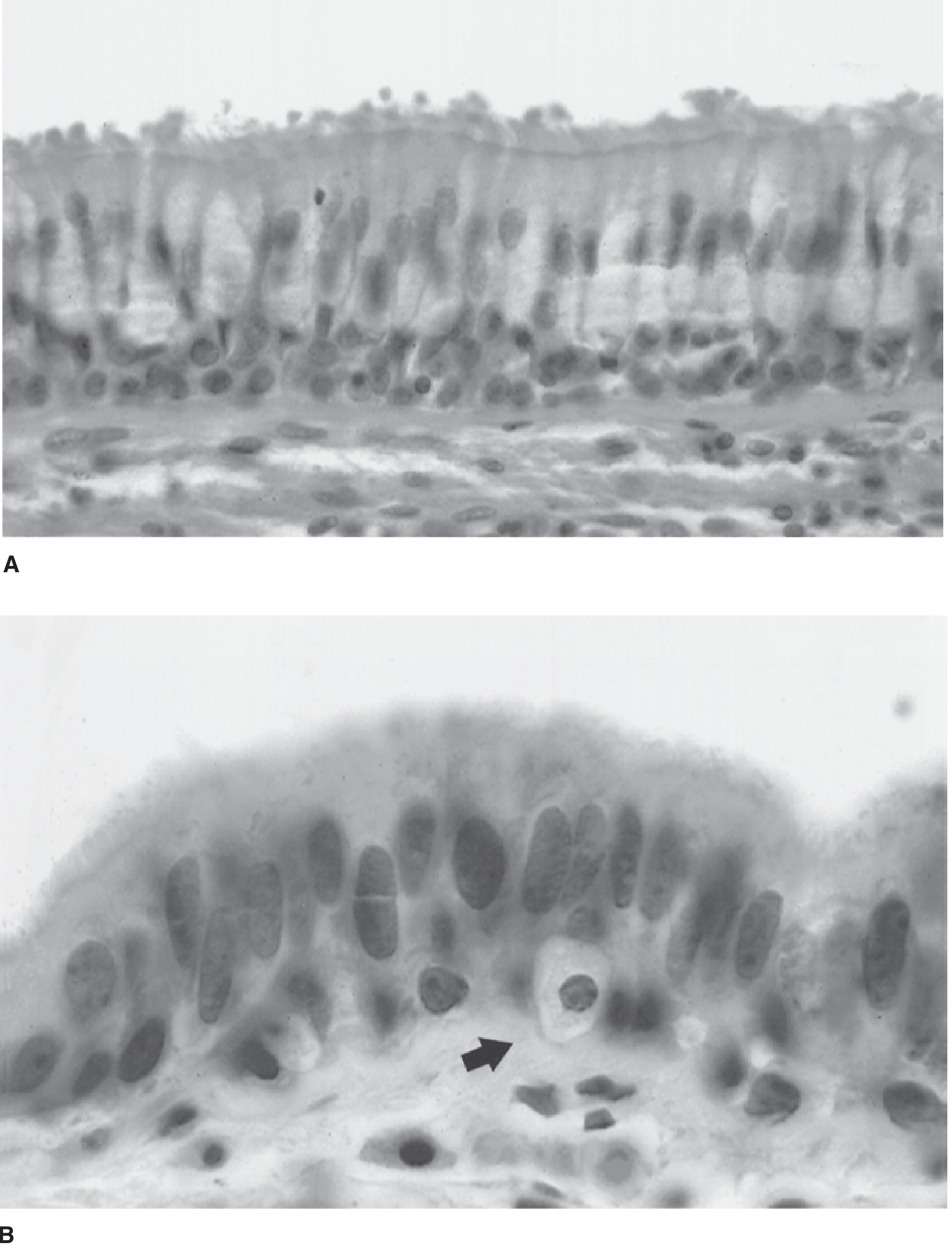
(A) Pseudostratified ciliated columnar cells and mucous cells lining the tracheobronchial tree. (B) A Kulchitsky (neuroendocrine) cell (arrow).
3. Bronchioles
As airways get smaller, they lose cartilage and submucosal glands. Histological features transition:
- Larger bronchioles: Still PCCE with cilia; smooth muscle bundles in wall
- Terminal bronchioles: The smallest airways without alveoli. Epithelium transitions from ciliated PCCE to ciliated simple columnar, and finally to club cells (formerly Clara cells) - non-ciliated cuboidal/low columnar cells that:
- Produce a surfactant-like surface-active agent
- Serve as progenitor stem cells for the bronchiolar epithelium
- Are involved in xenobiotic metabolism (cytochrome P450)
Histology of Terminal Bronchiole, Respiratory Bronchiole, and Alveoli
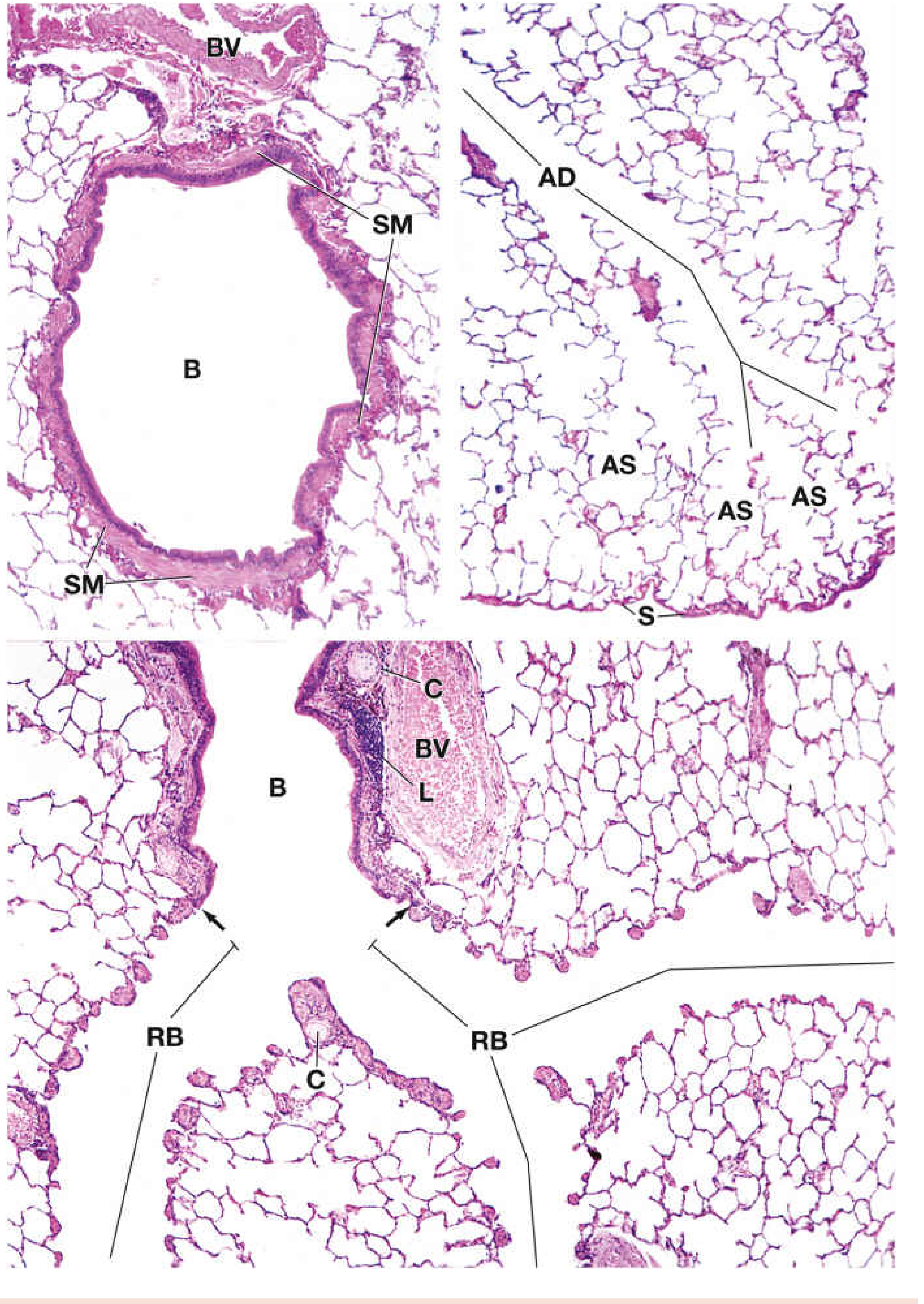
Key labels: B = bronchus, SM = smooth muscle, BV = blood vessel, AD = alveolar duct, AS = alveolar sac, S = serosa, RB = respiratory bronchiole, C = cartilage, L = lymphoid nodule.
4. Respiratory Portion
Respiratory Bronchioles
- Transitional structure: wall is partly ciliated epithelium, partly open alveoli budding off the wall
- Alveoli appear directly on the bronchiolar wall - this is the defining feature distinguishing respiratory from terminal bronchioles
Alveolar Ducts
- Passages lined solely by rows of alveoli opening into the lumen
- Have rings of smooth muscle in knob-like interalveolar septa
Alveolar Sacs
- Enlarged spaces surrounded by clusters of alveoli
Alveoli
Lined by two cell types:
| Feature | Type I Pneumocyte | Type II Pneumocyte |
|---|---|---|
| Shape | Extremely thin, flat (squamous) | Rounded/cuboidal |
| % of alveolar cells | ~40% | ~60% |
| % of surface area covered | ~95% | ~3-5% |
| Function | Gas exchange | Surfactant production |
| Mitotic potential | None (cannot regenerate) | Yes - progenitor for Type I |
| Histology | Attenuated nucleus; barely visible in H&E | Prominent rounded nucleus, pale cytoplasm; "septal cell" |
| Lamellar bodies | Absent | Present (store surfactant) |
Surfactant is a phospholipid-protein complex (primarily dipalmitoylphosphatidylcholine) that reduces alveolar surface tension, preventing collapse at end-expiration. Its deficiency in premature infants causes Respiratory Distress Syndrome (RDS/hyaline membrane disease).
The Air-Blood Barrier (Alveolar-Capillary Membrane)
The interalveolar septum (between adjacent alveoli) constitutes the air-blood barrier:
- Type I pneumocyte cytoplasm
- Fused basal laminae of pneumocyte + capillary endothelium (thin portion ~0.15-0.30 μm)
- Capillary endothelial cell
Gas exchange occurs through the thin portion where the two basal laminae are fused. In the thick portion, connective tissue (collagen, elastin, fibroblasts) lies between the two basal laminae.
High-Magnification Alveolar Histology
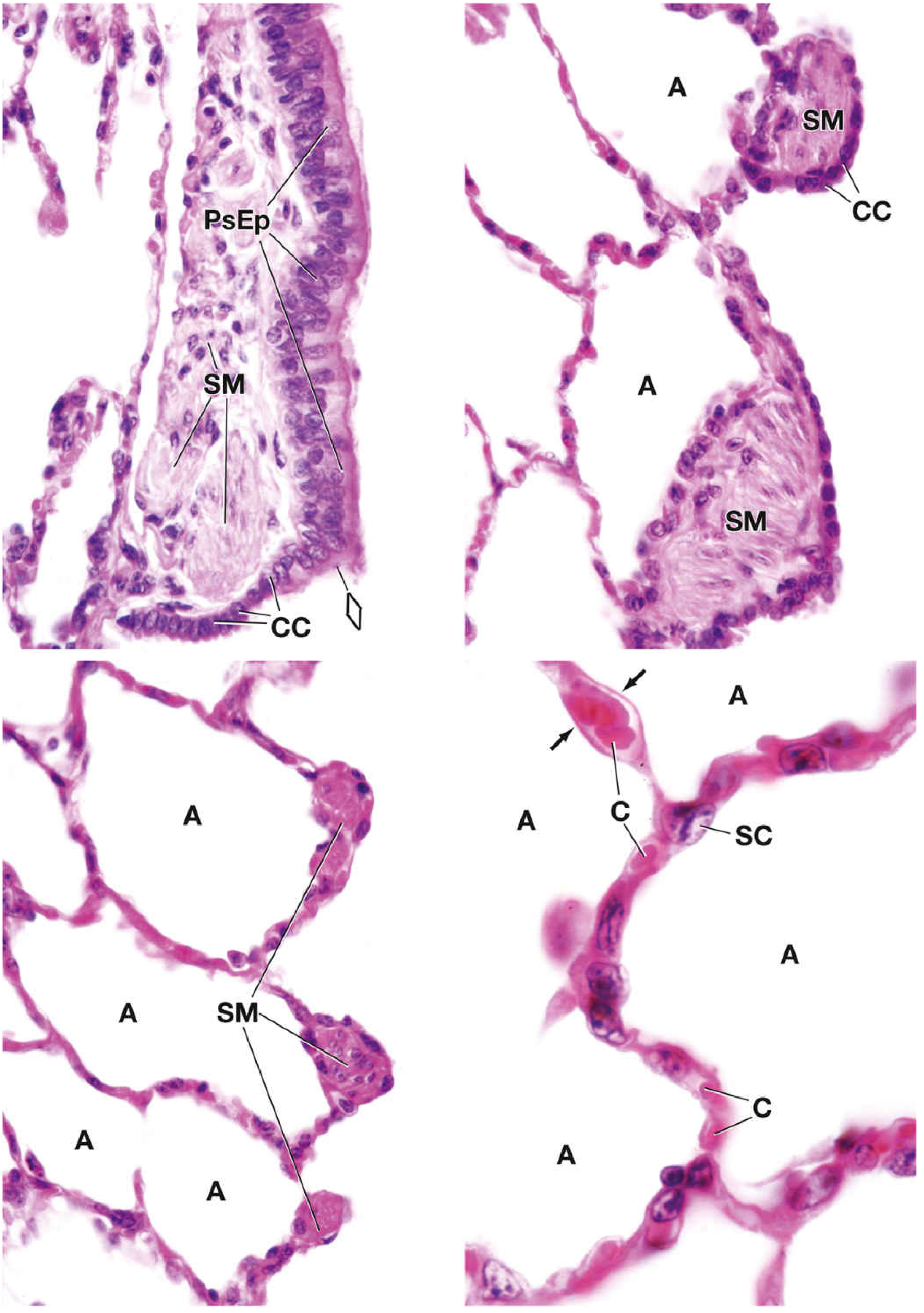
Key labels: PsEp = pseudostratified epithelium, CC = club cells, SM = smooth muscle, A = alveolus, C = capillary, SC = septal cell (Type II pneumocyte), arrows = thin portions of alveolar-capillary membrane where gas exchange occurs.
5. Other Cells in the Alveolar Space
- Alveolar macrophages ("dust cells") - resident macrophages derived from monocytes; patrol the alveolar surface phagocytosing debris, pathogens, and inhaled particles. Appear as large cells with granular cytoplasm floating free in alveoli.
- Clusters of neuroendocrine cells - found in alveolar spaces
- Mast cells, lymphocytes, plasma cells - sparse, in interstitium
6. Summary: Key Histological Markers by Structure
| Structure | Epithelium | Cartilage | Glands | Smooth Muscle |
|---|---|---|---|---|
| Trachea | PCCE | Complete rings (C-shaped) | Present | Yes (posterior) |
| Main/lobar bronchi | PCCE | Irregular plates | Present | Yes |
| Segmental bronchi | PCCE | Smaller plates | Present | Yes |
| Bronchioles | Simple ciliated columnar | Absent | Absent | Yes |
| Terminal bronchioles | Club cells (+ some ciliated) | Absent | Absent | Yes |
| Respiratory bronchioles | Cuboidal/club cells + alveoli | Absent | Absent | Yes (knobs) |
| Alveoli | Type I + II pneumocytes | Absent | Absent | Absent |
Sources: Histology: A Text and Atlas with Correlated Cell and Molecular Biology; Schwartz's Principles of Surgery, 11th ed.
This is a shared conversation. Sign in to Orris to start your own chat.