
Teach me glass coma scale in detail for my jrship viva
Reading File
Finding Sources
Searching PubMed
"Glasgow Coma Scale"
Searching the Web
Glasgow Coma Scale official scoring adult verbal motor eye response guidelines
Reading File
Reading Web Page
https://www.glasgowcomascale.org/faq
Searching Images
Glasgow Coma Scale eye verbal motor response scoring illustrated table
Glasgow Coma Scale (GCS): Jrship viva guide
The Glasgow Coma Scale is a standardized bedside method for describing and serially monitoring a patient's level of consciousness, especially after head injury, stroke, poisoning, infection, or other causes of altered sensorium.
It assesses the best response in three domains:
- E: Eye opening, maximum 4
- V: Verbal response, maximum 5
- M: Motor response, maximum 6
GCS = E + V + M, total range 3 to 15. The scale should be reported as components as well as total, for example: GCS 10/15 = E3 V2 M5, not merely “GCS 10.” The standard table is illustrated in Rosen's Emergency Medicine, p. 376.
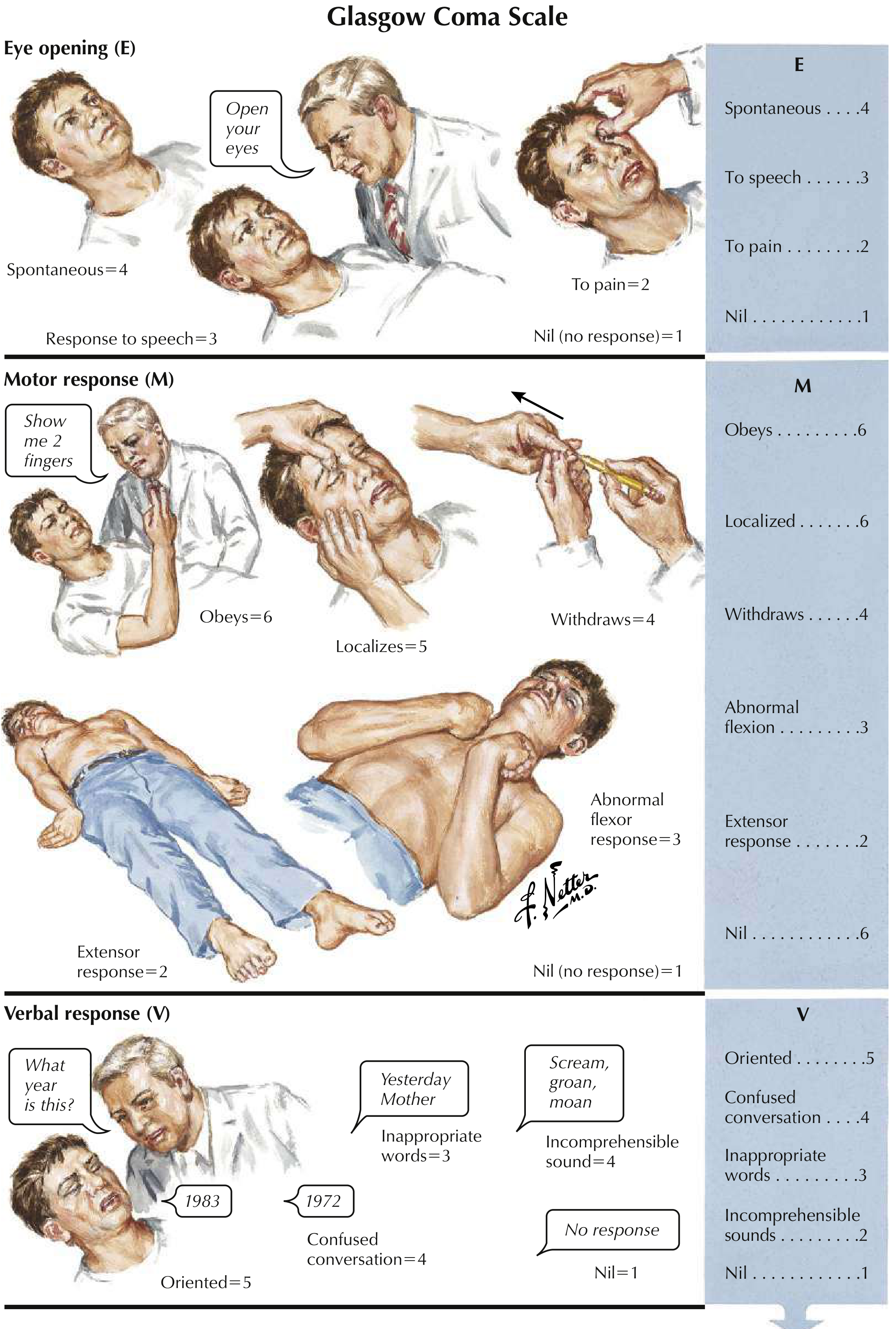
1. How to introduce it in a viva
“GCS is a clinical scale used to assess consciousness by evaluating eye opening, verbal response, and best motor response. The total score ranges from 3 to 15. I assess the patient after ensuring ABC stabilization, record the best response in each component, and document both the component scores and total, with time of assessment and any confounding factors such as sedation or intubation.”
2. Before assessing GCS
Do not start scoring before rapid stabilization.
First do ABCDE
- A: Ensure airway is patent and protect cervical spine if trauma is suspected.
- B: Check oxygenation, ventilation, respiratory effort.
- C: Check pulse, BP, shock, bleeding.
- D: Assess pupils, glucose, focal deficits, and GCS.
- E: Look for trauma, seizures, rash, needle marks, etc.
Important bedside rules
- Introduce yourself and observe the patient before touching them.
- Check whether the patient opens eyes spontaneously and speaks normally.
- Give a clear command first, for example:
“Open your eyes.”
“Show me two fingers.”
“Squeeze my hand and let go.” - If there is no response, apply an appropriate central painful stimulus.
- Record the best response, not the worst response.
- Repeat serially. A falling GCS is often more important than a single score.
3. Eye opening response: E4
| Score | Response | How to assess |
|---|---|---|
| E4 | Eyes open spontaneously | Patient already has eyes open without stimulation |
| E3 | Eyes open to speech | Opens eyes when spoken to or commanded |
| E2 | Eyes open to pain | Opens eyes only after central painful stimulus |
| E1 | No eye opening | No eye opening to voice or pain |
| E NT | Not testable | Eyelid edema, facial trauma, eye dressing, etc. |
Viva points
- “To speech” means eyes open when spoken to, not after painful stimulus.
- If the patient is asleep but opens eyes to normal voice, it is E3, not E4.
- If eyelids cannot be opened due to swelling, write E-NT, not E1.
4. Verbal response: V5
| Score | Response | Meaning / example |
|---|---|---|
| V5 | Oriented | Converses appropriately and knows person, place, and time |
| V4 | Confused conversation | Talks in sentences but is disoriented or confused |
| V3 | Inappropriate words | Recognizable words, but random or unrelated to the question |
| V2 | Incomprehensible sounds | Moaning, groaning, sounds but no understandable words |
| V1 | No verbal response | No sound |
| V NT | Not testable | Intubated, tracheostomy, severe facial injury, language barrier, aphasia |
How to test orientation
Ask:
- “What is your name?”
- “Where are you?”
- “What day/month/year is it?”
- “Why are you here?”
Common confusion in viva
- V4 confused: Patient speaks in meaningful sentences but is disoriented.
Example: “I am at home, it is 2019,” while actually in hospital in 2026. - V3 inappropriate words: Individual words are understandable but do not form a meaningful conversation.
Example: “Car... mother... blue.” - V2 incomprehensible sounds: Only moaning/groaning, no recognizable words.
Intubated patient
Do not give verbal score of 1 merely because the patient cannot speak. Record:
E3 V-NT M6, intubated
The official GCS guidance advises recording the untestable component as NT and avoiding a misleading total score when a component cannot be tested. See the official GCS FAQ.
Some units use “VT” or “1T,” but NT is clearer, particularly for formal documentation and handover.
5. Motor response: M6
This is the most clinically important component and the strongest predictor among the individual components.
| Score | Response | Meaning |
|---|---|---|
| M6 | Obeys commands | Carries out a simple command correctly |
| M5 | Localizes pain | Purposefully brings hand toward the site of central painful stimulus to remove it |
| M4 | Withdraws from pain | Pulls limb away from painful stimulus, but does not reach toward stimulus |
| M3 | Abnormal flexion | Decorticate posturing |
| M2 | Extension | Decerebrate posturing |
| M1 | No motor response | No movement to central pain |
| M NT | Not testable | Paralysis, spinal injury, limb immobilization, etc. |
The key distinction: localizing versus withdrawal
This is asked very commonly.
M5: Localizes pain
- The patient makes a purposeful movement toward the stimulus.
- For example, after trapezius squeeze, the patient reaches across the body to push your hand away.
- It shows higher cortical function.
M4: Withdrawal from pain
- The patient flexes or pulls the limb away from pain.
- The limb does not reach toward or attempt to remove the stimulus.
- It is less purposeful than localization.
Abnormal posturing
M3: Abnormal flexion, decorticate posture
- Arms flexed and adducted toward chest
- Wrists and fingers flexed
- Legs often extended
M2: Extension, decerebrate posture
- Arms extended and pronated
- Wrists may be flexed
- Legs extended
- Indicates severe brain dysfunction and is generally more concerning than abnormal flexion.
6. How to apply pain correctly
Use pain only if the patient does not respond adequately to voice and command.
Preferred central painful stimuli
Central stimuli help assess overall brain response:
- Trapezius squeeze
- Supraorbital pressure
Avoid if there is suspected facial/orbital fracture. - Mandibular pressure
- Sternal rub is commonly used but is less preferred because it can cause bruising and gives a less precise motor assessment.
Peripheral painful stimulus
- Nail-bed pressure may be used to assess each limb separately, especially when focal weakness is suspected.
- It should not be the only method used to determine the overall GCS motor response.
Do not do
- Do not cause injury.
- Do not repeatedly stimulate the patient unnecessarily.
- Do not use painful stimulus before trying voice and simple commands.
- Do not confuse a spinal reflex with purposeful motor response.
7. Interpretation of the total score
| GCS | Usual classification in traumatic brain injury |
|---|---|
| 13-15 | Mild head injury |
| 9-12 | Moderate head injury |
| ≤8 | Severe head injury |
A score of 3 is the lowest possible score, while 15 is normal consciousness.
“GCS 8, intubate?”
For viva, say:
“A GCS of 8 or less is a warning threshold for urgent airway assessment and likely airway protection, but intubation is a clinical decision based on airway reflexes, oxygenation, ventilation, trajectory, facial injury, seizures, and anticipated deterioration, not on the number alone.”
The familiar phrase is:
“GCS 8, intubate.”
But do not apply it blindly. A patient may have a score above 8 and still need intubation for airway compromise, hypoxemia, exhaustion, vomiting/aspiration risk, or rapid deterioration.
8. Examples for viva practice
Example 1
Patient opens eyes to voice, speaks confused sentences, obeys commands.
- E3
- V4
- M6
GCS = 13/15, E3 V4 M6
Example 2
Patient opens eyes only to trapezius squeeze, makes incomprehensible sounds, pulls arm away from pain.
- E2
- V2
- M4
GCS = 8/15, E2 V2 M4
This is severe impairment and needs urgent reassessment and airway evaluation.
Example 3
Patient’s eyes are open spontaneously, is confused, and reaches to push away your hand during trapezius squeeze.
- E4
- V4
- M5
GCS = 13/15, E4 V4 M5
Example 4: Intubated patient
Patient opens eyes to pain and localizes pain but is mechanically ventilated.
- E2
- V-NT
- M5
Document: E2 V-NT M5, intubated
Avoid recording the verbal component as V1 and avoid a falsely low total.
9. GCS documentation
A good clinical note:
15:00: GCS E3 V4 M6 = 13/15. Patient opens eyes to voice, confused but conversing, obeys commands. Pupils 3 mm bilaterally equal and reactive. Capillary glucose 112 mg/dL.
For an intubated patient:
15:00: GCS E2 V-NT M5, intubated and sedated. Pupils 3 mm equal/reactive.
Always add:
- Time
- Components and total when valid
- Sedation/paralysis/intubation status
- Pupillary findings
- Any focal deficit
- Trend compared with prior assessment
10. Limitations and confounders
GCS is useful, but it is not a complete neurological examination.
A low or unreliable score may result from:
- Alcohol or drug intoxication
- Sedation, anesthesia, or neuromuscular paralysis
- Hypoxia, hypercapnia, shock, hypoglycemia
- Intubation/tracheostomy
- Aphasia or hearing impairment
- Language barrier
- Dementia or intellectual disability
- Facial trauma, eyelid swelling, orbital injury
- Spinal cord injury or limb fractures
- Seizure/postictal state
- Pre-existing motor deficits
In such cases, document the limitation clearly and assess the remaining components. The official guidance specifically recommends NT, not 1, when a component is untestable.
11. Paediatric GCS
In preverbal children, adult verbal criteria cannot be used. Use a modified paediatric GCS.
Key change is verbal response:
| Score | Paediatric verbal response |
|---|---|
| V5 | Smiles, coos/babbles appropriately, or age-appropriate interaction |
| V4 | Cries but consolable, or interacts inappropriately |
| V3 | Persistently inappropriate crying/screaming |
| V2 | Grunts, moans, or agitated inconsolable response |
| V1 | No response |
For children, assess interaction with parents, consolability, crying, spontaneous movement, and age-appropriate behavior.
12. Common viva questions with model answers
What does GCS assess?
“It assesses level of consciousness using eye opening, verbal response, and best motor response.”
What is the minimum and maximum score?
“Minimum is 3 and maximum is 15.”
What is the most important motor response?
“The best motor response. It is often the most useful component when verbal assessment is limited, such as in intubated patients.”
Differentiate M5 from M4.
“M5 localizes pain with a purposeful attempt to remove the stimulus. M4 withdraws a limb away from pain without reaching toward the stimulus.”
How do you record GCS in an intubated patient?
“I record eye and motor components and document verbal response as NT due to intubation, for example E3 V-NT M6. I do not assign V1 simply because the patient is intubated.”
Is GCS 15 always normal?
“No. A patient can have GCS 15 with concussion, confusion not elicited by brief questioning, focal neurological deficits, intoxication, or intracranial pathology. GCS does not replace a full neurological examination.”
What is the significance of a drop in GCS?
“A fall in GCS, particularly a fall in motor score, may indicate neurological deterioration such as expanding intracranial hemorrhage, rising intracranial pressure, seizure, hypoxia, hypoglycemia, or worsening metabolic illness. It requires immediate reassessment.”
One-minute viva answer to memorize
“Glasgow Coma Scale is used to describe and monitor consciousness. It has three components: eye opening out of 4, verbal response out of 5, and best motor response out of 6, giving a total from 3 to 15. I first stabilize ABC and exclude reversible causes such as hypoxia and hypoglycemia. I assess spontaneous response, then response to voice and commands, and if required use a central painful stimulus. I record the best component scores, for example E3 V4 M6 equals 13/15, along with time and confounding factors. In intubated patients, verbal response should be recorded as not testable, not as V1. A falling GCS, especially motor response, requires urgent reassessment. GCS 13-15 is mild, 9-12 moderate, and 8 or below severe head injury, but airway management should be based on the whole clinical picture.”
Recent literature continues to emphasize that the individual components, particularly motor and verbal responses, carry important prognostic information and should not be replaced by the summed total alone, as discussed in a 2024 systematic review.
Teach me like a 10 yr old
Reading File
Finding Sources
Searching PubMed
"Glasgow Coma Scale"
Searching the Web
official Glasgow Coma Scale eye verbal motor score assessment
Think of the Glasgow Coma Scale, or GCS, as a simple point game doctors use to see how awake and responsive a person is.
We check 3 things:
- Eyes
- Talking
- Moving
The best possible score is 15.
The lowest possible score is 3.
The lowest possible score is 3.
Easy memory trick
E V M = 4, 5, 6
Eyes = 4 points
Voice = 5 points
Movement = 6 points
So:
GCS = Eyes + Voice + Movement
1. Eyes: E
We see how the person opens their eyes.
| Score | What happens |
|---|---|
| E4 | Eyes open by themselves |
| E3 | Opens eyes when you call them |
| E2 | Opens eyes only when firmly stimulated |
| E1 | Does not open eyes |
Example
You say, “Hello, open your eyes!”
- They open eyes: E3
- Their eyes were already open: E4
2. Voice: V
We see how well the person can talk.
| Score | What happens |
|---|---|
| V5 | Talks normally and knows who/where/when they are |
| V4 | Talks, but is confused |
| V3 | Says random words that do not make sense |
| V2 | Only makes sounds, like moaning |
| V1 | Makes no sound |
Example
- “My name is Ravi. I am in the hospital.” = V5
- “I am in my bedroom,” when actually in hospital = V4
- “Car... blue... mother...” = V3
- “Uhhh... ahhh...” = V2
3. Movement: M
We see how well the person can move.
| Score | What happens |
|---|---|
| M6 | Follows a command, like “Show me two fingers” |
| M5 | Pushes away the examiner's hand when stimulated |
| M4 | Pulls arm or leg away from stimulation |
| M3 | Arms bend in a strange stiff way |
| M2 | Arms straighten in a strange stiff way |
| M1 | Does not move |
The important confusing part
Imagine someone presses firmly on the shoulder:
- If the patient tries to remove that hand, that is M5: localizes.
- If the patient only pulls their arm away, that is M4: withdraws.
So:
M5 = “Get your hand away from me!”
M4 = “I move away, but do not find your hand.”
Putting it together
A patient:
- Opens eyes when called: E3
- Talks but is confused: V4
- Follows a command: M6
Add it:
E3 + V4 + M6 = 13
Say and write:
GCS 13/15, E3 V4 M6
Do not only say “GCS 13.” The letters tell other doctors exactly what the patient did.
What do the scores mean?
| Total GCS | Simple meaning |
|---|---|
| 15 | Fully awake and normal |
| 13-15 | Mild problem |
| 9-12 | Moderate problem |
| 8 or less | Very serious problem |
A score of 8 or less means the patient may not be able to keep their airway safe, so doctors urgently check whether they need a breathing tube.
One tiny story to remember it
Imagine your friend falls and hits their head.
You ask:
“Open your eyes!”
They open eyes when you call.
E3
E3
“What is your name? Where are you?”
They say, “I am at school,” but they are actually in hospital.
They can talk, but are confused.
V4
They can talk, but are confused.
V4
“Show me two fingers.”
They do it.
M6
M6
So total:
3 + 4 + 6 = 13/15
Important special case: breathing tube
If a patient has a tube in their mouth for breathing, they cannot talk.
Do not say their talking score is 1 just because they cannot speak. Instead write:
V-NT
NT means not testable.
Example:
E3 V-NT M6, intubated
The official GCS guidance says to record an untestable part as NT, not as a fake low score of 1, because that can make the patient sound worse than they are. Official GCS guidance
Super-short viva answer
“GCS checks consciousness by looking at eyes, talking, and movement. Eyes are out of 4, verbal response is out of 5, and motor response is out of 6. The total is out of 15. We report the separate parts too, for example E3 V4 M6 equals GCS 13/15. A lower score means the person is less awake. GCS 8 or below is serious and needs urgent airway assessment.”
Memory line
Eyes 4, Voice 5, Movement 6.
EVM makes 15.
This is a shared conversation. Sign in to Orris to start your own chat.