
Generate a detailed answer on this question for MBBS biochemistry exam based on Vasudevan with simple cycle(easily understandable) with simple diagram
Which biochemistry topic is your exam question about?
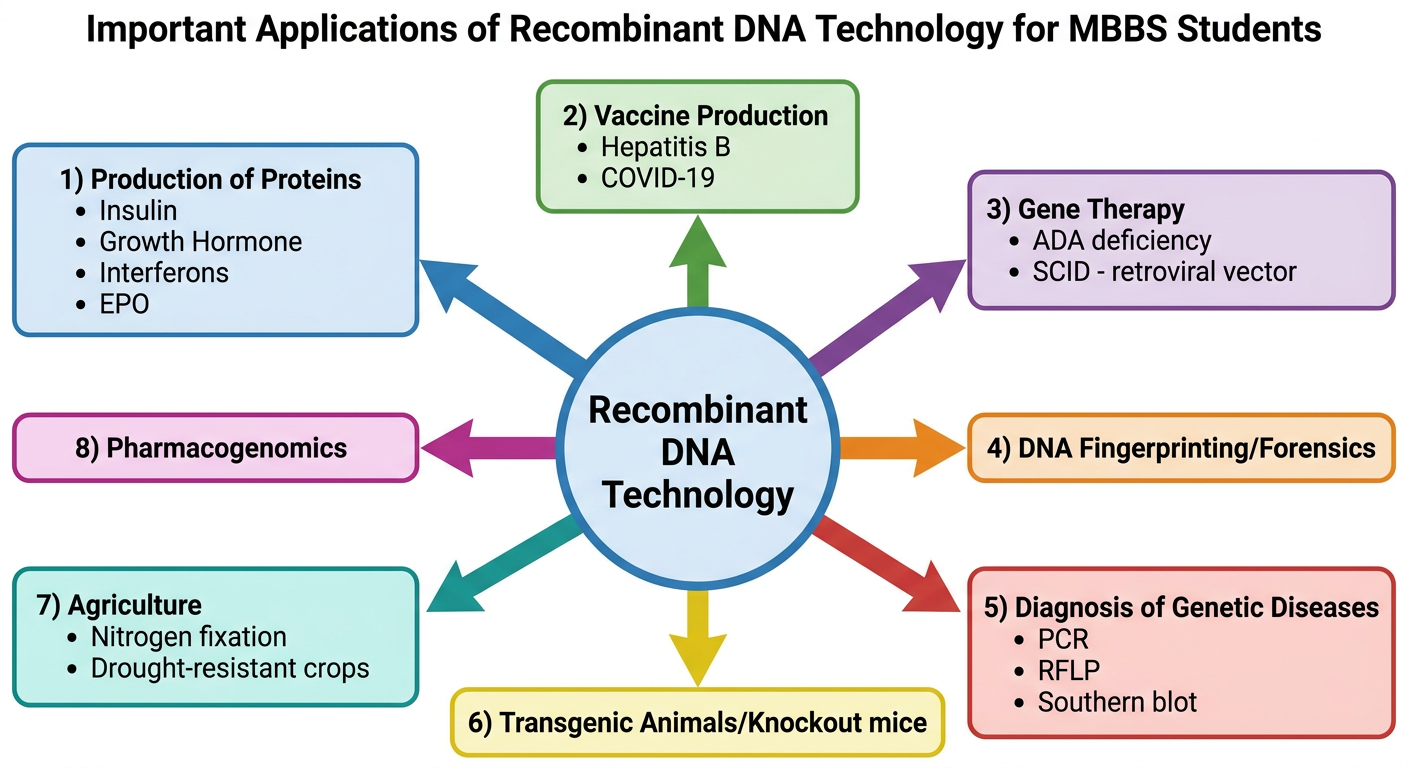
A clean, simple, educational biochemistry diagram showing the Important Applications of Recombinant DNA Technology for MBBS students. Use a central circle labeled "Recombinant DNA Technology" with arrows pointing outward to labeled boxes: 1) Production of Proteins (insulin, growth hormone, interferons, EPO), 2) Vaccine Production (Hepatitis B, COVID-19), 3) Gene Therapy (ADA deficiency, SCID - retroviral vector), 4) DNA Fingerprinting/Forensics, 5) Diagnosis of Genetic Diseases (PCR, RFLP, Southern blot), 6) Transgenic Animals/Knockout mice, 7) Agriculture (nitrogen fixation, drought-resistant crops), 8) Pharmacogenomics. Use clear fonts, color-coded boxes, white background, academic style.
Important Applications of Recombinant DNA Technology
Overview Diagram
Definition (1-liner for exams)
IMPORTANT APPLICATIONS
1. Production of Useful Proteins (Therapeutic Proteins)
- Supplies large quantities of proteins previously unavailable (e.g., interferon, tissue plasminogen activator - tPA)
- Provides human proteins, reducing immunological reactions (e.g., human insulin instead of pork/beef insulin)
| Protein | Use |
|---|---|
| Insulin | Diabetes mellitus treatment |
| Growth Hormone (GH) | Pituitary dwarfism |
| Erythropoietin (EPO) | Anemia in renal failure |
| Factor VIII / Factor IX | Hemophilia A and B |
| Tissue Plasminogen Activator (tPA) | Thrombolysis in MI, stroke |
| Interferon | Viral infections, cancer |
| Hepatitis B surface antigen | Vaccine production |
| Interleukins | Immune modulation |
Exam tip: "Recombinant human insulin" was the first therapeutic protein produced - introduced in 1982. It replaced animal insulin, which caused immune reactions.
2. Vaccine Production
- Hepatitis B vaccine - HBsAg (surface antigen) produced in yeast by inserting the HBsAg gene into a yeast expression vector
- COVID-19 vaccines - mRNA vaccines (Pfizer/Moderna) use recombinant mRNA technology
- HPV vaccine - Virus-like particles (VLPs) produced via recombinant technology
Advantage: No risk of causing the actual disease since no live/attenuated organism is used.
3. Gene Therapy
Normal Gene Isolated
       ↓
Inserted into Retroviral/Adenoviral Vector
       ↓
Vector introduced into Patient's Cells
(e.g., bone marrow stem cells / lymphocytes)
       ↓
Gene expressed → Normal Protein Produced
       ↓
Disease Corrected
- ADA (Adenosine Deaminase) deficiency → SCID (Severe Combined Immunodeficiency - "bubble boy disease")
- Dr. William French Anderson in 1990 introduced the normal ADA gene (via retroviral vector) into lymphocytes of a 4-year-old girl
- First successful gene therapy in humans
- Somatic gene therapy - Corrects defect in body cells only; not passed to offspring
- Germ line gene therapy - Corrects defect in germ cells; heritable (ethical concerns, mostly experimental)
4. Diagnosis of Genetic Diseases
| Technique | Application |
|---|---|
| PCR (Polymerase Chain Reaction) | Amplify tiny amounts of DNA; detect mutations |
| RFLP (Restriction Fragment Length Polymorphism) | Detect gene mutations; carrier testing |
| Southern Blotting | Detection of specific gene sequences |
| DNA Sequencing / NGS | Identify exact mutations in the genome |
| Gene Chips / Microarrays | Simultaneous analysis of thousands of genes |
- Sickle cell anemia detection - single base change (A→T) detected by RFLP
- Thalassemia diagnosis
- Carrier detection for cystic fibrosis, phenylketonuria
- Prenatal diagnosis of genetic diseases
5. DNA Fingerprinting (Forensic Medicine)
- Analyzes VNTRs (Variable Number of Tandem Repeats) - highly specific to individuals
- Every individual (except identical twins) has a unique DNA pattern
- Used in:
- Criminal identification (linking suspect to crime scene)
- Paternity testing
- Identifying disaster victims
- Immigration disputes
- PCR can amplify DNA from a single hair follicle, blood stain, or spermatozoon
6. Transgenic Animals
- Animals with a foreign gene stably incorporated into their genome
- Produced by injecting DNA into a fertilized ovum → gene integrated into genome
- Uses:
- Study tissue-specific gene expression
- Model human diseases (e.g., transgenic mice for cancer, Alzheimer's)
- Produce human proteins in animal milk (e.g., antithrombin III in transgenic sheep)
7. Enzyme Replacement Therapy
- Large amounts of missing enzymes can be produced via recombinant technology
- Gaucher's disease - Recombinant glucocerebrosidase (imiglucerase/velaglucerase)
- Fabry disease, Pompe disease - Enzyme replacement available
- Without recombinant technology, obtaining therapeutic amounts of pure human enzymes would be impossible
8. Agricultural Applications
- Engineer plants resistant to drought, temperature extremes, pests
- Improve nitrogen fixation efficiency
- Produce crops with complete essential amino acids (e.g., rice, wheat with better protein quality)
- Bt crops - insect-resistant transgenic plants
9. Pharmacogenomics
- Study of how an individual's genetic makeup affects drug response
- Tailor drug therapy to each patient's genome (personalized medicine)
- Identify patients likely to have adverse reactions before prescribing
- Next-generation sequencing (NGS) has made whole genome sequencing affordable ($1000 or less for a human genome)
10. CRISPR-Cas9 Gene Editing (Modern Application)
- Precise, targeted editing of the genome
- Can repair existing mutations or replace defective genes
- Can also silence gene expression
- Simpler and more efficient than older knockout/knockin methods
- Research tool and potential therapeutic application
Summary Table for Quick Revision
| Application | Example |
|---|---|
| Therapeutic proteins | Insulin, EPO, tPA, Factor VIII |
| Vaccines | Hep B, COVID-19 (mRNA), HPV |
| Gene therapy | ADA deficiency (SCID) - 1st case |
| Genetic diagnosis | PCR, RFLP, Southern blot, NGS |
| DNA fingerprinting | Crime, paternity, disaster victims |
| Transgenic animals | Knockout mice, disease models |
| Enzyme replacement | Gaucher's disease |
| Agriculture | Drought-resistant, high-protein crops |
| Pharmacogenomics | Personalized medicine |
| CRISPR-Cas9 | Precise gene editing |
High-Yield Exam Points
- First therapeutic protein produced = Recombinant human insulin (1982)
- First gene therapy = ADA deficiency / SCID by W.F. Anderson (1990)
- Hepatitis B vaccine = Subunit vaccine made in yeast (recombinant HBsAg)
- PCR = Can amplify DNA from a single cell - used in forensics, diagnosis, latent virus detection
- Transgenic animals = Useful for studying gene overexpression and disease models
- CRISPR-Cas9 = Most precise gene editing tool available today
- Sickle cell anemia = Caused by 1 base change in 3 billion bp - detectable only by recombinant DNA technology