
Hypertension 20 mark question
Reading File
Now let me search the medical library for comprehensive hypertension content.
Finding Sources
Finding Sources
Reading File
Finding Sources
Finding Sources
Good - now let me read the most relevant comprehensive sections on hypertension.
Reading File
Reading File
Finding Sources
Excellent - Harrison's has a dedicated secondary hypertension section. Let me read that along with more pharmacology and pathophysiology content.
Reading File
Reading File
I have very rich content now. Let me read more of the Harrison's section on hypertension (classification, management, hypertensive emergency) and more pharmacology.
Reading File
Reading File
I now have comprehensive content from Harrison's and Lippincott Pharmacology. Let me fetch the treatment flowchart image and read the Harrison's hypertensive urgency/emergency section.
Loading Image
Reading File
I now have all the content I need for a comprehensive 20-mark answer on hypertension. Let me compile the answer.
Hypertension - Comprehensive 20-Mark Answer
1. Definition and Classification
Hypertension is defined as a sustained elevation of systemic arterial blood pressure (BP). The 2017 ACC/AHA guidelines define it as an average systolic BP (SBP) ≥130 mmHg and/or diastolic BP (DBP) ≥80 mmHg on two or more occasions.
| Stage | SBP (mmHg) | DBP (mmHg) |
|---|---|---|
| Normal | <120 | <80 |
| Elevated | 120-129 | <80 |
| Stage 1 Hypertension | 130-139 | 80-89 |
| Stage 2 Hypertension | ≥140 | ≥90 |
| Hypertensive Crisis | >180 | >120 |
Hypertensive Urgency: BP >180/120 mmHg without acute target organ damage - managed by gradually lowering BP over 24-48 hours.
Hypertensive Emergency: BP severely elevated WITH acute target organ damage (e.g., aortic dissection, hypertensive encephalopathy, acute pulmonary edema, HELLP syndrome) - requires IV therapy with controlled BP reduction.
(Harrison's Principles of Internal Medicine, 22E)
2. Epidemiology
- Hypertension affects approximately 1.28 billion adults worldwide and is the leading modifiable risk factor for cardiovascular disease (CVD), stroke, renal failure, and premature death.
- It carries a 2.5-fold (men) to 3.9-fold (women) age-adjusted increased risk for peripheral arterial disease.
- Prevalence increases sharply with age, obesity, dietary sodium excess, and physical inactivity.
- African Americans tend to have more severe hypertension and higher rates of target organ damage than other populations.
3. Etiology and Classification
A. Primary (Essential) Hypertension (~90-95%)
No identifiable single cause. Results from a complex interaction of:
- Genetic factors: Polygenic inheritance; multiple modest-effect alleles
- Environmental/Lifestyle factors (the six key modifiable exposures):
- Poor diet quality (low adherence to DASH-style eating)
- Excess body weight / obesity (BMI ≥30)
- Excessive dietary sodium intake
- Insufficient dietary potassium intake
- Physical inactivity (<150 min aerobic exercise/week)
- Alcohol consumption (especially binge drinking)
- Other associations: Heavy metal exposure (lead, mercury, cadmium, arsenic), air pollution (PM2.5 increases SBP by ~3-5 mmHg), high altitudes, cold climate
(Harrison's 22E)
B. Secondary Hypertension (~5-10%)
An identifiable, treatable underlying cause. Should be suspected when:
- Treatment-resistant hypertension (BP >130/80 on 3+ drugs)
- Abrupt worsening of previously controlled hypertension
- Disproportionate target organ damage for BP level
- Lab abnormalities: unprovoked hypokalemia, proteinuria, left ventricular hypertrophy
| Cause | Prevalence | Key Feature |
|---|---|---|
| Renal parenchymal disease | Most common (overall) | Most common in children; proteinuria, GFR reduction |
| Renovascular disease (RAS, FMD) | Common in elderly | Bruit, flash pulmonary edema, worsening renal function on ACEi |
| Primary hyperaldosteronism | 5-15% of resistant HTN | Hypokalemia, adrenal adenoma |
| Obstructive sleep apnea | Very common | Obesity, daytime somnolence, nocturnal HTN |
| Pheochromocytoma | Rare but dangerous | Episodic headache, sweating, palpitations |
| Cushing syndrome | Uncommon | Truncal obesity, striae, moon facies |
| Thyroid disorders | Relatively common | Both hypo- and hyperthyroidism |
| Coarctation of aorta | Young patients | Radio-femoral delay, rib notching |
| Drug-induced | Important | NSAIDs, OCPs, sympathomimetics, cocaine, steroids |
(Harrison's 22E; National Kidney Foundation Primer on Kidney Diseases, 8E)
4. Pathophysiology
Blood pressure = Cardiac Output (CO) x Total Peripheral Resistance (TPR)
Hypertension arises when either or both components are abnormally elevated. Key mechanisms:
Renin-Angiotensin-Aldosterone System (RAAS)
- Increased renin secretion → angiotensin I → angiotensin II (ACE) → vasoconstriction + aldosterone release → sodium/water retention → increased BP.
Sympathetic Nervous System Overactivity
- Enhanced adrenergic tone increases heart rate, CO, and causes arteriolar constriction.
Sodium and Volume Retention
- Impaired renal pressure-natriuresis curve: kidneys maintain sodium retention at inappropriately high BPs.
Endothelial Dysfunction
- Reduced nitric oxide (NO) production, increased endothelin, oxidative stress → decreased vasodilation.
Arterial Stiffness
- Loss of vascular compliance with aging amplifies pulse pressure; stiffened arteries contribute to isolated systolic hypertension and target organ damage.
Insulin Resistance / Metabolic Syndrome
- Associated with elevated angiotensin II, aldosterone, and sympathetic activation.
5. Target Organ Damage (Complications)
| Organ | Complication |
|---|---|
| Heart | Left ventricular hypertrophy (LVH), heart failure (HFpEF and HFrEF), ischemic heart disease, arrhythmias |
| Brain | Ischemic stroke, hemorrhagic stroke, hypertensive encephalopathy, vascular dementia |
| Kidneys | Hypertensive nephrosclerosis, proteinuria, progressive CKD, ESRD |
| Eyes | Hypertensive retinopathy (arteriovenous nicking, flame hemorrhages, papilledema in grade IV) |
| Aorta / Vessels | Aortic dissection, aortic aneurysm, peripheral arterial disease |
6. Clinical Features and Evaluation
Hypertension is largely asymptomatic ("silent killer"). Symptoms, when present, include:
- Headache (typically occipital, worse in the morning)
- Dizziness, tinnitus, epistaxis (less specific)
- Hypertensive urgency/emergency: severe headache, visual disturbance, confusion, chest pain, dyspnea
Evaluation goals:
- Confirm diagnosis (BP measured correctly; two readings at two visits)
- Identify secondary causes
- Assess cardiovascular risk profile and comorbidities
- Identify target organ damage
7. Investigations
| Investigation | Purpose |
|---|---|
| Urinalysis, urine albumin/creatinine ratio | Renal parenchymal disease |
| Serum creatinine, eGFR, electrolytes | Renal function; hypokalemia → hyperaldosteronism |
| Fasting glucose, lipid profile | Cardiovascular risk |
| ECG | LVH, ischemia, arrhythmia |
| Echocardiography | LVH, diastolic dysfunction |
| Fundoscopy | Hypertensive retinopathy grading |
| Thyroid function tests | Thyroid disease as secondary cause |
| Plasma aldosterone/renin ratio | Primary hyperaldosteronism |
| 24-hour urine metanephrines | Pheochromocytoma |
| Renal doppler / CT angiography | Renovascular HTN |
| Serum cortisol, 1 mg overnight DST | Cushing syndrome |
| Ambulatory BP monitoring (ABPM) | White coat HTN, masked HTN, nocturnal dipping pattern |
8. Treatment
A. Non-Pharmacologic (Lifestyle Modifications) - First-line for ALL patients
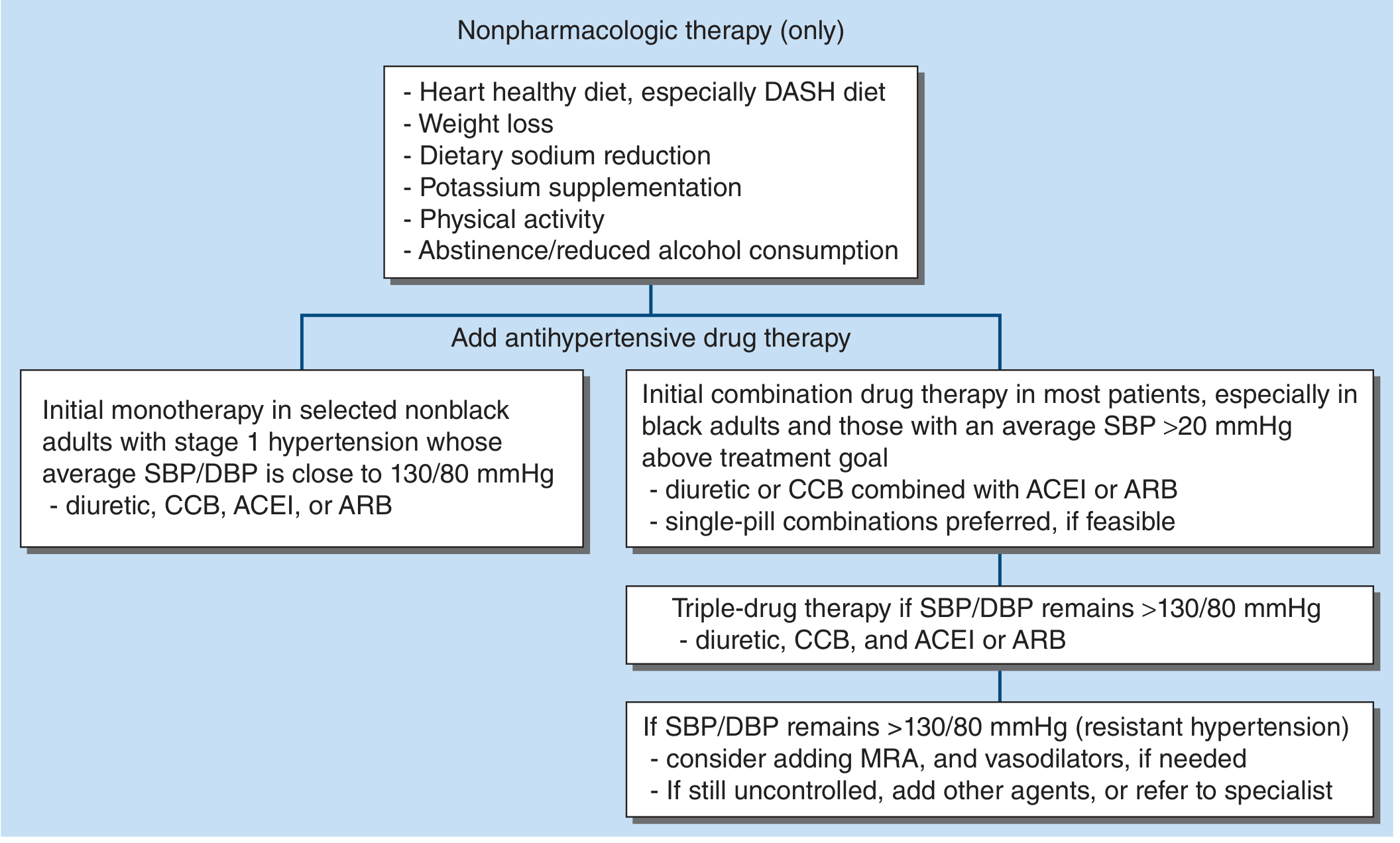
Treatment algorithm for hypertension in adults - Harrison's Principles of Internal Medicine, 22E
- DASH diet (high fruits, vegetables, low saturated fat) - reduces SBP by 8-14 mmHg
- Weight loss (each kg lost lowers SBP by ~1 mmHg)
- Dietary sodium reduction to <2.3 g/day (SBP ↓ 2-8 mmHg)
- Potassium supplementation (3500-5000 mg/day through diet)
- Physical activity ≥150 min/week of moderate aerobic exercise (SBP ↓ 4-9 mmHg)
- Alcohol reduction to ≤2 drinks/day in men, ≤1 in women
B. Pharmacologic Therapy
BP Goal: <130/80 mmHg for most adults (2017 ACC/AHA).
Step 1 - Monotherapy: For Stage 1, non-Black adults with SBP close to 130/80 mmHg.
Step 2 - Initial combination therapy: For most patients, especially Black adults and those with SBP >20 mmHg above goal - diuretic or CCB + ACEi or ARB.
Step 3 - Triple therapy: Diuretic + CCB + ACEi or ARB.
Step 4 - Resistant hypertension: Add mineralocorticoid receptor antagonist (MRA, e.g., spironolactone) + vasodilators.
i. Thiazide Diuretics (e.g., hydrochlorothiazide, chlorthalidone)
- Mechanism: Inhibit NaCl reabsorption in the distal convoluted tubule → ↓ intravascular volume initially → long-term ↓ peripheral vascular resistance
- Use: First-line; useful in combination with most other agents
- Adverse effects: Hypokalemia, hyperuricemia, hyperglycemia, hypercalcemia, hyponatremia
- Caution: Not effective when eGFR <30 mL/min (use loop diuretics instead)
ii. ACE Inhibitors (e.g., enalapril, lisinopril, ramipril)
- Mechanism: Block conversion of angiotensin I → angiotensin II → ↓ vasoconstriction, ↓ aldosterone, ↓ sodium retention
- Compelling indications: CKD with proteinuria, heart failure with reduced EF (HFrEF), post-MI, diabetes with nephropathy
- Adverse effects: Dry cough (most common; 10-15%), angioedema (rare but serious), hyperkalemia, teratogenic (class D/X in pregnancy)
- Contraindications: Pregnancy, bilateral renal artery stenosis, history of angioedema
iii. Angiotensin Receptor Blockers - ARBs (e.g., losartan, valsartan, telmisartan)
- Mechanism: Block AT1 receptors → same effect as ACEi without cough (no bradykinin accumulation)
- Use: Alternative when ACEi not tolerated; same compelling indications
- Adverse effects: Hyperkalemia, angioedema (rare), teratogenic
iv. Calcium Channel Blockers - CCBs
- Dihydropyridines (amlodipine, nifedipine): Selective vascular smooth muscle → vasodilation → ↓ TPR; minimal cardiac effects; long half-life of amlodipine (30-50 hours) allows once-daily dosing
- Non-dihydropyridines - Verapamil and Diltiazem: Both vascular and cardiac effects (negative chronotropy, dromotropy, inotropy); used in AF rate control; avoid in HFrEF
- Adverse effects (DHPs): Peripheral edema, reflex tachycardia, flushing
- Adverse effects (non-DHPs): AV block, constipation (verapamil), bradycardia
- Useful in: Asthma, diabetes, peripheral vascular disease (where beta-blockers are problematic)
v. Beta-Blockers (e.g., metoprolol, atenolol, carvedilol, nebivolol)
- Mechanism: ↓ CO via reduced heart rate and contractility; ↓ renin release → ↓ angiotensin II; ↓ central sympathetic outflow
- Compelling indications: Post-MI, HFrEF (carvedilol, metoprolol succinate, bisoprolol), stable angina
- 3rd generation (nebivolol, carvedilol): Vasodilatory properties (via NO and alpha-blockade respectively)
- Adverse effects: Fatigue, sexual dysfunction, masking of hypoglycemia, bradycardia
- Contraindications: High-degree AV block, non-selective beta-blockers in asthma; caution in diabetes
vi. Mineralocorticoid Receptor Antagonists (e.g., spironolactone, eplerenone)
- Mechanism: Antagonize aldosterone at collecting duct → natriuresis + potassium retention
- Use: Resistant hypertension (evidence-based add-on); also in primary hyperaldosteronism, HFrEF
- Adverse effects: Hyperkalemia, gynecomastia (spironolactone), menstrual irregularities
vii. Alpha-1 Blockers (e.g., doxazosin, prazosin)
- Mechanism: Block alpha-1 receptors → vasodilation
- Additional benefit: Improve benign prostatic hyperplasia (BPH) symptoms
- Caution: First-dose orthostatic hypotension; less recommended as monotherapy
C. Special Situations and Compelling Indications
| Condition | Preferred Drug(s) | Avoid |
|---|---|---|
| CKD / proteinuria | ACEi or ARB | NSAIDs |
| Post-MI | Beta-blocker, ACEi, MRA | - |
| HFrEF | ACEi/ARB, beta-blocker (carvedilol, metoprolol succinate), MRA | Non-DHP CCBs |
| Stable angina | Beta-blocker, CCB | - |
| Atrial fibrillation | Verapamil, diltiazem, beta-blocker | - |
| Diabetes | ACEi/ARB (renoprotective) | - |
| Asthma / COPD | CCB, thiazide, ACEi/ARB | Non-selective beta-blockers |
| Pregnancy | Labetalol, methyldopa, nifedipine | ACEi, ARB |
| Primary aldosteronism | Spironolactone | - |
| Recurrent stroke prevention | Thiazide + ACEi | - |
| Black adults | Thiazide + CCB (less RAAS responsive) | ACEi/ARB monotherapy |
(Lippincott Illustrated Reviews: Pharmacology; Harrison's 22E)
D. Hypertensive Emergency Management
- Goal: Reduce MAP by no more than 25% within the first hour, then to 160/100 mmHg over the next 2-6 hours, then normalize over 24-48 hours (too-rapid reduction risks ischemia due to impaired cerebral autoregulation)
- IV agents:
- Sodium nitroprusside: Arterial and venous dilator; instant onset/offset; use in most emergencies (risk: cyanide toxicity with prolonged infusion)
- Labetalol IV: Alpha + beta blockade; avoid in decompensated HF, asthma
- Nicardipine IV: DHP-CCB; useful in perioperative or stroke hypertension
- Hydralazine IV/IM: Used in hypertensive emergencies in pregnancy
- Clevidipine IV: Ultrashort-acting DHP-CCB
- Esmolol IV: Ultrashort beta-blocker; aortic dissection, perioperative HTN
- Phentolamine: Alpha-blocker; drug of choice in pheochromocytoma crisis
9. Resistant Hypertension
Defined as BP >130/80 mmHg despite use of ≥3 antihypertensives at optimal doses, including a diuretic. Important considerations:
- Exclude pseudo-resistance: poor medication adherence, white coat effect, incorrect BP measurement, suboptimal regimen
- Evidence-based add-on: spironolactone (mineralocorticoid receptor antagonist)
- Consider secondary causes in all resistant hypertension cases
(National Kidney Foundation Primer on Kidney Diseases, 8E; Goldman-Cecil Medicine)
10. Hypertension in Special Populations
| Population | Key Considerations |
|---|---|
| Elderly | Isolated systolic HTN common (↑ arterial stiffness); start low, go slow; caution with orthostasis |
| CKD | ACEi/ARB first-line; target <130/80; monitor potassium and creatinine |
| Diabetes | BP <130/80 mmHg; ACEi/ARB for nephropathy protection |
| Pregnancy | Pre-eclampsia: HTN + proteinuria ≥20 wks gestation; labetalol, methyldopa, or nifedipine; MgSO4 for seizure prophylaxis |
| Children | Increasingly primary; secondary causes (renal, coarctation) must be excluded first |
| Black adults | Higher prevalence and severity; better response to thiazides and CCBs than ACEi/ARB monotherapy; APOL1 risk alleles contribute to nephropathy |
Summary Points for Exam
- Hypertension = "silent killer"; defined as SBP/DBP ≥130/80 mmHg (ACC/AHA 2017)
- Primary (essential) in 90-95%; secondary in 5-10% - always screen for secondary causes in resistant/refractory cases
- Pathophysiology: abnormal CO and/or TPR, RAAS activation, SNS overactivity, sodium retention, endothelial dysfunction
- Complications: cardiac (LVH, HF, IHD), neurological (stroke, encephalopathy), renal (nephrosclerosis, CKD), retinopathy, aortic dissection
- Treatment: lifestyle first; pharmacologically use thiazide, CCB, ACEi, or ARB as first-line; combination preferred over high-dose monotherapy
- Match drug to comorbidity (compelling indications)
- Hypertensive emergency: reduce MAP by max 25% in 1st hour with IV agents
- Resistant hypertension: add spironolactone; rule out secondary causes
Sources: Harrison's Principles of Internal Medicine, 22E | Lippincott Illustrated Reviews: Pharmacology | National Kidney Foundation Primer on Kidney Diseases, 8E | Goldman-Cecil Medicine
This is a shared conversation. Sign in to Orris to start your own chat.