
Explain vitamins
Reading File
Now let me search the medical library for vitamins content in parallel.
Finding Sources
Searching the Web
vitamins overview fat soluble water soluble functions deficiency
Good, I have solid references. Now let me read the most relevant textbook sections in parallel:
Reading File
Finding Sources
There's an image from Lippincott's Biochemistry showing a vitamin classification diagram. Let me fetch that image and read more of the textbook content in parallel:
Loading Image
Reading File
Reading File
Excellent - I now have comprehensive content from multiple authoritative textbooks. Let me compile the full answer.
Vitamins
Vitamins are organic molecules required in microgram-to-milligram amounts for health, growth, and reproduction. Because humans cannot synthesize them in adequate quantities (or at all), they must come from the diet. The one partial exception is vitamin D, which can be synthesized in skin exposed to sunlight. - Henry's Clinical Diagnosis and Management by Laboratory Methods
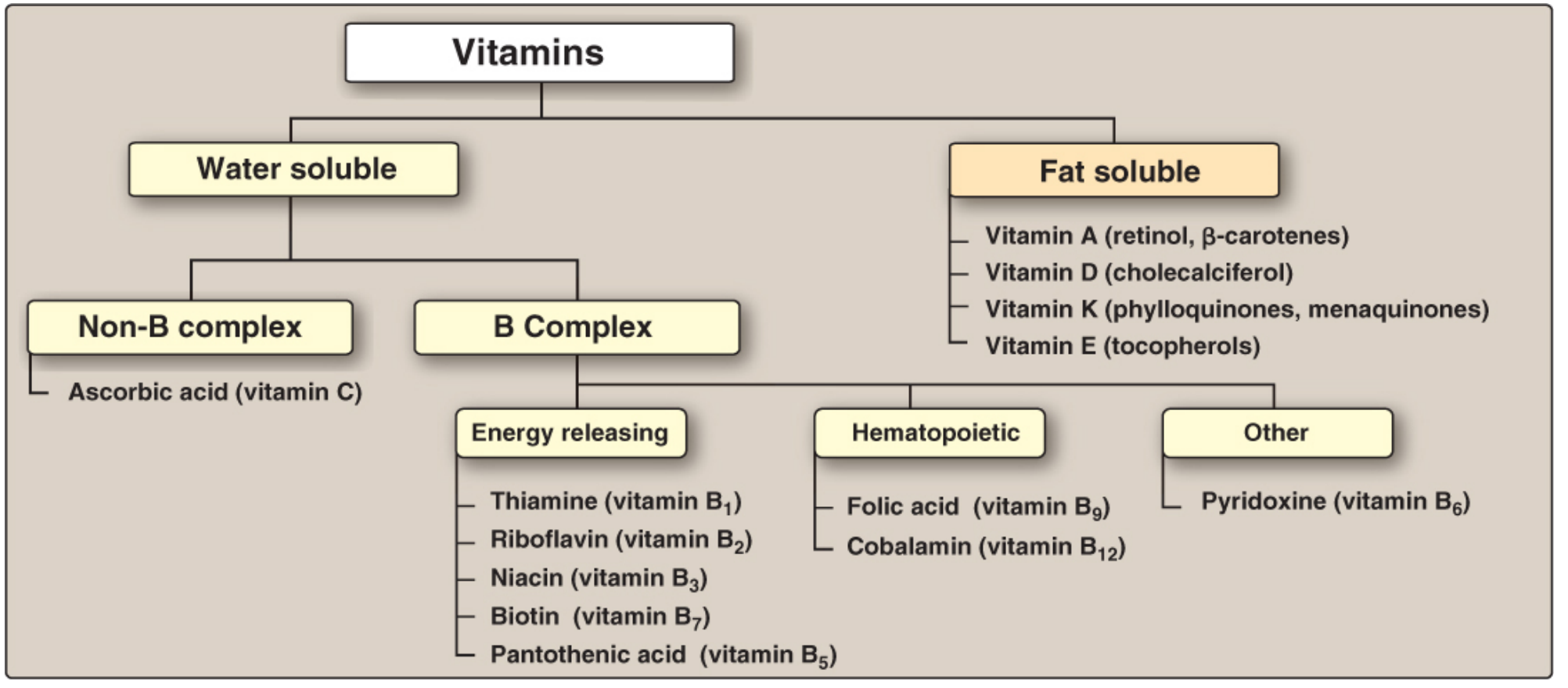
Classification
Vitamins are divided into two broad groups based on solubility. This classification has important consequences for absorption, storage, and toxicity.
| Property | Water-Soluble | Fat-Soluble |
|---|---|---|
| Members | Vitamin C + B-complex (B1, B2, B3, B5, B6, B7, B9, B12) | Vitamins A, D, E, K |
| Absorption | Direct absorption | Require bile and pancreatic lipase; absorbed with dietary fat; travel in chylomicrons |
| Storage | Minimal | Stored in liver and adipose tissue |
| Excretion | Rapidly excreted in urine | Eliminated slowly |
| Deficiency timeline | Weeks | Months to years |
| Toxicity risk | Low (pyridoxine is an exception) | Higher - especially vitamins A and D |
- Lippincott Illustrated Reviews: Biochemistry, 8th ed.
Fat-Soluble Vitamins (A, D, E, K)
Vitamin A (Retinol, beta-carotenes)
- Functions: Vision (formation of rhodopsin in retinal rod cells), epithelial differentiation, immune function, embryonic development
- Deficiency: Night blindness (earliest sign), xerophthalmia, keratomalacia, increased susceptibility to infections
- Toxicity: Teratogenic at >25x RDA; chronic excess causes liver damage, bone pain, pseudotumor cerebri
Vitamin D (Cholecalciferol / D3; Ergocalciferol / D2)
- Functions: Raises plasma calcium and phosphate by promoting intestinal absorption and bone resorption; essential for bone mineralization
- Deficiency: Rickets (children), osteomalacia (adults), hypocalcemia
- Toxicity: Hypercalcemia, nephrocalcinosis, soft-tissue calcification
- Note: Unlike other vitamins, the body CAN synthesize vitamin D via skin UV-B exposure
Vitamin E (Tocopherols)
- Functions: Major lipid-soluble antioxidant; protects cell membranes from oxidative damage; supports immune function
- Deficiency: Rare; seen in fat malabsorption syndromes - causes hemolytic anemia, peripheral neuropathy, ataxia
- Toxicity: Can antagonize vitamin K and increase bleeding risk
Vitamin K (Phylloquinones, Menaquinones)
- Functions: Essential cofactor for carboxylation of clotting factors (II, VII, IX, X) and proteins C and S; also involved in bone metabolism
- Deficiency: Hemorrhagic disease (especially in newborns), prolonged PT/INR
- Toxicity: Low; only the synthetic form (menadione) is toxic
Water-Soluble Vitamins
B-Complex Vitamins
| Vitamin | Key Function | Deficiency Syndrome |
|---|---|---|
| B1 - Thiamine | Cofactor in pyruvate dehydrogenase and alpha-ketoglutarate dehydrogenase (energy metabolism) | Beriberi (wet: cardiac failure; dry: peripheral neuropathy); Wernicke-Korsakoff syndrome (in alcoholism) |
| B2 - Riboflavin | Component of FAD and FMN; redox reactions | Cheilosis, angular stomatitis, corneal vascularization, glossitis |
| B3 - Niacin (Nicotinic acid) | Incorporated into NAD+ and NADP+; redox reactions | Pellagra: the "3 Ds" - Dermatitis, Diarrhea, Dementia |
| B5 - Pantothenic acid | Component of Coenzyme A; fatty acid metabolism | Rare; burning feet syndrome |
| B6 - Pyridoxine | Coenzyme in amino acid transamination and decarboxylation; heme synthesis | Peripheral neuropathy, seborrheic dermatitis, glossitis; sideroblastic anemia. Note: Toxic in megadoses - sensory neuropathy |
| B7 - Biotin | Cofactor in carboxylation reactions (gluconeogenesis, fatty acid synthesis) | Rare; caused by raw egg white consumption (avidin binds biotin) or absent from TPN - causes dermatitis, hair loss, depression |
| B9 - Folic acid (Folate) | Transfer of 1-carbon units; DNA synthesis | Megaloblastic anemia; neural tube defects in fetal development (most common vitamin deficiency in the US) |
| B12 - Cobalamin | Folate metabolism; DNA synthesis; myelin maintenance | Megaloblastic anemia + subacute combined degeneration of spinal cord (posterior and lateral columns); only found in animal products |
Vitamin C (Ascorbic acid)
- Functions: Cofactor for hydroxylation of collagen (proline and lysine residues); antioxidant; iron absorption enhancement; immune function
- Deficiency: Scurvy - perifollicular hemorrhages, gingival disease, poor wound healing, corkscrew hairs
- Toxicity: Chronic megadoses (1-15 g) can cause kidney stones, diarrhea; abrupt cessation after megadosing can paradoxically trigger scurvy
Who Is at Risk for Deficiency?
Several groups are particularly vulnerable:
-
Alcoholism: Thiamine (B1) most commonly; also folate and other B vitamins
-
Vegans: Vitamin B12 (only in animal products), vitamin D
-
Elderly: Vitamin D, folate, B12
-
Fat malabsorption (liver/biliary/small bowel disease): Vitamins A, D, E, and K
-
Ileal disease or resection: Vitamin B12 (absorbed in terminal ileum)
-
Kidney disease: Vitamin D (impaired activation to calcitriol)
-
Infants/newborns: Vitamin K (given prophylactically at birth)
-
Pregnancy: Folate (neural tube defect prevention), iron, D
-
Henry's Clinical Diagnosis and Management by Laboratory Methods, p. 511
Key Principle: Sources
No single food contains all vitamins. Notable points:
- B12 (cobalamin) is found only in animal products
- Vitamin K and biotin are partially produced by gut microflora, but not in amounts sufficient to sustain metabolism
- Leafy green vegetables are rich in folate, vitamin K, and riboflavin
- Liver is one of the richest sources of vitamins A, B12, and riboflavin
Toxicity Summary
-
Water-soluble vitamins are generally safe even in excess, since excess is excreted in urine. Pyridoxine (B6) is the main exception - megadoses cause sensory neuropathy.
-
Fat-soluble vitamins carry real toxicity risk. Vitamin A has the highest toxic potential, with chronic excess as low as 25x the RDA causing harm.
-
Vitamin D toxicity leads to hypercalcemia and tissue calcification.
-
Vitamin E in large doses can antagonize vitamin K and increase bleeding.
-
Henry's Clinical Diagnosis and Management by Laboratory Methods; Lippincott Illustrated Reviews: Biochemistry, 8th ed.
This is a shared conversation. Sign in to Orris to start your own chat.