
Explain the pathophysiology and management of scorpion sting
I'll start by reading the medical library skill, then search for scorpion sting content in parallel.
Quick answer: Scorpion stings cause toxicity primarily through venom-induced massive catecholamine and autonomic storm. The venom (mainly neurotoxins) opens sodium channels, causing uncontrolled nerve firing. This leads to sympathetic/parasympathetic overstimulation, cardiovascular dysfunction, pulmonary edema, and in severe cases multi-organ failure. Management centers on antivenom, supportive care (prazosin for autonomic storm, dobutamine for cardiac dysfunction), and monitoring.
Searching sources...
Reading File
Now let me search the medical library and PubMed in parallel.
Finding Sources
Searching PubMed
scorpion sting pathophysiology management
Good. Now let me read the textbook content on scorpion sting, search for more detailed pathophysiology/management content in paragraphs, and also search for antivenom/prazosin treatment:
Reading File
Finding Sources
Finding Sources
Let me search for more detailed content on scorpion sting pathophysiology, catecholamine storm, and clinical management in the library, while also searching the web:
Finding Sources
Finding Sources
Searching the Web
scorpion sting pathophysiology autonomic storm catecholamine management antivenom prazosin 2024
Excellent - I have rich content now. Let me also fetch the image from the textbook and extract details from the PMC article on neurological/systemic manifestations:
Loading Image
Reading Web Page
https://pmc.ncbi.nlm.nih.gov/articles/PMC8158070
I now have comprehensive information. Let me compile the full detailed answer.
Scorpion Sting: Pathophysiology and Management
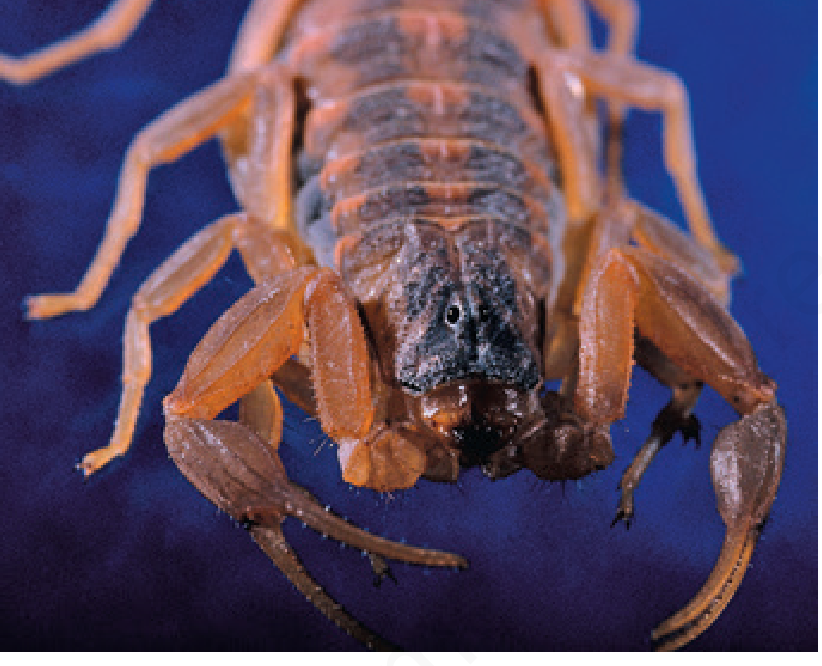
Medically Important Species
Scorpions of the family Buthidae are responsible for nearly all serious envenomations worldwide:
| Species | Region |
|---|---|
| Mesobuthus tamulus (Indian red scorpion) | India |
| Leiurus quinquestriatus | North Africa, Middle East |
| Androctonus crassicauda | North Africa, Southwest Asia |
| Tityus serrulatus | Brazil |
| Centruroides exilicauda / sculpturatus | USA (Arizona) |
| Centruroides suffusus | Mexico |
| Hemiscorpius lepturus | Iran (cytotoxic, not neurotoxic) |
Scorpions are nocturnal, hiding in shoes, folds of clothing, sandboxes, and under furniture. Two poison glands in the posterior abdomen empty into the telson (stinger). - Andrews' Diseases of the Skin
Pathophysiology
1. Venom Composition
Scorpion venom is a complex mixture of neurotoxic polypeptides (primarily alpha- and beta-toxins), enzymes (phospholipases, hyaluronidases), and vasoactive peptides. The principal toxic components are low-molecular-weight proteins that act on voltage-gated ion channels.
2. Molecular Mechanism - The Sodium Channel Toxin
The core mechanism is sustained activation of voltage-gated sodium channels (at sites 3 and 4 on the channel protein):
- Alpha-toxins slow inactivation of sodium channels, keeping them open
- Beta-toxins shift activation to more negative potentials, lowering the firing threshold
- Net result: prolonged membrane depolarization across the entire nervous system
Scorpion venoms also block potassium channels, further prolonging the action potential. - Katzung's Basic & Clinical Pharmacology, 16th Ed.
3. Autonomic Storm - The Central Pathophysiologic Event
Sustained membrane depolarization triggers massive simultaneous release of neurotransmitters from postganglionic nerve terminals of the autonomic nervous system (ANS):
- Sympathetic arm: Massive catecholamine (adrenaline + noradrenaline) release
- Parasympathetic arm: Massive acetylcholine release
This produces a mixed autonomic storm (simultaneous sympathetic + parasympathetic overactivation). The toxin also acts on brain synaptosomes, decreasing GABA production, adding to CNS excitability. - PMC8158070
4. Cardiovascular Pathophysiology
Three overlapping mechanisms drive cardiac injury:
- Autonomic storm effect:
- Catecholamine surge causes tachycardia, hypertension, increased afterload
- Coronary artery vasospasm leads to myocardial ischemia
- Imbalance between oxygen supply and demand
- Inflammatory mediators:
- Scorpion toxin activates the coagulation cascade
- Pro-inflammatory cytokines cause myocarditis (stress-induced/Takotsubo-like cardiomyopathy)
- Direct myocardial and endothelial toxicity:
- Direct cellular injury to cardiomyocytes and vascular endothelium
- Leads to cardiogenic shock, pulmonary edema, ARDS
5. Multi-System Consequences
| System | Manifestation | Mechanism |
|---|---|---|
| Cardiovascular | Hypertension/hypotension, arrhythmias, myocardial dysfunction, cardiogenic shock | Catecholamine surge, direct toxicity |
| Respiratory | Pulmonary edema, ARDS | Increased capillary permeability, cardiac failure |
| Neurological | Seizures, stroke (ischemic/hemorrhagic), autonomic dysfunction | Excitotoxicity, coagulopathy, cerebral vasospasm |
| Renal | Acute kidney injury | Hemodynamic compromise, direct tubular toxicity |
| Hematological | DIC | Coagulation cascade activation |
| Metabolic | Hyperglycemia (stress response), hypokalemia | Catecholamine-driven insulin resistance |
| Local | Pain, paresthesia, minimal/no swelling | Direct nerve fiber depolarization |
Species-specific effects also exist: Hemiscorpius lepturus causes a cytotoxic syndrome with late necrosis, hemolysis, and hemoglobinuria rather than the typical autonomic storm.
Clinical Grading (Bawaskar Grading System)
| Grade | Features |
|---|---|
| Grade 1 | Local pain and reaction at sting site only; no systemic involvement |
| Grade 2 | Autonomic storm: parasympathetic (sweating, salivation, bradycardia, hypotension) and/or sympathetic overactivity (hypertension, tachycardia, cold extremities) |
| Grade 3 | Myocardial dysfunction: clinical/echo evidence of heart failure, cardiomegaly, or need for inotropes (≥5 mcg/kg/min dobutamine/dopamine), or hypotension with cold peripheries (cold shock) |
| Grade 4 | Warm shock / multi-organ dysfunction |
Management
Prehospital / First Aid
- Remove the patient from the scorpion's vicinity
- Immobilize the affected limb
- Apply cold packs locally for pain
- Do NOT apply tourniquets, cut/suck the wound, or apply heat
- Rapid transport to hospital
Grade 1 (Local Pain Only)
- Oral analgesics (paracetamol, NSAIDs)
- Local infiltration with lidocaine for severe pain
- Tetanus prophylaxis if not current
- Observation for 4-6 hours for signs of systemic progression
Grade 2 (Autonomic Storm)
Antivenom is the most effective specific intervention and should be given promptly:
- Available species-specific antivenoms include: Anascorp (Centruroides F(ab')2 equine, USA), Haffkine monovalent antivenom (India, for M. tamulus)
- Antivenom neutralizes free-circulating venom and shortens the duration of autonomic storm
Prazosin (selective alpha-1 adrenergic blocker):
- Counteracts catecholamine-mediated vasoconstriction and reduces preload/afterload
- Dose: 30 mcg/kg in children; 0.5 mg in adults (repeated every 3 hours as needed)
- Reduces hypertension, sweating, salivation, and cardiovascular morbidity
- A Cochrane-style systematic review and RCT (Bawaskar et al., BMJ 2011) showed antivenom + prazosin is superior to prazosin alone for M. tamulus stings
Benzodiazepines (diazepam, midazolam):
- For excessive neuromuscular excitability, agitation, seizures
- Act centrally to reduce autonomic hyperexcitability by augmenting GABA
Grade 3 (Myocardial Dysfunction)
- Dobutamine (5-20 mcg/kg/min): first-line inotrope for pump failure/cardiogenic shock
- Monitor with echocardiography to guide inotrope therapy
- Beta-blockers: may be considered in tachycardia-dominant, hyperadrenergic picture, but require careful selection - evidence is limited and context-dependent
- Calcium channel blockers (e.g., nifedipine): limited/controversial role - evidence is weak
- IV fluids: cautious use; excess fluid worsens pulmonary edema
Grade 4 (Shock / MODS)
- Vasopressors (norepinephrine) for warm/distributive shock
- Mechanical ventilation for ARDS or respiratory failure
- Renal replacement therapy for severe AKI
- DIC management (FFP, cryoprecipitate, platelets as indicated)
- ICU monitoring
What Does NOT Work
- Corticosteroids: High-dose hydrocortisone has been tested in large clinical trials and shows no benefit on toxicity, mortality, or complications. The pathophysiology is primarily neurotoxic/autonomic, not immune-mediated, so anti-inflammatory strategies have no meaningful role. - JPHE review, 2024
- Antihistamines: No role in neurotoxic venom effects
- Atropine: Use is debated; can worsen tachycardia if given indiscriminately in mixed autonomic storm
Summary Management Table
| Grade | Key Intervention |
|---|---|
| 1 | Analgesics, observation |
| 2 | Antivenom + Prazosin + Benzodiazepines |
| 3 | Above + Dobutamine + Echo monitoring |
| 4 | ICU, vasopressors, ventilation, RRT |
Key Points
- The core mechanism is scorpion toxin binding to voltage-gated Na⁺ channels (sites 3 and 4), preventing inactivation and causing sustained depolarization.
- This triggers a mixed autonomic storm (sympathetic + parasympathetic), with massive catecholamine and acetylcholine release.
- The cardiovascular consequences (myocarditis, cardiomyopathy, pulmonary edema, shock) are the primary causes of death.
- Antivenom + prazosin is the evidence-based combination for grade 2 envenomation; dobutamine is added for myocardial dysfunction.
- Children are at significantly higher risk due to higher venom-to-body-mass ratio - the Egyptian scorpion (L. quinquestriatus) has a 50% mortality in children without treatment.
- Corticosteroids and antihistamines have no proven role.
Sources:
- Andrews' Diseases of the Skin, Scorpion Sting section
- Katzung's Basic & Clinical Pharmacology, 16th Ed., sodium channel pharmacology
- Godoy et al. 2021 - Neurological and Systemic Manifestations of Scorpion Envenomation (PMC8158070)
- Systematic review and meta-analysis of controlled clinical trials - Rodrigo C et al. PMC5385045
- Alternative pharmacological options to antivenom - JPHE 2024
This is a shared conversation. Sign in to Orris to start your own chat.