
Reports for dengue
I'll look up dengue lab reports from the medical library. Let me read the skill first.
Searching sources...
Reading File
Now let me search the library for dengue lab reports/investigations in parallel:
Finding Sources
Finding Sources
I have great sources. Let me now read the most relevant ones - Henry's Clinical Lab Methods, Harrison's, Park's PSM, and Goldman-Cecil - in parallel:
Reading File
Reading File
Reading File
Reading File
Let me now get the full Goldman-Cecil diagnosis section and Park's lab diagnosis section, plus search for an NS1 sensitivity figure:
Reading File
Reading File
Searching Images
dengue diagnostic testing NS1 antibody timeline sensitivity
I found the NS1/IgM/DENV RNA sensitivity chart in the Goldman-Cecil book. Let me fetch that image and also get the full Park's table on dengue diagnostics:
Loading Image
Reading File
I now have comprehensive information from multiple authoritative textbooks. Here is a complete, structured answer on dengue lab reports/investigations:
Laboratory Reports (Investigations) for Dengue
Dengue virus (DENV 1-4, family Flaviviridae) is an RNA virus transmitted by Aedes aegypti. The choice of diagnostic test depends critically on the day of illness at the time of sample collection.
1. Routine Blood Tests (CBC + Metabolic)
These are ordered at every visit and monitored serially:
| Parameter | Finding | Significance |
|---|---|---|
| Platelet count | Thrombocytopenia (<150,000/mm³ for DF; ≤100,000 for DHF) | Rapid fall after defervescence signals risk for severe dengue |
| Haematocrit (PCV) | Rising haematocrit ≥20% above baseline | Indicates plasma leakage (key for DHF diagnosis) |
| WBC / Leucocyte count | Leucopenia (WBC ≤5000 cells/mm³) | Supports dengue diagnosis |
| Liver enzymes (AST/ALT) | Mildly elevated aminotransferases | Hepatitis occurs in severe dengue |
Serial CBC is the backbone of dengue monitoring. A full blood count should be done at first visit to establish the patient's baseline haematocrit. A rapidly decreasing platelet count in parallel with a rising haematocrit is suggestive of progression to the plasma leakage/critical phase. - Park's Textbook of Preventive and Social Medicine
2. Specific Dengue Diagnostic Tests
The sensitivity of each test depends on how many days have passed since fever onset:
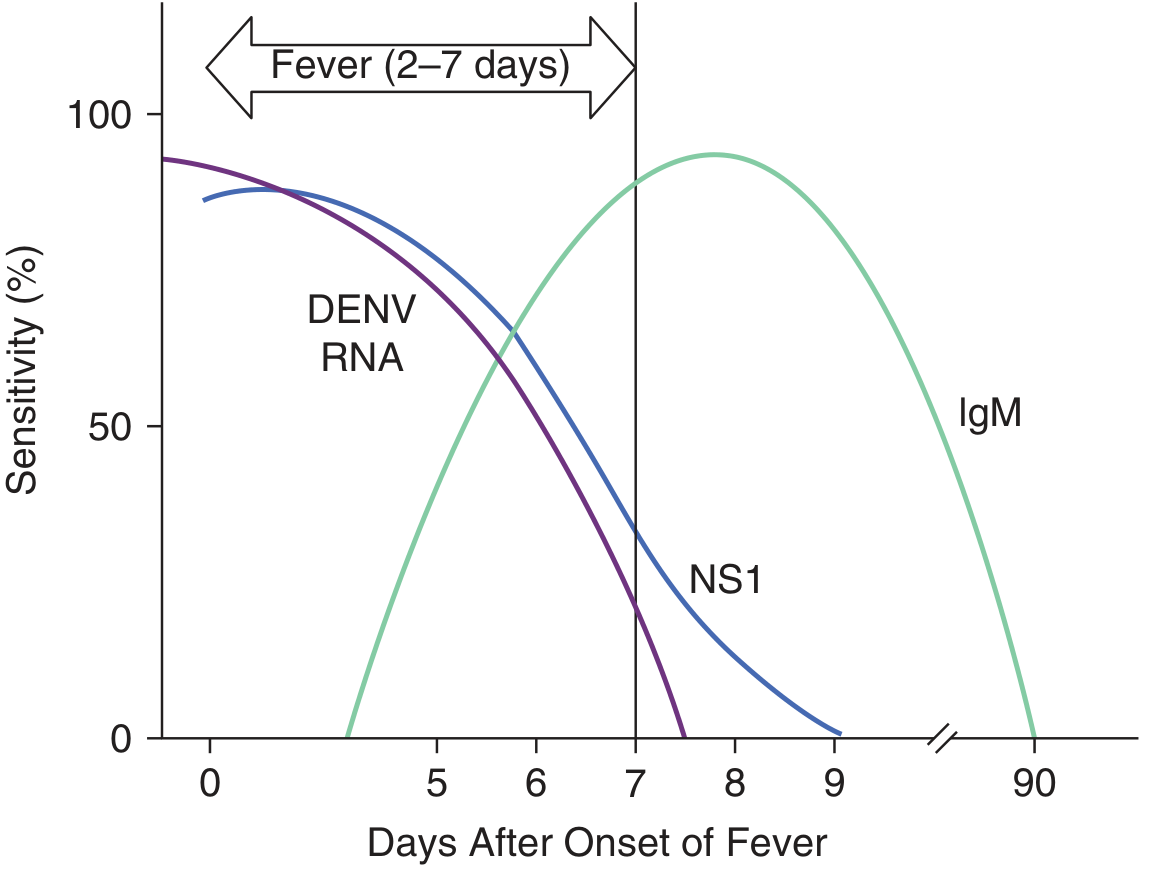
Figure: Sensitivity of NS1, DENV RNA (RT-PCR), and IgM over days after fever onset. - Goldman-Cecil Medicine, 26th Ed.
A. Acute Phase Tests (Days 1-5 of fever)
i. RT-PCR (Reverse Transcriptase Polymerase Chain Reaction)
- Detects dengue viral RNA in serum
- Highest sensitivity in the first 4-5 days (~85-90%)
- Also identifies the specific serotype (DENV 1-4)
- Turnaround: 1-2 days
- Gold standard for early diagnosis alongside NS1
ii. NS1 Antigen Detection
- NS1 (non-structural protein 1) is released into serum during early infection
- Detectable from Day 1 up to Day 6-9 of illness
- Available as rapid test (minutes) or ELISA (1 day)
- Works in both primary and secondary dengue infection
- Specific to dengue virus; does not differentiate serotypes
- Tietz Textbook of Lab Medicine notes: "NS1 is specific to dengue virus and detectable in serum during the acute febrile phase, filling a key role for early diagnosis."
iii. Virus Isolation
- Inoculation into mosquito or mosquito cell culture
- Very high specificity but time-consuming (≥1 week)
- Specimens: acute serum/plasma, washed buffy coat, autopsy tissue (liver, spleen, lymph nodes, thymus), or mosquitoes from the affected area
- Practical only in reference/research labs
B. Convalescent Phase Tests (After Day 5)
iv. IgM Antibody (MAC-ELISA - IgM Antibody Capture ELISA)
- Best single test after ~Day 4-5 of fever
- A single strongly positive serum sample suggests recent dengue infection
- Sensitivity peaks between Day 7 and Day 90
- Can remain positive for 2-3 months
- Cross-reactivity with other flaviviruses (Zika, yellow fever, West Nile) may give false positives
v. IgG Antibody (Indirect IgG-ELISA / HIA)
- IgG appears later and persists for years
- Indicates past infection, not necessarily current
- A fourfold or greater rise in IgG between acute and convalescent paired sera (collected 15-21 days apart) confirms diagnosis
- HIA (Haemagglutination Inhibition Assay): titre ≥1:1280 on a single sample supports probable diagnosis
vi. IgM/IgG Ratio
- Helps distinguish primary from secondary dengue infection
- High IgM/low IgG = primary infection
- Low IgM/high IgG = secondary infection (higher risk for severe disease)
vii. Plaque Reduction Neutralization Test (PRNT)
- Most specific serological test; used to confirm positive IgM
- Distinguishes between dengue serotypes and other flaviviruses
- Labour-intensive; restricted to reference labs
3. Summary Table: Dengue Diagnostics by Phase
(Based on Park's PSM, Table 2)
| Category | Sample | Method | Turnaround |
|---|---|---|---|
| Acute (Day 1-5) | Serum / necropsy tissue | Viral isolation (cell culture) | >1 week |
| Acute (Day 1-5) | Serum | RT-PCR / Real-time RT-PCR | 1-2 days |
| Acute (Day 1-6) | Serum | NS1 Ag rapid test / NS1 ELISA / IHC | Minutes / 1 day / 2-5 days |
| Paired sera | Day 1-5 + Day 15-21 | IgM or IgG seroconversion (ELISA, HIA, NT) | 1-2 days / ≥7 days |
| Late/Convalescent (>Day 5) | Serum | IgM ELISA / Rapid IgM test | 1-2 days / minutes |
| Late/Convalescent | Serum | IgG ELISA / HIA | 1-2 days |
4. WHO Case Classification Criteria (Diagnostic Thresholds)
Probable Dengue Fever: Acute febrile illness + ≥2 clinical symptoms + at least one of:
- Supportive serology (HI titre ≥1280, or positive IgM)
- Occurring in same location/time as confirmed cases
Confirmed Dengue:
- Isolation of dengue virus from serum/CSF/autopsy tissue, OR
- Fourfold+ rise in IgG (HI test) or rise in IgM, OR
- Detection of antigen/virus by IHC, immunofluorescence, or ELISA, OR
- Detection by RT-PCR
Dengue Haemorrhagic Fever (DHF): Requires ALL of:
- Fever 2-7 days
- Haemorrhagic manifestations (positive tourniquet test, petechiae, mucosal bleeding)
- Platelet count ≤100,000 cells/mm³
- Evidence of plasma leakage (haematocrit rise ≥20%, or pleural effusion/ascites/hypoproteinaemia)
Dengue Shock Syndrome (DSS): DHF criteria + signs of shock (pulse pressure ≤20 mmHg, tachycardia, cool extremities)
- Park's Textbook of Preventive and Social Medicine, p. 293-294
- Goldman-Cecil Medicine, 26th Ed.
- Henry's Clinical Diagnosis and Management by Laboratory Methods
5. Practical Testing Algorithm
Day 1-4 of fever:
  → RT-PCR (dengue RNA) + NS1 Antigen test
  → Serial CBC (platelet, haematocrit, WBC)

Day 5+ of fever / after defervescence:
  → IgM ELISA (MAC-ELISA)
  → Continue serial CBC - watch for platelet drop + haematocrit rise

Equivocal IgM or in flavivirus-endemic area:
  → Confirm with PRNT (plaque reduction neutralization test)

Suspected DHF/DSS:
  → Urgent platelet count + haematocrit
  → CXR / ultrasound for pleural effusion/ascites
Key clinical note: Avoid NSAIDs (aspirin, ibuprofen) as they potentiate bleeding risk. Use paracetamol only for fever management. - Goldman-Cecil Medicine
This is a shared conversation. Sign in to Orris to start your own chat.