
Diagnosis grading and grading wise treatment of piles
Reading File
Now let me search the library for hemorrhoids/piles content in parallel:
Finding Sources
Searching PubMed
"hemorrhoids" AND "treatment" AND "grading"
Bailey & Love and Sleisenger & Fordtran are the best surgical/GI references. Let me read both in parallel, along with the endoscopy text:
Reading File
Reading File
Reading File
Excellent content. Now let me read the treatment sections from Bailey & Love and Sleisenger more fully:
Reading File
Reading File
Searching Images
hemorrhoids grading classification degrees prolapse
Now let me read more of the Bailey & Love treatment section, and the external hemorrhoid / thrombosed hemorrhoid sections:
Reading File
Reading File
I now have comprehensive information from Bailey & Love and Sleisenger & Fordtran. Let me also fetch the clinical photograph of hemorrhoid prolapse to include in the response:
Loading Image
Loading Image
I now have all the information needed for a comprehensive response. Let me also read the key treatment details from Bailey & Love between lines 870–970:
Reading File
I now have comprehensive content from Bailey & Love's Surgery and Sleisenger & Fordtran's GI/Liver Disease. Here is the complete, structured answer:
Piles (Haemorrhoids): Diagnosis, Grading & Grade-Based Treatment
Definition & Anatomy
Haemorrhoids are symptomatic enlargements of the anal vascular cushions — submucosal components of the internal haemorrhoidal venous plexus that normally help seal the anal canal. Internal haemorrhoids lie classically at the 3, 7, and 11 o'clock positions (lithotomy position). External haemorrhoids lie distal to the dentate line, covered by squamous epithelium.
Pathogenesis: Upright posture, absence of portal venous valves, and raised intra-abdominal pressure (constipation, pregnancy, straining) cause venous engorgement. Shearing forces cause mucosal trauma (bleeding) and caudal displacement of anal cushions (prolapse).
Classification: Internal vs. External
| Type | Anatomical Landmark | Covering | Pain Threshold |
|---|---|---|---|
| Internal | Above dentate line | Columnar/transitional mucosa | Usually painless (no somatic innervation) |
| External | Below dentate line | Squamous epithelium | Painful (somatic innervation) |
Grading (Goligher Classification — Internal Haemorrhoids)
The standard 4-degree grading system used universally:
| Grade | Description | Key Clinical Feature |
|---|---|---|
| Grade I | Bleed only, no prolapse | Painless fresh rectal bleeding only; haemorrhoids may be enlarged |
| Grade II | Prolapse on straining, reduce spontaneously | Lump appears at anus during defecation, disappears on its own |
| Grade III | Prolapse, require manual reduction | Patient must push them back in |
| Grade IV | Permanently prolapsed, cannot be reduced | Irreducible; risk of strangulation |
"Mixed" haemorrhoids — Grade IV lesions with a significant cutaneous (external) component — represent external extensions from repeated congestion and oedema.
Clinical photograph: Grade III–IV prolapsing haemorrhoids (at rest vs. during Valsalva)
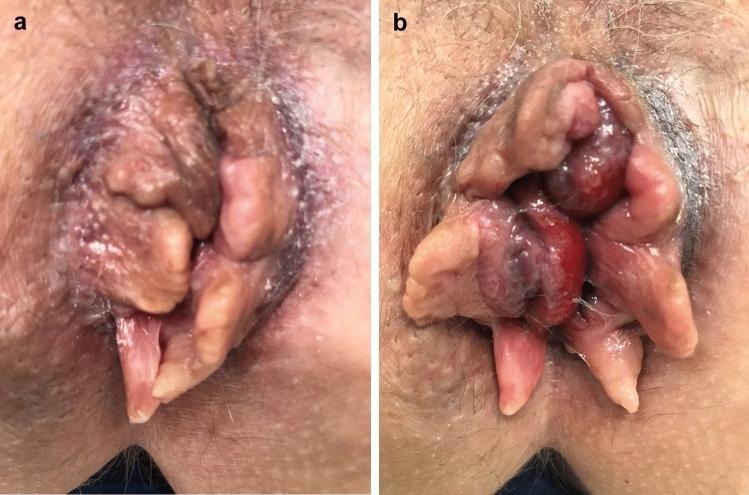
Diagnosis
History
- Bleeding: Bright red, painless, separate from stool — seen on paper or as a "fresh splash" in the pan
- Prolapse: Lump at the anal orifice during or after defecation
- Pruritus: Due to mucus discharge from prolapsed mucosa
- Pain: Unusual with internal haemorrhoids; pain suggests fissure, thrombosis, or another diagnosis
- Mucus discharge, perianal moisture, soiling
Examination
- Inspection: Perianal skin, prolapsing tissue, skin tags
- Digital rectal examination: Internal haemorrhoids are not palpable unless thrombosed
- Anoscopy (proctoscopy): Definitive — visualises degree of protrusion, position, bleeding points. Use bevelled or slotted anoscope
- Sigmoidoscopy / colonoscopy: Mandatory to exclude colorectal malignancy before attributing rectal bleeding to haemorrhoids, especially in patients >40 years or with risk factors
Important: Many patients attributing symptoms to "haemorrhoids" have another diagnosis (fissure, pruritus ani, warts, malignancy). Haemorrhoids coexist with other anal pathology.
Grade-Based Treatment
All Grades: Conservative (First-Line)
Before any intervention, the following apply to every grade:
- Adequate dietary fibre: 20–30 g/day
- Fluid intake: 6–8 glasses of non-caffeinated, non-alcoholic beverages daily
- Defecatory habit modification: Avoid straining, prolonged toilet sitting
- Stool softeners: Docusate sodium, polyethylene glycol 3350
- Bulking agents: Psyllium/ispaghula
- Sitz baths: Warm water soaks, especially post-defecation
- Topical agents: Phenylephrine/petrolatum creams — temporarily relieve pain and itching; glucocorticoid creams with caution (risk of candidiasis)
- Phlebotonics (plant flavonoids/diosmin): Improve venous tone, stabilise capillary permeability; useful in Grades II–III; excellent safety profile
Grade I: Conservative → Sclerotherapy
Primary: Conservative measures (above)
If conservative measures fail — Injection Sclerotherapy:
- Submucosal injection of 5% phenol in arachis/almond oil, 3–5 mL per haemorrhoid
- Injected at the apex of the pedicle (not into the haemorrhoid itself)
- Causes fibrosis obliterating vascular channels + mucosal support scar
- Repeat at 8 weeks if needed
- Largely superseded by rubber band ligation at many centres due to risk of deep injection complications (prostatitis, pelvic sepsis)
Grade II: Rubber Band Ligation (RBL) ± Sclerotherapy
Most effective office-based treatment
Rubber Band Ligation (Barron's technique):
- Tight elastic bands applied to the base of each haemorrhoidal pedicle, above the dentate line
- Causes ischaemic necrosis → haemorrhoid sloughs in ~10 days
- The resulting fibrosis supports residual anal cushions
- All three primary haemorrhoids may be banded at one session, or one per visit
- Patient warned of post-procedure bleeding when tissue sloughs
- Reassess at 4–6 weeks; repeat if needed
Injection sclerotherapy also applicable for Grade II.
Infrared photocoagulation / Cryotherapy: Less commonly used alternatives.
Grade III: RBL → HAL / Stapled Haemorrhoidopexy → Haemorrhoidectomy
Step-up approach:
- Rubber Band Ligation: First-line procedure; may need multiple sessions
- Haemorrhoidal Artery Ligation (HAL / HALO):
- Doppler-guided ligation of haemorrhoidal arteries
- Can treat Grade II–III; lower recurrence than RBL (HubBLe trial), but less cost-effective
- Better postoperative pain scores than conventional surgery
- Stapled Haemorrhoidopexy (PPH — Procedure for Prolapse and Haemorrhoids):
- Circular stapler removes a strip of mucosa/submucosa above the haemorrhoids, retracting prolapsed cushions
- Suitable for Grade II–III
- Less postoperative pain but higher recurrence rate than formal haemorrhoidectomy
- Formal Haemorrhoidectomy: If the above fail (see Grade IV below)
Grade IV: Haemorrhoidectomy (Surgical Excision)
Indications for haemorrhoidectomy:
- Grade III–IV haemorrhoids (main indication)
- Grade II that failed all non-operative treatments
- "Mixed" haemorrhoids with a well-defined external component
- Bleeding severe enough to cause anaemia
Techniques:
- Open technique (Milligan-Morgan): Haemorrhoidal pedicles ligated and excised leaving wounds open to granulate
- Closed technique (Ferguson): Wounds sutured closed after excision
- LigaSure / electrothermal: Bipolar vessel-sealing devices used as alternatives
Post-operative care: Warm baths twice daily, bulk laxative, adequate analgesia; metronidazole (5 days) reduces pain; anal dilator if stenosis develops.
External Haemorrhoids / Thrombosed External Haemorrhoid (Perianal Haematoma)
- Presents as sudden-onset painful, olive-shaped blue subcutaneous swelling at the anal margin
- Caused by straining, coughing, or heavy lifting
- If presenting within 48 hours: Evacuation of clot under local anaesthesia
- If presenting later: Conservative management — analgesia, warm baths, laxatives; most resolve in 3–4 days by fibrosing or spontaneous extrusion
Complications of Haemorrhoids
| Complication | Management |
|---|---|
| Strangulation / thrombosis | Urgent haemorrhoidectomy or conservative (analgesia, bed rest, cold compresses, laxatives, antibiotics) |
| Ulceration | Conservative; surgical if severe |
| Gangrene | Urgent surgical débridement |
| Severe haemorrhage | Adrenaline compress; examination under anaesthesia ± ligation/excision |
| Portal pyaemia | Systemic antibiotics |
Grade-Based Treatment Summary
| Grade | First Line | Second Line | Definitive |
|---|---|---|---|
| I | Diet/fibre/sitz baths | Sclerotherapy | RBL |
| II | Diet/fibre/phlebotonics | RBL / Sclerotherapy | Haemorrhoidectomy |
| III | RBL | HAL / Stapled haemorrhoidopexy | Haemorrhoidectomy |
| IV | Haemorrhoidectomy | — | — |
| Thrombosed external | Evacuation <48 h | Conservative >48 h | — |
Sources: Bailey and Love's Short Practice of Surgery, 28th Edition, pp. 1452–1455; Sleisenger and Fordtran's Gastrointestinal and Liver Disease, pp. 2671–2673
This is a shared conversation. Sign in to Orris to start your own chat.