
What advise I would give mother according to her baby growth chart in psm
Reading File
In PSM (Preventive & Social Medicine), the growth chart (Road to Health chart / weight-for-age chart) is used to monitor child growth and give mothers targeted advice. The advice depends on where the child's weight plots on the chart.
Searching sources...
Finding Sources
Finding Sources
Finding Sources
Finding Sources
Finding Sources
Finding Sources
Finding Sources
Reading File
Reading File
Reading File
Reading File
I found the growth chart images and relevant content. Let me fetch the key growth chart images and read the advice sections.
Loading Image
Reading File
I now have all the information needed from Park's PSM. Let me compile the comprehensive answer.
Advice to Mother Based on Baby's Growth Chart (PSM)
The growth chart (also called the "Road to Health" chart) used in India is the ICDS Weight-for-Age chart based on WHO Child Growth Standards 2006. It is kept by the mother and brought to the health centre (AWC) at each visit. Here is the advice a health worker should give the mother based on where the child's weight plots:
Understanding the Zones on the Chart
The ICDS chart (as seen in Park's PSM) shows three colour-coded zones:
| Zone | Criteria | Meaning |
|---|---|---|
| Normal (Good) | Above -2 SD | Child growing well |
| Underweight | Below -2 SD | Moderate undernutrition |
| Severely Underweight | Below -3 SD | Severe undernutrition - danger zone |
In Maharashtra-type charts with Gomez grading, 4 grades of malnutrition are shown (Grade I to IV based on % of expected weight-for-age).
Key Principle: Direction of Growth is More Important Than Position
According to Park's PSM, the direction of growth (the trend of dots) matters more than where the dot falls on the chart. A flattening or falling curve signals growth failure - the earliest sign of Protein-Energy Malnutrition (PEM) - which may precede clinical signs by weeks to months.
The growth curve can show:
- Rising curve - weight gaining normally
- Flat curve - weight not increasing (growth faltering)
- Falling curve - weight loss - serious danger
Advice Based on Growth Chart Findings
1. Child in the Normal Zone (curve rising steadily)
- Reassure the mother - the child is growing well
- Continue exclusive breastfeeding for the first 6 months
- Introduce complementary/supplementary foods at 6 months
- Maintain immunization schedule
- Continue bringing the child for monthly weighing at the AWC
- Practice good hygiene to prevent diarrhoea and infections
2. Child in Normal Zone but Curve is Flat (no weight gain)
- Early warning - even though the child is still in normal zone, a flat curve means growth faltering
- Enquire about: recent illness (diarrhoea, fever), adequacy of feeding, food quality
- Counsel on adequate feeding - frequency, quantity, quality
- Emphasize the deleterious effects of diarrhoea on growth
- Advise ORS if diarrhoea occurs
- Follow up more closely at next visit
3. Child in Underweight Zone (below -2 SD) - Curve Rising
- Child has moderate malnutrition but is improving
- Provide supplementary nutrition through ICDS (take-home ration / hot cooked meals)
- Detailed dietary counselling - energy-dense foods, increased feeding frequency
- Check for and treat infections/worm infestations
- Ensure complete immunization
- Motivate mother for regular follow-up
4. Child in Underweight Zone - Curve Flat or Falling
- High-risk child - needs priority attention
- Refer to the AWW/ANM immediately (as shown on the chart: "Talk to the AWW/ANM immediately")
- Investigate for underlying illness (infections, TB, worm infestation)
- Provide supplementary feeding
- Counsel on correct feeding practices
- Refer to medical facility if needed
5. Child in Severely Underweight Zone (below -3 SD) - "Very Dangerous" Zone
- This is a medical emergency
- Refer immediately to AWW/ANM and then to hospital/nutrition rehabilitation centre
- Manage complications (hypoglycaemia, hypothermia, infections)
- Intensive nutrition rehabilitation
- Therapeutic feeding
- The chart itself says "Talk to the AWW/ANM immediately"
General Advice to Give to ALL Mothers at Every Visit
- Bring the child every month for weighing at the Anganwadi Centre (AWC)
- Breastfeed exclusively for 6 months; continue breastfeeding up to 2 years
- Start complementary feeding at 6 months - mashed family foods, increasing consistency with age
- Ensure all vaccines are given on schedule
- Wash hands before feeding the child and after defecation - prevent diarrhoea
- Give ORS during diarrhoea - do not stop feeding during illness
- Bring the child to health centre during illness without delay
- Vitamin A supplementation as per schedule
- Deworm the child as recommended
- Ensure the child sleeps under a mosquito net in malaria-endemic areas
Uses of Growth Chart (for awareness)
As per Park's PSM, the growth chart serves as:
- Tool for growth monitoring
- Diagnostic tool - identifies high-risk children (malnutrition detected before symptoms appear)
- Planning and policy tool - helps grade malnutrition for health planning
- Educational tool - mother can be educated visually about her child's care
- Tool for action - guides health worker on intervention needed
- Teaching tool - demonstrates importance of adequate feeding and the harm of diarrhoea
The growth chart has been described as a "passport to child health care" - Park's Textbook of Preventive and Social Medicine, p. 637-638
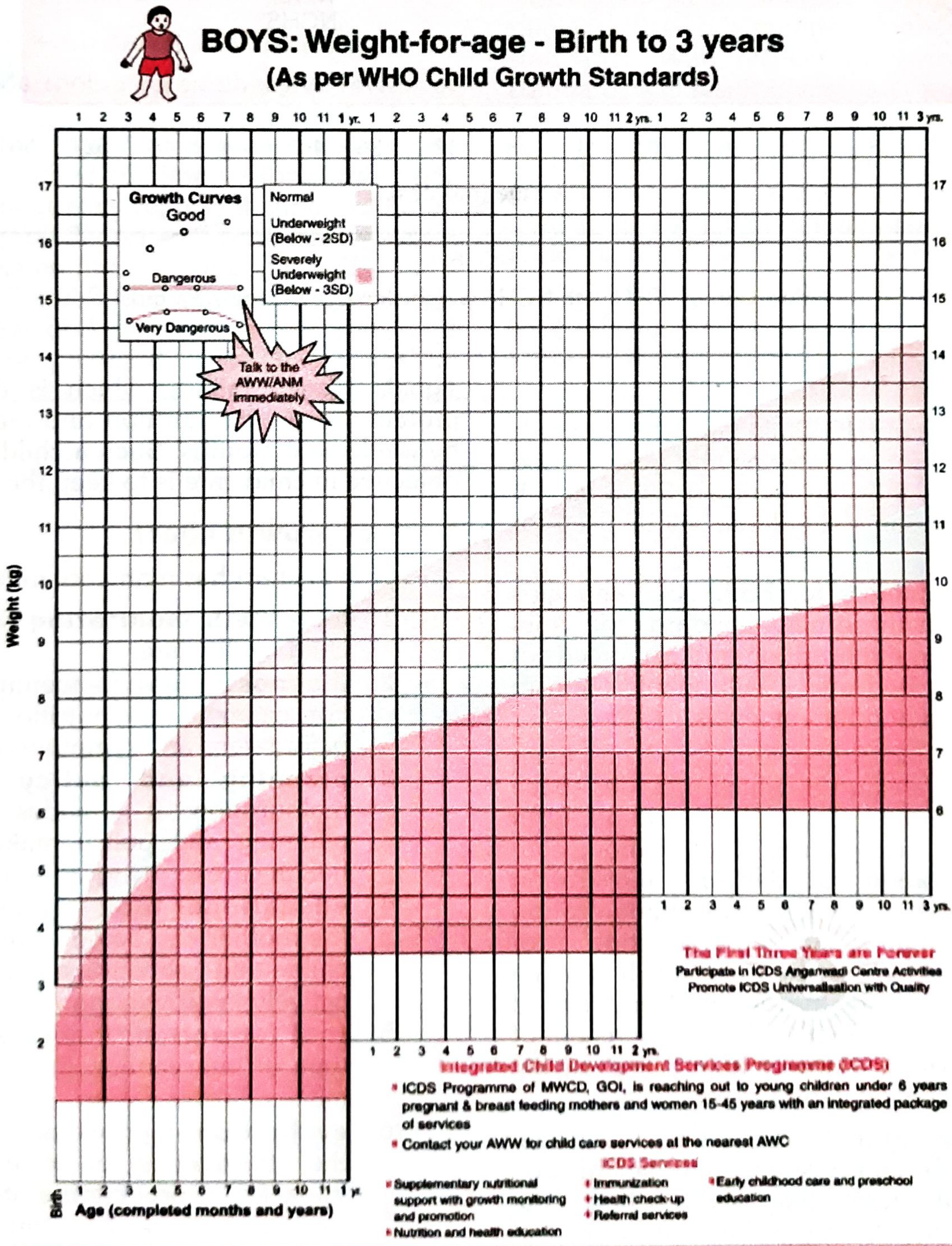
ICDS Growth Chart for Boys (Birth to 3 years) - WHO Child Growth Standards
The pink shaded areas show the underweight and severely underweight zones. A child whose weight-dot falls in these zones - or whose curve flattens - needs immediate action and referral to the AWW/ANM.
This is a shared conversation. Sign in to Orris to start your own chat.