
Patient having weight loss since 3 months. He has pain is right lower quadrant of abdomen. Guess the probable diagnosis.
The right lower quadrant (RLQ) pain with 3 months of weight loss is a classic combination pointing toward a few key diagnoses. The most probable ones are:
- Ileocecal tuberculosis - very common in endemic regions, causes RLQ pain, constitutional symptoms including weight loss, fever, and night sweats
- Crohn's disease - terminal ileum is the most common site; causes RLQ pain, diarrhea, and significant weight loss
- Carcinoma of the cecum/ascending colon - right-sided colonic cancers classically present with weight loss, anemia, and RLQ mass
- Appendiceal pathology (chronic appendicitis or appendiceal tumor/carcinoid)
- Lymphoma (especially in younger patients)
Searching sources...
Reading File
Now let me search the medical library for relevant content on these diagnoses simultaneously.
Finding Sources
Finding Sources
Finding Sources
Finding Sources
Finding Sources
Finding Sources
Reading File
Reading File
Finding Sources
Reading File
Loading Image
Here is a thorough, textbook-backed answer:
Probable Diagnoses: RLQ Pain + 3 Months of Weight Loss
The combination of right lower quadrant (RLQ) pain and progressive weight loss over 3 months points to a relatively short list of high-probability diagnoses. The ileocecal region is the key anatomical focus, as it is where the terminal ileum, cecum, and appendix converge.
1. Crohn's Disease (Ileocolitis) - Most Likely in Young Patients
The terminal ileum is the most common site of Crohn's inflammation.
"The usual presentation of ileocolitis is a chronic history of recurrent episodes of right lower quadrant pain and diarrhea... Weight loss is common - typically 10-20% of body weight - and develops as a consequence of diarrhea, anorexia, and fear of eating. An inflammatory mass may be palpated in the right lower quadrant of the abdomen."
- Harrison's Principles of Internal Medicine 22E, p. 2601
Key features:
- RLQ pain (colicky, often relieved by defecation)
- Low-grade fever, diarrhea
- Palpable RLQ mass in some patients
- The initial presentation can mimic acute appendicitis
2. Ileocecal Tuberculosis - Most Likely in Endemic Regions / Immigrants
GI TB most commonly involves the ileocecal region, and the chronic constitutional symptoms fit perfectly.
"Clinical presentation of abdominal TB includes abdominal pain, fever, and weight loss, which usually have been present for months. A mass is palpable in the right lower quadrant in 25% of cases. In North America, Crohn's disease, colon cancer, lymphoma, and even amebiasis may be considered before TB. However, for at-risk populations, such as immigrants from endemic countries or indigenous populations, TB should be a primary consideration."
- Yamada's Textbook of Gastroenterology, 7th ed.
This is an MRI of ileocecal TB showing parietal mural thickening and associated iliopsoas abscess:
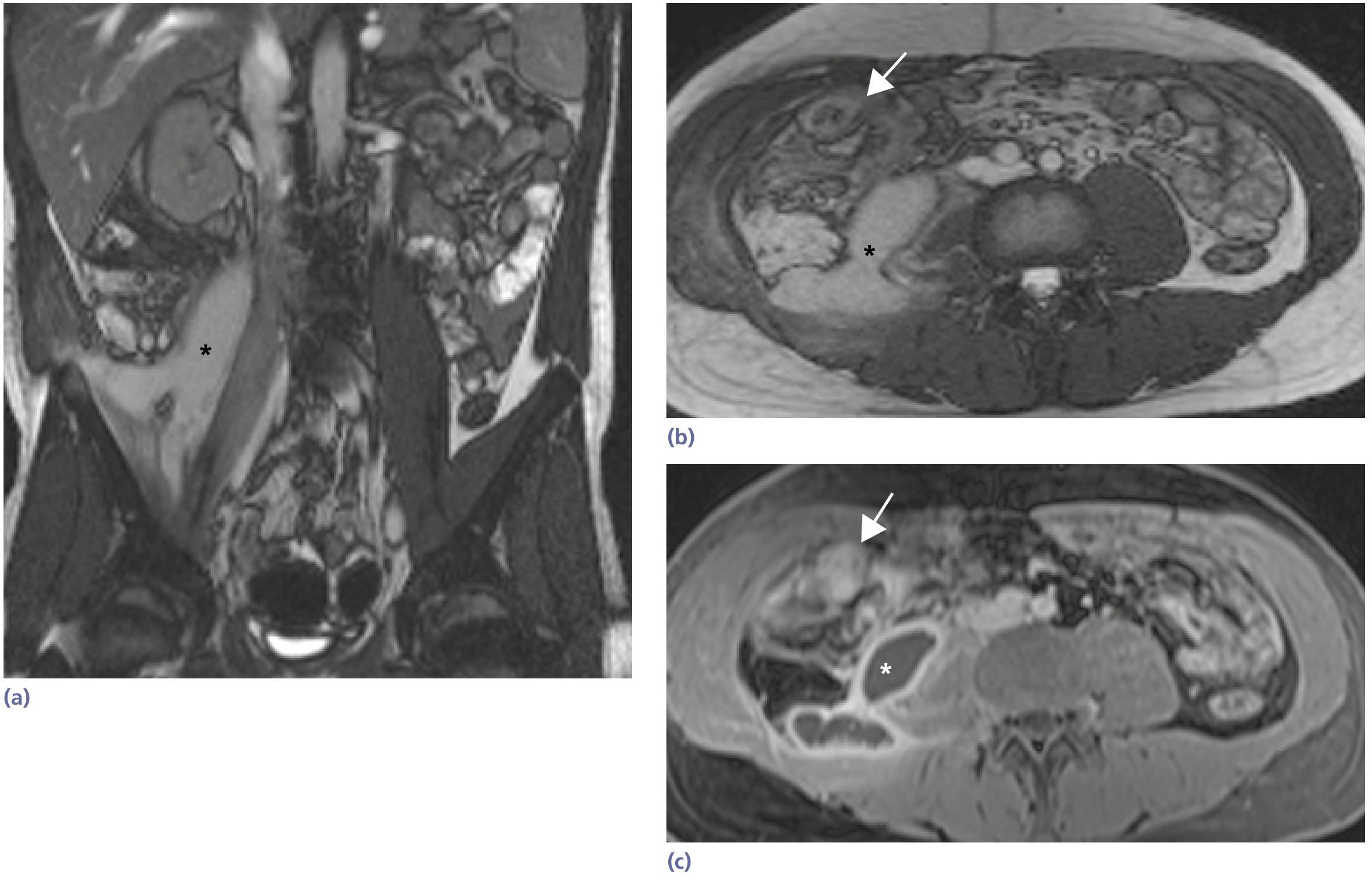
Key distinguishing features from Crohn's: transverse ulcers, patulous ileocecal valve, ascites on imaging, caseating granulomas on biopsy.
3. Carcinoma of the Cecum / Right Colon - Most Likely in Older Patients (>45 years)
Right-sided colon cancers are notoriously "silent" and present late.
"Right-sided tumors tend to present with anemia, whereas left-sided cancers are more likely to present with obstructive symptoms. However, many patients with colon cancer are asymptomatic at the time of diagnosis."
- Current Surgical Therapy 14e
Key features:
- Weight loss + iron-deficiency anemia (occult bleeding into the wide cecal lumen)
- RLQ mass or fullness
- Fatigue, anorexia
- No early obstruction (cecum is wide)
4. Intestinal Lymphoma
Primary GI lymphoma commonly involves the ileocecal region in adults. Presents with RLQ pain, weight loss, a palpable mass, and sometimes fever - overlaps significantly with TB and Crohn's.
Summary Table
| Diagnosis | Age Group | Key Clue | Distinguishing Feature |
|---|---|---|---|
| Crohn's disease | Young adults (15-40) | Diarrhea, perianal disease | Cobblestoning, skip lesions, "string sign" |
| Ileocecal TB | Any age, endemic exposure | Night sweats, travel history | Caseating granulomas, ascites |
| Cecal carcinoma | >45 years | Iron-deficiency anemia | CEA elevated, colonoscopy biopsy |
| GI Lymphoma | Middle-aged adults | Fever, bulky mass | CT: large heterogeneous mass |
| Chronic appendicitis | Any age | Localized RLQ pain | Migratory pain, Rovsing's sign |
| Amoebiasis | Endemic exposure | Bloody diarrhea | Amoeba trophozoites in stool |
Recommended Next Steps
- CBC - anemia suggests malignancy or TB
- ESR/CRP, Mantoux test, IGRA - for TB
- Stool examination - ova, cysts, parasites; occult blood
- Colonoscopy with biopsy - gold standard for Crohn's vs. TB vs. carcinoma
- CT abdomen - mass, lymphadenopathy, ascites, liver mets
- Chest X-ray - pulmonary TB focus
The most common probable diagnoses in clinical practice are Crohn's disease (in Western countries) and ileocecal tuberculosis (in South Asia, Africa, developing nations), with cecal carcinoma always kept in mind in patients over 45.
This is a shared conversation. Sign in to Orris to start your own chat.